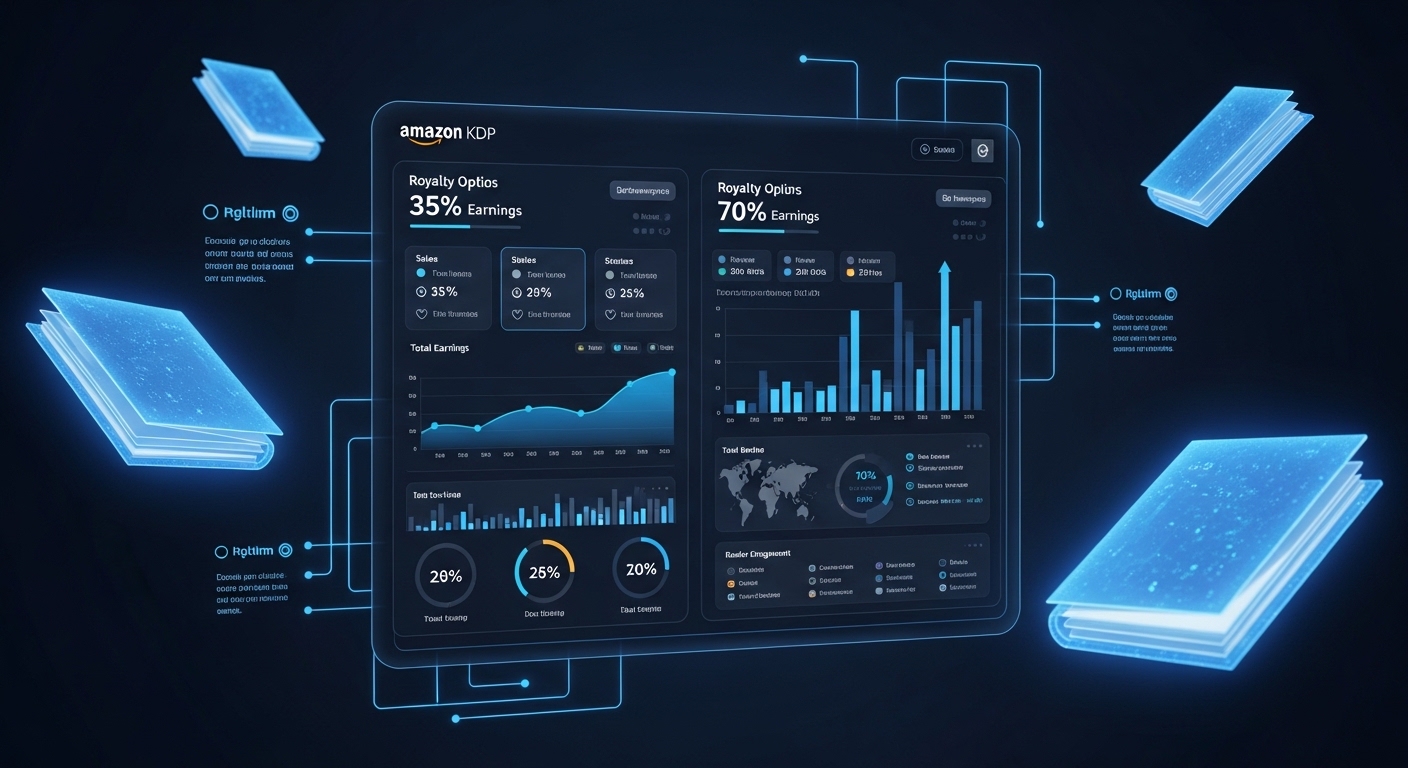
Choosing between the 35% and 70% royalty options on Amazon KDP is one of those decisions that looks simple on the surface but quietly shapes how much money you actually make as an author. Many first-time self-publishers assume the 70% plan is always better, but Amazon’s pricing structure is more nuanced than that. In reality, the “best” choice depends on your book’s price, file size, distribution goals, and even your long-term publishing strategy.
If you are planning to publish an eBook on Kindle Direct Publishing, understanding this decision is not optional—it directly affects your earnings per sale, your competitiveness in pricing, and how your book performs in different markets.
Let’s break this down in a practical, real-world way so you can confidently decide which royalty plan actually works in your favor.
Understanding KDP Royalty Plans Without the Confusion
Amazon KDP offers two royalty structures for eBooks:
- 35% royalty option
- 70% royalty option
At first glance, 70% looks like the obvious winner. But Amazon applies strict conditions to qualify for it. If your book doesn’t meet those conditions, it automatically falls back to 35%, regardless of your preference.
The key mistake many authors make is assuming these are simply “high vs low” payout options. In reality, they are pricing systems tied to delivery costs, distribution regions, and file size economics.
To make a smart decision, you need to understand not just the percentage, but how Amazon calculates what you actually earn.
How the 70% Royalty Plan Actually Works
The 70% royalty option is designed for competitively priced eBooks that fall within Amazon’s preferred ecosystem. However, it comes with several constraints that can affect your earnings more than expected.
To qualify for 70% royalty, your eBook must:
- Be priced between $2.99 and $9.99 in most marketplaces
- Be sold in eligible countries (not all regions qualify)
- Have delivery costs deducted based on file size
- Be enrolled in KDP Select is not required but often used alongside
That last point about delivery costs is important. Amazon charges a per-MB delivery fee for every download. So even though you get 70% of the listed price, a large file (like a book with images or formatting-heavy content) reduces your actual earnings.
For example, a $4.99 book might not give you a clean 70% payout after deductions. The final amount is slightly lower due to digital delivery costs.
The takeaway here is simple: 70% is high, but not “pure” in real-world payouts.
How the 35% Royalty Plan Works (And Why It Still Exists)
The 35% royalty plan is often misunderstood as the “bad option.” In reality, it serves a very strategic purpose.
Under this model:
- You earn 35% of the list price
- There are no delivery fees
- You have more flexibility in pricing
- It applies to books outside the $2.99–$9.99 range
This plan is commonly used for:
- Very low-priced eBooks (like $0.99 promotions)
- Very high-priced niche books
- Large file-size books where delivery fees would hurt earnings
- Experimental pricing strategies
While the percentage looks low, the absence of delivery fees sometimes makes it more predictable and stable.
In other words, the 35% plan is less about maximizing per-sale revenue and more about maintaining control over pricing structure.
The Real Difference: It’s Not Just the Percentage
A direct comparison of 35% vs 70% can be misleading if you only look at numbers. The real difference lies in how Amazon treats your book behind the scenes.
Here is a simplified comparison:
| Factor | 35% Plan | 70% Plan |
| Royalty Rate | Lower percentage | Higher percentage |
| Delivery Fee | None | Applied per MB |
| Price Flexibility | Wider range | Restricted ($2.99–$9.99) |
| Best for | Experimental or niche pricing | Mainstream commercial eBooks |
| Earnings Predictability | Stable | Variable due to fees |
This table alone shows why authors sometimes choose the lower percentage intentionally. The “higher royalty” doesn’t always translate to higher profit.
When the 70% Royalty Plan Makes Sense
The 70% plan is usually the right choice when your publishing strategy aligns with mainstream eBook sales.
It works best if:
- Your book is priced competitively in the $2.99–$4.99 range
- Your file size is optimized and lightweight
- You are targeting mass-market readers
- Your goal is volume-based sales rather than premium pricing
This model is especially effective for fiction authors, self-help writers, and general non-fiction books that compete in crowded categories.
However, success with the 70% plan depends heavily on pricing psychology. A poorly priced book—even at 70%—can underperform if it doesn’t align with reader expectations.
When the 35% Royalty Plan Is Actually Smarter
The 35% plan becomes strategically powerful in specific publishing scenarios that many beginners overlook.
It is often the better choice when:
- Your book is priced below $2.99 or above $9.99
- You are publishing image-heavy content or large PDFs converted into eBooks
- You are running promotional pricing experiments
- You want pricing freedom without worrying about delivery fees
- You are targeting niche academic or professional audiences
For example, some technical guides or design-heavy manuals can become expensive under the 70% delivery fee system. In such cases, the 35% plan can actually result in higher net earnings per sale.
This is where many experienced authors quietly switch strategies depending on the book type.
Pricing Strategy: The Hidden Factor Most Authors Ignore
Royalty percentage matters, but pricing strategy often has a bigger long-term impact on earnings. On Amazon Kindle, price doesn’t just decide how much you earn per sale—it directly influences visibility, conversions, and how readers perceive your book.
A $2.99 book under 70% royalty can outperform a $6.99 book under 35% royalty, but that is not guaranteed. The difference comes from how pricing shapes demand, not just the payout structure.
The real question is not simply “which pays more per sale,” but how pricing affects discovery, conversion, and sustained sales performance over time.
How Pricing Influences Performance on Kindle
Pricing plays a psychological and algorithmic role at the same time. Readers respond to price before they even read the description, and Amazon’s system also reacts to how well that price performs in terms of clicks and purchases.
Lower prices generally reduce hesitation and increase impulse buying, especially in fiction and general non-fiction. Higher prices tend to filter for intent-driven buyers who already see value in the content.
In simple terms, pricing shapes both who clicks and who buys.
Key Ways Pricing Impacts Sales
Here is a clear breakdown of what pricing actually affects in the Kindle ecosystem:
| Factor | Lower Price (e.g., $2.99–$3.99) | Higher Price (e.g., $6.99–$9.99) |
| Click-through rate | Usually higher due to low risk | Lower but more selective |
| Conversion rate | Often stronger for impulse buys | Depends on perceived value |
| Reader perception | Accessible, casual, quick read | Premium, authoritative, in-depth |
| Category competition | Highly competitive | More niche-focused positioning |
| Revenue per sale | Lower | Higher |
This shows why pricing cannot be evaluated in isolation. It directly changes how your book competes inside Amazon’s marketplace.
Why Lower and Higher Pricing Both Work
A lower-priced book often wins through volume. It attracts more clicks and more frequent purchases, which helps in crowded categories where attention is limited.
A higher-priced book wins through margin. It sells fewer copies but earns more per transaction, especially in specialized or professional niches where readers expect higher value.
Neither approach is universally better. The outcome depends on your niche, positioning, and how well your book matches reader expectations.
The Real Optimization Point
The most important insight is that pricing is not just about earnings per sale. It affects total system performance.
A better way to think about it is:
- Low price = higher traffic, lower margin
- High price = lower traffic, higher margin
Successful authors often test different price points instead of locking into one assumption. Small adjustments can significantly change visibility, conversion rate, and total monthly income.
File Size and Delivery Fees: The Silent Profit Killer
One of the least discussed aspects of KDP royalties is file size impact.
Under the 70% plan, Amazon deducts delivery fees based on file size. This means:
- Text-heavy novels are cheap to deliver
- Illustrated books, guides, and textbooks cost more per sale
If your book includes images, charts, or design-heavy formatting, your royalty percentage may effectively shrink.
This is why some authors of educational content and workbooks prefer the 35% model—it avoids unpredictable deductions.
Real-World Scenario Comparison
Let’s strip away theory and look at how this actually plays out when money starts coming in.
Imagine two authors publishing in different niches with different pricing strategies.
Book A is a fast-moving digital fiction title:
- Price: $3.99
- Royalty: 70% plan
- Lightweight file (no images, clean formatting)
- Competing in a crowded genre where impulse buying matters
Book B is a specialized premium non-fiction guide:
- Price: $7.99
- Royalty: 35% plan
- No delivery fee concerns (simple or optimized file structure)
- Targeting a smaller but more committed professional audience
At first glance, Book A looks like the obvious winner because the 70% royalty appears more efficient per sale. But that assumption only holds if both books generate similar sales behavior—which they rarely do.
Book A depends heavily on volume. It needs consistent discovery, algorithm visibility, and frequent impulse purchases to outperform. Even small shifts in ranking or visibility can significantly affect income because each sale carries a lower absolute price point.
Book B operates differently. It doesn’t need mass appeal. Instead, it relies on intent-driven buyers—readers who are willing to pay more because the content solves a specific, high-value problem. Even if it sells fewer copies, each transaction carries significantly higher revenue per sale.
This is where the misunderstanding often happens. Authors compare royalty percentages instead of comparing earning behavior. A higher percentage on a low-priced, high-volume book is not automatically more profitable than a lower percentage on a higher-priced, niche-positioned book.
In real publishing terms, Book A is optimized for reach. Book B is optimized for margin. And depending on your niche, audience quality, and content depth, either model can outperform the other—not because of the royalty structure itself, but because of how that structure interacts with reader demand.
Psychological Pricing and Buyer Behavior
Amazon readers are sensitive to pricing brackets. The $2.99–$4.99 range is often considered the “sweet spot” for impulse purchases.
The 70% plan is designed to support this behavior.
Meanwhile, books priced higher under the 35% model often rely on perceived authority, niche demand, or professional value.
In short:
- 70% plan = volume-driven psychology
- 35% plan = value-driven psychology
Understanding this distinction helps you position your book correctly instead of randomly choosing a royalty option.
Long-Term Publishing Strategy: What Successful Authors Do
Experienced self-publishers rarely stick to one plan permanently. Instead, they adjust based on:
- Genre performance
- Seasonal demand
- Marketing campaigns
- Series vs standalone books
For example, a debut novel might start under the 70% plan at $2.99. Later, a special edition or expanded version might shift to a higher price under the 35% structure.
This flexibility allows authors to maximize lifetime revenue instead of optimizing for a single snapshot.
Final Perspective: There Is No Universal Winner
The idea that one royalty plan is “better” than the other is misleading. Amazon designed both options for different publishing behaviors.
The 70% plan rewards competitive pricing and mass-market appeal.
The 35% plan rewards flexibility and niche positioning.
The smartest authors don’t pick a side permanently—they choose based on the book’s purpose.
FAQ: 35% vs 70% KDP Royalty Plan
1. Is the 70% royalty plan always better than 35%?
No. It depends on price range, file size, and delivery fees. In some cases, 35% earns more net profit.
2. Why does Amazon offer a lower royalty option?
Because it provides flexibility for pricing outside standard ranges and supports different publishing strategies.
3. Do delivery fees apply to all eBooks?
Only under the 70% plan, and they are based on file size.
4. Can I change royalty plans after publishing?
Yes, you can update pricing and royalty settings at any time in KDP.
5. What price range works best for 70% royalty?
Generally $2.99 to $4.99 performs best for most genres.
6. Is 35% better for high-priced books?
Often yes, especially if the book exceeds $9.99 or includes large files.
7. Do fiction books perform better under 70%?
Usually yes, because they rely on volume sales and competitive pricing.