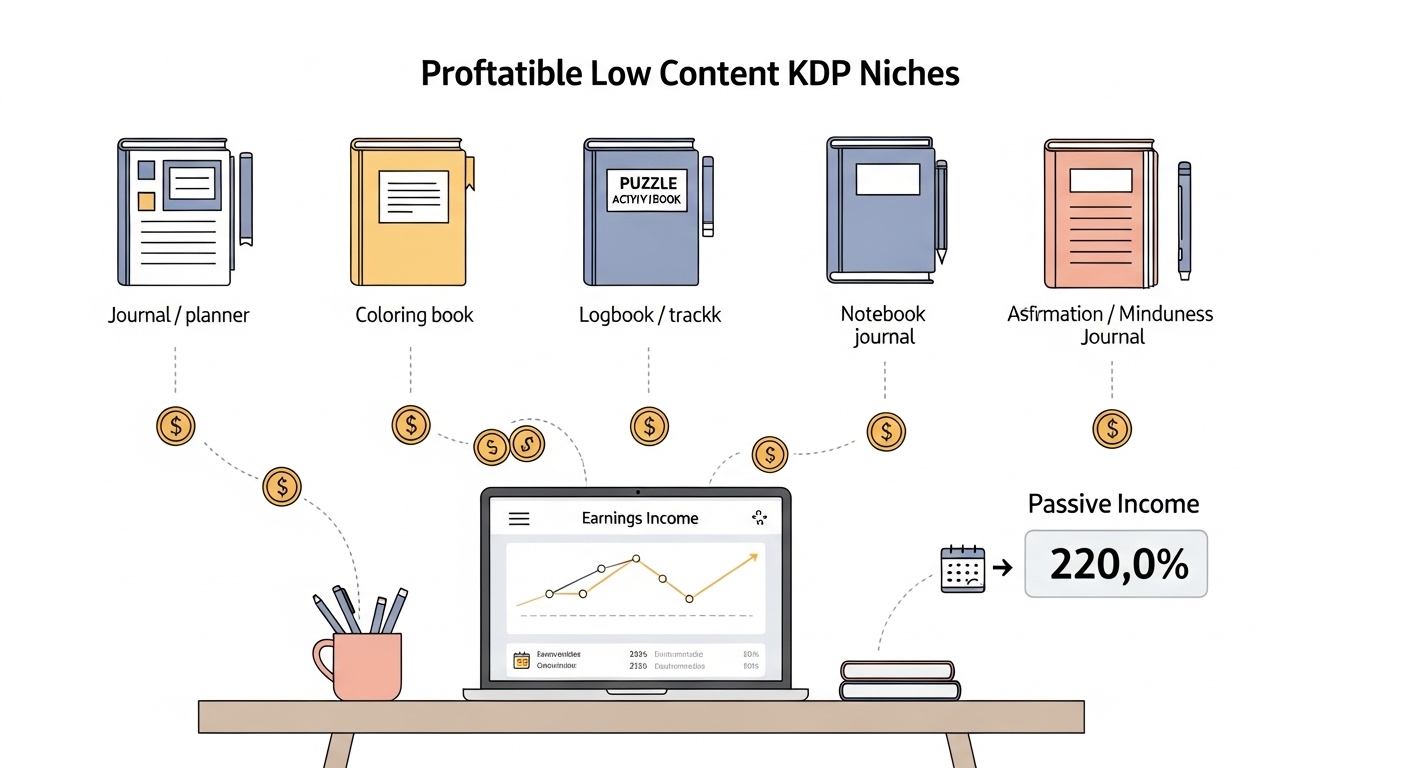
Low-content publishing on Kindle Direct Publishing is not what it used to be.
A few years ago, almost anything would sell—blank journals, simple planners, basic logbooks. But in 2025, the space looks very different. Competition has increased, automation has flooded the market, and generic books rarely survive long enough to generate meaningful income.
Still, low-content publishing is far from dead.
What has changed is not the opportunity itself, but the level of precision required to succeed. Today, the niches that still perform are not broad or generic—they are specific, practical, and tied to real daily behavior. Success now depends more on understanding user psychology, daily habits, and micro-problems people actively want solved. That shift is what separates struggling publishers from consistent earners.
Let’s break down the niches that are still quietly generating consistent income.
Guided Mental Health Journals Still Perform Because They Solve Real Emotional Needs
Mental health journaling remains one of the strongest low-content categories because it is rooted in real emotional demand. People are not buying these books for design or novelty—they are buying them to process thoughts, manage stress, or create emotional structure in their daily lives.
What separates successful journals from failed ones is guidance. A blank notebook doesn’t offer direction, but a structured journal does. Buyers want prompts that help them reflect without overthinking. This is especially important for people dealing with anxiety, overthinking, or emotional burnout, where structure itself becomes a form of relief.
Why this niche still works
Emotional relevance drives consistent demand
Mental health is not seasonal. Anxiety, stress, and emotional overwhelm are ongoing human experiences, which means demand stays stable throughout the year. Even during economic changes or seasonal slowdowns, this niche maintains steady interest because emotional needs do not pause. The consistency makes it one of the most reliable low-content categories.
Structured prompts increase perceived value
Books that include guided questions or reflection systems feel more useful, which directly improves conversion rates. A well-designed prompt-based journal feels like a personal coaching tool rather than a simple notebook, which allows higher pricing and stronger customer satisfaction over time.
Hyper-Specific Planners Continue to Sell Because They Match Real Lifestyles
General planners have become saturated to the point where they no longer stand out. But planners designed for specific lifestyles still perform well because they solve very targeted problems.
Instead of trying to organize “life in general,” they focus on how people actually live and work. This includes time constraints, mental load, and unique routines that standard planners ignore. The more accurately a planner reflects a real lifestyle, the more useful it feels to the buyer.
What makes planners work in 2025
They solve identity-based problems
People don’t want a generic planner—they want a planner built for their exact situation, whether that is ADHD, remote work, or exam preparation. This identity alignment is powerful because it creates instant emotional connection. Buyers feel understood, which increases both trust and conversion rate significantly.
They feel personally designed
The more specific the planner, the stronger the emotional connection with the buyer, which improves sales conversion. When a planner feels tailored instead of generic, users are more likely to stick with it long-term, making it feel more valuable and increasing perceived usefulness.
Financial Tracking Journals Remain Strong Because Money Management Never Stops
Finance is one of the most stable niches in low-content publishing because it is tied to ongoing human behavior. People are constantly trying to manage, save, or improve their financial situation.
This creates a natural demand for tracking systems. Unlike entertainment-based niches, finance is driven by necessity, not curiosity. People don’t casually engage with budgeting—they actively rely on it. That makes this category highly resilient across market changes and economic cycles.
Why financial journals stay profitable
They create long-term usage patterns
Unlike one-time books, financial trackers are used daily or weekly, increasing their perceived value. The longer someone uses a tracker, the more attached they become to it, which also increases the likelihood of positive reviews and repeat purchases in similar formats.
They align with emotional goals
Saving money or paying off debt is emotionally charged, which increases motivation to use the product consistently. Financial stress is one of the strongest behavioral drivers, and journals that help users feel progress become highly sticky products.
Habit Tracking Systems Work Because They Connect to Behavior Change
Habit-building books continue to perform because they tap into one of the most consistent human goals: self-improvement. People are always trying to build better routines, improve discipline, or change behavior patterns.
But simple checklists are no longer enough. The modern buyer expects structure, motivation, and psychological reinforcement. That’s why successful habit trackers now feel more like systems than simple logs.
What makes habit trackers effective
They provide visible progress
Users like seeing improvement over time, which reinforces continued use of the book. This visual feedback loop is powerful because it creates motivation through consistency rather than pressure, making the product feel rewarding instead of restrictive.
They support structured systems
Books that guide 21-day or 30-day habit transformations perform better than generic trackers. The structure gives users a sense of direction, which increases completion rates and overall satisfaction with the product.
Parenting Trackers Stay Relevant Because They Solve Real Daily Problems
Parenting is not a trend—it is a continuous life stage filled with routine tracking and organization. This makes it one of the most reliable low-content niches.
Parents are constantly managing schedules, behaviors, and developmental milestones, which creates a natural demand for structured tools. These books are not optional—they are often practical necessities during early childhood stages.
Why parenting books continue to sell
They reduce daily stress
Tracking feeding, sleep, or behavior gives parents a sense of control in unpredictable routines. This emotional relief is a major reason these books are purchased and consistently used, especially by new parents who feel overwhelmed.
They are used repeatedly
These books are not decorative—they become part of daily life, which increases engagement and value perception. Because they integrate into real routines, they often achieve longer usage cycles than many other low-content niches.
Wellness and Self-Care Journals Still Work When They Are Specific
Self-care has become a saturated keyword, but that doesn’t mean the niche is dead. It simply means generic versions no longer work.
What still performs are focused wellness systems that target specific emotional or physical challenges. These are not vague lifestyle journals—they are structured tools designed to solve particular problems like burnout, sleep issues, or emotional exhaustion.
Why this niche survives in 2025
It aligns with modern burnout culture
People are actively looking for ways to manage stress, sleep issues, and emotional fatigue. The fast pace of modern life has made structured self-care more relevant than ever, which keeps demand stable even in saturated conditions.
It works when structured properly
Guided routines outperform blank journals because they offer direction instead of just space. Users want clarity on what to do each day, not just a place to write, which increases engagement and perceived usefulness.
What All These Niches Have in Common
Although these niches look different on the surface, they all follow the same pattern.
They are not built around content volume—they are built around daily human behavior.
That is the real shift in low-content publishing today. Success no longer comes from simply creating books, but from understanding how people actually live, what they struggle with, and how often they interact with the product.
The books that still perform well share a few clear traits:
- They solve specific, real-life problems
- They are used repeatedly, not just once
- They match emotional or behavioral needs
Each of these factors increases engagement, which is exactly what drives visibility and sales on Kindle Direct Publishing.
Final Thought
Low-content publishing is still alive in 2025, but it has become far more selective. The opportunity hasn’t disappeared—it has simply moved from broad ideas to narrow, behavior-driven niches. Success today is no longer about producing more books. It is about understanding what people actually use, what problems they face daily, and how your book fits into that routine.
The shift is simple but important:
It’s no longer about making journals.
It’s about building tools people rely on.
FAQs About Low-Content KDP Niches in 2025
Are low-content books still profitable on Amazon KDP in 2025?
Yes, but not in the way they used to be. On Kindle Direct Publishing, profitability now depends heavily on niche selection and positioning. Generic journals and planners are oversaturated, but highly specific, problem-solving formats are still generating consistent income. The key shift is that buyers are no longer purchasing “blank books”—they are purchasing structured tools that solve a real need in their daily lives.
What is the biggest mistake beginners make in low-content publishing?
The most common mistake is creating books without validating demand. Many beginners assume that because a journal or planner is simple to make, it will also be easy to sell. In reality, the market is driven by competition quality, keyword targeting, and buyer intent. Another major mistake is copying existing ideas without adding differentiation, which leads to getting buried in saturated categories.
How do I know if a low-content niche is saturated?
A niche is usually saturated when most top-selling books look professionally designed, have strong reviews, and dominate rankings consistently. If every book in the category looks polished and well-established, it becomes harder to enter without a unique angle. On the other hand, if you see outdated designs, weak reviews, or inconsistent positioning, it often signals opportunity.
Do I need tools to find profitable KDP niches?
Not necessarily. Many of the most reliable insights come directly from Amazon itself. You can analyze Best Sellers Rank (BSR), search suggestions, competitor reviews, and category depth manually. Tools can speed up research, but understanding how to interpret Amazon’s data is far more important than relying on software alone.
Which low-content niche is easiest for beginners?
There is no single “easy” niche, but some are more beginner-friendly than others. Journals focused on specific emotions (like anxiety or gratitude), simple habit trackers, and basic routine planners tend to have lower entry barriers. However, even in these niches, success depends on targeting the right sub-audience rather than creating generic versions.
How many books should I publish in one niche?
It’s better to focus on a niche cluster rather than random publishing. Most successful publishers build multiple related books within the same micro-niche so they can benefit from cross-sales and audience familiarity. Publishing consistently in one direction is far more effective than spreading effort across unrelated topics.