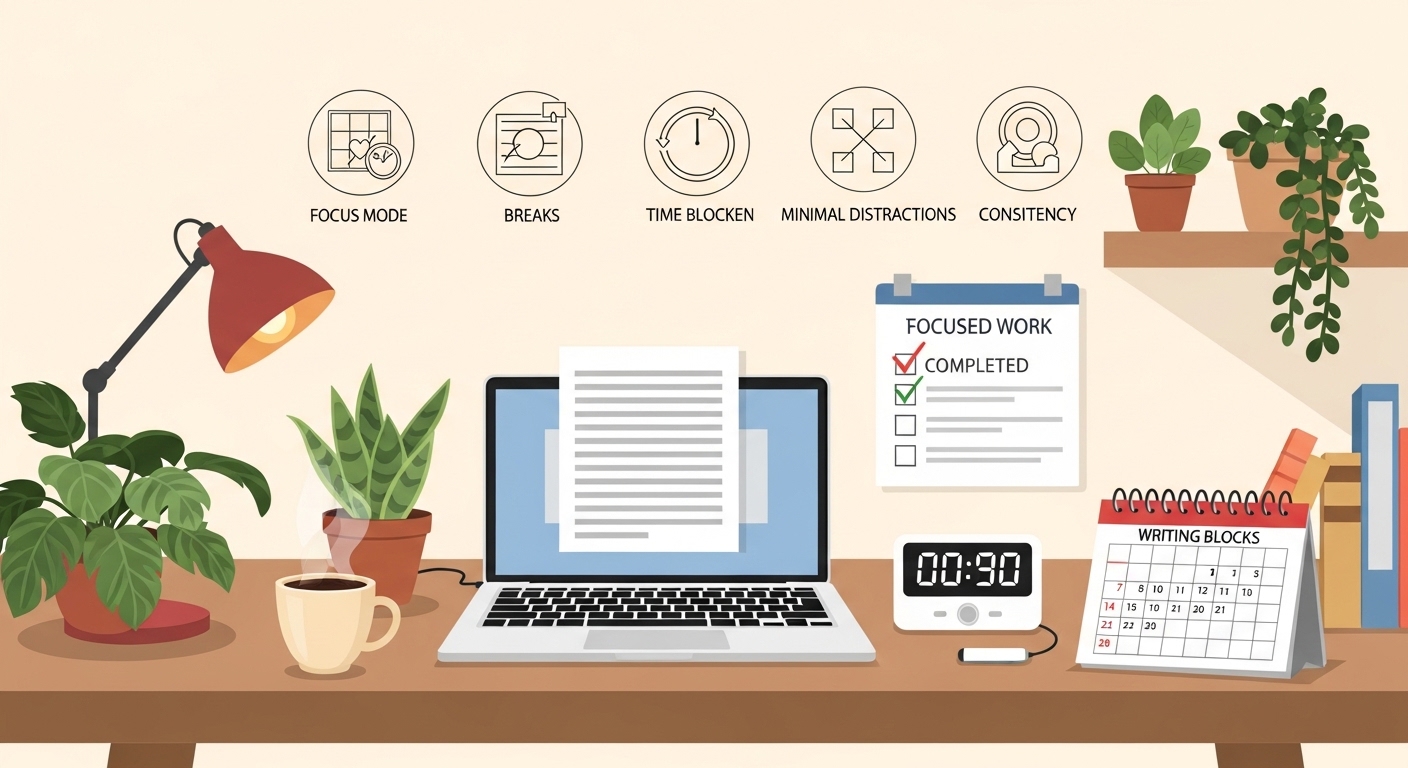
Working from home has become a normal setup for many writers today. It provides freedom to choose working hours, create personal routines, and build a comfortable environment that supports creativity. For writers, this flexibility can be highly valuable because writing often depends on mood, focus, and uninterrupted thinking time, especially in areas like ghostwriting services and professional book writing support.
At the same time, working from home also introduces real challenges. Without a structured office environment, it becomes easier to get distracted by household responsibilities, social media, or irregular schedules. Over time, these interruptions can affect consistency and reduce overall productivity, even for those working with a ghostwriter for hire or managing long-form projects.
Writers especially need steady focus because their work relies on continuous thinking, drafting, and revising. Even small breaks in concentration can disrupt flow and slow down progress on manuscripts and articles. That is why having strong productivity habits is essential. Writers who learn how to manage time, control distractions, and maintain structure are better able to stay consistent. This makes their writing process smoother, more efficient, and more reliable over time, whether working independently or with a professional ghostwriting agency.
Real-World Writer Workflow Example (Day in the Life of a Work-From-Home Writer)
Understanding productivity strategies becomes much easier when you see how they actually work in a real routine. A typical work-from-home writer does not rely on random inspiration; instead, the day is structured around focused writing blocks, breaks, and revision time.
A common morning starts with a calm setup—checking tasks, reviewing outlines, and preparing the writing plan for the day. This is often the most productive period, where deep writing work such as drafting chapters, blog sections, or client content is completed. Writers involved in ghostwriting services usually dedicate this time to high-focus tasks that require creativity and clarity.
As the day progresses, the workflow shifts into client communication, research, or secondary writing tasks. This prevents cognitive overload while still maintaining productivity. Midday sessions are often used for lighter writing or editing previously completed work.
Afternoons or evenings are typically reserved for editing, refining structure, and improving readability. This stage is less about creativity and more about precision, ensuring the final output is polished and professional.
Breaks are strategically placed between writing sessions to avoid burnout and maintain mental freshness. This structured rhythm allows writers to consistently produce high-quality work without feeling overwhelmed.
1. Establish a Consistent Writing Routine
A consistent writing routine is essential for building discipline and long-term productivity. It means setting fixed hours for writing each day and following them regularly so the mind adapts to a predictable work rhythm. This reduces procrastination and helps you enter a focused state faster. Over time, writing at the same time daily becomes a habit rather than a forced effort. It also creates a clear separation between work and personal life, preventing burnout. A stable routine ultimately improves efficiency and ensures steady progress on writing projects without relying on motivation alone.
- Set fixed daily writing hours
- Align work with peak focus time
- Avoid random schedule changes
- Build a start-and-stop writing ritual
- Treat writing time as non-negotiable
2. Create a Dedicated Writing Space
A dedicated writing space is a specific area reserved only for writing tasks. This helps train the brain to associate that environment with focus and productivity. When you consistently write in the same place, distractions naturally reduce and concentration improves. The space should be comfortable, quiet, and free from unnecessary clutter. Good lighting and ergonomic seating also play a role in maintaining focus for longer periods. Keeping essential writing tools nearby reduces interruptions. Over time, this dedicated environment becomes a mental trigger that signals it is time to work, improving both speed and writing quality.
- Choose a fixed writing location
- Keep the area clutter-free
- Ensure proper lighting and comfort
- Remove unrelated items from the desk
- Use only writing-related tools in that space
3. Plan Your Writing Tasks in Advance
Planning writing tasks in advance provides clarity and direction, which is especially important for long or complex projects. Instead of starting randomly, writers can break work into smaller, achievable steps. This prevents overwhelm and makes progress more visible. A clear plan also helps prioritize important tasks and avoid wasting time deciding what to do next. Outlining ideas before writing improves structure and flow. With a planned approach, each writing session becomes purposeful and efficient, allowing writers to track progress and maintain steady momentum across projects without losing focus or consistency.
- Break projects into smaller tasks
- Create daily or weekly goals
- Outline before starting writing
- Prioritize high-impact tasks first
- Track progress regularly
4. Manage Digital Distractions Effectively
Managing digital distractions is critical for maintaining deep focus while working from home. Devices and online platforms often interrupt concentration and reduce productivity. To handle this effectively, writers should reduce unnecessary interruptions and control their digital environment. For example, turning off non-essential notifications and limiting social media use helps protect attention span. Setting specific times for checking emails or messages prevents constant disruption. A distraction-free environment allows for longer, uninterrupted writing sessions, making work more efficient and mentally less exhausting.
- Turn off non-essential notifications
- Limit social media usage during work hours
- Set fixed times for emails and messages
- Use focus or blocking apps if needed
- Keep phone away during writing sessions
5. Use Structured Writing Techniques
Structured writing techniques help maintain focus and consistency during work sessions. Methods such as time-blocking or focused writing intervals encourage writers to work in short, productive bursts instead of long, draining hours. Setting word-count targets for each session creates measurable goals and reduces hesitation. Regular breaks between focused sessions also prevent mental fatigue. These techniques provide a framework that guides the writing process and reduces decision-making stress. With structure in place, writers spend more time creating content and less time thinking about what or how to write next, improving overall productivity.
- Use time-blocking for writing sessions
- Work in focused intervals (e.g., Pomodoro)
- Set daily word-count targets
- Take short breaks between sessions
- Stick to a structured workflow
6. Maintain Mental and Physical Well-being
Maintaining mental and physical well-being is essential for sustained writing performance. Long hours of sitting and screen time can reduce energy and creativity if not managed properly. Taking short breaks helps refresh the mind and prevent burnout. Light physical activity such as stretching or walking improves circulation and focus. Proper hydration and balanced meals also support mental clarity. Additionally, mindfulness practices can reduce stress and improve concentration. When both body and mind are well-maintained, writers can work more efficiently, stay focused longer, and consistently produce higher-quality writing without exhaustion.
- Take regular short breaks
- Do light stretching or walking
- Stay hydrated throughout the day
- Eat balanced and healthy meals
- Practice mindfulness or relaxation techniques
Comparison of Productivity Styles for Writers
Different writers use different productivity systems depending on their work style, deadlines, and creative process. Understanding these methods helps identify what works best for long-term consistency.
| Method | Best For | Effectiveness |
| Time Blocking | Structured writers handling multiple tasks | High |
| Pomodoro Technique | Writers struggling with focus and distractions | High |
| Flexible Writing Schedule | Creative writers who need freedom | Medium |
| Deadline-Based Writing | Freelancers and ghostwriting services projects | Very High |
Each method has its own strengths. Time blocking helps create discipline, while Pomodoro improves focus in short bursts. Flexible writing allows creativity but may reduce consistency if not controlled properly. Deadline-based writing, commonly used in ghostwriting services, ensures output remains steady and client expectations are met on time.
Choosing the right system depends on personality, workload, and writing goals. Many professional writers even combine multiple methods to build a hybrid system that maximizes both creativity and efficiency.
Psychology of Productivity for Writers
Productivity is not only a matter of discipline—it is deeply connected to psychology. Understanding how the mind works can significantly improve writing performance and consistency.
One of the biggest factors affecting writers is the dopamine-driven distraction cycle. Social media, notifications, and instant entertainment constantly compete for attention, making it harder to stay focused on long-form writing tasks. This is why many writers struggle with consistency, even when they have time available.
Another key factor is procrastination, which often comes from perfectionism rather than laziness. Writers tend to delay starting because they want the first draft to be perfect. However, professional writers and those working in ghostwriting services understand that imperfect drafts are the foundation of great final content.
Habits also play a major role. When writing becomes a daily habit, the brain reduces resistance and treats it as a normal activity instead of a difficult task. This is where identity-based thinking becomes powerful—when a writer starts thinking “I am a writer,” productivity becomes part of their identity rather than a forced action.
By understanding these psychological patterns, writers can design better systems that naturally improve focus, consistency, and output quality.
Monetization and Career Growth Through Writing Productivity
Productivity is not just about writing more—it directly impacts income, career growth, and long-term opportunities. In the writing industry, consistency is one of the most valuable traits clients look for.
Writers who maintain structured workflows are able to take on more projects, meet deadlines reliably, and deliver higher-quality work. This is especially important in ghostwriting services, where clients expect complete manuscripts, blogs, or business content within strict timelines.
Higher productivity also allows writers to scale their work. Instead of handling one project at a time, efficient writers can manage multiple clients simultaneously without compromising quality. This creates a direct link between productivity and earning potential.
From a business perspective, writing is no longer just a creative activity—it is a service-based profession. Systems, deadlines, and output consistency determine success more than raw talent alone. Writers who treat their work as a structured system rather than an occasional task are more likely to build sustainable income streams.
Additionally, clients prefer writers who are dependable. Whether it is blog writing, book development, or ghostwriting services, consistency builds trust, and trust leads to long-term collaborations.
Ultimately, productivity becomes a career asset. The more structured and efficient a writer is, the more valuable they become in the professional writing market.
FAQ
1. How can work-from-home writers stay productive daily?
By following a fixed routine, minimizing distractions, and using structured writing systems that create consistency in output.
2. What is the biggest challenge for remote writers?
The biggest challenge is maintaining focus in an unstructured environment filled with digital and household distractions.
3. Do professional writers use routines?
Yes, most professional writers and those in ghostwriting services rely heavily on routines and structured workflows.
4. How long should a writing session be?
It depends on the writer, but focused sessions of 45–90 minutes with breaks are commonly used for sustained productivity.
5. Can productivity improve without strict schedules?
Yes, but structured schedules significantly improve consistency, quality, and long-term writing output.
Conclusion
Staying productive as a work-from-home writer is not about working longer hours—it is about working with structure, intention, and clarity. The combination of routine, environment, planning, distraction control, structured systems, and well-being forms a complete productivity framework.
Writers who implement these strategies consistently are able to maintain high-quality output even in flexible or unpredictable environments. This is especially important in fields like ghostwriting services and long-form content creation, where consistency and reliability are essential.
Ultimately, productivity is not a trait—it is a system. And when that system is properly built, writing becomes not only more efficient but also more sustainable over time.