The Difference Between Saving and Remembering
Digital storage gives us the illusion that everything is preserved. In a technical sense, that’s true. Your images are there. Searchable. Backed up. Safe.
But preservation is not the same as remembrance.
To remember something, you have to revisit it with attention. You have to sit with it long enough for it to reconnect with your present self. That rarely happens when your photos are buried three folders deep, surrounded by hundreds of near-identical frames.
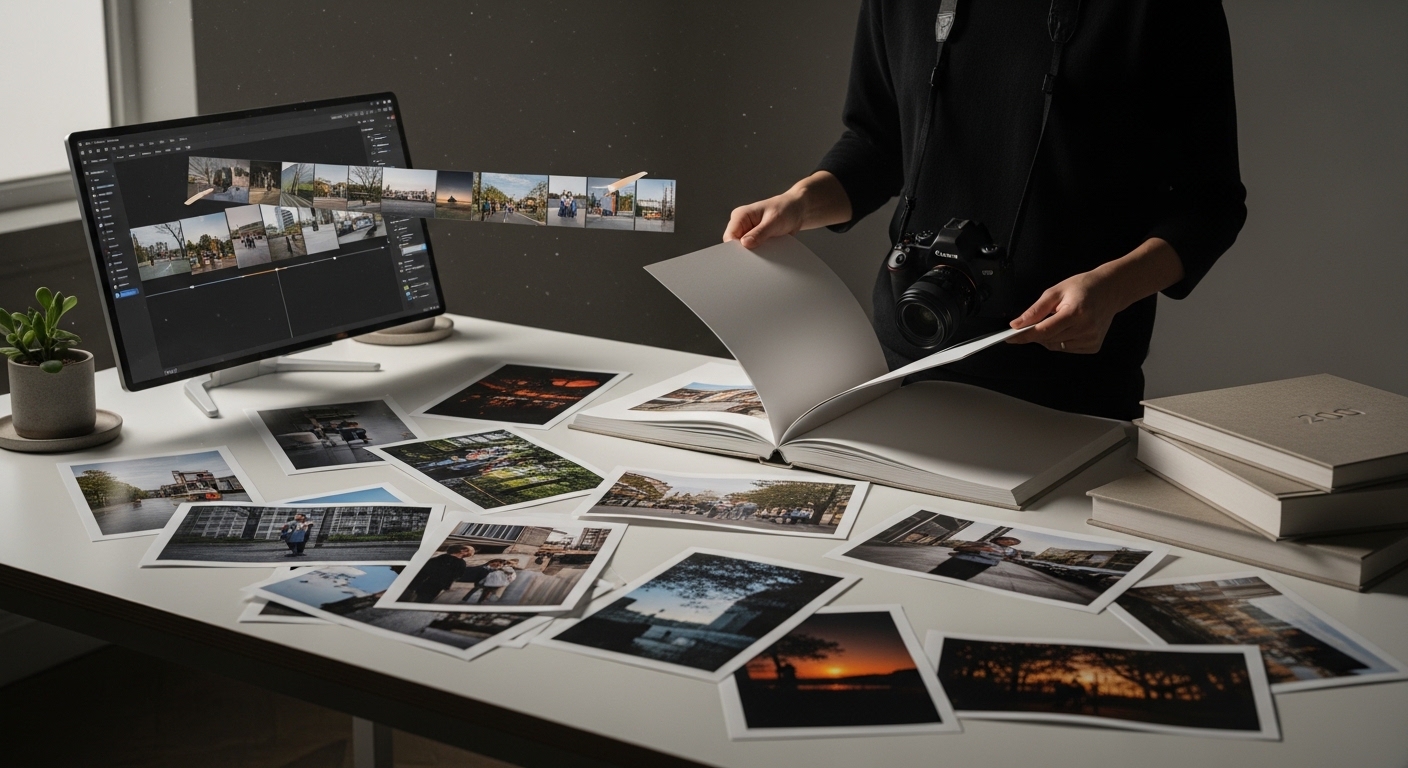
A printed annual changes the conditions under which your images exist.
It removes friction. There are no folders to navigate, no thumbnails to scan, no distractions pulling you elsewhere. You open a book, and your year unfolds in front of you—deliberately, sequentially, without interruption.
That shift may seem small, but it fundamentally alters how your work is experienced. What was once fragmented becomes continuous. What was once forgotten becomes visible again.
And visibility changes value.
The Subtle Discipline It Creates
What’s interesting about committing to an annual isn’t just what happens at the end of the year—it’s what happens during it.
At first, nothing feels different. You shoot the way you always have. But gradually, a kind of awareness starts to build. You begin to sense that your images are not just isolated moments; they are part of a future sequence you haven’t assembled yet.
This doesn’t make you rigid—it makes you attentive.
You start noticing gaps. If everything you’ve shot lately feels visually similar, you become curious about breaking that pattern. If your work leans heavily toward one subject, you might instinctively begin exploring another. Not because you have to, but because you feel the imbalance.
Without forcing structure, you begin to develop it.
Over time, your year naturally starts to include a broader spectrum of experience:
- The obvious highlights—the trips, the events, the visually striking moments
- The in-between spaces—ordinary days that gain meaning only in hindsight
- The uncertain experiments—photos that don’t quite work, but mark a shift in how you see
- The personal fragments—images that may not impress anyone else, but matter to you
This is where the annual becomes more than a portfolio. It becomes a reflection of attention itself—what you chose to notice, and what you almost missed.
Curation as Self-Confrontation
If shooting is intuitive, curation is confrontational.
At the end of the year, you’re no longer behind the camera. You’re looking at the results of your decisions—what you prioritized, what you ignored, what you repeated without realizing.
And now you have to choose.
The difficulty isn’t just in reducing volume. It’s in deciding what your year means. Because the moment you exclude an image, you’re saying something about what doesn’t belong in that meaning.
This is why curation often feels heavier than expected. It forces you to evaluate your work on multiple levels at once:
- Technical strength—Is the image well executed?
- Emotional weight—Does it carry something beyond aesthetics?
- Narrative role—Does it contribute to the larger story, or sit outside it?
These criteria don’t always align. Some of your sharpest images may feel empty. Some of your most meaningful ones may be flawed. Navigating that tension is part of the process.
A useful way to move through it is to accept that your annual is not a “best of” collection. It’s a truest of collection.
That distinction matters.
You’re not trying to impress an audience. You’re trying to represent a year honestly, even if that honesty includes unevenness, uncertainty, or quiet moments that don’t immediately stand out.
And in that honesty, something more compelling emerges—something that feels lived, not curated for approval.
Sequencing: Where Meaning Is Created
Once you’ve chosen your images, the next challenge is placing them in relation to each other.
Individually, photographs are fragments. Sequencing is what turns those fragments into a language.
This is where many annuals either come alive or fall flat.
A purely chronological sequence can work, especially if your year has clear transitions. But chronology alone doesn’t guarantee engagement. What matters more is how one image leads into the next—how it prepares you, contrasts with you, or shifts your attention.
You begin to notice that meaning doesn’t just live inside images—it emerges between them.
A few subtle strategies can guide this process:
- Let contrast do some of the work. A loud, busy frame followed by a quiet, minimal one creates a natural pause.
- Pay attention to visual echoes. Repeated colors, shapes, or gestures can create cohesion across different moments.
- Control intensity. If every image demands attention, none of them will hold it for long.
Sequencing is less about rigid rules and more about sensitivity. You’re shaping the emotional rhythm of the book—deciding when the viewer should feel grounded, surprised, reflective, or still.
When it works, the book feels intentional without feeling forced.
Designing for Time, Not Just Space
Design is often treated as a final step—a way to “present” images. But in an annual, design plays a deeper role. It shapes how time is experienced.
A crowded layout compresses time. A sparse one expands it.
A full-bleed image can feel immediate and immersive, while a smaller image surrounded by space can feel distant, almost like a memory fading at the edges.
These aren’t just aesthetic choices. They influence how your year is felt.
You don’t need complexity to achieve this. In fact, complexity often gets in the way. What matters is consistency and restraint—allowing the structure of the book to support the flow of images rather than compete with them.
At key moments, subtle variations can have a strong impact:
- A sudden full-page image after several smaller ones can feel like a turning point
- A blank or nearly empty page can create space for reflection
- A sequence of tightly related images can slow the viewer down, encouraging closer attention
Design, in this sense, becomes invisible—but deeply effective.
The Physical Encounter
When the book finally exists in physical form, something shifts again.
It’s not just that you can see your images—it’s that you encounter them differently.
On a screen, images are backlit, fleeting, and often surrounded by distractions. In print, they are fixed. They don’t move unless you move them. They don’t compete unless you place them side by side.
This changes your pace.
You spend longer with each image, whether you intend to or not. You notice details you missed. You feel the weight of sequences in a way that scrolling never quite delivers.
And perhaps most importantly, the work feels finished. Not in the sense that you can’t improve, but in the sense that this version of your year has been acknowledged and preserved.
That sense of closure is rare in digital workflows, where everything remains editable, replaceable, unfinished.
Repetition as Meaning
The first annual is an experiment. The second is a decision.
By the third or fourth, the act itself begins to carry meaning independent of the images. You’re no longer just making books—you’re building continuity.
Each year becomes a chapter, and the gaps between them start to matter as much as the content within them.
You begin to see long-term patterns:
- How your visual preferences evolve
- What subjects return, even when you think you’ve moved on
- How your environment and circumstances shape what you notice
Over time, the collection becomes more than documentation. It becomes perspective.
And this is where the tradition reveals its real value—not in any single book, but in the accumulation of years, each one edited by a different version of you.
The Resistance to Starting
Despite all of this, most people hesitate.
The reasons are predictable, but still powerful. Not enough time. Not enough good photos. Not enough experience in design or printing.
Underneath those reasons, though, there’s usually something simpler: the discomfort of taking your own work seriously.
A printed annual requires a decision. It asks you to say, “This is worth preserving.” That can feel like a bold claim, especially if you’re used to treating your photography casually.
One way to lower that barrier is to reduce the scope. The first version doesn’t need to be ambitious. It just needs to exist.
You might begin with something minimal:
- A limited number of images—far fewer than you think you need
- A simple, template-based layout with little customization
- A focus on completion rather than refinement
What matters is not how impressive the first book is. What matters is that it establishes the cycle. Once the cycle exists, improving it becomes natural.
What You’re Really Preserving
It’s easy to think that you’re preserving photographs. But that’s only part of it.
You’re preserving a way of seeing.
Every year, your attention shifts slightly. You notice different things. You respond to different kinds of light, different kinds of moments. Those shifts are subtle, and without some form of consolidation, they’re easy to overlook.
A printed annual captures those shifts indirectly. It shows you not just what you photographed, but how you experienced the world at that time.
Years later, that perspective becomes invaluable.
You’ll recognize places that have changed, people who have moved on, habits you didn’t realize you had. You’ll see the distance between who you were and who you’ve become—not in abstract terms, but in concrete, visual evidence.
And because it’s physical, it remains accessible in a way digital archives often aren’t. It sits on a shelf. It waits. It doesn’t require searching.
It simply asks to be opened.
Closing Thought
A year passes whether you document it or not. Photos accumulate whether you revisit them or not.
The difference lies in what you choose to do with them.
Turning your photography into a printed annual is a quiet act of intention. It doesn’t demand attention from others. It doesn’t rely on platforms or algorithms. It exists for a simpler reason: to give form to time.
And over the years, those forms begin to add up. Not as a collection of images, but as a record of a life—seen, selected, and remembered on purpose.