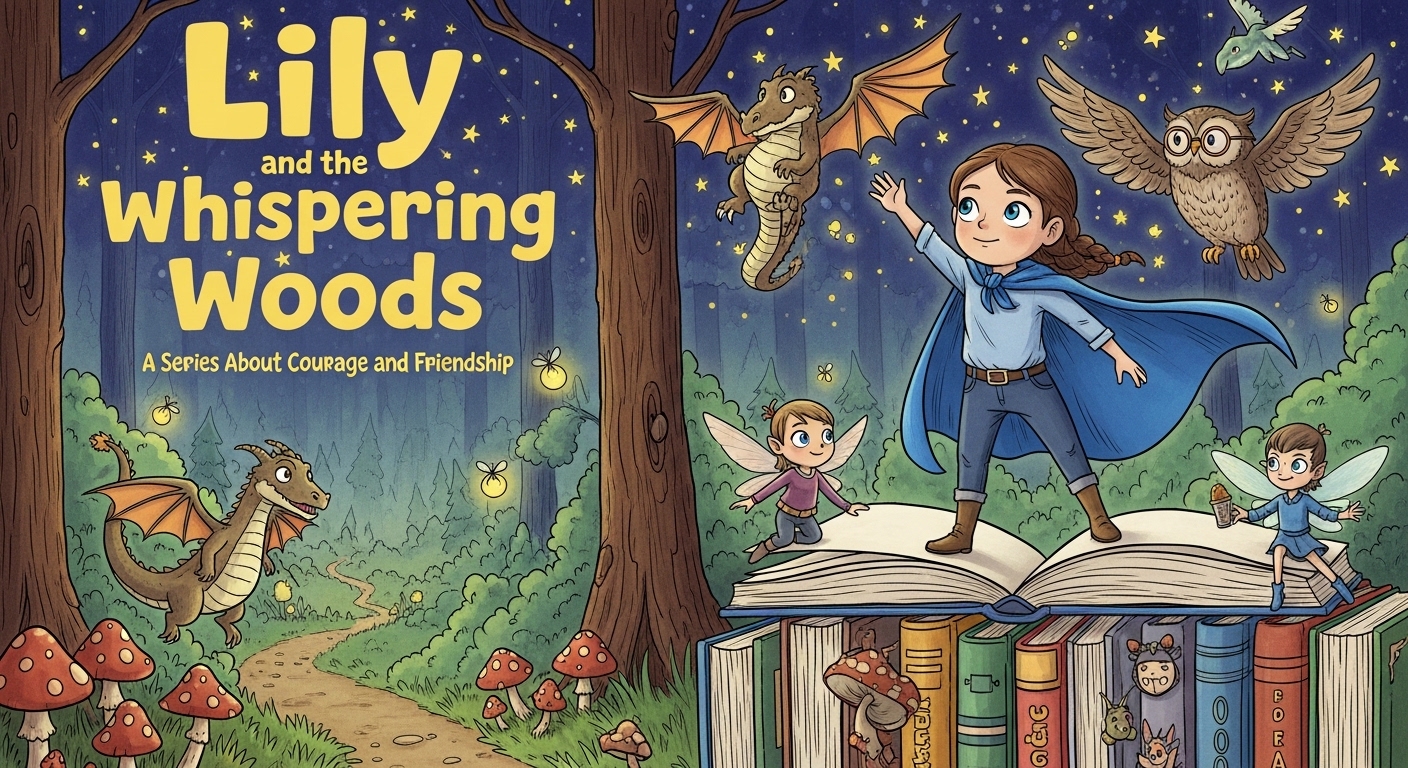
here are stories that feel too important to be left as memories.
They live in quiet moments—small acts of bravery, resilience in the face of something overwhelming, a child choosing to be strong in ways that even adults struggle to understand. These moments often pass without ceremony, yet they carry a kind of emotional weight that lingers long after the moment itself is gone.
For many families, especially grandparents, witnessing that kind of courage creates a natural instinct: to preserve it.
But preservation alone is not enough. A memory written in a journal or shared in conversation can fade over time. What transforms it into something lasting—something that can be revisited, shared, and even passed on—is storytelling with structure and intention.
This is where the idea of turning a granddaughter’s courage into a children’s book series begins to take shape.
It is not simply about writing a story. It is about translating real emotion into a form that children can understand, connect with, and grow from. It is about shaping a lived experience into a narrative that feels both personal and universal. And in many cases, it involves collaboration—whether through family effort or professional support such as children’s book ghostwriting—to ensure that the story is told with clarity, warmth, and purpose.
When done thoughtfully, what starts as a single moment of courage can evolve into something much larger: a series of stories that reflect growth, resilience, and identity over time.
Why Personal Stories Resonate So Deeply in Children’s Literature
Children’s books have always been rooted in imagination, but the most powerful ones often carry a thread of truth. Even when wrapped in fictional worlds, they reflect real emotions—fear, curiosity, courage, and belonging.
A story inspired by a real child carries an authenticity that is difficult to replicate artificially.
The emotional clarity of real experiences
Children may not always understand complex narratives, but they respond strongly to emotional clarity. A story built around genuine courage—whether it involves overcoming fear, adapting to change, or facing challenges—naturally resonates because it mirrors feelings they recognize.
When a granddaughter’s real-life experience becomes the foundation, the story carries a subtle honesty that readers can feel, even if they cannot articulate it.
From personal memory to universal message
The challenge, however, lies in shaping that personal story into something broader. A children’s book cannot rely solely on personal context—it must translate the experience into a message that other children can relate to.
This is where storytelling craft becomes essential. The goal is not to document events exactly as they happened, but to interpret them in a way that preserves meaning while making the story accessible.
Shaping Courage Into a Narrative Structure
Turning a real-life moment into a children’s story requires thoughtful adaptation. Raw experiences rarely follow a clean narrative arc, but stories need structure to feel complete.
Identifying the core moment of courage
Every story begins with a defining moment. It might be a challenge the child faced, a decision they made, or a situation where they showed unexpected strength.
This moment becomes the emotional anchor of the story. Everything else is built around it.
Creating a beginning, middle, and emotional resolution
A strong children’s story needs a clear progression. It begins by establishing the child’s world, introduces a challenge or conflict, and then moves toward a resolution that reflects growth or understanding.
The resolution does not need to be dramatic. In many cases, subtle emotional change is more powerful than grand outcomes.
Balancing simplicity with depth
Children’s books must remain simple in language, but that does not mean they should be shallow. The writing should be accessible while still carrying emotional nuance.
This balance is often where professional children’s book writing or ghostwriting services add value—ensuring the story remains clear without losing its emotional depth.
Expanding One Story Into a Book Series
A single story of courage can stand alone, but when approached thoughtfully, it can also become the foundation for a series.
Why a series creates deeper impact
A series allows the character to grow over time. Instead of capturing one moment, it captures a journey. Each book can explore a different aspect of courage—facing new environments, building friendships, overcoming fears, or learning self-confidence.
This continuity creates familiarity for young readers. They begin to recognize the character, relate to her experiences, and anticipate new stories.
Maintaining consistency across books
While each story should stand on its own, the character’s voice, personality, and emotional tone should remain consistent. This creates a cohesive reading experience.
Consistency also applies to visual elements, especially if illustrations are involved. The character should feel recognizable from one book to the next.
Introducing new themes while preserving identity
Each book in the series can explore a different theme, but it should always connect back to the core idea of courage and growth.
This prevents repetition while maintaining a clear identity for the series.
The Role of Writing in Preserving Authentic Voice
When a story is inspired by a real child, authenticity becomes the most valuable element—and the most delicate to handle. It is not just about what happened, but how it felt. The tone, the small reactions, the emotional truth behind each moment—these are what give the story its depth.
The challenge is that authenticity does not automatically translate into effective storytelling. It has to be shaped carefully, without losing its original essence.
Writing from memory vs writing for readers
Memories are naturally rich. They carry detail, emotion, and context that feel complete to the person who experienced them. But when translated directly onto the page, they often lack structure. They may move too quickly, linger on the wrong details, or assume understanding that a young reader simply doesn’t have.
Writing for children requires a shift in perspective.
Instead of trying to include everything, the focus moves toward clarity and emotional precision. The writer must decide which moments carry the most meaning and build the narrative around them. This often means simplifying events without simplifying emotion.
It also involves adjusting language. Children’s writing needs to be accessible, but still expressive. The goal is to create sentences that are easy to follow while still carrying warmth, personality, and emotional truth.
In this process, writing becomes less about recording memory and more about interpreting it—reshaping lived experience into something that can be understood, felt, and remembered by others.
Collaborating with a children’s book ghostwriter
For many families, this transition from memory to structured story can feel overwhelming. This is where working with a children’s book ghostwriter becomes valuable.
A professional writer approaches the story with both distance and discipline. They are able to see which elements carry narrative weight, how scenes should be structured, and where emotional emphasis should be placed. At the same time, their role is not to take ownership of the story, but to protect its authenticity while making it readable and engaging.
This collaboration is less about rewriting and more about refining.
The ghostwriter helps shape pacing so the story flows naturally. They adjust language so it feels appropriate for young readers. They organize scenes so that each moment leads clearly into the next. And perhaps most importantly, they ensure that the emotional core—the reason the story matters in the first place—remains intact.
When done well, the final result does not feel “written by someone else.” It feels like the original story, expressed more clearly, more cohesively, and in a way that allows other children to truly connect with it.
In the end, preserving authentic voice is not about keeping every detail unchanged. It is about holding onto the emotional truth while giving it a form that others can experience. Writing, in this sense, becomes a bridge—carrying a personal story into a shared space without losing what made it meaningful to begin with.
Designing the Visual World of the Story
In children’s books, visuals are not optional—they are central to the experience.
How illustrations support storytelling
Illustrations help translate emotion into something immediately understandable. They show expressions, environments, and actions that words alone may not fully capture.
For a story about courage, visuals can highlight subtle emotional shifts—nervousness, determination, relief, and joy.
Creating a consistent visual identity
If the story becomes a series, visual consistency becomes even more important. The character design, color palette, and illustration style should remain aligned across all books.
This helps build recognition and strengthens the overall identity of the series.
Choosing the Right Format for Publishing
Once the story and visuals are complete, format decisions begin to shape how the book is experienced.
| Format Type | Best Use Case | Experience Impact |
|---|---|---|
| Print book | Keepsake and gifting | Tangible and emotionally lasting |
| Digital eBook | Easy sharing and accessibility | Flexible and widely accessible |
| Hybrid approach | Print + digital | Balanced reach and experience |
Printed books often carry stronger emotional value, especially for family stories. Digital versions, however, make it easier to share the story with a wider audience.
Sharing the Story With a Wider Audience
While the story may begin as something deeply personal, it often holds value for others as well.
Connecting with readers who share similar experiences
Stories of courage resonate because they reflect universal emotions. Other children—and parents—may see their own experiences in the narrative.
Positioning the book as both personal and relatable
The key is to present the story in a way that feels personal without being exclusive. It should invite readers in, not limit them to observing someone else’s experience.
Challenges to Expect During the Process
Creating a children’s book series rooted in real-life experiences is deeply rewarding, but it comes with a unique set of creative and structural challenges. Unlike purely fictional work, you’re not starting from a blank slate—you’re shaping something personal into something universal. That tension requires careful decision-making at every stage.
Emotional Attachment vs. Narrative Clarity
One of the most common challenges is managing emotional attachment to real events. Certain memories may feel too important to leave out, even if they don’t serve the story. This can lead to overcrowded scenes, unclear pacing, or a lack of focus for young readers.
The key is recognizing that storytelling requires selection, not preservation. A strong children’s narrative is built on clarity, simplicity, and emotional direction. This often means compressing events, combining moments, or even removing details that don’t move the story forward.
The goal isn’t to capture everything—it’s to capture what matters most in a way that children can easily understand and connect with.
Maintaining Consistency Across Multiple Books
As a series expands, consistency becomes increasingly important and increasingly difficult. What works naturally in one book—tone, pacing, character voice—must be intentionally maintained across future installments.
Children are especially sensitive to inconsistency. Even subtle shifts in how a character speaks, behaves, or reacts can break immersion. Visual consistency is equally critical if illustrations are involved. Changes in style, color palette, or character design can make the series feel disconnected.
Maintaining this cohesion requires a system. Many creators develop informal “story bibles” that document character traits, recurring themes, language style, and visual guidelines. Without this structure, each new book risks drifting away from the identity established in earlier volumes.
Balancing Authenticity with Storytelling Needs
Real experiences rarely follow clean narrative arcs. They can be messy, uneven, or lack clear resolution—while children’s stories depend on structure, rhythm, and emotional payoff.
This creates a necessary balance: staying true to the essence of the experience while shaping it into something that works as a story. Authenticity does not mean literal accuracy. It means preserving the emotional truth while adapting events to fit a narrative framework.
This may involve simplifying timelines, enhancing key moments, or adding gentle structure to create a beginning, middle, and end that feels satisfying to a young audience.
When done well, the story still feels real—but it becomes accessible, engaging, and memorable in a way that raw experience alone cannot achieve.
A children’s book series based on real life succeeds when it moves beyond documentation and becomes intentional storytelling. These challenges are not obstacles to avoid—they are part of the creative process that turns personal experience into something meaningful for others.
FAQs
Can a real-life story work as a children’s book?
Yes, as long as it is adapted into a clear and engaging narrative suitable for children.
Do I need professional help to write it?
Not necessarily, but working with a children’s book ghostwriter can improve structure, clarity, and overall quality.
How long should each book be?
Children’s books are typically short, focusing on a single theme or moment.
Can one story become multiple books?
Yes, especially if the character’s journey includes different experiences and lessons.
Is illustration necessary?
For most children’s books, illustrations are essential for engagement and understanding.
Conclusion
Turning a granddaughter’s courage into a children’s book series is more than a creative project—it is an act of preservation, interpretation, and storytelling. It transforms a personal moment into something lasting, something shareable, and something meaningful for others.
When shaped with care, supported by thoughtful writing and design, and guided by a clear narrative vision, a single story can grow into a series that not only honors one child’s courage but inspires many more.