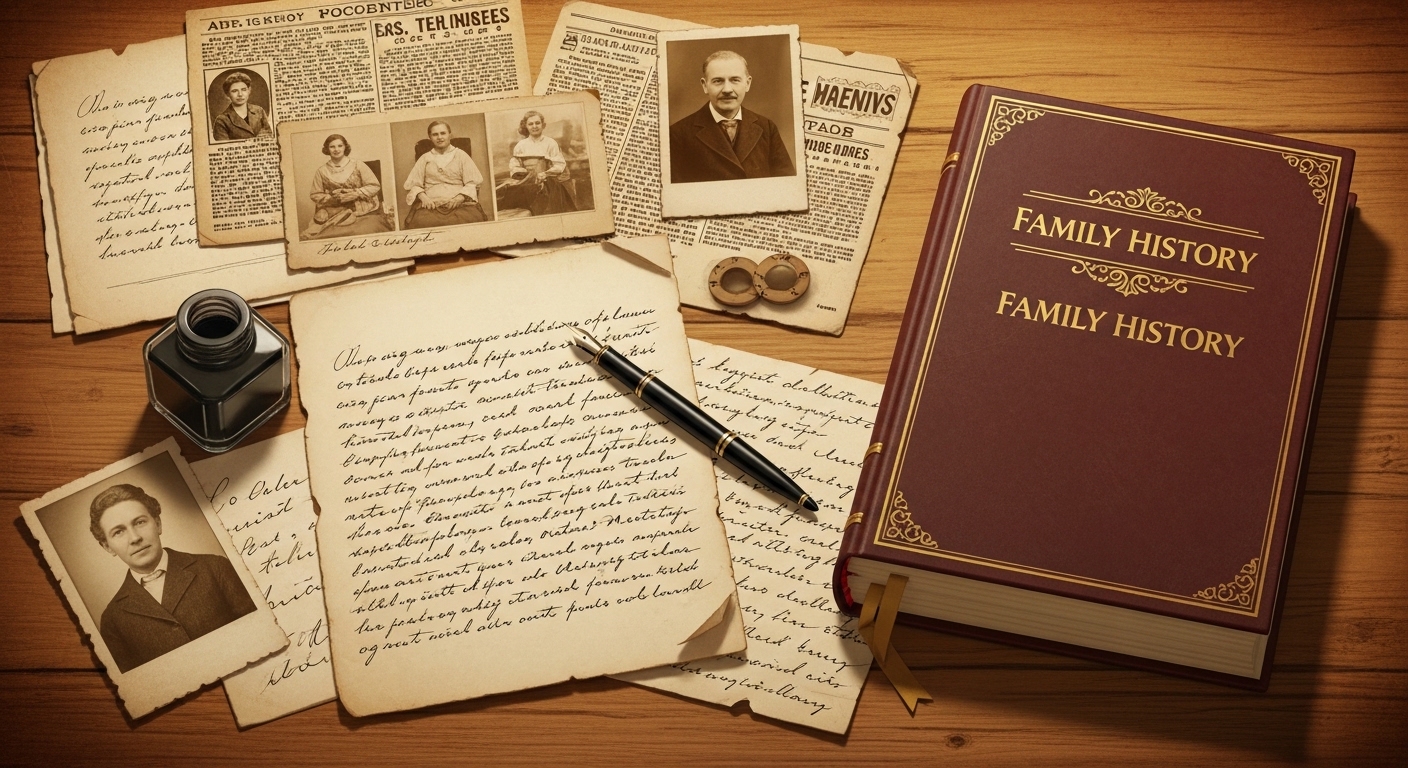
Family history books are more than personal projects—they are structured records of identity, memory, and legacy. Unlike general nonfiction writing, a family history book combines archival research, storytelling, interview transcription, genealogy documentation, and publishing knowledge into a single long-form narrative. It is both a creative and documentary process, requiring patience, organization, and attention to historical detail, often supported by family genealogy research methods, historical documentation, oral history collection, and archival record analysis.
In recent years, interest in genealogy and personal heritage has grown significantly. With access to digital archives, ancestry databases, census records, immigration documents, and self-publishing tools, more people are now choosing to document their lineage in book form. This shift has made family history writing accessible even to those without professional writing backgrounds, though the process still demands a clear methodology, structured research planning, and strong narrative development skills often associated with professional nonfiction writing, biographical storytelling, and historical content creation.
Creating a meaningful family history book involves three major stages: research, writing, and printing. Each stage requires different skills and tools, including genealogical research platforms, manuscript development techniques, editing and proofreading practices, and print-on-demand publishing systems. When executed properly, the result is a permanent legacy document that preserves family heritage, strengthens intergenerational identity, and serves as a long-term cultural archive.
Defining the Vision and Purpose of Your Family History Book
Before beginning research or writing, it is important to define the purpose of the book. A family history book is not simply a collection of names and dates. It is a narrative that connects generations through stories, cultural context, and lived experiences.
Some people create these books to preserve heritage for future generations, while others use them to understand migration patterns, ancestral professions, or family traditions. In many cases, it becomes a way to reconnect fragmented histories and give structure to oral stories that have been passed down informally.
A well-crafted family history book typically combines three elements:
- Genealogical facts and timelines
- Personal stories and interviews
- Historical context of places and events
This combination transforms raw data into meaningful storytelling.
Semantic keywords often associated with this process include genealogy research, ancestry documentation, historical storytelling, archival writing, and legacy preservation.
Step 1: How to Research Family History Effectively
Research is the foundation of any family history book. Without accurate and verified information, the narrative loses credibility and coherence. This stage often takes the most time because it involves gathering information from multiple sources and cross-checking details.
Start With What You Already Know
The research process begins at home. Most families already have partial records such as birth certificates, old photographs, letters, or handwritten family trees. These materials provide the initial structure for deeper investigation.
Interviewing family members is equally important. Older relatives often hold valuable oral histories that are not documented anywhere else. These conversations should be recorded, transcribed, and organized carefully.
Key starting points include:
- Names and dates of immediate relatives
- Places of birth, marriage, and migration
- Family stories and traditions
- Religious or cultural background
Use Genealogy Databases and Archives
Once basic information is collected, digital genealogy platforms become essential. These databases help verify facts and fill in missing gaps.
Common research tools include:
- Census records
- Immigration documents
- Birth and death certificates
- Military service records
- Church and parish registries
Local libraries and national archives also provide access to historical documents that may not be available online.
Organize Information Systematically
As research expands, organization becomes critical. Many writers use family tree software or spreadsheets to track relationships and timelines. Without proper structure, information can become overwhelming and difficult to verify.
A simple system includes:
- Individual profiles for each family member
- Chronological timelines
- Source citations for every fact
This ensures accuracy and prevents duplication or conflicting information.
Step 2: Structuring Your Family History Narrative
Once research is complete, the next step is transforming raw data into a readable structure. A family history book should not feel like an archive report; it should read like a cohesive story.
There are several structural approaches depending on your goals.
Once research is complete, the next step is transforming raw data into a readable structure. A family history book should not feel like an archive report; it should read like a cohesive story. Strong narrative flow helps readers emotionally connect with ancestors rather than simply observing dates and facts on a page.
There are several structural approaches depending on your goals. Choosing the right structure early also helps determine how you organize your research materials and write each chapter with consistency and purpose.
Chronological Structure
This is the most common format, where the story begins with the earliest known ancestor and moves forward through generations. It provides clarity and historical progression. Readers can easily follow the evolution of the family line across time periods, major events, and migrations. It also helps highlight how historical events influenced family decisions and life changes in a natural sequence.
Thematic Structure
Instead of following time, this approach focuses on themes such as migration, occupation, or cultural traditions. It allows deeper exploration of specific aspects of family identity. This structure is especially useful when family history spans multiple countries or professions. It helps group similar experiences together, making patterns more visible and allowing readers to understand shared values or recurring challenges across generations.
Biographical Structure
Each chapter focuses on an individual or family branch. This works well for large families with diverse histories. It allows detailed storytelling for each person, giving space for personal achievements, struggles, and life journeys. This format also makes it easier to include photographs, letters, and personal anecdotes, creating a more intimate and character-driven narrative experience.
Regardless of structure, clarity and consistency are essential. Maintaining uniform formatting, timeline accuracy, and narrative tone ensures the book remains readable and professionally organized from start to finish.
Step 3: Writing the Family History Book
Writing a family history book requires balancing factual accuracy with engaging storytelling. Unlike fiction, the writer cannot invent events, but narrative techniques can still be used to make the content compelling.
Blending Facts With Storytelling
Instead of listing dates and events, writers should describe context. For example, rather than stating a migration year, the narrative can explain the conditions that led to relocation.
This approach transforms genealogy into human storytelling.
Using Interviews and Personal Accounts
Including direct quotes from interviews adds emotional depth and authenticity. These voices make the narrative more relatable and preserve oral traditions.
Maintaining Accuracy
Every claim should be supported by documentation or verified sources. This is where proper citation and referencing become essential.
Professional writers, editors, and even ghostwriters are often used in complex family history projects to ensure narrative clarity and historical accuracy, especially when the material spans multiple generations.
Step 4: Editing and Refining the Manuscript
Editing is a crucial stage that determines the final quality of the book. Even strong research and writing can lose impact if the structure is unclear or repetitive.
Editing involves:
- Removing redundant information
- Ensuring chronological consistency
- Verifying factual accuracy
- Improving readability and flow
Many authors also hire professional editors to refine tone, structure, and grammar. This is especially useful for large manuscripts that contain multiple family branches and historical references. At this stage, the manuscript transitions from a personal document into a publishable book.
Step 5: Designing and Formatting the Book
Design plays a major role in how the final book is perceived. A well-designed family history book feels professional, readable, and archival in quality.
Key formatting elements include:
- Chapter headings and subheadings
- Consistent typography
- Page numbering and indexing
- Inclusion of photographs and captions
Photographs are particularly important in family history books. They provide visual context and emotional connection. Proper scanning and restoration may be required for older images.
Tools like Adobe InDesign, Canva, and Microsoft Word are commonly used for formatting.
Step 6: Printing Your Family History Book
Once the manuscript is complete and properly formatted, the final step is printing and transforming your work into a physical legacy. This stage gives your family history book permanence, turning years of research and storytelling into something that can be held, shared, and preserved across generations. At this point, authors must decide on a printing method based on budget, quality expectations, and intended distribution.
Print-on-Demand Services
Print-on-demand services have reshaped modern publishing by removing the need for large upfront investments. Platforms such as Amazon Kindle Direct Publishing (KDP) allow authors to upload their manuscript and print copies only when someone places an order. This makes the process financially safer and more flexible, especially for family history books that usually have a limited but meaningful audience.
This approach is particularly useful because it eliminates inventory management and storage concerns. It also allows for global accessibility, meaning family members in different countries can order copies without logistical challenges. Another advantage is that the content can be updated and re-uploaded easily if corrections or additions are needed in the future.
Local Printing Presses
Local printing presses offer a more traditional and highly customizable publishing experience. Unlike automated systems, these services give authors direct control over the physical quality of the book. Decisions about paper texture, ink quality, binding style, and cover design can all be made in consultation with printing professionals.
This option is often preferred when the goal is to create a premium or archival edition of a family history book. Many families choose this route when the book is intended to serve as a long-term historical record or a commemorative gift. The ability to inspect proofs and adjust details before final printing also ensures a higher level of precision and craftsmanship.
Local presses are especially valuable for bulk family orders, where multiple copies are needed for distribution among relatives. While this method may require a higher upfront cost, the result is often a more durable and visually refined product.
Hardcover vs Paperback
The decision between hardcover and paperback formats plays an important role in how your family history book will be preserved and used over time. Hardcover editions are typically chosen for their durability and long-term preservation qualities. They provide stronger binding, better protection against physical damage, and a more formal presentation that suits archival purposes.
Hardcover books also tend to feel more significant as heirloom items. Many families prefer them for gifting, storage in family libraries, or inclusion in historical archives because they are designed to withstand decades of handling.
Paperback editions, in contrast, are lighter, more affordable, and easier to distribute widely among extended family members. They are practical for sharing large quantities without significantly increasing production costs. However, they may not offer the same level of longevity as hardcover versions, especially when frequently handled.
Step 7: Preserving and Sharing the Family History Book
A family history book becomes most meaningful when it is shared. Many families distribute copies to relatives or donate copies to libraries and archives. Digital versions can also be stored for long-term preservation. PDF archives ensure that the information remains accessible even if physical copies are damaged or lost. Some families also create updated editions over time as new information becomes available.
FAQ: Writing a Family History Book
1. How long does it take to write a family history book?
It can take anywhere from a few months to several years depending on the depth of research and number of generations covered.
2. Do I need professional writing experience?
No, but strong organization and research skills are essential. Many people collaborate with professional writers or editors.
3. Where can I find reliable genealogy information?
Online databases, national archives, church records, and family interviews are the most reliable sources.
4. Can I include photographs in the book?
Yes, and they are highly recommended. They enhance storytelling and historical authenticity.
5. What is the best way to publish a family history book?
Self-publishing through platforms like Amazon KDP or using local printing services are the most common options.
6. Should I hire a professional writer?
If the project is large or complex, professional writers or ghostwriters can help structure and refine the narrative.
Final Thoughts
Creating a family history book is both a creative and archival process that preserves identity across generations. It combines research, storytelling, and publishing into a single meaningful project.
When done properly, it becomes more than a book—it becomes a legacy document that connects the past, present, and future of a family in a lasting and tangible form.