Word count functions as one of the earliest structural filters in the publishing industry, often shaping whether a manuscript is even considered before deeper qualitative evaluation begins. Long before narrative voice, character development, or thematic depth are assessed, the length of a manuscript signals its commercial category, production feasibility, and market positioning. This makes word count less of a creative constraint and more of an industrial classification tool embedded within modern publishing systems.
This becomes especially significant when viewed alongside genre-specific demands such as Crime Fiction: How to Research Your Novel Without Breaking Any Laws, where structural expectations are already tightly bound to realism, procedural accuracy, and legally sensitive subject matter. In such contexts, both narrative construction and research depth must align with clear boundaries defined not only by storytelling needs but also by external regulatory and ethical considerations.
For writers, this introduces a dual-layer challenge. Creativity itself is inherently fluid and does not naturally conform to fixed lengths. A story expands or contracts based on emotional pacing, narrative necessity, and structural rhythm. However, publishing operates within standardized frameworks where word count is used as a proxy for genre classification, audience targeting, and production cost estimation.
Because of this, manuscripts that fall outside expected length ranges are often flagged as commercially uncertain, regardless of their artistic quality. A work that is too short may be perceived as underdeveloped, while one that is excessively long may raise concerns about pacing, marketability, or editing complexity. These judgments are not purely editorial—they are structural decisions influenced by publishing economics.
Understanding word count, therefore, is not about restricting creative expression but about aligning narrative design with industry logic. Writers who ignore these parameters often encounter avoidable rejection or extensive restructuring during editorial review, not because their work lacks quality, but because it does not fit within established publishing categories.
In practice, word count operates as an early-stage alignment mechanism between creative intent and commercial viability, shaping how manuscripts are categorized, reviewed, and ultimately positioned within the market.
Does Novel Length Matter? What Publishers Expect From Every Genre
Modern publishing no longer treats novel length as a rigid rulebook, but it still operates within recognizable expectations. The rise of digital publishing, self-publishing platforms, and global readership has introduced more flexibility than traditional print-era standards. However, this flexibility does not mean the absence of structure; it simply means the structure is more adaptive.
A key distinction that writers of novels often overlook is the difference between manuscript length and published length. A first draft is almost always longer due to repetition, pacing issues, and exploratory writing. Editors then refine this into a more commercially viable form, adjusting pacing and removing unnecessary content while preserving narrative integrity.
Despite these changes, word count still signals intent. A 60,000-word manuscript communicates a different reading experience than a 120,000-word one. Publishers use this as a predictive tool for market positioning and reader expectations.
- Digital publishing has increased flexibility but not eliminated standards
- Manuscripts are typically reduced during editing phase
- Word count signals genre and reading experience expectations
Standard Word Count Ranges Every Writer Should Know
Word count categories in fiction are not arbitrary; they are based on long-standing publishing conventions shaped by reader behavior and production realities. While exceptions exist, most manuscripts fall into predictable ranges that help publishers classify and market books effectively.
Short novels or novellas generally fall under 50,000 words and are often harder to position in traditional publishing unless they serve a specific literary or experimental purpose. Standard novels, ranging between 50,000 and 90,000 words, form the backbone of commercial fiction and are considered the most market-friendly. Longer novels, especially those exceeding 90,000 words, are typically reserved for genres that require expanded worldbuilding or complex plotting.
These categories are not strict rules but functional guidelines that help align storytelling with audience expectations. Writers who understand these ranges early can better plan pacing and structure.
- Novellas are under 50,000 words and niche in traditional publishing
- Standard novels (50,000–90,000) are the most commercially accepted
- Longer novels often require justification through genre demands
Word Counts by Genre — What Publishers Expect
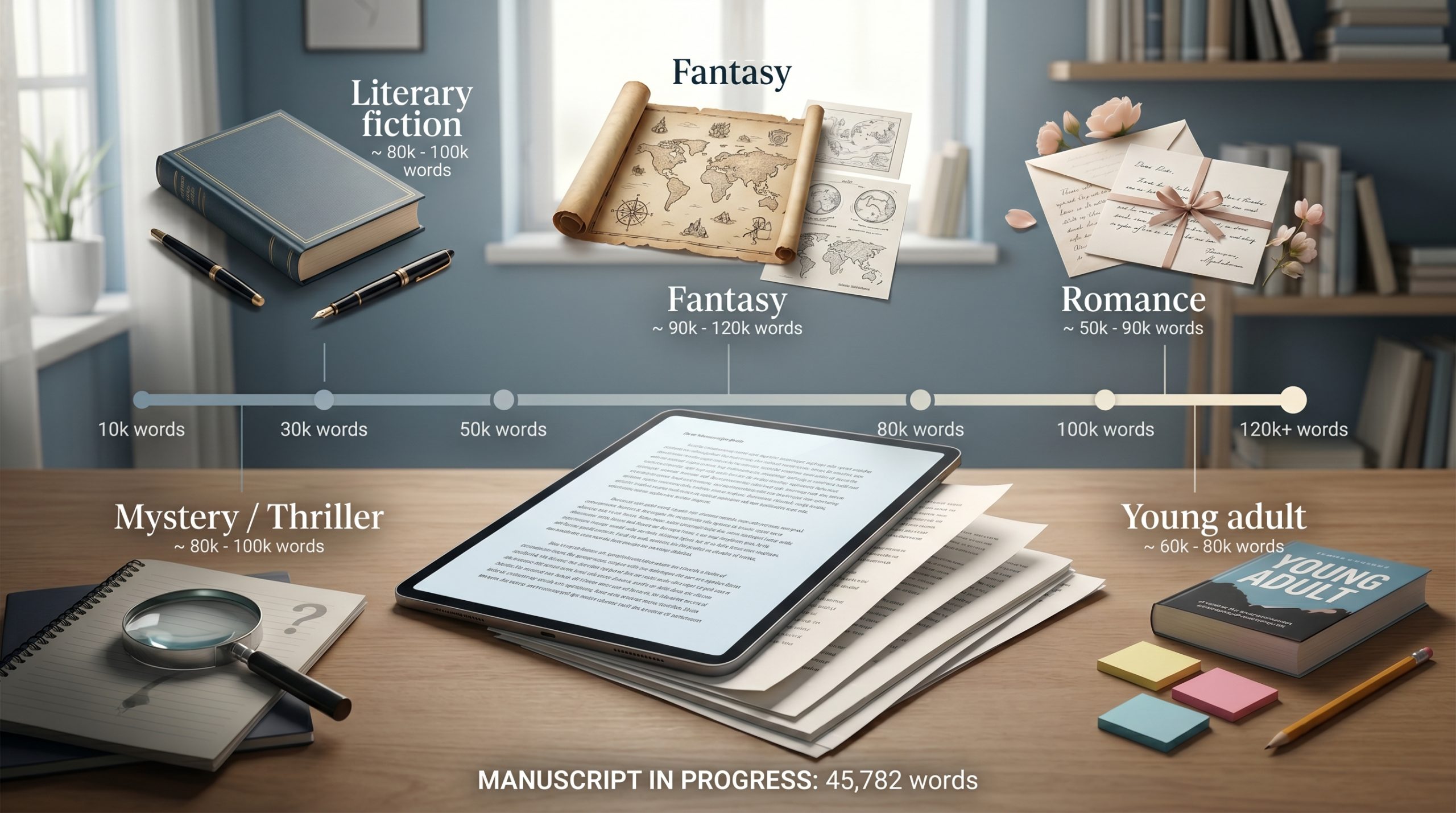
Different genres naturally support different word counts because they serve different reading experiences. Literary fiction often allows more flexibility, focusing on depth of theme and style rather than strict length constraints. Romance novels tend to be more tightly structured, with pacing that favors quicker emotional progression and clear narrative arcs.
Thriller and crime fiction rely heavily on pacing, which generally keeps word counts moderate to maintain tension and readability. In contrast, fantasy and science fiction often require significantly more space due to worldbuilding demands, complex systems, and layered plot structures. Young adult fiction usually stays shorter to align with accessibility and faster narrative engagement.
Understanding these expectations helps writers avoid mismatches between story type and manuscript length, which is a common reason for early rejection.
- Literary fiction allows flexible word count ranges
- Romance and YA prefer tighter, faster pacing structures
- Fantasy and sci-fi typically require higher word counts
Why Word Count Affects Publishing Decisions
Word count influences publishing decisions far beyond simple page length. It directly impacts production costs, printing feasibility, and pricing strategies. Longer books cost more to produce and may be priced higher, which can affect sales performance in certain markets.
Reader behavior also plays a major role. Publishers analyze how much time audiences are willing to invest in specific genres, and word count helps predict engagement levels. A mismatch between expected and actual length can affect readability and market positioning.
Additionally, bookstores and online platforms categorize books based on genre and length, which influences discoverability. A novel that does not fit expected ranges may struggle to find its audience even if the content is strong.
- Production costs increase with higher word counts
- Reader engagement expectations vary by genre
- Market categorization depends on length and structure
Here’s your section properly structured and fully developed in blog form with H2 + H3 hierarchy and coherent depth:
How Long Should a Novel Be? Word Counts by Genre Explained
Word count remains one of the most practical yet misunderstood elements in modern fiction writing. While storytelling is ultimately driven by character, structure, and theme, the publishing industry still uses word count as a functional benchmark to evaluate manuscripts quickly. It is not a measure of quality, but it strongly influences how a book is categorized, marketed, and positioned within a competitive publishing ecosystem.
Understanding how word count works across genres is essential for any writer aiming to publish traditionally or even self-publish strategically. Different genres operate under different structural expectations, and ignoring these patterns can lead to unnecessary rejection or structural revision later in the process.
Why word count still matters in modern publishing
Despite the rise of digital publishing and flexible storytelling formats, word count continues to act as an early filtering mechanism in the industry. Agents and editors often receive hundreds of submissions, and word count immediately signals whether a manuscript fits within commercially viable boundaries for a specific genre or audience.
It also affects production planning. Longer manuscripts increase printing costs, affect pricing strategies, and influence how a book is positioned in both physical and digital marketplaces. Even in self-publishing, word count impacts reader expectations, as audiences subconsciously associate certain lengths with specific reading experiences.
More importantly, word count shapes pacing. A 60,000-word novel feels fundamentally different from a 120,000-word one, regardless of writing quality. This makes it a practical tool for both publishers and readers to anticipate narrative scope before engaging with the content itself.
The role of industry expectations in determining novel length
Every publishing category operates within an established range of expected word counts, shaped by decades of market behavior. These expectations are not rigid rules but practical guidelines that help align manuscripts with audience demand and editorial feasibility.
Agents often assess whether a manuscript “fits” its genre before even evaluating its content in depth. A novel that falls outside expected length ranges may be perceived as structurally unbalanced or difficult to position in the market, even if the writing is strong.
This is because publishing is not only about storytelling but also about distribution logic. Books must fit into retail categories, marketing campaigns, and reader purchasing habits. Word count becomes a proxy for all of these considerations, helping industry professionals quickly categorize a manuscript’s commercial identity.
Why different genres require different word counts
Genre plays a major role in determining expected novel length because each genre demands a different type of reader experience. For example, literary fiction prioritizes thematic depth and stylistic exploration, often allowing more flexibility in length. In contrast, genres like romance or young adult fiction tend to rely on faster pacing and tighter narrative structures, resulting in shorter word counts.
Fantasy and science fiction often require significantly higher word counts because they involve worldbuilding, system construction, and layered narrative arcs. Crime and thriller fiction, on the other hand, balance complexity with pacing, typically staying within moderate ranges to maintain tension and readability.
These differences exist because readers approach each genre with different expectations. A fantasy reader expects immersion and scope, while a thriller reader expects momentum and urgency. Word count helps support these expectations by shaping how long a reader remains engaged within a particular narrative rhythm.
How writers should approach word count strategically
For writers, word count should not be treated as a restriction but as a planning tool. Instead of writing freely and adjusting later, it is more effective to align story structure with expected genre ranges from the beginning. This ensures that pacing, subplot development, and character arcs evolve within a manageable framework.
However, strict adherence to numbers without regard for story needs can be counterproductive. The strongest manuscripts are those where word count naturally emerges from narrative structure rather than being artificially enforced. Writers should aim for balance—understanding industry expectations while still allowing the story to dictate its own scope.
Ultimately, strategic awareness of word count helps writers avoid major structural revisions during editing and increases the likelihood of smoother acceptance within publishing systems. It becomes less about limitation and more about alignment with how the industry evaluates and positions fiction.
How to Decide the Right Length for Your Novel
Choosing the right word count should always begin with story structure rather than external expectations. A novel naturally defines its own length through its plot complexity, character development, and thematic depth. Forcing a story into a predetermined word count often weakens its natural rhythm.
At the same time, understanding genre expectations helps writers plan more effectively from the beginning. This prevents major restructuring later in the editing phase and ensures better alignment with publishing standards.
Professional writers also think like editors during the drafting process. This means balancing creative freedom with awareness of pacing, structure, and market readability.
- Story structure should determine final word count
- Genre awareness helps prevent major revisions
- Editing mindset improves narrative efficiency
Conclusion — Word Count as a Strategic Writing Tool
Word count is not a limitation on creativity but a strategic tool that helps align storytelling with publishing realities. While great stories are not defined by length alone, understanding industry expectations significantly improves a manuscript’s chances of success.
The most effective writers are those who treat word count as part of the storytelling process rather than an external restriction. When used correctly, it becomes a guide for structure, pacing, and clarity rather than a constraint on imagination.
- Word count is a structural tool, not a creative barrier
- Successful novels balance storytelling with industry expectations
- Strong narratives prioritize completeness over length
FAQs
What is the ideal word count for a first novel?
Most debut novels fall between 70,000 and 90,000 words, depending on genre.
Do publishers reject books based on word count?
Yes, extreme deviations from genre expectations can lead to early rejection.
Can a novel be too long or too short?
Yes, both can create pacing and marketability issues if not justified by genre.
Does genre determine word count?
Yes, each genre has typical length expectations based on reader behavior.
Should I write to a target word count?
No, the story should define length, but awareness of ranges helps planning.