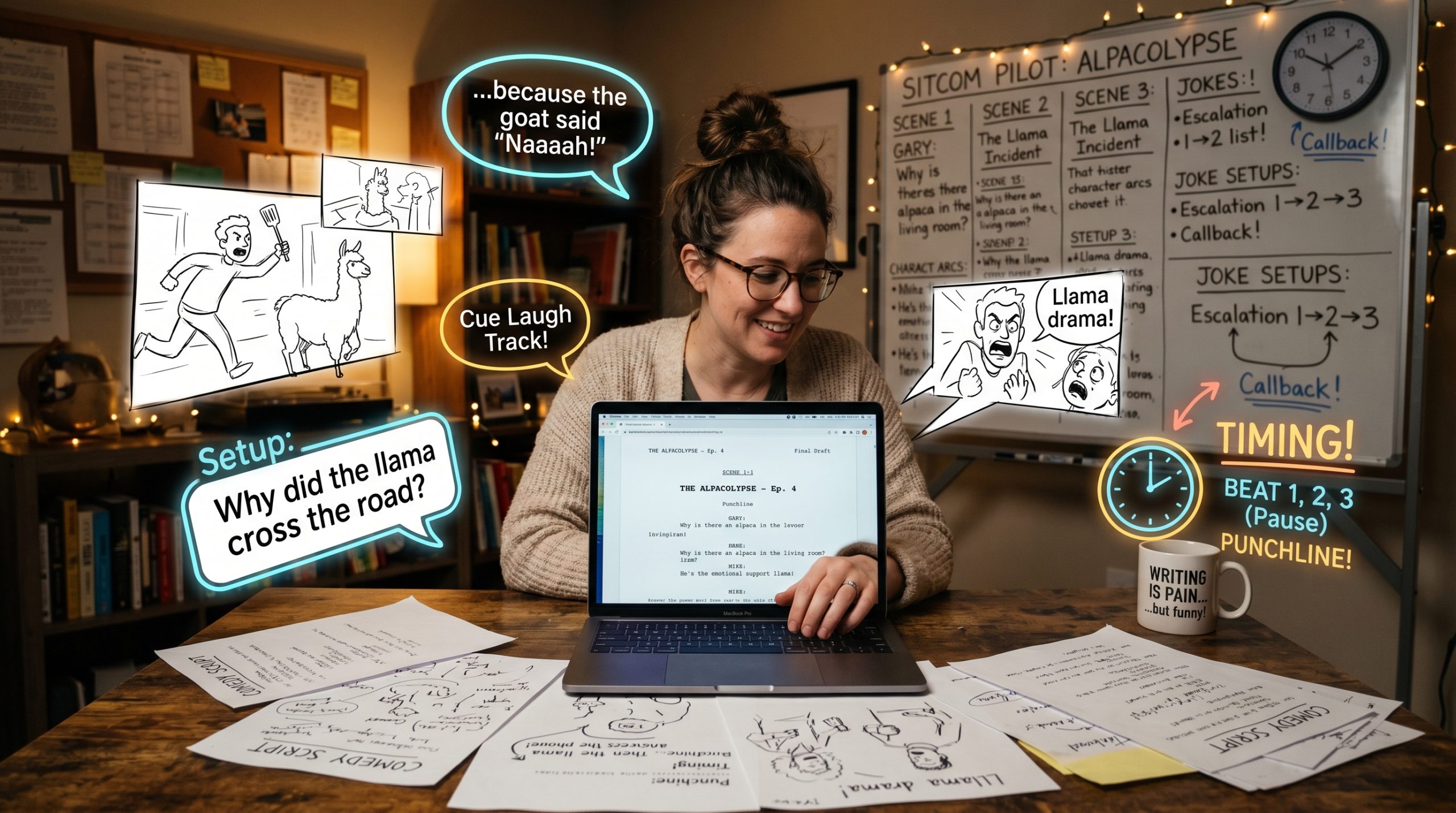
Comedy writing is often misunderstood as something spontaneous or purely instinctive, but effective comedy scripts are built with structure, timing, and precision. A joke may feel effortless when it lands well on screen, yet behind that moment is deliberate writing, careful pacing, and a deep understanding of audience expectation. The real craft of comedy scriptwriting lies not in being “funny all the time,” but in knowing how to construct situations where humor naturally emerges from character, conflict, and context.
A strong comedy script does not rely on random jokes or constant punchlines. Instead, it builds a world where humor feels inevitable. This is where script writing, narrative timing, and comedic structure design come together. The writer’s role is not simply to entertain but to engineer moments of surprise, contrast, and emotional release. When audiences laugh, it is often because something unexpected aligns perfectly with something familiar.
Modern comedy writing also goes beyond dialogue. Visual humor, awkward silence, character contradictions, and situational irony are just as important as witty lines. In fact, the strongest comedy scripts often rely on restraint rather than excess. What is left unsaid or delayed often becomes more powerful than what is immediately delivered.
To write engaging comedy scripts, you need to think in terms of rhythm, escalation, and payoff. Every comedic moment should be earned, not forced. The audience should feel like the humor grows naturally from the situation rather than being inserted into it.
- Comedy works best when it comes from situation and character, not forced jokes
- Timing and structure matter more than constant punchlines
- Silence, awkwardness, and contrast are powerful comedic tools
What Makes a Comedy Script Work
A successful comedy script is not defined by how many jokes it contains but by how consistently it creates situations where humor can naturally emerge. At its core, comedy is about expectation and disruption. The audience expects one outcome, and the script delivers another in a way that feels surprising but logical in hindsight. This principle is closely related to how to write a wedding speech that feels personal, where impact does not come from filling space with lines, but from shaping moments that feel authentic, specific, and emotionally aligned with real experience.
In comedy script writing and storytelling structure, this balance between expectation and surprise is essential. If everything is predictable, the humor disappears. If everything is random, the audience disconnects. The writer must maintain a controlled rhythm where setups lead to meaningful payoffs.
Comedy scripts also rely heavily on character consistency. The more clearly defined a character is, the easier it becomes to place them in situations that challenge their traits in humorous ways. A serious character placed in absurd circumstances, or an overly confident character facing repeated failure, creates natural comedic tension.
Building Comedy Through Character Design
Character-driven comedy is often more effective than joke-driven writing. Instead of writing jokes first, writers should focus on building personalities that naturally create humor through their behavior and reactions.
A strong comedic character usually has:
- A clear personality trait taken to an extreme or contradiction
- A consistent worldview that clashes with reality
- Predictable behavior that leads to unpredictable outcomes
When characters are well-defined, comedy emerges from how they respond to situations rather than from external punchlines. This makes the humor feel organic and sustainable throughout the script.
1. Scene Objective (What Must Change?)
The scene objective is the specific transformation that must occur between the beginning and end of a comedy scene. It defines what is at stake narratively, even in a humorous context. Without a clear objective, a scene becomes random and loses direction. In sitcom and film writing rooms, writers first determine what has to change—emotionally, relationally, or situationally—by the final beat.
Comedy is then built around obstructing, delaying, or complicating that change. The objective gives structure to jokes, ensuring they serve the story rather than exist independently. It anchors humor in progression rather than randomness.
- Defines what must be different by the end of the scene
- Keeps comedy tied to story progression instead of isolated jokes
2. Comedic Engine (Core Source of Humor)
The comedic engine is the underlying situation or conflict that naturally generates humor throughout the scene. It is not the joke itself but the mechanism that keeps producing comedic tension. Writers use it to ensure comedy feels continuous and organic rather than inserted.
Common engines include misunderstandings, lies, conflicting goals, or exaggerated character flaws. In professional writing rooms, if the engine is strong, jokes emerge effortlessly from the situation. If it is weak, no amount of dialogue can fix the scene. The engine ensures that humor is structurally built into every interaction, not artificially added.
- The structural problem that continuously generates humor
- Ensures comedy emerges naturally from situation and conflict
3. Character Desires (Conflicting Goals)
Character desires refer to what each character wants in the scene, and more importantly, how those desires clash. Comedy is created when characters pursue goals that are incompatible but must still interact. This conflict forces reactions, misunderstandings, and escalating tension. In sitcom writing, every character should have a clear objective that directly or indirectly opposes another character’s goal.
The stronger the contradiction, the stronger the comedic potential. Even simple situations become funny when characters interpret them differently based on what they want. Desire is what drives behavior, and behavior is what generates comedic situations naturally.
- Each character must want something specific and clear
- Comedy comes from conflicting goals within the same situation
4. Normal World + Disruption (Setup Break)
The normal world is the brief moment where the scene establishes baseline behavior before comedy begins. It shows what “normal” looks like for the characters or situation. However, this normal state must be quickly disrupted by an event, misunderstanding, or unexpected change. The disruption is what triggers comedic tension and sets the scene in motion. Writers avoid staying in normality too long because comedy depends on instability.
The contrast between normal behavior and sudden disruption creates immediate engagement. Once order is broken, characters are forced into reactions that generate humor through confusion and escalation.
- Establishes baseline behavior before conflict begins
- Comedy starts when normality is suddenly disrupted
5. Escalation in Beats (Rising Chaos)
Escalation in beats refers to the structured progression of increasing tension within a scene. A beat is a small shift in information, emotion, or situation. Comedy works best when each beat makes the problem slightly worse, more awkward, or more complicated. Writers in professional rooms describe this as “turning the screw,” where pressure continuously increases.
Without escalation, jokes remain flat and repetitive. Each beat should introduce a new complication or reaction that pushes the scene forward. The audience stays engaged because they sense the situation spiraling, which builds anticipation for how far it will go.
- Each beat increases tension or complication
- Builds momentum by progressively worsening the situation
6. Reversals (Expectation Flips)
Reversals are moments where the expected outcome is suddenly changed or flipped. In comedy writing, this is a core technique for generating surprise and humor. A reversal can happen in dialogue, behavior, or situation—such as a confident character suddenly failing or a lie unexpectedly working before collapsing later.
These flips keep the audience from predicting the next move, which is essential for comedic engagement. Writers often layer multiple reversals within a single scene to maintain unpredictability. The key is that the reversal feels surprising in the moment but logical when reflected upon afterward.
- Flips audience expectations to create surprise and humor
- Keeps scenes unpredictable and emotionally dynamic
7. Timing (Controlled Delivery)
Timing is the strategic control of when information, reactions, or punchlines are delivered in a comedy scene. It is not about what is said but when it is revealed. In sitcom writing, timing includes delaying responses, extending silence, interrupting emotional moments, or cutting away at peak tension.
Proper timing amplifies humor by allowing anticipation to build before release. Poor timing weakens even strong jokes. Writers treat timing as structural, not decorative—it shapes how the audience experiences the scene moment by moment. Effective timing creates rhythm, which is essential for sustained comedic engagement.
- Controls when jokes or reactions are delivered for maximum impact
- Uses delay, silence, and interruption to enhance humor
8. Payoff (Comedic or Narrative Resolution)
The payoff is the final outcome of the comedic setup, where tension resolves through a joke, revelation, or consequence. It is the moment where all previous beats converge into a satisfying release. In strong comedy writing, the payoff is both surprising and inevitable—it feels unexpected in the moment but perfectly logical afterward.
Payoffs can take many forms, including punchlines, failed plans, exposed lies, or escalating chaos. The key is that the payoff must feel earned through earlier setup. Without payoff, the scene feels incomplete, no matter how funny individual moments were.
- Final resolution of the comedic setup or conflict
- Must feel both surprising and logically earned
9. New Status Quo (Aftermath Shift)
The new status quo is the final state of the scene after the payoff occurs. It defines what has changed and how the characters now exist within the updated situation. In sitcom writing, scenes rarely return to exactly where they started; instead, they leave behind some form of emotional or situational residue. This shift can be minor or major, but it ensures narrative continuity. The new status quo often sets up future comedic opportunities or ongoing conflict. It gives the scene purpose beyond humor by connecting it to the larger story arc.
- Establishes what has changed after the scene ends
- Creates continuity and setup for future comedic situations
Table: Types of Comedy in Script Writing
| Comedy Type | Description | Example Use |
| Situational Comedy | Humor from circumstances | Wrong place, wrong time |
| Character Comedy | Humor from personality flaws | Overconfidence, anxiety |
| Dialogue Comedy | Humor from wordplay or timing | Miscommunication |
| Physical Comedy | Humor from actions and movement | Slapstick moments |
| Irony-Based Comedy | Contrast between expectation and reality | Unexpected outcomes |
Writing Dialogue That Feels Funny Without Trying Too Hard
One of the biggest mistakes in comedy writing is forcing jokes into dialogue. Natural comedic dialogue does not feel like a series of punchlines. Instead, it feels like real conversation where humor emerges through timing, misunderstanding, or contradiction. In strong script writing and dialogue construction, comedic effect often comes from what is not said as much as what is spoken. Pauses, interruptions, and incomplete thoughts can carry as much humor as well-written lines.
A good rule is: if a line feels like it is trying too hard to be funny, it probably needs rewriting.
The Role of Timing in Comedy Scripts
Timing is the foundation of all effective comedy. Even a strong joke will fail if the timing is wrong. Comedy timing is about controlling when information is revealed, how long a moment is held, and when a reaction is delivered.
Cutting away at the right moment In comedic storytelling and screenwriting structure, timing is what turns an average moment into a memorable one. It is less about what is written and more about how it unfolds.
Escalation: How Comedy Builds Momentum
Comedy works best when it escalates. A single joke may get a reaction, but a series of escalating situations creates sustained engagement. Escalation means making each situation slightly more intense, awkward, or unexpected than the previous one.
This progression keeps the audience invested because they begin to anticipate how far the situation can go before it breaks. The humor increases naturally as tension builds.
Visual Comedy and Non-Verbal Humor
Not all comedy exists in dialogue. Visual storytelling plays a major role in engaging viewers. Facial expressions, physical reactions, awkward positioning, and environmental interactions can all contribute to humor.
In many cases, visual comedy is stronger than spoken jokes because it allows the audience to interpret meaning themselves. This makes the experience more engaging and memorable.
Table: Common Comedy Writing Mistakes and Fixes
| Mistake | Why It Fails | Better Approach |
| Overloading jokes | Reduces impact | Focus on timing and spacing |
| Forced punchlines | Feels unnatural | Let humor emerge from situation |
| Weak characters | Limits comedy potential | Build strong personalities |
| No escalation | Flat storytelling | Increase stakes gradually |
| Ignoring silence | Missed comedic moments | Use pauses effectively |
Editing a Comedy Script for Maximum Impact
Editing is where comedy is refined. Many jokes that seem funny in early drafts lose impact when repeated or overused. The goal of editing is to remove unnecessary dialogue, tighten timing, and strengthen comedic rhythm.
A strong editing process focuses on:
- Cutting repetitive humor
- Strengthening setups and payoffs
- Improving pacing between jokes
- Enhancing clarity of character intent
Good comedy is often built more in editing than in first drafts.
FAQ: Writing Comedy Scripts That Engage Viewers
What makes a comedy script engaging?
A comedy script is engaging when humor comes naturally from character, situation, and timing rather than forced jokes or constant punchlines.
Do comedy scripts need a lot of jokes?
No. The quality of humor matters more than quantity. A few well-placed moments are more effective than constant jokes.
How important is timing in comedy writing?
Timing is essential. Even strong jokes fail if they are delivered too early, too late, or without proper buildup.
Can comedy work without dialogue?
Yes. Visual humor, physical comedy, and situational irony can be just as effective as dialogue-based jokes.
What is the biggest mistake in comedy script writing?
Forcing humor instead of letting it emerge naturally from character and situation is the most common mistake.