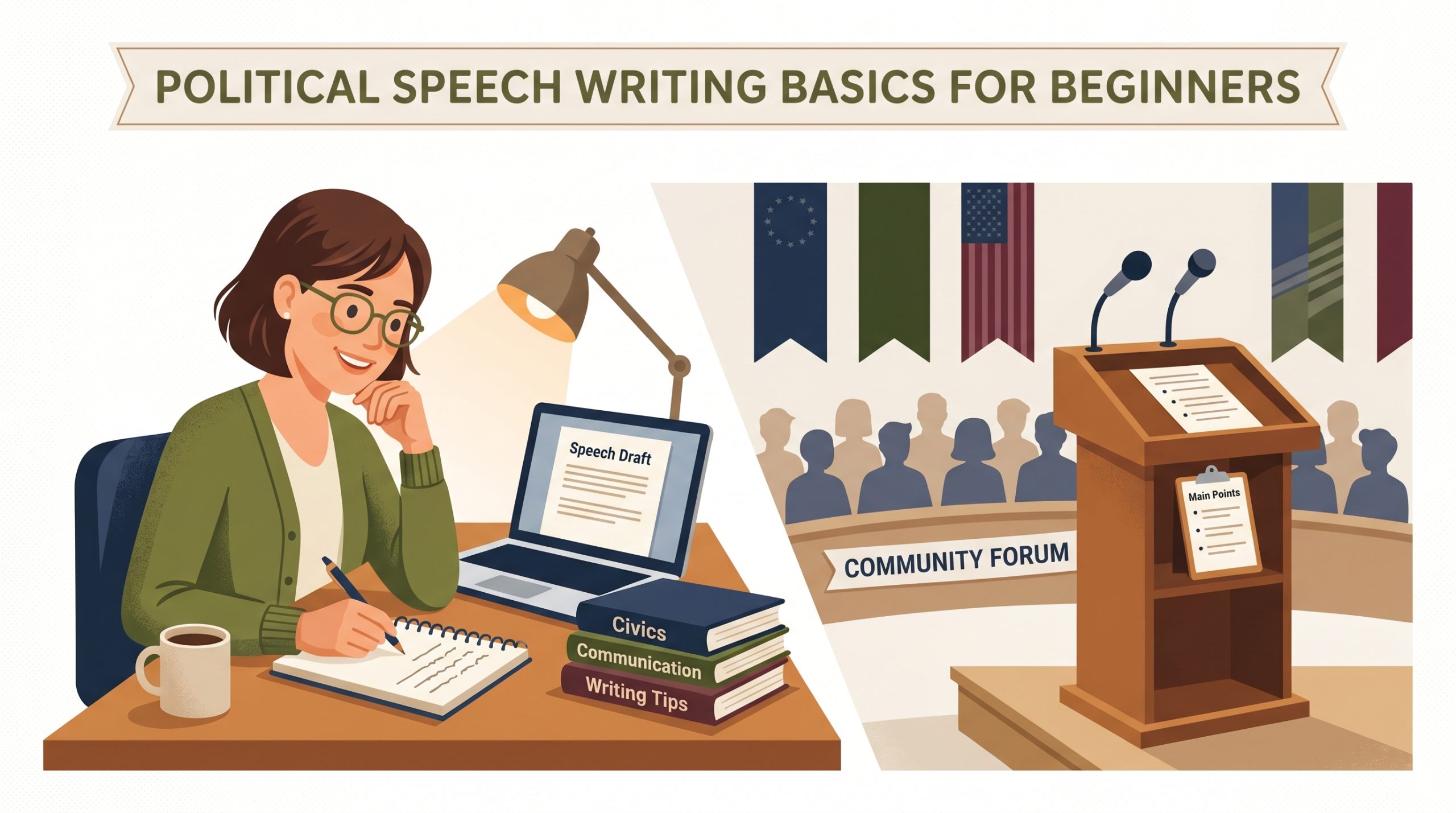
Political speech writing also operates as a form of strategic framing, where the same issue can be presented in multiple ways depending on intent. A beginner must understand that language is never neutral in political contexts. Every word choice signals alignment, urgency, or priority. This is why experienced speechwriters spend significant time refining phrasing rather than adding new ideas. In many ways, this mirrors metadata optimization for self-published books, where carefully chosen language and positioning determine how effectively a message is discovered, interpreted, and valued by its intended audience.
Another overlooked aspect is timing. A well-written speech delivered at the wrong political moment loses its impact. Speechwriting therefore sits at the intersection of communication and strategy, where context determines effectiveness as much as content. Additionally, digital amplification has changed expectations—speeches are no longer limited to live audiences but are designed for clips, quotes, and social circulation. This demands tighter writing, sharper hooks, and highly quotable lines that can stand independently without full context.
Understanding the Foundation of Political Speech Writing
A deeper layer of foundation-building involves understanding ideological positioning. Every political speech implicitly or explicitly reflects a worldview. Beginners often ignore this layer and focus only on surface-level messaging, but audiences quickly detect inconsistency between message and ideology.
Another critical component is constraint awareness. Political speech writing is rarely done in free conditions; it operates under party lines, policy limits, and public expectation pressures. Effective writers learn how to communicate within boundaries without diluting meaning. This is achieved through controlled phrasing, selective emphasis, and strategic omission.
Additionally, message durability matters. A strong political speech is designed not only for immediate reaction but also for long-term recall. This is why foundational clarity ensures that even fragmented quotes retain meaning when separated from full context.
Audience Analysis in Political Speech Writing
Advanced audience analysis also includes sentiment mapping. This involves predicting emotional reactions before the speech is delivered. A skilled speechwriter anticipates points of resistance and integrates pre-emptive clarification into the speech itself.
Another layer is linguistic accessibility. Audience understanding is not only about content relevance but also vocabulary familiarity. Overestimating audience comprehension leads to disengagement, while underestimating it reduces credibility. Striking the right balance is a core skill in political communication.
Cultural framing also plays a major role. The same political message can be interpreted differently across cultural contexts, even within the same geographic region. This requires sensitivity to symbols, metaphors, and references used in speechwriting. Effective political speech writing ensures inclusivity without diluting message strength.
Structuring a Political Speech for Maximum Impact
Beyond basic structure, pacing is a critical element. Pacing refers to how information density changes throughout the speech. Strong openings are often slower and more emotionally grounded, while the body accelerates with data and arguments, and the conclusion slows again for emotional reinforcement.
1. Pacing in Speech Writing
Pacing refers to how the intensity, detail level, and emotional weight of a speech change from beginning to end. It is not just about speed of delivery but about how information is distributed across time. In political speech writing, pacing is used to control audience attention and emotional engagement.
A strong opening usually uses slower pacing with simpler, emotionally grounded statements to establish relevance and connection. The middle section increases pacing by introducing data, arguments, and policy explanations in a denser format.
The conclusion then slows down again, allowing emotional reinforcement and key message recall. Poor pacing leads to audience fatigue or disengagement, especially when too much information is delivered at a uniform intensity. Effective speechwriters treat pacing as a deliberate design tool rather than a natural byproduct of writing.
2. Information Density Control
Information density refers to how much meaning is packed into each sentence or section of a speech. High-density sections include statistics, policy explanations, or complex reasoning, while low-density sections focus on emotional clarity and simplicity.
In political speech writing, balancing density is essential because audiences cannot process continuous high-intensity information without losing comprehension. Beginners often overload speeches with dense content throughout, which weakens retention.
Skilled writers alternate between dense and light sections to give the audience cognitive recovery points. This controlled variation ensures that key ideas stand out instead of blending into background noise. Proper density control also improves delivery, allowing speakers to emphasize critical points more effectively.
3. Modular Structuring
Modular structuring is the practice of designing a speech as a collection of independent but connected sections rather than a fixed linear script. Each module represents a self-contained idea—such as a problem statement, policy solution, or case example—that can stand alone if necessary. In political speech writing, this approach provides flexibility during live delivery, where time constraints or audience reactions may require adjustments.
Modules can be shortened, expanded, or reordered without breaking overall coherence. This is especially useful in campaign environments where speeches must be adapted for rallies, interviews, or televised formats. Modular structuring also improves clarity during writing because each segment is developed with a single focus, reducing conceptual overlap.
4. Repetition Strategy and Placement
Repetition strategy involves deciding when and where key phrases or ideas should be repeated for maximum impact. In political speech writing, repetition is not random reinforcement—it is a timing-sensitive persuasive tool. Repeating ideas too early in a speech reduces their perceived importance, while repeating them too frequently causes listener fatigue.
Strategic repetition is most effective at structural peaks, such as after key arguments or during the conclusion. This placement reinforces memory retention and strengthens emotional association with the message. Skilled speechwriters often use varied repetition techniques, such as phrase reframing or rhythmic echoing, to maintain engagement while reinforcing meaning. Proper repetition placement turns key ideas into anchor points within the audience’s memory.
5. Psychological Alignment with Audience Attention
Psychological alignment refers to structuring a speech in a way that matches how audiences naturally process information. Human attention is not linear; it fluctuates based on emotional relevance, cognitive load, and expectation. Political speech writing uses this understanding to position emotional cues, data points, and narrative shifts at moments when attention is naturally higher.
For example, attention peaks at the beginning (curiosity), dips during heavy information processing, and rises again during emotionally charged conclusions. Aligning structure with these patterns improves retention and persuasion. Poor alignment—such as placing dense policy explanations at emotional low points—reduces impact significantly. Effective speechwriters design speeches not only for logical flow but also for cognitive rhythm, ensuring the message lands when the audience is most receptive.
Rhetorical Devices in Political Speech Writing
Rhetorical devices also function as memory anchors. They are not just stylistic tools but cognitive reinforcement mechanisms that help audiences recall key points long after the speech ends.
Another advanced aspect is layered rhetoric, where multiple devices are combined within a single sentence or paragraph. For example, repetition can be paired with contrast to create stronger emotional polarity. However, overuse can lead to rhetorical fatigue, where the audience becomes desensitized to stylistic emphasis.
Timing of rhetorical deployment is also critical. Early use builds engagement, mid-use reinforces understanding, and late use strengthens emotional closure. Political speech writing becomes significantly more powerful when rhetorical devices are distributed strategically rather than concentrated.
Storytelling in Political Speech Writing
Advanced storytelling in political speech writing often involves narrative sequencing rather than standalone stories. This means arranging multiple short narratives that collectively support a broader political argument.
Another important dimension is perspective control. Stories can be told from first-person, third-person, or collective viewpoints depending on emotional intent. Each perspective creates a different level of intimacy and authority.
Symbolic storytelling is also widely used, where individual experiences represent larger systemic issues. This technique allows complex policy matters to be communicated through relatable human experiences without oversimplification. Effective storytelling in political speeches ultimately transforms abstract governance issues into emotionally accessible narratives.
Persuasion Strategy in Political Speech Writing
Advanced persuasion also involves resistance handling. This means acknowledging opposing views without weakening the primary argument. When done correctly, it increases credibility rather than diluting message strength.
Another layer is incremental persuasion, where belief formation is built gradually throughout the speech instead of being forced at the end. This reduces audience resistance and increases acceptance.
Ethical persuasion is also critical in political speech writing. Overly manipulative framing can damage long-term trust. Effective writers balance influence with transparency, ensuring that persuasion does not feel coercive but rather logically and emotionally justified.
Language, Tone, and Delivery in Speech Writing
Language also plays a role in perceived leadership strength. Short, decisive sentences often communicate authority more effectively than long explanatory ones. However, over-simplification can reduce perceived depth, so balance is essential.
Tone modulation within a single speech is another advanced technique. A speech may begin with concern, shift to determination, and end with optimism. This emotional progression mirrors audience psychology and increases engagement.
Delivery compatibility is also crucial. A speech must be written in a way that matches the speaker’s natural speaking rhythm. Even well-written content fails if it does not align with delivery style, breathing patterns, and emphasis tendencies.
Editing and Refining Political Speeches
Advanced editing includes compression editing, where the goal is to reduce word count without losing meaning. This improves speech clarity and increases impact per sentence.
Another technique is vocal simulation editing, where writers read the speech aloud mentally or physically to test flow and rhythm. This helps identify awkward phrasing that may not appear in written form.
Emotional calibration is also part of editing. This involves ensuring that emotional intensity is evenly distributed and does not peak too early or too late. Proper calibration ensures audience engagement remains stable throughout the speech.
Conclusion
Political speech writing is ultimately a discipline of control—control over structure, emotion, timing, and interpretation. When these elements are handled deliberately, a speech stops being a simple message delivery and becomes a guided experience for the audience. The strength of any political speech does not come from complexity, but from how clearly a single idea is shaped, reinforced, and remembered.
Beginners often focus too much on what to say, while experienced speechwriters focus on how the message unfolds. Pacing ensures attention is managed, structure ensures clarity is maintained, and repetition ensures the message survives beyond the moment of delivery. When combined with psychological awareness of audience behavior, speechwriting becomes less about writing paragraphs and more about designing perception.
In real political environments, speeches are judged in fragments, clips, and headlines. That means every section must be strong enough to stand alone while still contributing to the overall narrative. A well-written speech does not just communicate—it directs thinking, anchors memory, and shapes interpretation long after it has ended.
FAQs
1. What is the most important part of political speech structure?
The core message is the most important element. Every section of the speech must support and reinforce a single dominant idea.
2. Why is pacing important in political speech writing?
Pacing controls how attention and emotion shift throughout the speech, helping the audience stay engaged from start to finish.
3. What is modular structuring in speech writing?
It is the practice of building speeches in independent sections that can be rearranged or adjusted without breaking overall meaning.
4. How should repetition be used in speeches?
Repetition should be used at key emotional or structural moments to strengthen memory, not scattered randomly throughout the speech.
5. Why is audience psychology important in speech structure?
Because audiences do not process information evenly; structuring content around attention patterns increases clarity and persuasive impact.