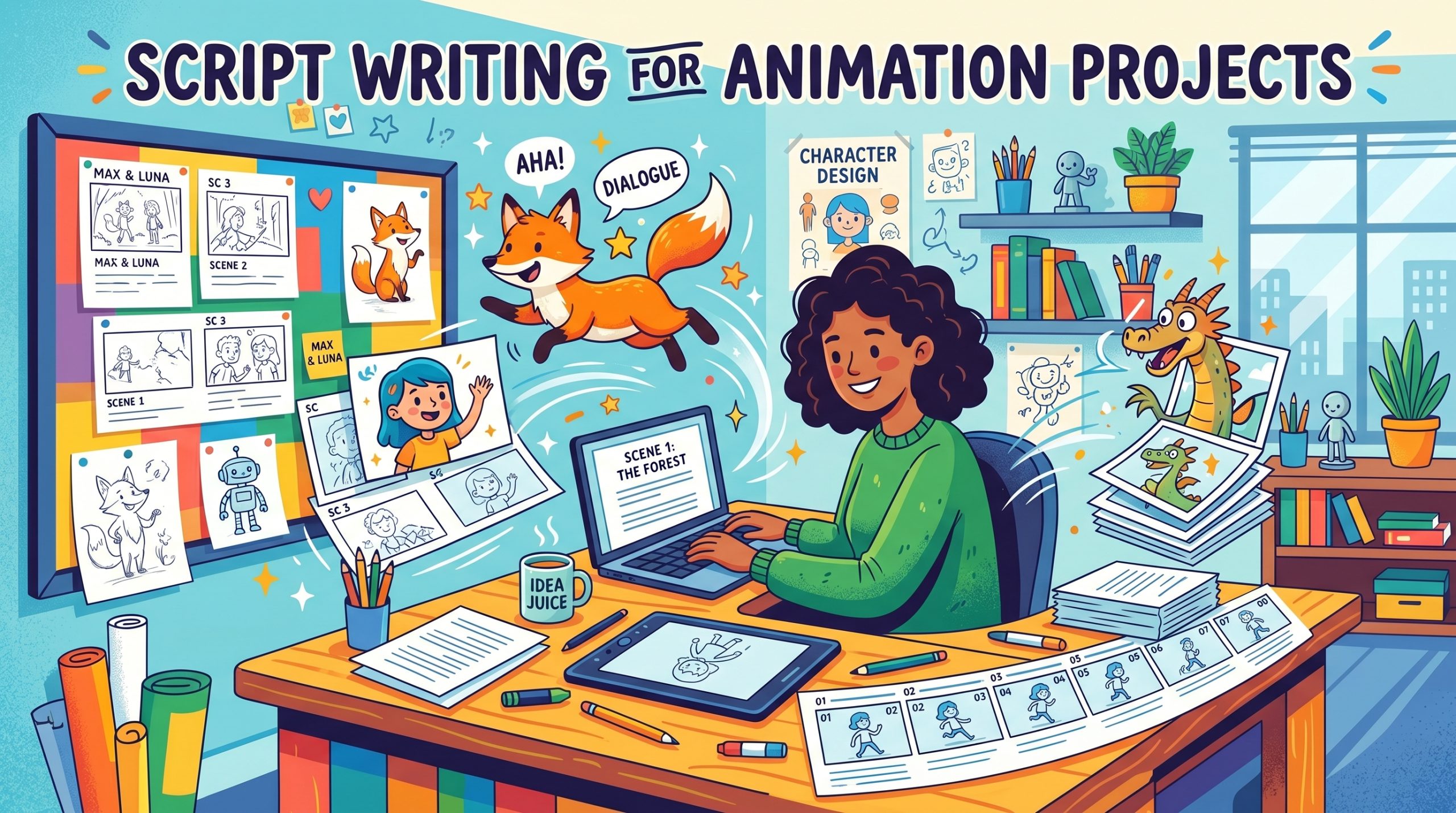
Animation scripting operates inside a production pipeline where writing is not treated as a finished literary artifact but as a working technical layer that determines how visuals are constructed, timed, and budgeted. Every script functions as a production blueprint that defines scene count, shot complexity, animation workload, and the sequencing logic that animators, storyboard artists, and editors rely on to build the final product. In this environment, writing is evaluated less for stylistic elegance and more for how efficiently it translates into drawable, timeable, and repeatable visual units.
This production-first mindset is especially evident in 2D episodic animation, explainer content, and 3D pipeline-driven projects, where cost is measured in seconds of animation rather than pages of script. Writers must therefore encode narrative clarity while simultaneously accounting for constraints such as rig reuse, background cycling, motion economy, and compositing feasibility. Every line effectively carries dual responsibility: it must advance the story while also justifying its production cost in visual terms.
A similar discipline exists in political speech writing, where language is not written for literary appreciation but for controlled delivery, audience pacing, emotional timing, and message retention. In both fields, writing is performance-driven rather than text-driven. A political speech must anticipate pauses, crowd response, emphasis points, and rhetorical rhythm, just as an animation script must anticipate framing, timing beats, and visual emphasis. Both rely on structured compression—distilling intent into units that can be performed, not merely read.
This creates a shared principle across animation scripting and political speech writing: meaning is not contained in sentences alone, but in how those sentences are executed in time. Writers who understand this parallel approach both domains as systems of controlled delivery rather than expressive prose.
The sections ahead focus strictly on production mechanics, script construction logic, and writing decisions that directly influence execution quality in animation pipelines.
Writing for Shot Economy and Production Load
In animation, writing is inseparable from shot economy. Every new action, location change, or character movement translates into additional layout work, background painting, rigging complexity, and compositing time. A professional script writer actively controls production load through narrative design decisions rather than leaving those concerns to the studio.
A single scene can be written in a way that either multiplies or reduces production effort. For example, a conversation written across five locations requires five backgrounds, while the same conversation staged in a single controlled environment reduces cost without harming narrative clarity. This is why animation writing often prioritizes spatial containment and reusable environments.
- Scripts must minimize unnecessary scene fragmentation that increases background production load
- Character movement should be written in reusable spatial loops when possible
- Action design should account for rig reuse and cycle animation efficiency
| Writing Decision | Production Impact |
| Multiple location changes | High background cost |
| Single-location dialogue scene | Low production overhead |
| Complex action choreography | Increased animation time |
| Repeated movement cycles | Efficient asset reuse |
Shot economy thinking is not about limiting creativity; it is about designing narrative within production reality. Writers who ignore this typically face heavy rewrites during storyboard breakdown.
Scene Construction as Animation Units, Not Story Blocks
Animation scripts are not structured as traditional scenes but as animation units—self-contained visual sequences that can be independently storyboarded and timed. Each unit must contain a complete visual idea that can survive without reliance on external context. A strong animation unit has three properties: spatial clarity, temporal continuity, and visual completeness. If any of these are missing, storyboard interpretation becomes inconsistent, leading to revision loops.
- Each scene must function as an isolated visual module that can be storyboarded independently
- Spatial layout should remain stable unless transition is narratively essential
- Temporal flow must be predictable for animatic timing alignment
| Animation Unit Component | Function |
| Spatial Definition | Fixes environment layout |
| Action Progression | Defines movement flow |
| Emotional Beat | Anchors narrative purpose |
Unlike prose scenes, animation units are judged by how easily they convert into panels. Writers who structure scenes in this modular way reduce breakdown errors during pre-production.
Writing Action for Frame-Level Translation
Action writing in animation is not descriptive writing—it is frame decomposition. Each action line must imply how it will be broken into individual drawings or keyframes. This means the writer is implicitly controlling pacing at the frame level even if they never specify exact timing. A critical skill is distinguishing between drawable action and implied action. Drawable action can be storyboarded directly; implied action requires interpretation, which increases production variability. Professional scripts minimize ambiguity by favoring explicit visual motion logic.
- Action must be written in sequential visual beats that can be directly storyboarded
- Every physical movement should imply a start point, transition, and end state
- Non-visible actions should be avoided unless they influence on-screen behavior
| Action Type | Animation Translation |
| “He turns slowly toward the door” | Keyframe sequence with easing |
| “She hesitates” | Micro-motion + pause frame |
| “They fight” | Multi-beat choreography breakdown |
The goal is not literary elegance but mechanical clarity for animators and storyboard artists who depend on precise interpretation.
Dialogue Timing as Animation Rhythm Control
In animation, dialogue is not only written for meaning but also for timing alignment with motion, cut rhythm, and mouth movement cycles. Writers must account for how spoken language will synchronize with animation frames and scene pacing.
Unlike live-action, where dialogue can flow naturally, animation dialogue must be structured with rhythm awareness. Sentence length directly influences frame allocation and shot duration. This makes dialogue a pacing instrument rather than just communication.
- Dialogue must align with expected mouth movement cycles and animation timing windows
- Sentence structure should support cut timing and visual transition points
- Emotional emphasis is often reinforced through pause timing rather than word choice alone
| Dialogue Pattern | Animation Function |
| Short bursts | Fast-paced action scenes |
| Extended lines | Emotional or expositional beats |
| Fragmented speech | Tension or comedic timing |
Writers who ignore timing often produce dialogue that feels visually mismatched when animated, requiring re-editing during animatic development.
Writing for Revision Loops in Animation Pipelines
Animation scripts are expected to evolve through structured revision loops, typically triggered after storyboard reviews and animatic testing. Unlike static writing formats, animation scripts are working documents that adapt to visual feedback.
This means writers must anticipate change from the first draft. A rigid script increases production friction, while a flexible structure reduces revision cost. The goal is to write in a way that isolates changeable components without destabilizing the entire narrative structure.
- Scripts should separate core narrative intent from adjustable visual execution details
- Scenes must be modular enough to be reordered or trimmed during editing
- Dialogue should be adaptable to timing shifts in animatics
| Revision Trigger | Common Script Adjustment |
| Storyboard mismatch | Scene restructuring |
| Timing issues | Dialogue compression |
| Cost constraints | Action simplification |
This iterative structure is why animation writing is closer to systems design than traditional authorship.
Visual Constraint Writing in Limited Animation Pipelines
Many animation projects operate under strict constraints such as limited frame counts, reused backgrounds, and simplified motion cycles. Writers must consciously design scenes that respect these constraints while maintaining narrative clarity.
This discipline is often called visual constraint writing: shaping the script so that animation limitations become stylistic advantages rather than production bottlenecks.
- Scripts should prioritize static or semi-static compositions where appropriate
- Repetition in motion should be leveraged as rhythm rather than redundancy
- Complex visuals must be reserved for high-impact narrative moments only
| Constraint Type | Writing Strategy |
| Limited frames | Reduce motion complexity |
| Background reuse | Stage multiple actions in one space |
| Budget limits | Compress scene transitions |
Constraint-aware writing is what separates hobby-level scripts from production-ready animation scripts.
FAQ: Practical Animation Scriptwriting Questions
How technical should animation scripts be?
Technical enough to guide storyboard translation, but not so rigid that it restricts visual interpretation.
Do writers decide camera movement in animation scripts?
Only when camera motion is essential to narrative clarity or timing structure.
Why are animation scripts revised so often?
Because visual execution reveals pacing, clarity, and cost issues that are not visible in text form.
What is the biggest mistake new animation writers make?
Writing prose-style descriptions instead of frame-oriented visual instructions.
Can animation scripts be improvisational?
Only at early draft stage; production scripts require structured precision