A eulogy is one of the most emotionally demanding forms of writing because it sits at the intersection of memory, language, and loss. Unlike essays, articles, or even memoirs, it is not written in a neutral state of reflection. It is created in a moment where emotions are heightened, attention is fragmented, and clarity often competes directly with grief. In that sense, it is not just writing—it is the act of shaping remembrance into spoken form when language itself feels limited.
This is also where structural decisions, such as length, become far more significant than they initially appear. Whether a eulogy is short or long is not simply a stylistic preference. It directly influences how the message is delivered, how the audience absorbs it, and how accurately a person’s life is represented within a constrained emotional setting. Length affects pacing, memory recall, and the speaker’s ability to maintain composure, all of which determine whether the tribute lands with clarity or becomes difficult to follow in real time.
In recent years, professional writing support for memorial speeches has become increasingly common, especially among families who want to preserve emotional authenticity without struggling through structure during grief. Much like discussions found in topics such as “Self-Publishing for Non-Fiction vs Fiction Authors,” where different writing forms demand entirely different approaches, eulogy writing also follows its own distinct logic. It requires balancing narrative depth with delivery practicality, rather than relying on a one-size-fits-all approach.
Within this context, the question of short versus long eulogies becomes less about preference and more about design. It is a decision shaped by emotional capacity, audience setting, and the level of detail required to do justice to a person’s life in a meaningful and spoken format.
What a Eulogy Really Is From a Writer’s Perspective
From a writing standpoint, a eulogy is not just a speech delivered at a funeral or memorial service. It is a compressed narrative of a human life, structured under emotional constraints. Unlike biography writing, which has the space to expand over time, a eulogy must capture meaning in a limited window.
Writers often approach eulogies as a hybrid form of storytelling. It combines elements of memoir, narrative nonfiction, and personal essay, but it is shaped by one key limitation: it must be delivered aloud in a highly emotional environment.
This is where structure becomes essential. A well-written eulogy is not a list of memories. It is a carefully shaped sequence of emotional points that reflect who the person was, how they lived, and what they meant to others. Professional writing services that specialize in eulogies often begin by collecting raw memories rather than polished sentences. These memories are then organized into narrative form, ensuring that the final tribute feels coherent rather than fragmented.
The Psychology Behind Short Eulogies
Short eulogies are often chosen not because they are simpler, but because they are more emotionally manageable. In moments of grief, cognitive processing changes. Attention span decreases, emotional sensitivity increases, and memory recall becomes less linear.
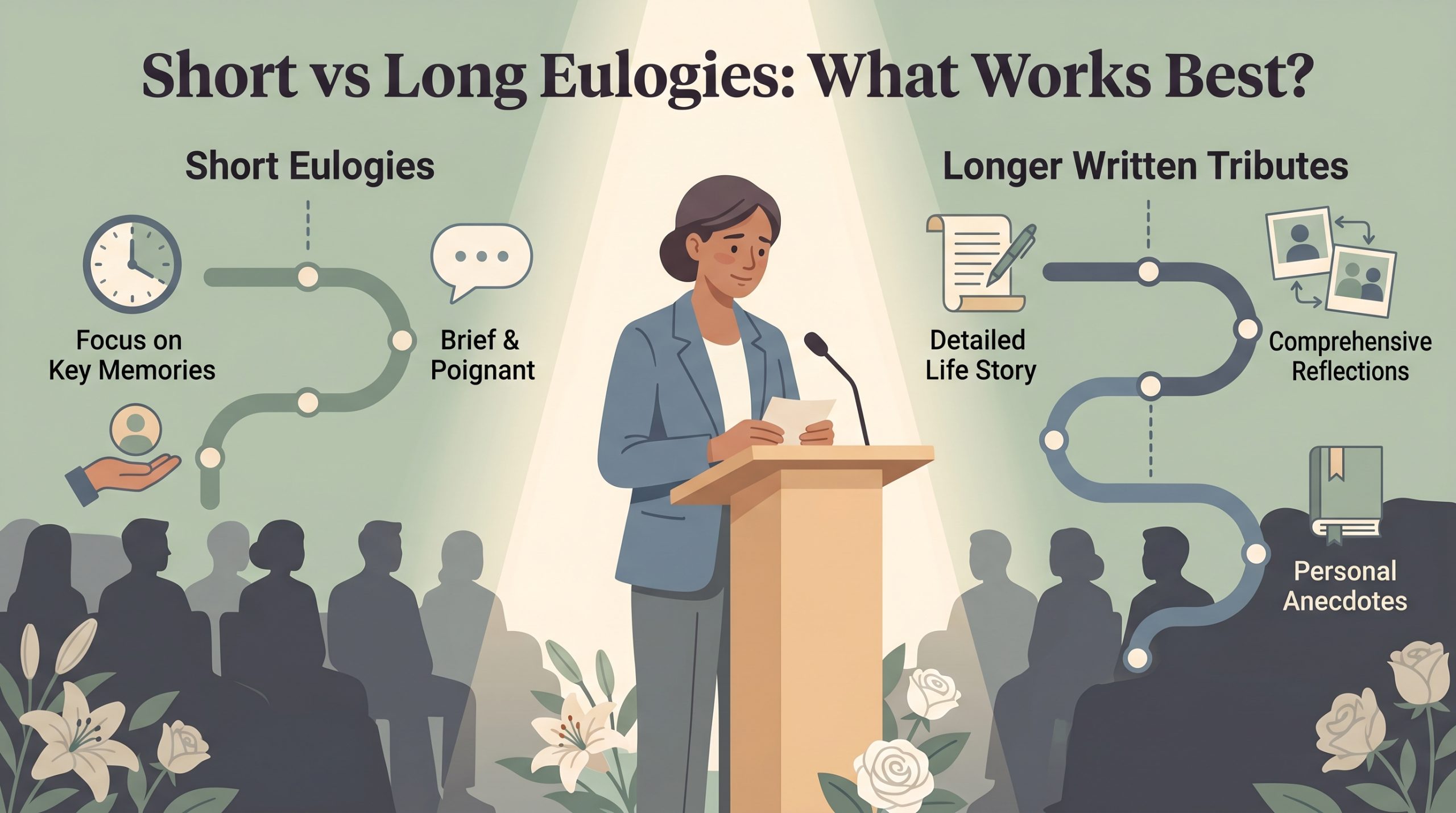
A short eulogy typically focuses on a few key emotional anchors rather than a full life overview. These anchors might include defining personality traits, a handful of meaningful memories, or one central message that reflects the person’s identity. From a writing perspective, this requires precision. Every sentence must carry emotional weight. There is no room for unnecessary detail or extended storytelling. Writers often compare this to poetic compression, where meaning is concentrated rather than expanded.
Short eulogies tend to work best in more intimate settings or when the speaker is not comfortable with extended public speaking. They reduce pressure on delivery while still maintaining emotional impact. However, their limitation is also clear. Because they rely on selective memory, they may not capture the full complexity of a person’s life. Instead, they highlight essence rather than breadth.
How Writers Condense a Life Into Short Form
When professional writers create short eulogies, the process is highly selective. They begin by identifying emotional patterns rather than chronological events. Instead of asking what happened in someone’s life, they ask what defined them. This often results in a structure built around three or four emotional touchpoints. For example, a person might be remembered for kindness, resilience, humor, or dedication. Each trait is supported by one brief but meaningful story. The goal is not to tell everything. The goal is to ensure that what is said feels complete within its limited scope. This kind of writing demands discipline. It is less about inclusion and more about omission. The strength of a short eulogy comes from what is intentionally left out.
The Strength of Long Eulogies
Long eulogies serve a different purpose. They are designed for depth, narrative richness, and fuller representation of a person’s life. When time and emotional capacity allow, they can create a more complete portrait. A long eulogy allows space for storytelling. Instead of focusing on a few defining traits, it can explore different phases of life, relationships, achievements, and transformations. It becomes closer to a narrative biography delivered in spoken form.
This format is often used in larger memorials or ceremonies where multiple audiences are present—family, friends, colleagues, and community members. Each group may have different memories of the same person, and a longer eulogy can integrate those perspectives. From a writing standpoint, long eulogies require strong structure. Without structure, they risk becoming repetitive or emotionally diluted. Professional writers often treat them like narrative essays, ensuring that each section builds on the previous one and contributes to an overall emotional arc.
How Writers Structure Long Eulogies
In long-form eulogy writing, structure becomes the foundation of clarity. Writers typically organize content into thematic or chronological progression. Instead of listing memories randomly, they are grouped into meaningful phases of life.
For example, early life may focus on personality formation, adulthood may focus on achievements and relationships, and later life may emphasize legacy and reflection.
Within each section, stories are selected carefully to avoid redundancy. The goal is to maintain emotional engagement without overwhelming the audience with excessive detail. A well-written long eulogy feels like a journey rather than a speech. It moves through time and emotion in a controlled but natural way.
The Real Constraint: The Speaker’s Emotional Capacity
While length is often discussed in abstract terms, the most important factor is not writing—it is delivery.
A perfectly written long eulogy is meaningless if the speaker cannot deliver it under emotional pressure. Grief affects memory, pacing, and voice control. Even simple sentences can become difficult to read aloud in such conditions.
This is why professional writing services often evaluate not just the content, but the speaker’s emotional capacity. Some individuals are able to speak comfortably for several minutes. Others may struggle after a few sentences.
In many cases, writers prepare two versions of the same eulogy. One is a complete written tribute that preserves full detail. The other is a shortened, speech-ready version designed for delivery.
This dual-format approach ensures that emotional depth is preserved even when spoken delivery must be simplified.
Audience Absorption and Attention in Emotional Settings
Another factor that influences eulogy length is the audience itself. Funeral and memorial audiences are not typical listeners. Their emotional state directly affects attention span and comprehension.
In many cases, even a well-structured long eulogy can feel heavy if the audience is already emotionally overwhelmed. On the other hand, a short eulogy may feel too brief if it fails to reflect the significance of the person being remembered. Writers often manage this balance by creating natural pauses in structure. These pauses allow emotional processing without breaking narrative flow. The effectiveness of a eulogy is not measured only by content but by how well the audience can absorb it in real time.
How Professional Writers Decide Eulogy Length
Professional writers who specialize in memorial or tribute writing do not decide eulogy length arbitrarily. It is the outcome of a structured editorial process that balances emotional truth, delivery feasibility, and audience context. Unlike general speechwriting, eulogy writing operates under unique constraints where emotional intensity can directly affect performance. Because of this, length is treated as a strategic decision rather than a stylistic preference.
1. Memory Collection: Building the Raw Material First
The process begins with gathering unfiltered memories from close family members, friends, and sometimes colleagues. Writers do not immediately think in terms of structure or length at this stage. Instead, the focus is on collecting emotional material in its most natural form.
These inputs often come through conversations, voice notes, written anecdotes, or even fragmented recollections. What matters is not polish, but emotional authenticity.
A professional writer looks for patterns during this stage. Certain stories tend to repeat across different people. Certain traits appear consistently in how the person is described. These repetitions are not ignored—they become signals of emotional significance.
At this stage, the writer is essentially building a “memory archive” before deciding what deserves to be spoken aloud.
2. Emotional Mapping: Identifying the Core Themes of a Life
Once enough material is collected, the writer shifts from gathering to interpretation. Instead of organizing content chronologically, they begin identifying emotional themes that define the person’s identity.
These themes might include qualities such as generosity, resilience, humor, leadership, or quiet strength. Each theme is supported by specific memories, but the goal is not to list events—it is to understand emotional essence.
This is where professional writing diverges significantly from casual speech preparation. A non-professional approach often tries to include as many memories as possible. A professional approach does the opposite: it filters everything down to what truly represents the individual.
These emotional anchors become the structural backbone of the eulogy, and they directly influence how long the final piece needs to be. A life defined by a few strong themes may require a shorter structure, while a more complex or multifaceted life naturally expands into a longer narrative.
3. Structural Planning: Translating Emotion Into Time
After emotional themes are defined, writers begin translating them into a spoken structure. This is where length starts to take shape in practical terms.
A key consideration is pacing. Emotional content cannot be compressed indefinitely without losing impact, but it also cannot be extended beyond what an audience can meaningfully absorb in a heightened emotional environment.
Writers estimate how much time each thematic section will require when spoken aloud, including natural pauses and emotional breaks. Unlike written text, spoken eulogies are slower, more reflective, and often interrupted by emotion. This significantly affects length planning.
At this stage, writers are essentially converting emotional weight into speaking time.
4. Delivery Assessment: Matching Length to the Speaker’s Capacity
One of the most important factors in determining eulogy length is the emotional and physical capacity of the person delivering it.
Professional writers carefully assess how comfortable the speaker is with public speaking under normal circumstances. In a memorial setting, that baseline changes dramatically. Grief affects memory recall, voice stability, and pacing control.
A person who might normally speak comfortably for ten minutes may only be able to manage a few minutes in an emotional setting. Writers account for this reality rather than ignoring it.
This is why experienced memorial writers often create adaptive versions of the same eulogy: a full narrative version for record-keeping and a condensed version designed specifically for delivery.
5. Ceremony Context: Understanding the Environment
The final factor in determining length is the structure of the ceremony itself. Different memorial settings allow for different levels of spoken time and emotional pacing.
A small private gathering may allow for a longer, more conversational tribute. A formal service with multiple speakers requires stricter time management. Cultural expectations can also influence how detailed or extended a eulogy is expected to be.
Writers take into account not just the speaker and the content, but also the audience size, ceremony format, and sequence of speakers. Length is adjusted so that the tribute fits naturally within the overall flow of the event.
In professional eulogy writing, length is never decided first. It is the final outcome of several layered decisions involving emotional analysis, structural design, speaker capability, and ceremony context. A well-calibrated eulogy is not simply “short” or “long.” It is appropriately scaled to the life being remembered and realistically deliverable in the moment it is spoken. This is what distinguishes professional memorial writing from informal preparation: length is not guessed—it is engineered.
The Hybrid Approach: The Most Effective Model
In professional writing practice, the most effective solution is often a hybrid format. This approach combines a full written tribute with a shortened spoken version. The full version preserves detail, storytelling, and emotional depth. The shortened version focuses on clarity and delivery. This allows families to retain a complete record of remembrance while ensuring that the spoken moment remains manageable.
A typical hybrid structure includes an opening reflection, a small number of key stories, and a closing message that summarizes emotional legacy. This format has become increasingly common in modern memorial writing services because it balances emotional richness with practical delivery needs.
The Role of Professional Writing Services
The increasing reliance on professional writing support for eulogies reflects a practical reality of grief: under emotional pressure, language does not organize itself cleanly. Thoughts become fragmented, memories surface unpredictably, and even simple structure can feel difficult to maintain. In such moments, the challenge is not a lack of meaning—it is the inability to shape that meaning into a coherent spoken form.
Professional writers help bridge that gap. They do not generate emotion; they translate it. Their role is to take unstructured memories, scattered anecdotes, and personal reflections, and organize them into a narrative that feels natural when spoken aloud. This process is less about writing “for” someone and more about refining what already exists emotionally, but cannot easily be structured in the moment.
A key part of this work is preserving authenticity. The goal is not to overwrite a personal voice with polished language, but to refine it so that it remains clear, consistent, and emotionally aligned throughout the tribute. Tone becomes more stable, transitions become smoother, and the overall message becomes easier for both the speaker and the audience to follow.
Professional writing services also play an important structural role, particularly in managing length. They help determine how much material can realistically be delivered in a high-emotion setting without overwhelming the speaker or losing audience engagement. This ensures that the final eulogy is not only meaningful on paper, but also achievable in performance.
In many cases, families find that having a professionally shaped structure significantly reduces the emotional burden during delivery. Instead of struggling to remember how to continue, the speaker can focus on presence and emotion, trusting that the underlying narrative has already been carefully organized.
Key Contributions of Professional Writing Services
- Converting fragmented memories into a clear, structured narrative
- Preserving the speaker’s natural voice while improving clarity and flow
- Identifying and organizing key emotional themes from multiple recollections
- Adjusting length based on emotional capacity and speaking comfort
- Creating smooth transitions between stories and ideas for better delivery
- Reducing pressure on the speaker during emotionally intense moments
- Ensuring the eulogy remains meaningful, balanced, and audience-appropriate
FAQs on How Professional Writers Decide Eulogy Length
1. Is there a standard length for a professionally written eulogy?
There is no fixed standard length because eulogies are shaped by emotional context rather than word counts. However, professional writers typically design speeches that fall within a practical speaking range of 3 to 10 minutes. The exact length depends on the speaker’s comfort level, the ceremony format, and the depth of material available.
2. Do professional writers always create long eulogies first and then shorten them?
In many cases, yes. Writers often begin with a fuller narrative version that includes all meaningful memories and emotional themes. This allows them to preserve depth before carefully condensing the content into a version suitable for spoken delivery. The shortened version is not a simplified draft—it is a carefully refined structure designed for emotional clarity and timing.
3. What matters more in a eulogy: length or emotional impact?
Emotional impact is far more important than length. A shorter eulogy that is sincere, structured, and emotionally clear will always be more effective than a longer one that feels repetitive or difficult to follow. Professional writers prioritize emotional resonance and clarity over word count.
4. How do writers handle situations where too many memories are shared?
When families share extensive memories, writers do not try to include everything. Instead, they identify repeating emotional patterns and select the most representative stories. The goal is not to document every detail of a life, but to highlight the experiences that best express the person’s character and legacy.
5. Can a eulogy be adjusted at the last minute for delivery purposes?
Yes. One of the key advantages of working with professional writers is flexibility. If the speaker feels overwhelmed or unsure before delivery, the eulogy can be shortened or adjusted without losing its emotional core. Writers often prepare multiple versions specifically for this reason.
Conclusion: Length Matters Less Than Meaning
The question of whether short or long eulogies work best does not have a single answer. Both formats serve different emotional and practical purposes.
Short eulogies offer clarity, focus, and emotional manageability. Long eulogies offer depth, storytelling, and fuller representation. The right choice depends on the speaker, the audience, and the emotional context of the ceremony. However, the most important insight is that length is not the deciding factor. Meaning is.
A well-written eulogy—regardless of length—succeeds when it captures the essence of a life in a way that feels sincere, structured, and human. In the end, the best eulogies are not measured by how much they say, but by how deeply they are felt