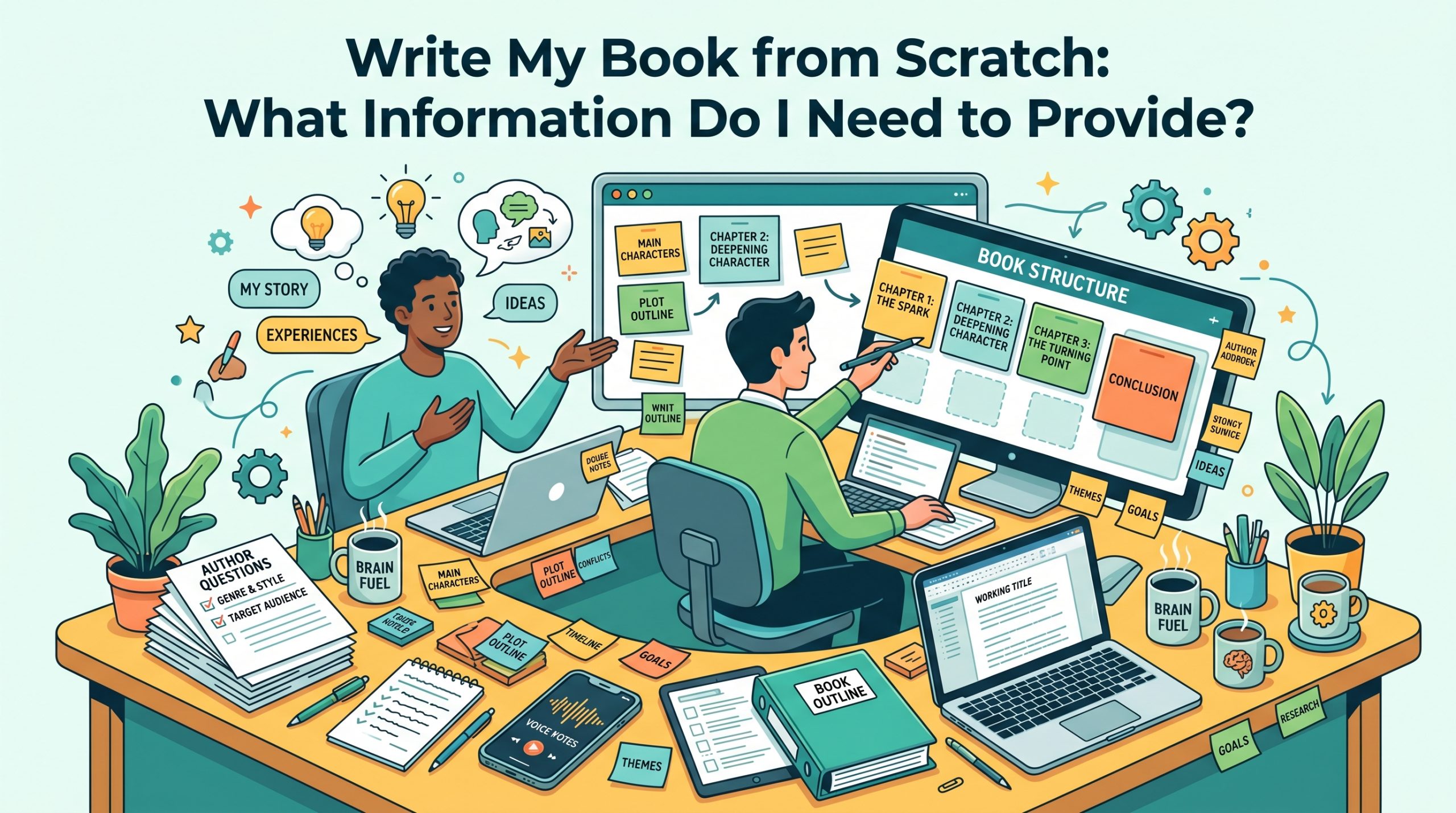
Hiring a ghostwriter or professional book writer does not begin with writing—it begins with structuring. Most people assume the process starts once a topic is shared, but in reality, that is only the entry point into a much more defined production system. A complete manuscript is built from a series of structured inputs that determine not just what the book says, but how it is shaped, who it speaks to, and what outcome it is designed to produce.
This is why understanding what happens after you hire someone to write your book is essential. The work does not move directly into chapters or drafts. Instead, it moves into a definition phase where purpose, audience, structure, tone, and content boundaries are established before execution begins.
Writing a book from scratch requires more than an idea or general direction. It requires a complete informational framework that allows a ghostwriter to construct a coherent, publishable manuscript without guesswork. The writing itself is only the final stage of a longer system that begins with clarity and ends with structured communication.
When authors search for “write a book from scratch” or “book writing requirements,” they are usually looking for the wrong starting point. The real starting point is not writing—it is specification. The following breakdown explains what information is actually required before a single chapter is produced and how it shapes the entire book-building process.
Book Idea Definition and Conceptual Clarity
The most fundamental requirement in writing a book from scratch is a clearly defined concept. This is not simply a topic but the central intellectual or narrative foundation that governs everything in the manuscript. Without this clarity, the writing process becomes unfocused and inconsistent.
At this stage, the author must provide a precise explanation of what the book is about in a way that can be understood without ambiguity. The concept should define the subject matter, the central argument or storyline, and the unique perspective the book offers. For nonfiction projects, this may involve identifying a specific problem and the framework used to address it. For fiction, it may involve the core premise, conflict, or thematic structure that drives the narrative forward.
The strength of a book is directly proportional to the clarity of its core idea. A weak or overly broad concept leads to scattered content, while a precise concept allows the entire manuscript to develop logically and consistently. This is why professional book writing services treat concept definition as the first and most important stage of the entire process.
Author Purpose and Intent Behind the Book
Beyond the idea itself, the author must define why the book is being written. This purpose acts as the strategic foundation that shapes tone, structure, and messaging throughout the manuscript. A book written for authority building will differ significantly from one written for storytelling or education, even if the topic appears similar.
Strategic Role of Purpose in Book Development
The purpose of a book functions as the strategic foundation that governs how the entire manuscript is constructed. It goes beyond topic selection and defines the underlying reason the book exists. This purpose directly influences structural decisions, narrative direction, depth of explanation, and the overall messaging framework used throughout the content.
Defining the Intended Outcome of the Book
The author must clearly specify what outcome the book is expected to achieve once it reaches readers. This may include establishing professional authority, generating business leads, sharing lived experience, educating a defined audience, or strengthening long-term brand positioning. Each of these outcomes requires a different writing approach, meaning the intent must be explicitly defined before development begins.
Differentiating Between Types of Book Objectives
Books that share similar topics can still differ significantly depending on their underlying objective. A book designed for authority building typically emphasizes structured insights and credibility, while a storytelling-focused book prioritizes narrative flow and emotional engagement. Educational books, on the other hand, focus on clarity, explanation depth, and instructional progression. The purpose determines which of these directions the manuscript will follow.
Influence of Purpose on Reader Impact
The intended impact on readers is a critical component of defining purpose. The author must clarify how the reader should think, feel, or act after reading the book. Some books aim to persuade readers toward a specific viewpoint, while others are designed to inform, inspire, or document real-world experience. This desired impact shapes how arguments are framed, how examples are selected, and how conclusions are presented.
Emotional Direction and Communication Style
Purpose also establishes the emotional tone of the manuscript. A persuasive book relies on conviction and structured argumentation, an inspirational book emphasizes motivation and emotional resonance, and an informational book focuses on clarity and objectivity. Without defining this emotional direction, the writing can become inconsistent or fail to connect meaningfully with readers.
Purpose as a Non-Negotiable Structural Input
In professional book development, purpose is treated as a fixed and essential input rather than an optional guideline. Every decision in the writing process—including structure, tone, content depth, and chapter sequencing—stems from this initial intent. Without a clearly defined purpose, the manuscript lacks direction and risks becoming a collection of loosely connected ideas rather than a cohesive and intentional work.
Target Audience Identification and Reader Positioning
A book cannot be written effectively without a clearly defined reader profile. The target audience determines vocabulary, complexity, pacing, and even the type of examples used throughout the manuscript. Writing without audience clarity almost always results in content that is either too technical or too simplified.
The author must specify who the book is intended for in terms of professional background, knowledge level, and expectations. A book written for industry professionals will require a different structure and depth compared to one written for beginners or general readers. Similarly, a book aimed at entrepreneurs will differ significantly from one aimed at students or casual readers.
Understanding the audience also involves identifying their problems, motivations, and what they expect to gain from the book. This ensures that the content is relevant and engaging rather than abstract or disconnected. Audience clarity is one of the strongest predictors of a book’s success because it directly affects readability and engagement.
Raw Material, Knowledge Base, and Source Inputs
One of the most important yet often overlooked requirements in writing a book from scratch is raw content. Writers do not create subject matter expertise; they organize and articulate it. This means the author must provide the foundational material that the book will be built on.
This material can include personal notes, drafts, business insights, professional experiences, research findings, case studies, or any form of documented knowledge. Even unstructured information is valuable because it provides direction and authenticity. In many cases, voice notes, interviews, or rough outlines are transformed into structured chapters through the writing process.
For nonfiction books, supporting material such as data, reports, or references strengthens credibility and depth. For fiction, background details, character notes, and world-building elements serve the same purpose. Without this input, the writer is forced to rely on external interpretation, which can reduce alignment with the author’s original vision.
Book Category, Format, and Structural Type
Another essential requirement is defining the type of book being created. The structural logic of a manuscript depends heavily on whether it is fiction, nonfiction, memoir, instructional, or hybrid in nature.
Nonfiction books often follow structured frameworks such as problem-solution models, thematic chapters, or case-study-driven analysis. Fiction books rely on narrative progression, character arcs, and plot development. Memoirs follow chronological or thematic storytelling approaches, while instructional books focus on step-by-step conceptual breakdowns.
The author must also clarify whether the book is intended to be linear or modular. A linear structure follows a progressive flow from beginning to end, while a modular structure allows independent chapters that still connect under a central theme. This decision influences how chapters are organized and how information is distributed across the manuscript.
Without clear structural direction, the writing process becomes inconsistent because there is no agreed framework guiding content development.
Chapter-Level Direction and Content Mapping
Once the concept and structure are defined, the next requirement is chapter-level guidance. A book is not written as a continuous block of text but as a series of structured units that each contribute to the overall message.
The author must provide directional input for each chapter, even if it is rough or incomplete. This includes what each chapter should cover, what ideas must be included, and how topics should progress logically across the book. It is also important to identify any content that must be excluded to avoid misalignment.
This stage is often referred to as content mapping because it connects raw ideas to structured progression. A strong chapter map ensures that the book does not repeat ideas, lose direction, or jump between unrelated themes. It also improves pacing and ensures that readers experience a logical flow of information or narrative.
Tone, Voice, and Writing Style Requirements
Tone and voice define how the book feels when read. This is one of the most critical elements in maintaining consistency across the manuscript. Without clear tone direction, the writing may feel uneven or inconsistent from chapter to chapter.
The author must specify whether the book should be formal, conversational, persuasive, analytical, narrative-driven, or instructional. Each tone creates a different reading experience and serves a different purpose. For example, a business book often requires clarity and authority, while a memoir requires emotional depth and narrative engagement.
Voice refers to the personality of the writing. Many authors want their personal voice preserved even when working with a writer or ghostwriter. This requires detailed guidance, writing samples, or stylistic references that reflect how the author naturally communicates.
Without tone and voice alignment, even accurate content can feel disconnected from the author’s identity.
Supporting Examples, Case Studies, and Narrative Material
Books gain depth and credibility through examples and real-world applications. This is especially important in nonfiction writing, where abstract ideas must be grounded in practical or relatable scenarios.
The author should provide case studies, personal experiences, professional examples, or illustrative stories that support the main ideas. These elements help transform theoretical content into applied knowledge that readers can understand and use.
In fiction writing, similar inputs take the form of character backstories, setting descriptions, and narrative references. These elements ensure consistency and emotional depth across the story.
Without this material, the book may become overly conceptual and lose reader engagement.
Research Expectations and Content Accuracy Level
Not all books require the same level of research, but every book requires clarity on how much external information should be used. The author must define whether the book should rely on personal knowledge, verified research, or a combination of both.
In academic or technical writing, accuracy and citation standards are critical. In business or self-help books, the focus may be more on frameworks and insights rather than strict referencing. In narrative writing, research may focus on realism, context, or authenticity rather than data accuracy.
Clear research expectations prevent inconsistencies and ensure that the final manuscript meets the appropriate level of credibility for its category.
Length, Depth, and Scope Definition
One of the most practical but essential inputs is defining how long and how deep the book should be. Scope determines pacing, chapter size, and content density.
The author must clarify whether the book is intended to be a short guide, a standard-length manuscript, or an extensive deep-dive publication. This also includes whether the book is part of a series or a standalone work.
Without scope definition, books often become either too shallow or unnecessarily long, both of which reduce reader satisfaction and publishing effectiveness.
Timeline, Workflow, and Revision Structure
Writing a book from scratch is a multi-stage process that requires structured planning. The author must define expectations around deadlines, milestones, and revision cycles.
This includes how the draft will be delivered, how feedback will be provided, and how many rounds of editing are expected. Clear workflow structure ensures that both author and writer remain aligned throughout the project and reduces delays or misunderstandings.
A well-defined timeline also ensures that the book progresses in controlled stages rather than an unstructured continuous process.
Ownership, Rights, and Confidentiality Conditions
Before writing begins, ownership and legal conditions must be clarified. This includes copyright ownership, confidentiality agreements, and usage rights for the final manuscript.
If sensitive or proprietary information is included in the book, additional clarity is required regarding privacy and disclosure boundaries. This is particularly important for business books, memoirs, or industry-related publications where information sensitivity is high.
Clear agreements protect both the author and the writing process from future disputes.
Copyright Ownership
Copyright ownership determines who legally owns the final manuscript once it is completed. In most book writing arrangements, the author retains full ownership of the content, including all intellectual property rights. This means the author has the exclusive right to publish, distribute, modify, or license the book. Clarifying this at the beginning prevents any ambiguity regarding creative control and long-term usage of the work.
Confidentiality Agreements
Confidentiality agreements ensure that any information shared during the writing process remains private and protected. This includes personal details, business strategies, unpublished ideas, and any sensitive material used in the manuscript. Such agreements are especially important when working with ghostwriters or external collaborators, as they legally bind all parties to non-disclosure terms and prevent unauthorized sharing of content.
Usage Rights for the Final Manuscript
Usage rights define how the completed manuscript can be used after delivery. This includes whether the writer has any rights to reference the work in portfolios, whether the author can publish across multiple platforms, and whether adaptations or derivative works are permitted. Clearly defining usage rights ensures there are no disputes regarding distribution, publication, or commercial exploitation of the book.
Privacy and Disclosure Boundaries for Sensitive Content
When a book includes sensitive, proprietary, or personal information, clear boundaries must be established regarding what can and cannot be disclosed. This is particularly important for business-related books, memoirs, or industry-specific content where confidentiality may extend to third-party data or internal practices. Defining these boundaries ensures that only approved information is included in the manuscript and protects all parties from unintended exposure.
Protection Against Future Disputes
Clear legal and ownership definitions serve as a preventive safeguard against future misunderstandings or conflicts. When roles, rights, and responsibilities are explicitly agreed upon before writing begins, it minimizes the risk of disputes related to authorship, credit, payment, or content usage. This creates a stable and transparent foundation for the entire book writing process.
Frequently Asked Questions (FAQs)
1. What is the most important information needed to write a book from scratch?
The most important information is the core idea and purpose of the book. These define what the book is about and why it exists, which influences every other part of the writing process.
2. Can a book be written without providing raw material?
Yes, but it significantly reduces quality and originality. Without raw material, the writer must rely on external research, which may not fully reflect the author’s intent or experience.
3. Why is target audience important in book writing?
Target audience determines language complexity, tone, examples, and structure. Without it, the book becomes generic and fails to connect with specific readers.
4. Do I need to provide a chapter outline before writing starts?
It is highly recommended. A chapter outline ensures logical flow and prevents repetition or structural confusion during writing.
5. What happens if I don’t define tone and style?
The book may feel inconsistent or disconnected. Tone and style ensure that the writing maintains a unified voice throughout all chapters.
Final Understanding: Why Information Quality Determines Book Quality
Writing a book from scratch is not an isolated creative task but a structured development process. Every stage of writing depends on the quality of information provided at the beginning. Concept clarity, audience definition, raw material, structure, tone, and scope all function as interconnected inputs that shape the final manuscript.
When these inputs are complete and well-defined, the writing process becomes efficient, consistent, and aligned with the author’s intent. When they are incomplete, the result is usually fragmented content that fails to achieve its purpose.
A successful book is not just written. It is carefully constructed from precise, structured, and complete information provided before the first word is ever written.