You’ve finally done it. After months—maybe years—of writing, rewriting, and refining, your manuscript is complete. You imagine it sitting on bookstore shelves, readers flipping through its pages, maybe even a launch event somewhere down the line. Naturally, the next question arises: how long will it take to get there?
The honest answer surprises most writers. Traditional publishing is not a fast track—it’s a carefully structured, multi-stage journey that often takes anywhere from 18 months to 3 years (or more). What feels like a finished product to you is only the beginning of a much longer process involving agents, editors, designers, marketers, and distributors.
Understanding this timeline is crucial—not to discourage you, but to prepare you. When you know what’s ahead, you stop measuring progress in weeks and start seeing the bigger picture. This guide breaks down each stage of the traditional publishing timeline, explaining not just how long it takes, but why it takes that long.
The Big Picture: Understanding the Traditional Publishing Timeline
Traditional publishing operates like a pipeline rather than a straight road. Your manuscript moves through several checkpoints, each with its own pace, priorities, and decision-makers.
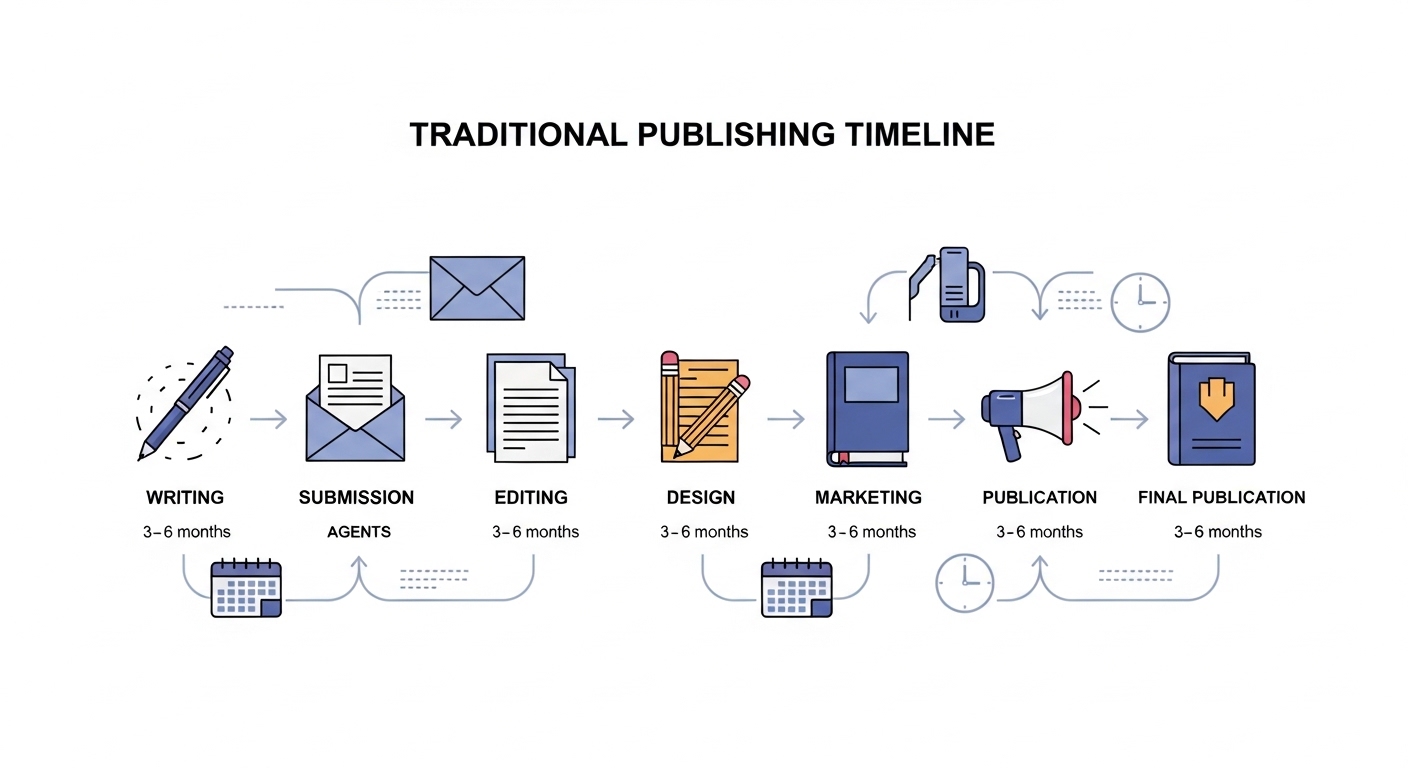
On average, the journey looks something like this:
| Stage | Estimated Time |
|---|---|
| Querying Literary Agents | 3–12 months |
| Signing with an Agent | 1–3 months |
| Submitting to Publishers | 3–9 months |
| Editing & Contract Finalization | 6–12 months |
| Production & Marketing | 9–18 months |
At first glance, this might seem excessive. But each phase serves a purpose. Publishers are not just producing books—they’re investing in products that must succeed in a competitive market. That requires careful planning, coordination, and timing.
Delays are rarely random. They’re often tied to factors like seasonal release schedules, internal workflows, and market positioning. Once you understand this, the timeline starts to feel less like a barrier and more like a structured system.
Stage 1 – Querying Literary Agents (The Waiting Game Begins)
Before your manuscript reaches a publisher, it typically needs a literary agent. This is where the process truly begins—and where patience is tested the most.
Querying involves sending a carefully crafted pitch, often including a query letter, synopsis, and sample chapters. From there, you wait. Agents receive hundreds of submissions, which means response times can stretch from weeks to several months.
Even strong manuscripts face rejection here. Not because they lack quality, but because they may not align with an agent’s current needs or market trends. This stage can easily take 3 to 12 months, sometimes longer.
What affects this timeline?
- The clarity and strength of your query letter
- The polish of your manuscript
- Current demand within your genre
Many writers underestimate this phase, assuming that once the book is written, things will move quickly. In reality, this is often the longest and most unpredictable stage.
Stage 2 – Securing the Right Literary Agent
When an agent expresses interest, the process doesn’t instantly conclude with a contract. Instead, it often opens the door to further revisions.
Agents may request changes to improve the manuscript’s marketability before officially signing you. This collaborative stage can take weeks or even months, depending on the depth of revisions required.
Choosing the right agent is also a strategic decision. It’s not just about who says yes first—it’s about who understands your vision, knows your genre, and has the right industry connections.
A strong agent doesn’t just represent your book—they shape its future. Taking time here can significantly influence what happens next.
Stage 3 – Submitting Your Manuscript to Publishers
Once you’ve signed with an agent, your manuscript enters the submission phase. This is where your agent pitches your book to acquiring editors at publishing houses.
Submissions often happen in rounds. Your agent may send the manuscript to a select group of editors first, gauge interest, and then expand outreach if needed.
Responses vary widely:
- Some editors may request revisions
- Others may pass without detailed feedback
- Occasionally, multiple offers can emerge
This stage typically takes 3 to 9 months, but there’s no guaranteed timeline. Even exceptional manuscripts can take time to find the right home. Timing, trends, and editorial priorities all play a role.
The key here is persistence. A “no” from one editor doesn’t define the book’s potential—it simply means the match wasn’t right.
Stage 4 – The Book Deal and Contract Negotiation
When a publisher decides to acquire your book, it’s a major milestone—but not the finish line.
The deal-making process involves negotiating terms such as:
- Advance payments
- Royalty rates
- Rights (print, digital, international)
This stage can take several weeks or even a few months, depending on the complexity of the agreement. Lawyers and agents work together to ensure the contract protects your interests.
While it may feel like a delay, this step is essential. A well-negotiated contract sets the foundation for your publishing career.
Stage 5 – Editing and Revisions (Where the Real Work Begins)
After signing the contract, many authors expect things to move quickly. Instead, this is where the most intensive work begins.
Editing happens in multiple layers:
- Developmental editing focuses on structure, pacing, and content
- Line editing refines language and flow
- Copyediting ensures grammar, consistency, and clarity
Each round requires time, feedback, and revisions. It’s not unusual for this phase to last several months.
While it may feel repetitive, this is where your book truly evolves. The goal isn’t speed—it’s excellence. Every revision brings the manuscript closer to its best possible version.
Stage 6 – Design, Production, and Pre-Launch Preparation
Once editing is complete, the book enters production. This is the stage most readers never see, yet it’s critical to the final product.
Design teams work on:
- Cover design
- Interior formatting
- Typography and layout
Meanwhile, proofreaders ensure that the final version is polished and error-free.
One key factor here is scheduling. Publishers plan releases months in advance, aligning books with specific seasons and marketing windows. Even if your book is ready, it may be scheduled for a later release to maximize its impact.
This stage alone can take 9 to 18 months, depending on the publisher’s calendar.
Stage 7 – Marketing, Distribution, and Release Planning
As your book approaches its release date, marketing efforts begin to ramp up.
This includes:
- Sending advance copies to reviewers
- Coordinating media outreach
- Planning promotional campaigns
Distribution logistics also come into play. Books need to reach retailers, warehouses, and online platforms before launch. All of this requires coordination and timing. A well-planned release can significantly influence a book’s success, which is why publishers invest heavily in this phase.
Why Traditional Publishing Takes So Long
At its core, traditional publishing is not a single step—it’s a layered, collaborative ecosystem. A manuscript doesn’t simply move from writer to bookshelf; it passes through the hands of agents, developmental editors, copy editors, designers, marketers, and sales teams. Each professional refines a different aspect of the book, ensuring it meets both creative and commercial standards.
This complexity is exactly what makes the process time-intensive.
Several key factors contribute to the extended timeline:
- Multiple layers of decision-making: A manuscript often requires approval from agents, editorial boards, and publishing executives before moving forward.
- Deep editorial refinement: Developmental edits, line editing, and proofreading are carried out in stages, each demanding careful attention.
- Strategic release planning: Publishers don’t just release books—they position them. Timing is aligned with seasonal trends, catalog schedules, and marketing campaigns.
- Market competition: Your book is evaluated within a broader landscape, ensuring it stands out without clashing with similar titles.
Rather than viewing this timeline as a bottleneck, it’s more accurate to see it as a process of deliberate refinement. The objective isn’t simply to publish quickly—it’s to launch a book with the strongest possible foundation for long-term success.
Can You Speed Up the Traditional Publishing Timeline?
There is some room for acceleration—but only within the areas you directly control.
You can significantly improve your momentum by:
- Submitting a polished, professionally edited manuscript
- Crafting a compelling, targeted query letter that captures attention quickly
- Responding promptly and thoughtfully during revision stages
These actions can reduce back-and-forth delays and position you as a reliable, professional author.
However, much of the timeline remains outside your influence. Agents juggle multiple clients, editors work within publishing cycles, and marketing teams align releases with broader strategies. Industry pacing is shaped by factors far beyond a single manuscript.
The most productive mindset is not to fight the timeline—but to work alongside it. Waiting periods can become powerful creative windows, often best used to begin your next project or strengthen your writing portfolio.
What Successful Authors Do Differently
Authors who thrive in traditional publishing rarely treat it as a one-book journey. Instead, they approach it as a long-term career built on consistency, adaptability, and growth.
They don’t pause after submission—they keep writing. While one manuscript is under consideration, another is already in progress. This not only sharpens their craft but also builds a pipeline of work that increases future opportunities. They also develop a healthy relationship with feedback. Instead of viewing editorial input as criticism, they treat it as collaboration—an opportunity to elevate their work to a higher standard.
Above all, they commit to persistence. Traditional publishing is a slow-moving industry, often measured in months and years rather than weeks. The authors who succeed are not necessarily the fastest—they are the ones who remain steady, focused, and resilient לאורך the process.
In the end, success in traditional publishing isn’t about speeding through the journey. It’s about staying in it long enough to let the process work in your favor.
Here’s a clear, professional table you can include in your blog to illustrate the traditional publishing timeline in a structured and easy-to-understand way:
Traditional Publishing Timeline Breakdown
| Stage | What Happens | Estimated Timeframe |
|---|---|---|
| Manuscript Completion | Writing, revising, and polishing your manuscript | 3 months – 2+ years |
| Querying Agents | Sending query letters, waiting for responses, securing representation | 3 – 6 months (or longer) |
| Agent Submission to Publishers | Agent pitches your manuscript to editors and publishing houses | 2 – 6 months |
| Publishing Deal | Negotiations, contract signing, and onboarding with the publisher | 1 – 3 months |
| Developmental Editing | Big-picture edits: structure, plot, pacing, and content refinement | 2 – 4 months |
| Copyediting & Proofreading | Grammar, clarity, consistency, and final polish | 1 – 2 months |
| Cover Design & Formatting | Designing the book cover, interior layout, and formatting | 1 – 3 months |
| Marketing & Pre-Launch | Building buzz, advance copies, promotions, and distribution planning | 3 – 6 months |
| Final Publication | Book release in stores and online platforms | — |
Total Estimated Timeline
| From Manuscript to Publication | Typical Duration |
|---|---|
| Fast Track (Rare Cases) | 12 – 18 months |
| Average Timeline | 18 – 36 months |
| Longer Timeline | 3 – 5 years |
Key Insight
The timeline may seem long, but each stage serves a strategic purpose—transforming a manuscript into a market-ready, professionally positioned book. Authors who understand this timeline are better equipped to plan, stay patient, and make the most of every phase.
FAQ Section
How long does traditional publishing usually take?
Most books take between 18 months and 3 years from manuscript completion to publication.
Why do publishers delay book releases?
Delays are often strategic, aligning books with seasonal trends, marketing plans, and distribution schedules.
Can a book be published faster traditionally?
In rare cases, yes—usually when demand is high or the author is already established.
Do all books need a literary agent?
Most major publishers require agents, though some smaller presses accept direct submissions.
Is the long timeline worth it?
For many authors, yes. Traditional publishing offers professional support, wider distribution, and industry credibility.
Conclusion
Traditional publishing is not a race—it’s a carefully paced journey designed to transform a manuscript into a market-ready book. While the timeline may feel long, every stage plays a role in shaping the final product. Understanding this process changes how you approach it. Instead of waiting impatiently, you begin to see each phase as progress. Each revision, each delay, each decision brings your book closer to readers.
The key is patience, persistence, and perspective. When you embrace the timeline instead of resisting it, you position yourself not just to publish a book—but to build a lasting writing career.