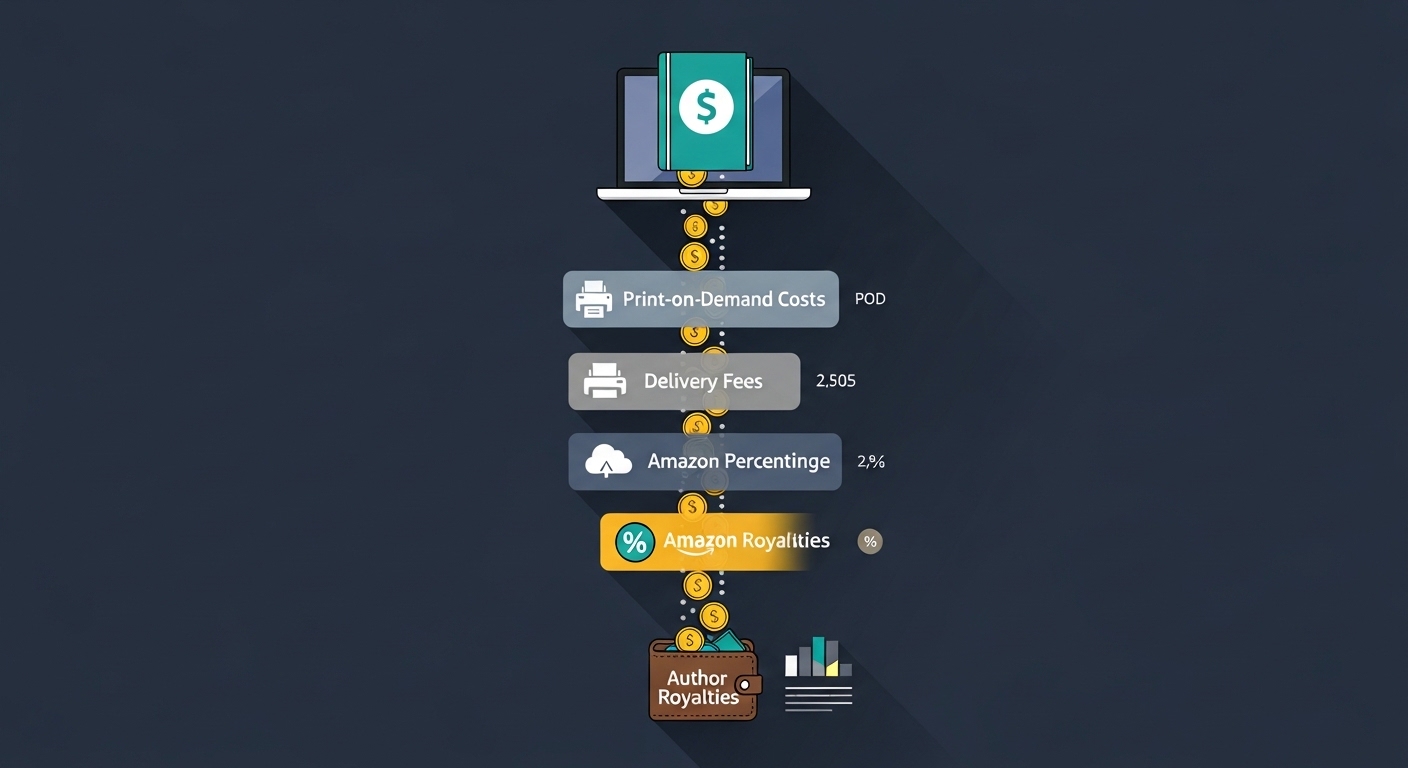
For many independent authors, the moment a physical copy of their book arrives in the mail is the pinnacle of their creative journey. There is an undeniable magic in holding a tangible object that started as a digital file on a laptop. However, once the initial excitement subsides, a more analytical reality sets in: the business of making a profit.
The print-on-demand (POD) model allows writers to offer physical books to a global audience without spending money on inventory or storage. But this convenience comes with a financial trade-off. Unlike eBooks, physical books carry a “manufacturing tax” subtracted before the author receives payment. Navigating print royalties involves balancing list prices, page counts, and ink types to ensure that after printing and shipping, there is a meaningful profit left over. Treating your writing like a career requires understanding exactly how the gears of the printing press affect your earnings.
The Mathematical Foundation: How the Royalty Formula Functions
The calculation for a physical book royalty is more complex than the straightforward percentage applied to digital sales. To determine your take-home pay, a tiered subtraction method is used.
Standard formula for a primary retail sale:
The 60% represents the portion of the retail price allocated to the author before production expenses. The remaining 40% is retained by the retailer to cover platform fees, hosting, and customer service.
Key takeaway: If printing costs are high and your retail price is low, production fees can consume your entire 60% share, leaving a royalty of zero.
Decoding the Printing Cost: The Three Pillars of Production
To truly master the economics of self-publishing, you must move beyond the surface-level understanding of “manufacturing fees.” The printing cost is the ultimate gatekeeper of your profit margin. Unlike the digital world, where the cost of delivering a file remains static whether the book is 100 or 1,000 pages, the physical world demands a granular accounting of materials.
Amazon’s Print-on-Demand (POD) model relies on a sophisticated, multi-variable equation that balances fixed overhead with the specific physical footprint of your work. By dissecting the three primary pillars of production, you can strategically engineer your book to maximize royalties without compromising the reader’s experience.
The Strategic Impact of Ink and Paper Selection
Your choice of interior styling is the single most significant lever you can pull to shift your royalty from cents to dollars. In the POD ecosystem, ink isn’t just a medium; it’s a pricing tier. Authors must choose between three distinct categories, each tailored to specific genres and budget profiles:
Black Ink on White or Cream Paper: This is the gold standard for text-heavy volumes such as novels, memoirs, and academic non-fiction. It offers the lowest fixed cost and the most competitive per-page rate. Choosing between white and cream paper generally does not change the cost, allowing you to select the aesthetic that best fits your genre—cream for fiction and white for non-fiction—without financial penalty.
Standard Color: This middle-tier option was designed to bridge the gap between expensive art books and plain text. It is ideal for workbooks, technical manuals, or non-fiction books that utilize simple charts and diagrams. It uses an inkjet process that provides color without the massive overhead of high-density printing, though it requires a minimum of 72 pages in most marketplaces.
Premium Color: Reserved for high-end photography books, cookbooks, and children’s literature, premium color utilizes a heavy 60lb (100gsm) paper stock. The ink saturation is significantly higher, resulting in vibrant, professional-grade imagery. However, the per-page cost is often five to seven times higher than black ink, which necessitates a much higher retail price just to reach the break-even point.
Page Count: The Weight of Your Words
In the physical realm, your manuscript’s length is a direct financial liability. Every page added to your file increases the per-unit printing cost by a specific, fixed increment (for example, $0.012 per page in the US market). While a single cent seems negligible, in the context of a 400-page thriller, the “page tax” accounts for nearly five dollars of your production cost.
This creates a fascinating intersection between editorial craft and business strategy. Authors often find that by tightening their prose or slightly adjusting their interior formatting, they can reduce their page count by 10% to 15%. This doesn’t just result in a faster-paced story; it directly lowers the manufacturing floor. Strategic formatting—such as choosing a 6×9 trim size over a 5×8—can often allow for more words per page, effectively lowering the cost per copy while maintaining a professional, readable layout.
Marketplace Variability and Global Logistics
The cost of producing a book is not a global constant. Because Amazon prints your books in regional facilities—located in the US, UK, Europe, Japan, and Australia—the “Pillar of Geography” plays a massive role in your final payout. Printing costs are influenced by local labor laws, energy prices, and the regional cost of paper pulp.
| Marketplace | Fixed Cost (B&W) | Per-Page Rate (B&W) |
| Amazon.com (USD) | $1.00 | $0.012 |
| Amazon.co.uk (GBP) | £0.85 | £0.010 |
| Amazon.de (EUR) | €0.60 | €0.012 |
Because of these variations, a book priced at $14.99 in the United States may yield a healthy $4.50 royalty, whereas that same price point converted to Euros might only yield €3.20 after higher local printing costs are deducted. Professional authors do not simply “auto-convert” their prices; they manually adjust their international list prices to ensure their margins remain consistent regardless of where the reader clicks “Buy Now.”
Comparing Costs Across Different Formats
Here’s how different formats affect royalties for a book priced at $18.00 (US market):
| Book Type | Page Count | Printing Cost | 60% Gross Share | Final Royalty |
| Standard Fiction (B&W) | 300 | $4.45 | $10.80 | $6.35 |
| Large Memoir (B&W) | 500 | $6.85 | $10.80 | $3.95 |
| Standard Color Guide | 100 | $3.65 | $10.80 | $7.15 |
| Premium Color Photo Book | 100 | $7.25 | $10.80 | $3.55 |
Insight: A 500-page black-and-white book can be less profitable than a 100-page color book, highlighting the financial importance of concise, well-formatted content.
Expanded Distribution: The Hidden Profit Killer
Here’s a clear table version of your “Expanded Distribution” example to make it visually clear and easy to understand:
| Sale Type | Retail Price | Royalty Rate | Printing Cost | Final Royalty |
| Standard Sale | $15.00 | 60% | $4.00 | $5.00 |
| Expanded Distribution | $15.00 | 40% | $4.00 | $2.00 |
Key Insight: Expanded Distribution royalties can be less than half of standard sales, highlighting the importance of setting a higher retail price to maintain profitability.
If you want, I can expand this table to include multiple pricing scenarios to show how different book prices impact royalties for both Standard and Expanded Distribution. This creates a practical, quick-reference tool for authors. Do you want me to do that
Strategic Pricing: Finding the “Sweet Spot”
Setting the right retail price is a delicate balance between market expectations, reader psychology, and profitability. Pricing too low can undervalue your work and erode potential earnings, while pricing too high may reduce sales and limit your audience. To maximize both revenue and reach, consider the following multi-layered approach:
1. Research Your Genre Thoroughly
Before setting a price, take a close look at your competition. Examine top-selling books in your category to identify common price ranges, page counts, formats, and audience expectations. Understanding what readers are willing to pay in your niche allows you to position your book strategically without pricing yourself out of the market.
Key Considerations:
- Compare paperback, hardcover, and eBook prices separately.
- Look at how pricing varies with page count and format.
- Note seasonal trends, such as holiday promotions or back-to-school periods.
2. Calculate Your Minimum Price
Identify the break-even point where your royalty equals zero, taking into account printing costs, KDP fees, and any platform deductions. This step ensures you never sell at a loss and helps define the lowest safe threshold for your book.
Practical Tip:
If your book costs $4 to print and the royalty rate is 60%, your minimum retail price must cover that $4 plus any additional overhead, such as shipping or marketing. Anything below that is unsustainable for your business.
3. Factor in Marketing and Operational Costs
If you plan to run ads, offer promotions, or pay for other marketing initiatives, include these costs in your pricing strategy. A well-priced book ensures that after marketing expenses, each sale still contributes to your net profit.
Strategies:
- Estimate advertising cost per sale and include it in the break-even calculation.
- Consider periodic price adjustments during promotional campaigns to maintain margins.
- Track the ROI of campaigns to guide future pricing decisions.
4. Leverage Psychological Pricing
Pricing isn’t just math—it’s also perception. Small psychological strategies can significantly influence buying behavior. Prices ending in .99 or .95 often outperform round numbers like $16.00 or $18.00 because they create the impression of value while encouraging impulse purchases.
Advanced Tips:
- Test multiple price points in your niche to see which generates the highest combination of sales volume and revenue.
- Use odd pricing for digital formats and round numbers for premium print editions to signal quality.
- Factor in the competitive landscape: a slightly higher price may actually attract readers who associate price with credibility or professionalism.
5. Monitor and Adjust Over Time
Strategic pricing isn’t a one-time decision—it’s dynamic. Market trends, competitor adjustments, and audience feedback all influence optimal pricing. Periodically review your sales data and adjust prices to maximize both revenue and long-term audience growth.
Actionable Steps:
- Track royalties and units sold monthly to detect trends.
- Adjust pricing for new releases based on competitor benchmarking.
- Consider regional pricing differences if selling internationally, adjusting for local purchasing power and currency variations.
6. Test Pricing With Promotions and Experiments
Experimentation is critical. Run limited-time discounts, bundle offers, or tiered pricing strategies to identify which price points generate the highest total revenue, not just the highest per-sale royalty.
Examples:
- A $2.99 eBook may sell more copies than a $4.99 one, but the overall revenue could be lower.
- Limited-time promotions can drive reviews, increase visibility, and improve long-term sales at your standard price.
Pro Tip: Combine all these steps into a pricing strategy sheet. Include columns for:
- Retail Price
- Printing Costs
- Royalty Rate
- Marketing Costs
- Net Profit
This allows you to see exactly how each pricing choice impacts your earnings, making adjustments more precise and strategic.
Takeaway: Pricing is not just about a number—it’s a strategic lever that affects visibility, revenue, and long-term success. By combining market research, minimum price calculations, marketing considerations, psychological tactics, and ongoing adjustments, you can find the true “sweet spot” where both your readers and your bottom line are satisfied.
Frequently Asked Questions (FAQ)
Does book size affect printing cost?
Mostly no—standard trim sizes are priced by page count and ink type, not dimensions.
Why are hardcover royalties lower than paperback?
Hardcover fixed costs are much higher, requiring a higher retail price for similar profit.
Can I buy my own books at a discount?
Yes. Authors can purchase “Author Copies” at wholesale printing cost plus shipping.
Can I change my book’s price?
Yes, prices can be adjusted anytime. Updates may take 24 hours on Amazon and weeks for Expanded Distribution.
What’s the difference between Standard and Premium Color?
Standard uses thinner paper and inkjet printing; Premium uses thicker paper and high-quality ink for photography or premium book.
Conclusion: Empowering Your Author Business
Print-on-demand has democratized publishing, but authors are responsible for financial management. Every page, image, and formatting choice affects your bottom line.
Mastering the math of fixed costs, per-page fees, and distribution tiers allows you to make informed decisions, protecting your profits and enabling a sustainable publishing strategy. With clear knowledge of your royalties, you can focus on what matters most: writing more books and building a long-term, profitable author business.