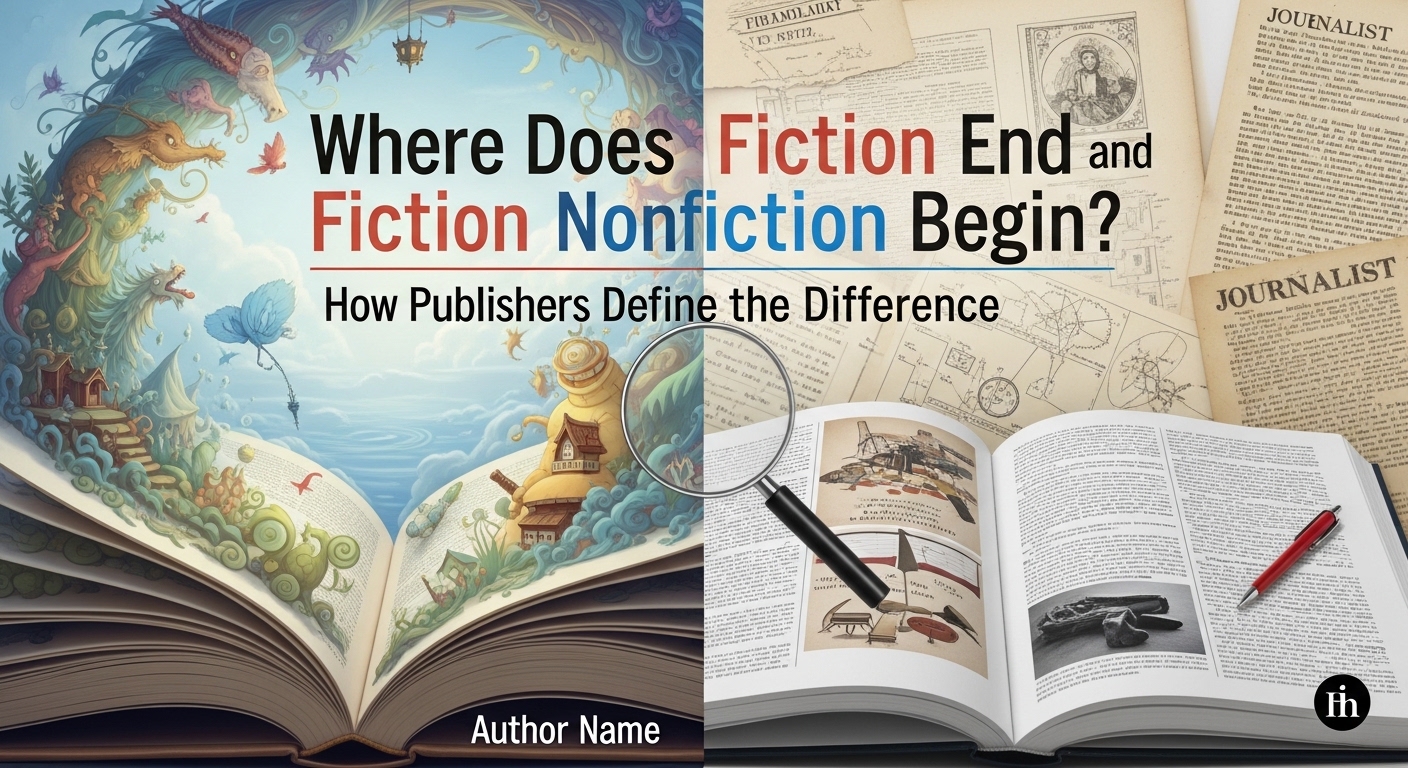
The boundary between fiction and nonfiction has never been as stable as it appears on a bookstore shelf. At first glance, the distinction seems obvious: fiction is invented, nonfiction is real. But in practice, that line becomes increasingly difficult to draw. Memoirs read like novels, novels borrow from real history, and “based on a true story” has become one of the most flexible phrases in publishing.
For publishers, however, this is not just a philosophical question—it is a structural one. The classification of a manuscript determines how it is edited, marketed, priced, and ultimately understood by readers. And while readers often assume the difference is about truth, publishers define it through a more complex lens: intent, verifiability, narrative technique, and commercial positioning.
Understanding where fiction ends and nonfiction begins requires stepping into the mechanics of publishing itself, where practical decisions often matter more than abstract definitions.
Defining Fiction and Nonfiction: How Reality Is Framed in Literature
At a foundational level, fiction and nonfiction are defined by their relationship to reality—but not always in the way readers expect. The distinction is less about content alone and more about how that content is presented, structured, and validated within publishing systems.
Fiction: Constructed Reality and Imaginative Design
Fiction is built on imagination. Characters, events, and worlds may resemble reality, but they are ultimately constructed. Even when fiction draws heavily from real life, it is not bound by factual accuracy or real-world accountability.
In fiction:
- Events do not need to have happened
- Dialogue can be invented or stylized
- Characters can be composites or symbolic representations
The central obligation is internal consistency, not real-world accuracy A novel succeeds not because it is “true,” but because it creates a believable emotional and narrative experience. Readers accept fiction as an intentional departure from factual obligation. Fiction also allows experimentation with time, perspective, and identity in ways nonfiction cannot, giving authors complete creative control over structure and meaning.
Nonfiction: Structured Reality and Factual Responsibility
Nonfiction, in contrast, is anchored in factual claims about the real world. It includes memoirs, biographies, essays, journalism, and academic writing, all of which rely on varying degrees of evidence, documentation, or lived experience.
In nonfiction:
- Events are expected to be verifiable
- Names, places, and timelines matter
- Claims are subject to fact-checking
Accuracy is part of the author’s responsibility However, nonfiction is still a constructed narrative. It selects, organizes, and interprets reality rather than reproducing it in full. Even factual writing involves emphasis, omission, and framing choices that shape meaning.
The Core Publishing Question: How Truth Is Claimed, Not Just Written
Publishers rarely begin with the question “Is this true?” Instead, they focus on how truth is being positioned within the text and how readers are expected to interpret it. This distinction between factual content and truth claim is central to classification decisions.
Is the author presenting the work as a real account of events, or as a constructed narrative inspired by reality? That framing determines everything from editorial standards to marketing strategy and even legal responsibility in some cases. In practice, publishers treat truth as a contractual expectation rather than a philosophical concept, making intent one of the most decisive factors in genre classification.
Why Genre Classification Matters in Publishing Systems
To readers, genre labels may seem like simple organizational tools, but for publishers they function as critical infrastructure. Every stage of the book’s lifecycle depends on whether it is classified as fiction or nonfiction, influencing both commercial performance and operational workflow.
Market Structure and Distribution Systems
Books are not only written—they are positioned within highly structured distribution systems. Fiction and nonfiction are separated across:
- Bookstore shelving categories
- Online recommendation algorithms
- Library classification systems
- Academic and retail metadata structures
- A misclassified book disrupts discoverability and can significantly impact sales performance, as readers rely heavily on genre-based navigation.
Reader Expectations and Interpretive Frameworks
Genre shapes how readers interpret content before they even begin reading. Fiction invites emotional immersion and symbolic interpretation, while nonfiction establishes expectations of factual accuracy and informational value. If a book violates these expectations, it can create confusion, disappointment, or even accusations of deception. Publishers therefore treat classification as a tool for managing reader trust and interpretive alignment.
Legal Responsibility and Editorial Oversight
Nonfiction carries legal and ethical obligations that fiction does not. If a memoir or biography contains false or defamatory claims about real individuals, publishers may face serious legal consequences.
As a result, nonfiction manuscripts often undergo:
- Rigorous fact-checking processes
- Legal review for defamation risk
- Verification of sources and claims
Fiction is not free from scrutiny, but it is generally protected from literal interpretation, giving it far greater flexibility in representation.
Hybrid Genres: When Fiction and Nonfiction Overlap
Despite clear definitions, many modern works exist in a hybrid space where classification becomes complex. These forms challenge traditional publishing boundaries by blending factual reference with creative interpretation.
Autofiction: Blurring Memory and Imagination
Autofiction merges autobiographical experience with fictionalization. Authors may draw from real life but reshape events, identities, and timelines to serve narrative or emotional goals. In these works, the central tension is not factual accuracy but emotional authenticity. The result is a narrative that feels real but cannot be fully verified as such, complicating traditional genre expectations.
Narrative Nonfiction: Literary Style with Factual Anchoring
Narrative nonfiction uses storytelling techniques commonly associated with novels—such as scene construction and character development—while remaining committed to factual accuracy.
It relies on:
- Historical records and evidence
- Interviews and documentation
- Verifiable real-world events
The challenge lies in balancing stylistic storytelling with strict factual responsibility, making it one of the most carefully managed nonfiction forms in publishing.
Historical Fiction: Reconstructing the Past Through Imagination
Historical fiction occupies another hybrid category where real historical contexts are combined with invented characters and narrative arcs.
Typically:
- Major historical events remain accurate
- Characters may be fictional or composite
- Dialogue and private interactions are reconstructed
This raises ongoing publishing questions about how much creative interpretation can exist before historical representation becomes fictionalized storytelling.
Memoir, Autobiography, and Personal Essay: Variations of Memory
Even within nonfiction, boundaries remain fluid. These forms differ in scope and intent rather than strict factual methodology.
- Autobiography seeks comprehensive life documentation
- Memoir focuses on selective thematic experiences
- Personal essays explore subjective reflection and interpretation
All rely on memory, which is inherently selective and interpretive rather than perfectly accurate, making absolute factual precision impossible.
How Publishers Decide What Category a Book Belongs To
Classification in publishing is ultimately a practical decision shaped by multiple intersecting factors rather than a single rule. Publishers evaluate manuscripts using a combination of author positioning, factual reliability, narrative technique, and legal risk.Author Intent and Presentation The way an author frames a manuscript heavily influences classification. If it is presented as a factual account, publishers typically treat it as nonfiction. If it is framed as imaginative or symbolic, it becomes fiction, regardless of real-world inspiration.
This initial framing shapes editorial direction, contract terms, and marketing strategy from the earliest stages of publication.
Verifiability and Evidence Requirements
Nonfiction must be supportable through evidence, documentation, or credible sourcing. If claims cannot be independently verified, publishers may hesitate to classify a work as nonfiction, even if it is based on real events.
Fiction, by contrast, does not require verification, allowing greater creative flexibility in storytelling and structure.
Narrative Techniques and Stylistic Choices
The use of literary techniques can influence classification decisions. Heavy reliance on reconstructed dialogue, composite characters, or dramatized scenes may shift perception toward fiction, even in otherwise factual narratives.
However, style alone does not determine category—it interacts with intent and verifiability to shape final classification outcomes.
Legal Risk and Defamation Concerns
Nonfiction carries potential legal exposure when it references real individuals or events. Publishers must carefully evaluate whether claims could be interpreted as defamatory or misleading. In some cases, works inspired by real events are labeled as fiction specifically to reduce legal risk and protect both author and publisher.
Reader Interpretation and the Power of Genre Labels
Readers do not engage with books in a neutral way; they interpret content through expectations shaped by genre classification. These expectations significantly influence how truth, meaning, and narrative credibility are perceived.
How Genre Shapes Perception
Fiction is typically read as imaginative or symbolic, while nonfiction is read as factual and authoritative. This distinction shapes how readers evaluate every detail within the text. As a result, the same narrative can be interpreted in entirely different ways depending solely on its classification, even if the content remains unchanged.
Institutional Reinforcement of Categories
Bookstores, libraries, and digital platforms reinforce these divisions through rigid classification systems. Metadata tags, shelving rules, and algorithmic recommendations all depend on binary genre distinctions. This infrastructure ensures consistency in discovery but also limits how fluid or hybrid narratives can be categorized in practice.
Real-World Controversies and Genre Ambiguity
Publishing history includes numerous cases where the boundary between fiction and nonfiction becomes contested. Memoirs have occasionally faced scrutiny when factual accuracy was questioned, leading to broader debates about memory, truth, and narrative integrity.
Marketing strategies such as “based on a true story” further complicate interpretation by signaling authenticity while leaving room for creative adaptation. Similarly, literary fiction often draws heavily from real events while reshaping them into symbolic or thematic narratives, making classification inherently flexible.
The Future of Fiction and Nonfiction in Modern Publishing
The distinction between fiction and nonfiction is not disappearing, but it is becoming increasingly flexible. Hybrid genres are gaining acceptance, and readers are more comfortable with narratives that blend factual and imaginative elements.
Digital publishing systems also allow multiple metadata classifications, reducing reliance on strict binaries. At the same time, AI-generated content and evolving storytelling formats are challenging traditional assumptions about authorship, truth, and narrative authority.
Publishers are gradually shifting toward more adaptive classification models that prioritize reader experience and narrative intent over rigid genre boundaries.
Conclusion: Fiction and Nonfiction as a Continuum of Truth
Fiction and nonfiction are not separate, opposing categories but points along a spectrum defined by intent, structure, and interpretation. Publishers do not simply determine whether a story is real; they evaluate how truth is presented, framed, and experienced by readers.
Ultimately, the distinction is less about the existence of truth itself and more about how that truth is packaged, communicated, and understood. As storytelling continues to evolve, the boundary between fiction and nonfiction will remain fluid, reflecting the changing nature of narrative itself.