Every author reaches a moment when the manuscript feels “done.” The ideas are clear, the chapters are structured, and the story—or argument—flows. It’s tempting to believe the hardest part is over. But in reality, one of the most critical stages is still ahead: proofreading.
Proofreading is often misunderstood, rushed, or treated as a final checkbox before publication. In truth, it’s the last line of defense between a polished book and one that quietly undermines its own credibility. Even the most insightful nonfiction or compelling narrative can lose impact if it contains distracting errors, inconsistencies, or formatting issues.
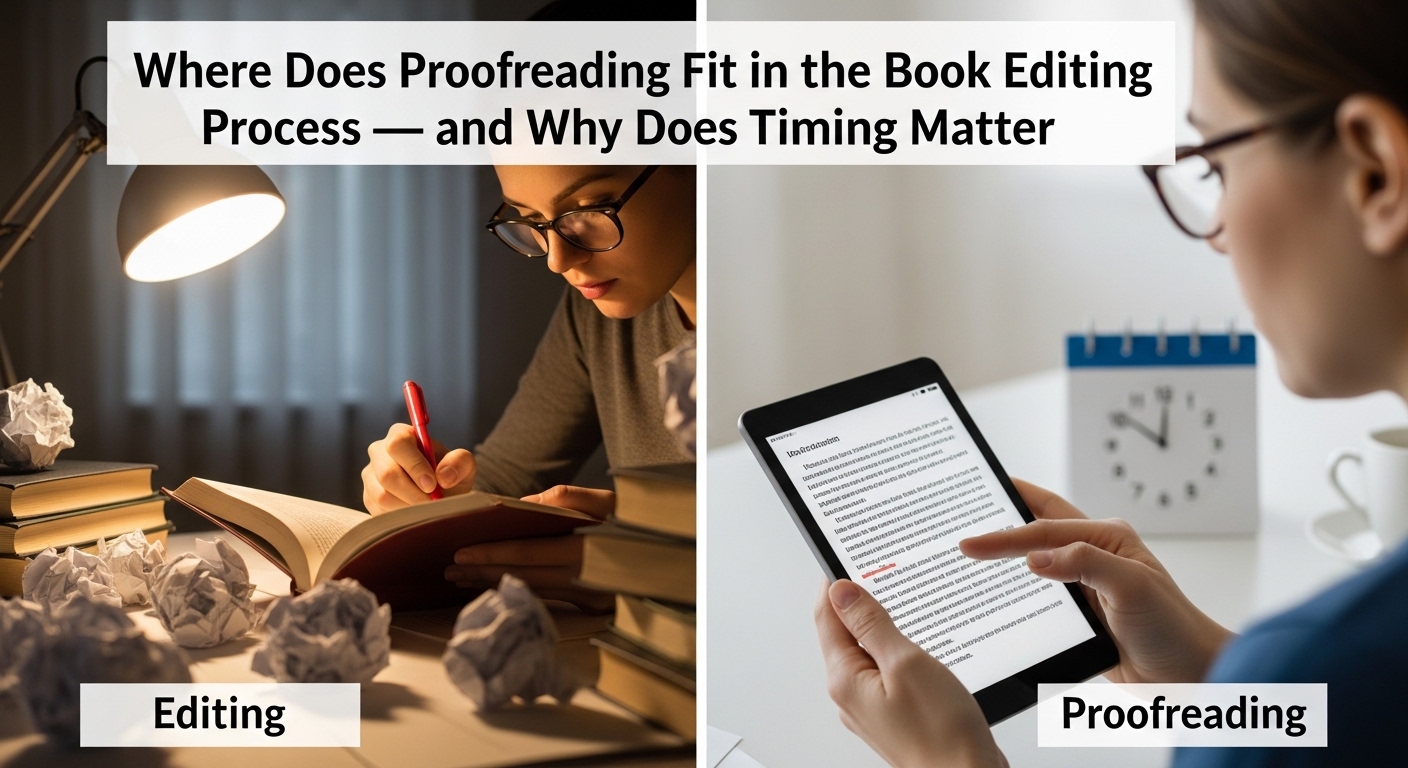
Understanding where proofreading fits in the book editing process—and why timing matters—can make the difference between a professional-quality book and one that feels unfinished. This guide walks through the entire editing journey, clarifies the role of proofreading, and explains how to approach it strategically for the best possible results.
The Complete Book Editing Process: A Layered Approach
Editing is not a single step—it’s a structured, multi-layered process. Each stage builds on the one before it, refining the manuscript from big-picture ideas down to the smallest details.
At a high level, the editing process typically unfolds in this order:
| Editing Stage | Focus Area | Purpose |
|---|---|---|
| Developmental Editing | Structure, ideas, content flow | Strengthens the foundation of the book |
| Line Editing | Style, tone, clarity | Improves readability and engagement |
| Copyediting | Grammar, consistency, accuracy | Ensures technical correctness |
| Proofreading | Surface errors, formatting | Final polish before publication |
This progression is intentional. You don’t want to fix grammar in a paragraph that might later be deleted or rewritten. Each stage narrows the focus, moving from macro-level improvements to micro-level precision.
Proofreading sits at the very end of this process—not because it’s less important, but because it depends on everything else being complete.
What Proofreading Actually Involves
Proofreading is often confused with copyediting, but the two serve different purposes. Copyediting addresses grammar, syntax, and consistency during the refinement phase, while proofreading is the final quality check after all edits are complete.
At this stage, the manuscript should already be fully edited and formatted. The proofreader’s job is to catch any remaining errors that slipped through earlier stages.
These may include:
- Typographical errors (misspellings, missing words)
- Punctuation inconsistencies
- Minor grammar mistakes
- Formatting issues (spacing, alignment, headings)
- Inconsistencies in fonts, page numbers, or layout
Proofreading is meticulous work. It requires a fresh set of eyes and a high level of attention to detail. Unlike earlier editing stages, it does not involve rewriting or restructuring content—it focuses purely on accuracy and presentation.
Why Proofreading Must Come Last
Timing is everything when it comes to proofreading. If done too early, it becomes inefficient and often pointless.
Imagine proofreading a chapter, only to later revise or delete entire sections during line editing. All that effort is wasted. This is why proofreading must come after all substantive and stylistic changes are finalized.
There are several reasons why proofreading belongs at the end:
- It ensures you’re working on the final version of the manuscript
- It prevents repeated corrections caused by ongoing edits
- It allows the proofreader to focus solely on surface-level accuracy
- It captures errors introduced during formatting or typesetting
In many cases, new mistakes can appear during the layout stage—such as spacing issues, broken paragraphs, or misplaced headings. Proofreading at the final stage ensures these are caught before publication.
The Risks of Poor Timing in Proofreading
Misplacing proofreading in the editing process can lead to several problems that affect both quality and efficiency.
Wasted Time and Resources
Proofreading too early means you’ll likely need to repeat the process after further edits. This not only increases costs but also slows down your publishing timeline.
Overlooked Errors
If proofreading is rushed or skipped entirely, small mistakes can slip into the final version. These errors may seem minor, but they can disrupt the reader’s experience and reduce credibility.
Compromised Professionalism
Readers often equate technical accuracy with authority. A book filled with typos or formatting issues can appear unprofessional, regardless of how valuable the content is.
Cognitive Blindness
Authors who proofread their own work too soon may miss errors simply because they’re too familiar with the text. Fresh eyes at the right stage are essential for catching overlooked mistakes.
Proofreading vs. Copyediting: Clearing the Confusion
One of the most common challenges authors face is distinguishing between proofreading and copyediting. At a glance, both seem to serve the same purpose—fixing errors—but in reality, they operate at entirely different levels of the editing process. Misunderstanding this distinction often leads to misplaced expectations, rushed workflows, and ultimately, a less polished final book.
Copyediting and proofreading are not interchangeable steps. They are sequential, meaning one prepares the manuscript for the other. Copyediting shapes and refines the language, while proofreading verifies that everything is clean, consistent, and publication-ready.
To understand the difference clearly, it helps to compare them across multiple dimensions:
Key Differences Between Copyediting and Proofreading
| Aspect | Copyediting | Proofreading |
|---|---|---|
| Stage in Process | Comes after line editing but before formatting | Final stage, after formatting and layout |
| Primary Goal | Improve clarity, correctness, and consistency | Catch surface-level errors before publication |
| Depth of Edits | Deep and detailed changes to language and structure | Light corrections with minimal intervention |
| Focus Areas | Grammar, sentence structure, tone, consistency, accuracy | Typos, punctuation, formatting, spacing |
| Content Changes | May rephrase sentences or adjust wording | Does not rewrite or restructure content |
| Involvement Level | High involvement in shaping the manuscript | Minimal involvement, focused on precision |
| Error Types Addressed | Complex grammar issues, inconsistencies, unclear phrasing | Minor errors missed in earlier stages |
| Timing Sensitivity | Flexible within mid-stage editing | Must be done at the very end |
| Impact on Manuscript | Enhances readability and coherence | Ensures professional polish and presentation |
Going Deeper: What Copyediting Really Does
Copyediting is where your manuscript begins to feel refined and professional. At this stage, the editor looks beyond basic errors and focuses on how effectively your writing communicates its message.
A copyeditor examines sentence flow, eliminates awkward phrasing, and ensures consistency across the entire manuscript. For example, if you switch between different spellings (e.g., American vs. British English) or vary terminology unintentionally, a copyeditor standardizes these elements.
They also address subtle issues that can weaken your writing, such as:
- Repetitive sentence structures
- अस्पष्ट or ambiguous phrasing
- Inconsistent tone or voice
- Incorrect word usage in context
In nonfiction, copyediting may also involve light fact-checking or ensuring that claims are presented clearly and logically. The goal is not to rewrite your voice but to strengthen it—making your ideas easier to understand and more engaging to read.
Without copyediting, a manuscript may still contain hidden friction points that disrupt the reader’s experience, even if the overall content is strong.
What Makes Proofreading Fundamentally Different
Proofreading operates on a completely different level. By the time a manuscript reaches this stage, all major and minor edits should already be complete. The content is considered final.
The proofreader’s role is to act as a quality control specialist. They scan the manuscript for any remaining surface-level issues that may have been missed or introduced during formatting.
These often include:
- Typographical errors
- Missing or repeated words
- Incorrect punctuation
- Formatting inconsistencies
- Layout issues such as spacing or alignment
Unlike copyediting, proofreading does not involve improving sentences or reworking ideas. In fact, making major changes at this stage can create new errors or disrupt the layout, especially in formatted documents.
Proofreading is about precision. It ensures that the manuscript is clean, consistent, and ready for readers without distractions.
Why the Difference Matters More Than You Think
Understanding the distinction between copyediting and proofreading is not just a technical detail—it directly impacts the quality of your book.
When authors skip copyediting and move straight to proofreading, they often expect the proofreader to fix deeper issues. This creates two problems:
- The proofreader is forced to go beyond their intended role, reducing efficiency
- Many structural or clarity issues remain unresolved because proofreading is not designed to address them
This leads to a manuscript that may be technically “clean” but still feels rough or unpolished in terms of readability.
On the other hand, when both stages are done correctly and in sequence, the results are significantly stronger. Copyediting ensures the writing is clear and consistent, while proofreading ensures it is flawless in presentation.
A Simple but Powerful Distinction
A helpful way to internalize the difference is this:
- Copyediting improves the text
- Proofreading perfects the text
This distinction highlights their relationship. One builds the quality; the other confirms it.
Think of copyediting as refining a piece of furniture—sanding rough edges, strengthening joints, and ensuring stability. Proofreading, then, is the final polish—removing dust, adding shine, and making sure everything looks flawless before display.
The Cost of Confusing the Two
When authors misunderstand these roles, it often results in:
- Increased revision cycles
- Higher overall costs due to repeated corrections
- Delays in publishing timelines
- A final product that doesn’t meet professional standards
More importantly, readers notice. Even if they can’t identify the exact issue, inconsistencies and errors subtly reduce trust and engagement.
When Is the Right Time to Proofread Your Book?
The ideal moment for proofreading is after your manuscript has gone through all editing stages and has been formatted for its final presentation.
This typically means:
- All developmental and structural changes are complete
- Line editing and copyediting revisions have been implemented
- The manuscript is laid out in its final format (print or digital)
Proofreading at this stage ensures that the version being reviewed is identical—or very close—to what readers will see.
Some authors also opt for a second round of proofreading after minor last-minute changes, especially for high-stakes publications. This extra step can provide additional assurance of quality.
Should You Proofread Your Own Book?
It’s entirely possible to proofread your own manuscript—but relying on it as your only line of defense is where problems begin. The challenge isn’t effort; it’s familiarity. After spending weeks or months immersed in your writing, your brain becomes conditioned to read what should be there rather than what actually appears on the page. This phenomenon, often called cognitive bias, makes it surprisingly easy to overlook even obvious errors.
That said, self-proofreading still has value when used strategically. Think of it as a preparatory step rather than a final one. Before handing your manuscript to a professional, taking time to review it yourself can help eliminate basic mistakes and reduce the workload in later stages.
A more effective approach to self-proofreading involves slowing down and changing how you engage with the text. Instead of reading for meaning, you’re reading for accuracy. A few practical techniques can make this process more productive:
- Read the text slowly and deliberately, ideally aloud, to catch awkward phrasing and missing words
- Change the format—print the manuscript or view it on a different device to disrupt visual familiarity
- Focus on one category of errors at a time, such as punctuation, spelling, or spacing
Even with these methods, self-proofreading has its limits. It’s difficult to replicate the objectivity and trained attention of a professional proofreader who approaches your manuscript with fresh eyes. That external perspective is often what catches the subtle inconsistencies and overlooked details that authors miss.
The Role of Formatting in Proofreading
Proofreading is not just about language—it’s equally about presentation. Once your manuscript moves into its final layout, whether for print or digital formats, a new layer of complexity is introduced. At this stage, even a previously clean manuscript can develop issues during typesetting or formatting.
These errors are often small but noticeable enough to disrupt the reading experience. Common examples include:
- Uneven spacing between paragraphs or lines
- Misaligned text, images, or margins
- Inconsistent heading sizes or styles
- Incorrect or skipped page numbers
What makes formatting errors particularly tricky is that they don’t always exist in the original document. They often emerge after the manuscript has been converted into its final form. This is why proofreading should always be performed on the formatted version rather than the raw file.
A well-proofread book ensures that both content and design work together seamlessly. Clean formatting improves readability, maintains visual consistency, and enhances the overall professionalism of your work. Even minor layout issues, if left unchecked, can create friction for readers—especially in digital formats where presentation directly affects usability.
How to Work Effectively With a Proofreader
A strong collaboration with your proofreader can significantly improve the quality of your final manuscript. While proofreading may seem like a one-sided task, it actually benefits from clear communication and proper preparation.
Before you send your manuscript, it’s important to ensure that everything is truly finalized. Proofreading is most effective when the text is stable and no major changes are expected. To prepare properly:
- Confirm that all editing stages (developmental, line editing, copyediting) are complete
- Ensure the manuscript is formatted in its intended final layout
- Provide any relevant style guides, preferences, or specific instructions
Once the proofreading process begins, your role shifts from creator to reviewer. Staying open to feedback is essential, even when corrections seem minor. Small changes often have a cumulative effect on the overall polish of the book.
After receiving the proofread version, take time to review every correction carefully. This step is just as important as the proofreading itself. Implement changes consistently and double-check that nothing has been missed during the revision process.
Effective collaboration isn’t about handing off the manuscript and stepping away—it’s about working together to ensure that every detail, no matter how small, contributes to a clean, professional, and publication-ready book.
Final Thoughts
Proofreading is not just a finishing touch—it’s a critical stage that ensures your book meets professional standards. Its placement at the end of the editing process is intentional, allowing it to function as a final safeguard against errors. Timing matters because proofreading depends on stability. When your manuscript is fully edited and formatted, proofreading becomes efficient, focused, and effective. Done too early or too late, it loses its impact. For authors who want their work to stand out, investing time and attention into proper proofreading is non-negotiable. It’s the step that transforms a good manuscript into a polished, credible, and reader-ready book.
Frequently Asked Questions (FAQ)
Is proofreading really necessary if I’ve already edited my book?
Yes. Even after thorough editing, small errors can remain or appear during formatting. Proofreading ensures these are caught before publication.
Can proofreading fix major writing issues?
No. Proofreading is not designed for rewriting or restructuring. Major issues should be addressed during earlier editing stages.
How long does proofreading take?
The timeline depends on the length and complexity of the manuscript, but it typically takes a few days to a couple of weeks.
Should proofreading be done before or after formatting?
It should be done after formatting to catch layout and presentation errors that may not appear in the raw manuscript.
Is one round of proofreading enough?
In many cases, one thorough round is sufficient. However, a second pass can be beneficial if significant changes are made afterward.