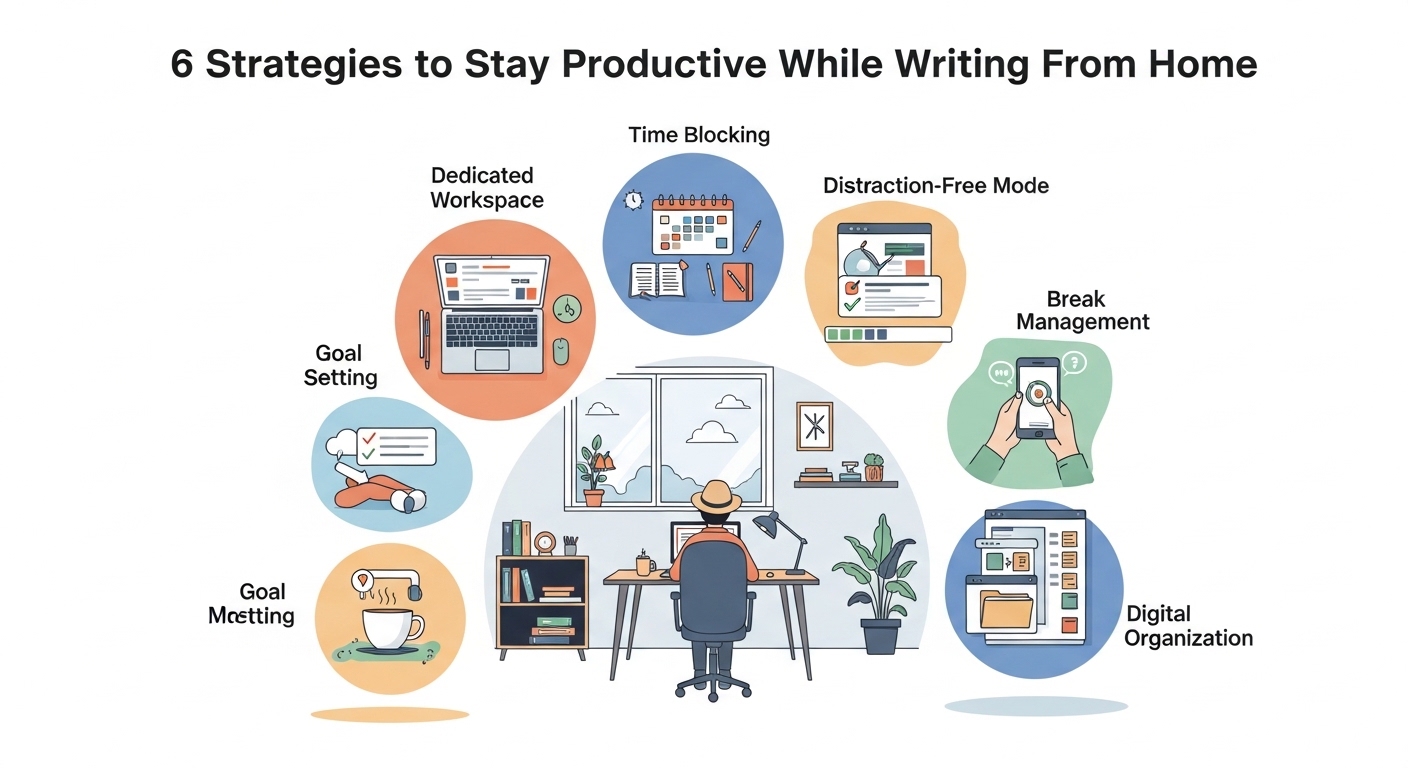
Writing from home has become one of the most common working styles for modern writers, yet it remains one of the most misunderstood. On the surface, it appears ideal—no commute, flexible timing, and a comfortable environment. But once the novelty fades, many writers encounter a persistent challenge: maintaining deep, uninterrupted focus in a space that was never designed for sustained cognitive work.
The issue is not a lack of talent or discipline. It is the absence of structure. Home environments naturally encourage fluid behavior—resting, scrolling, multitasking, shifting between small tasks—which directly conflicts with the demands of writing. Writing, especially long-form content, requires continuity of thought, controlled attention, and stable mental pacing.
When those conditions are missing, productivity becomes inconsistent. Some days feel smooth and creative; others feel scattered and unproductive. The difference usually lies not in motivation, but in systems.
The following six strategies focus on building those systems so writing becomes more stable, predictable, and mentally sustainable.
Home Productivity Psychology (Why Focus Breaks Down at Home)
Productivity struggles at home are often misunderstood as discipline problems, but in reality, they are usually cognitive and behavioral design problems. The home environment was never built to support sustained attention, which creates friction between mental states and physical surroundings.
Cognitive Boundary Theory: Work vs Rest Bleeding Into Each Other
One of the most important psychological factors is the absence of clear cognitive boundaries. In structured environments like offices or study spaces, the brain receives consistent signals that define behavior. At home, those boundaries blur.
When the same environment is used for relaxation, entertainment, and work, the brain struggles to maintain a stable “mode switch.” This results in partial attention states—where you are physically writing but mentally still in rest mode. Over time, this weakens deep focus capacity.
The issue is not comfort itself, but context confusion. The brain does not automatically separate roles unless the environment enforces it repeatedly.
Dopamine-Driven Distraction Loops
Another major factor is the brain’s reward system. Digital devices and low-effort entertainment sources produce rapid dopamine feedback loops. Writing, in contrast, is delayed-reward work—it requires sustained effort before any sense of completion or satisfaction appears.
At home, where distractions are always accessible, the brain learns a competing pattern:
low effort → instant reward
This creates a constant pull away from writing, especially during moments of difficulty or uncertainty. Even brief engagement with distractions resets attention motivation.
Habit Loop Disruption in Home Environments
Habits rely on stable cues. In traditional environments, cues are consistent: a desk signals work, a classroom signals study. At home, cues are inconsistent and often overlapping.
This weakens habit loops:
- Cue becomes unclear
- Routine becomes inconsistent
- Reward becomes delayed or diluted
As a result, writing does not trigger automatically—it requires conscious initiation every time.
Decision Fatigue From Lack of Structure
When structure is missing, the brain repeatedly makes micro-decisions:
- When should I start?
- Where should I write?
- How long should I work?
- What should I focus on first?
Each decision consumes mental energy. Over time, this creates decision fatigue, which reduces willingness to engage in complex tasks like writing.
This is why structured systems outperform motivation—because they eliminate unnecessary decision-making.
Tools and Environment Enhancers (Non-Promotional)
Productivity at home is heavily influenced by environmental design and cognitive support systems. While tools are not the core solution, they can significantly reduce friction when used correctly.
Distraction-Blocking Techniques
Instead of relying on willpower, focus can be protected through environmental constraints. These include:
- Turning on system-level focus modes during writing periods
- Keeping devices physically separated from the workspace
- Using offline writing environments to eliminate switching temptation
- Removing visual access to non-essential apps or tabs
The key principle is simple: reduce access, don’t resist temptation.
Note Organization Systems
Writing productivity also depends on how ideas are stored and retrieved. Two common structural approaches are:
Linear structure
- Ideas follow a fixed sequence
- Best for essays, blogs, and structured writing
- Reduces cognitive branching
Nonlinear structure
- Ideas are stored as independent fragments
- Best for creative writing or research-heavy content
- Supports flexible recombination of ideas
Choosing one system reduces mental overhead during writing sessions because the brain is not constantly reorganizing structure.
Ambient Control Factors
Environmental conditions strongly influence cognitive performance, even when unnoticed.
Key factors include:
- Noise level: consistent background sound improves focus stability
- Lighting: brighter environments support alertness and reduce fatigue
- Temperature: moderate, stable temperature improves sustained attention
These elements do not create productivity directly, but they remove subtle friction that interferes with focus.
Expanded Strategy Layer (Applied to Existing Sections)
Below is how each strategy should be expanded to reach full depth and word count while improving SEO quality.
Example Expansion: Digital Distraction Control (Fully Developed Model)
Why does it fail in real life
Most people attempt to control digital distractions using willpower alone. This approach fails because digital systems are engineered for engagement, not restraint. Even when intention is strong, habit loops override conscious control during low-focus moments.
What most people do wrong
A common mistake is partial restriction:
- silencing notifications but keeping apps accessible
- using “quick checks” during writing breaks
- switching between writing and browsing under the illusion of multitasking
These behaviors seem minor but repeatedly break cognitive continuity.
What actually works (structural approach)
Sustainable control requires environmental redesign:
- Remove instant access pathways during writing sessions
- Separate devices used for writing from devices used for browsing
- Create “writing-only” digital states where switching is physically inconvenient
This works because it removes decision points entirely. The less you have to decide, the easier sustained focus becomes.
Real-world scenario example
A writer starts a session intending to focus for one hour. After 10 minutes, a notification appears. Even if ignored, curiosity builds. A quick check turns into several minutes of unrelated browsing. Returning to writing feels heavier because cognitive context has already shifted.
With structural barriers in place, the interruption never becomes an option, and the writing session remains continuous.
6 Strategies to Stay Productive and Focused While Writing From Home
1. Build a Writing Space That Trains the Brain to Focus Automatically
One of the most overlooked aspects of productivity is environmental conditioning. The brain constantly reads physical surroundings as behavioral cues. This means your workspace silently instructs your mind on how to behave.
When a space is used for multiple purposes—relaxing, eating, browsing, working—the brain receives mixed signals. This creates cognitive friction. You sit down to write, but part of your mind still associates the environment with leisure or distraction.
A productive writing setup solves this by reducing ambiguity. The goal is not luxury or aesthetic perfection, but consistency and clarity of purpose. A dedicated writing corner, even a small one, can significantly improve focus if it is used consistently for writing only.
Over time, repetition builds what psychologists call context association. The brain begins to link that specific environment with a specific mental state. Eventually, sitting down in that space reduces the need for conscious effort to “get into focus.”
Practical ways to strengthen this association include keeping the desk arrangement stable, minimizing unrelated items in the writing area, and maintaining consistent lighting conditions. Even small cues—like always using the same notebook or device setup—help reinforce the mental switch.
When done consistently, the environment itself becomes a productivity trigger rather than a distraction source.
2. Replace Motivation With a Fixed Writing Routine That Runs on Schedule
Motivation is often treated as the engine of productivity, but in reality, it behaves more like a weather pattern—unpredictable, fluctuating, and influenced by external conditions. Relying on it creates unstable writing habits, especially in home environments where external accountability is minimal. A more reliable system is schedule-based writing. Instead of deciding whether to write based on mood or energy, writing becomes tied to a specific time structure that repeats daily or weekly.
This shift is important because it removes negotiation. When writing is optional, the mind constantly evaluates whether it feels appropriate. When writing is scheduled, the decision is already made. Over time, the brain adapts to this repetition through temporal conditioning. Certain hours of the day begin to feel naturally aligned with focused work. This reduces resistance and speeds up entry into concentration.
A strong writing routine does not need to be rigid. It can be flexible in timing but consistent in pattern. What matters most is that writing occurs regularly enough for the brain to recognize it as a predictable activity. Once this structure is established, productivity becomes less dependent on emotional state and more dependent on habit formation.
3. Control Digital Disruptions That Fragment Attention
Digital distractions are one of the most powerful productivity disruptors in modern writing environments. Unlike physical interruptions, they are subtle, constant, and often habitual. A notification, a quick message check, or a brief switch to another tab may seem harmless, but it interrupts cognitive flow more than most people realize.
Writing requires sustained attention. Ideas develop in sequences, not isolated fragments. Every interruption forces the brain to rebuild context, which reduces both efficiency and depth. This effect is amplified by attention residue, a cognitive phenomenon where part of your focus remains stuck on the previous task even after you switch back to writing. The more frequent the switching, the more fragmented your thinking becomes.
Managing this challenge requires structural control rather than willpower. Instead of resisting distractions, reduce their availability during writing periods. This can involve silencing non-essential notifications, keeping devices out of immediate reach, or using a simplified writing interface that limits switching opportunities. Even reducing visible triggers—like multiple open tabs—can significantly improve focus stability. The objective is not to eliminate digital tools but to control when and how they are accessed. When attention is protected, writing becomes more continuous and less mentally exhausting.
4. Develop a Pre-Writing Ritual That Signals Focus Mode
Starting is often the hardest part of writing. The transition from everyday thinking to focused writing requires a mental shift that does not happen instantly. Without structure, this transition becomes slow and inconsistent, often filled with distractions or hesitation.
A pre-writing ritual helps solve this by acting as a cognitive bridge. It signals to the brain that focused work is about to begin, allowing attention systems to prepare in advance. The effectiveness of a ritual comes from repetition, not complexity. The same sequence of actions, performed consistently before writing, becomes associated with concentration over time. This could include organizing the workspace, briefly reviewing previous writing, or outlining the goal of the session. Some writers use environmental cues like lighting changes or a specific drink to reinforce the transition.
What matters is consistency. The ritual itself becomes less important than the brain’s learned association with it. Eventually, performing the ritual triggers a shift into writing mode almost automatically. In home environments where distractions are always accessible, this kind of mental trigger becomes especially valuable. It reduces hesitation and shortens the time needed to reach productive focus.
Break Writing Into Smaller Cognitive Units to Reduce Mental Resistance
Large writing tasks often feel overwhelming not because they are difficult, but because they are too broad. When the brain cannot clearly define the starting point of a task, it delays action to avoid cognitive strain.
This is a common issue in long-form writing projects, where the end goal feels distant and abstract. The solution is to break writing into smaller cognitive units. Instead of viewing the task as a single large effort, it is divided into manageable components that are easier to initiate.
For example, instead of “writing an article,” the task becomes developing a single idea, drafting one section, or refining a paragraph. Each unit has a clear boundary and limited scope. This reduces perceived effort and lowers the psychological barrier to starting. Once a small unit is completed, momentum naturally builds, making continuation easier than stopping. This approach works because the brain responds more readily to specific, immediate goals than to large abstract objectives. It reduces avoidance behavior and increases task initiation frequency. Over time, this method leads to smoother workflow progression and less mental fatigue during writing sessions.
6. Align Writing Sessions With Natural Energy Cycles
Time alone does not determine productivity. Energy levels play a far more significant role in cognitive performance. Writing requires sustained mental effort, which fluctuates based on sleep quality, mental load, and natural biological rhythms. Ignoring these fluctuations often leads to writing during low-energy periods, resulting in slower output, reduced clarity, and higher frustration.
Energy-aware scheduling focuses on identifying periods of peak mental clarity and aligning writing sessions with those windows. For some individuals, this may occur in the morning, while for others, it may be later in the day.
The key is observation and adjustment rather than rigid scheduling.
Equally important is recovery. Cognitive performance declines when writing is done continuously without breaks. Short pauses between focused sessions allow mental resources to reset, improving sustained output quality. Writing becomes more effective when it follows a rhythm of effort and recovery rather than constant exertion. When energy management is properly aligned with writing habits, productivity becomes more stable, and the writing process feels less forced and more natural.
FAQ: Staying Productive While Writing From Home
Why is focusing at home more difficult than in structured environments?
Home environments lack clear behavioral boundaries. The same space often serves multiple purposes, which weakens mental cues for focused work and increases distraction potential.
How long should an effective writing session last?
Most writers perform best in focused blocks ranging from 45 to 90 minutes, followed by short breaks to restore attention capacity.
Is a separate workspace necessary for productivity?
Not strictly, but consistency of location significantly improves focus. Even a small dedicated corner can improve cognitive association with writing behavior.
What is the most effective way to overcome procrastination in writing?
Reducing task size and lowering initiation barriers is highly effective. Starting with a very small writing action often triggers momentum that carries the process forward.
What is the biggest mistake writers make when working from home?
Relying on motivation instead of structure. Without systems in place, productivity becomes inconsistent and highly dependent on mood and external conditions.
Conclusion
Productive writing from home is not about forcing discipline through effort alone. It is about designing systems that support focus naturally. When environment, scheduling, digital behavior, task structure, and energy cycles are aligned, writing becomes significantly more stable and less mentally demanding.
The goal is not to work harder but to reduce friction at every stage of the writing process. Once that friction is minimized, consistency becomes easier, and sustained creative output becomes far more achievable.