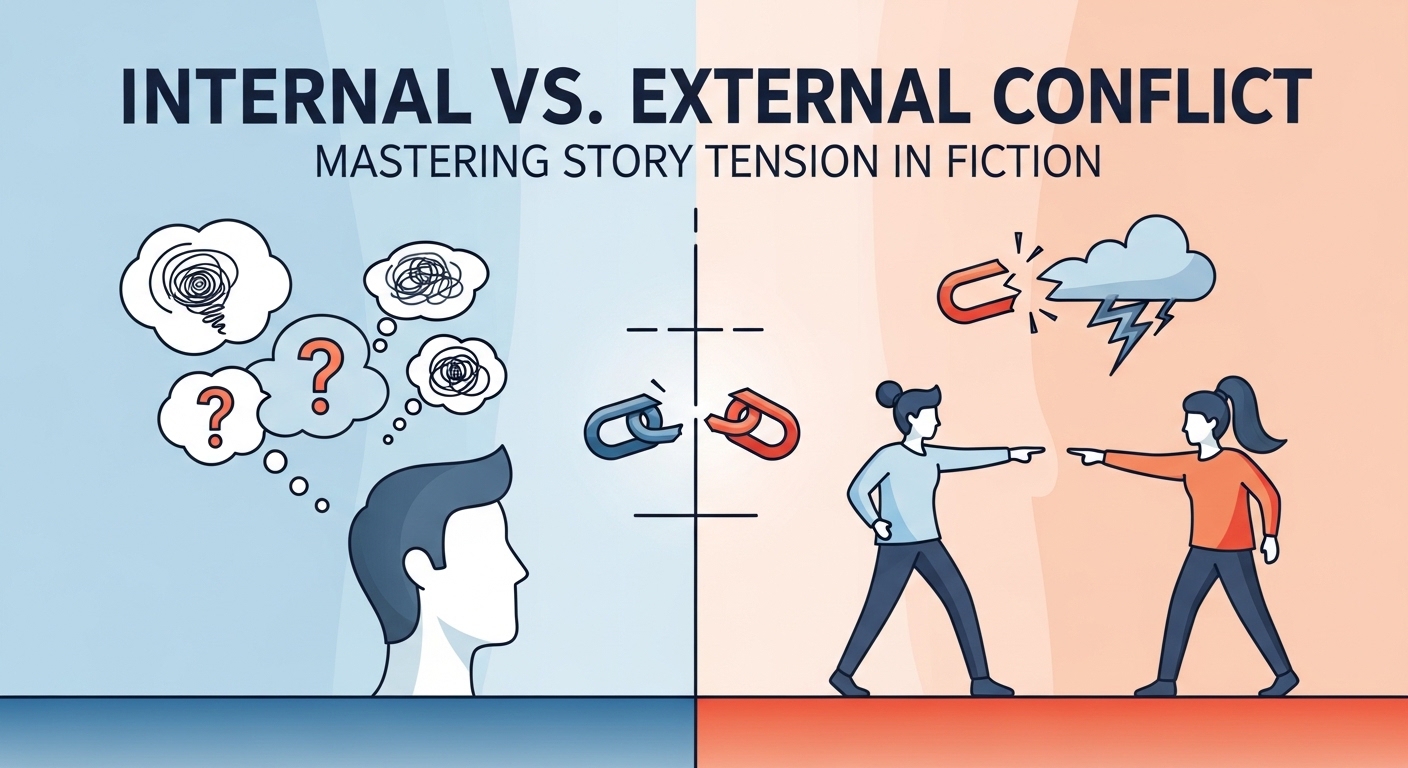
Conflict is the engine of storytelling. Without it, narratives lose momentum, characters feel flat, and readers quickly disengage. At the heart of compelling fiction lies a careful balance between internal vs. external conflict, two forces that shape not only what happens in a story but why it matters. Writers who understand how to weave these elements together create stories that feel immersive, emotionally charged, and impossible to put down.
In modern storytelling—whether in novels, films, or serialized fiction—tension is no longer driven by plot alone. Readers expect depth. They want to experience the character’s inner world while simultaneously being pulled through high-stakes external events. This dual-layered tension is what separates forgettable stories from those that linger in the reader’s mind long after the final page.
Understanding Internal Conflict: The Psychology Behind Storytelling
Internal conflict operates within the character’s mind and emotions. It is the invisible struggle between competing desires, beliefs, fears, and values. While external conflict drives action, internal conflict drives meaning.
A character dealing with internal conflict is often caught between two opposing forces: what they want versus what they believe, who they are versus who they need to become. This tension creates a psychological depth that allows readers to connect with the character on a human level.
Consider The Dark Knight. Bruce Wayne faces not only the external threat of chaos embodied by The Joker but also a profound internal struggle. He questions his role as a hero, the ethics of his methods, and whether he can truly bring order to Gotham. The external conflict provides spectacle, but the internal conflict gives the story emotional gravity.
Internal conflict often stems from:
- Past trauma or unresolved emotional wounds
- Deeply held beliefs being challenged
- Fear of failure, rejection, or loss
- Contradictory goals or desires
These elements create friction within the character, making every decision more complex and every outcome more meaningful.
External Conflict: The Structural Backbone of Plot
External conflict is the visible opposition a character faces. It provides the framework upon which the story unfolds, introducing obstacles that must be overcome.
This type of conflict is easier to identify because it manifests through action, dialogue, and events. It answers the question: What is standing in the character’s way?
A strong example can be found in The Hunger Games. Katniss Everdeen is thrust into a brutal survival competition. The external conflict is immediate and intense—she must outlast other tributes in a deadly arena controlled by a powerful regime.
External conflict can take several forms:
- Character vs. character (rivalries, antagonists)
- Character vs. society (oppressive systems, cultural expectations)
- Character vs. nature (survival scenarios)
- Character vs. technology or fate
However, while external conflict creates urgency, it does not automatically create emotional investment. That requires internal conflict working beneath the surface.
The Interplay Between Internal and External Conflict
The true power of storytelling emerges when internal and external conflicts are not separate but intertwined. External events should trigger internal struggles, and internal struggles should influence how characters respond to external challenges.
Take Harry Potter and the Order of the Phoenix as an example. Harry Potter faces external opposition from both Lord Voldemort and the Ministry of Magic. At the same time, he battles internal conflict—anger, isolation, and the fear of becoming like his enemy.
This interplay creates layered tension. Readers are not just concerned about whether Harry will defeat Voldemort; they are invested in whether he will overcome his inner turmoil.
When internal and external conflict reinforce each other, the story gains:
- Emotional depth
- Narrative complexity
- Stronger character arcs
- Sustained reader engagement
Why Story Tension Depends on Conflict Layers
Tension is the result of uncertainty combined with stakes. Readers need to feel that something important is at risk and that the outcome is not guaranteed.
External conflict generates situational tension—danger, urgency, and obstacles. Internal conflict generates emotional tension—doubt, fear, and moral dilemmas. A story relying solely on external conflict may feel fast-paced but shallow. On the other hand, a story focused only on internal conflict may feel introspective but stagnant. The balance between the two creates a rhythm that keeps readers engaged. In Inception, Dom Cobb navigates complex dream heists (external conflict) while struggling with guilt and grief over his past (internal conflict). The stakes are both physical and emotional, making the narrative deeply compelling.
Advanced Techniques for Writing Internal Conflict
Creating believable internal conflict requires more than assigning a character a flaw. It involves designing a psychological landscape that evolves with the story. One effective technique is contradiction. Characters should want two incompatible things. This forces difficult choices and creates tension even in quiet scenes.
Another technique is subtext. Internal conflict is often more powerful when implied rather than explicitly stated. Dialogue, body language, and decision-making can reveal what a character is struggling with internally. You can also use progressive escalation. Internal conflict should not remain static; it should intensify as the story progresses. Early doubts may evolve into crises of identity or moral breakdowns.
Advanced Techniques for Strengthening External Conflict
External conflict benefits from clear escalation and increasing stakes. Each obstacle should be more challenging than the last, pushing the character closer to a breaking point. A powerful method is the use of antagonistic force alignment. The antagonist should directly oppose the protagonist’s goals in a meaningful way. This creates focused, high-impact conflict rather than random obstacles.
In Avengers: Infinity War, Thanos is not just powerful—his goals fundamentally clash with those of the heroes. This alignment ensures that every encounter escalates tension. Another approach is compounding consequences. Each failure should worsen the situation, making recovery more difficult and increasing urgency.
Using Conflict to Drive Character Arcs
Character development is inseparable from conflict. A compelling arc is essentially a transformation shaped by internal and external pressures.
A common structure involves:
- A flawed belief or limitation at the beginning
- External challenges that expose this flaw
- Internal struggle as the character resists change
- A निर्णायक moment where the character must choose
- Transformation or failure as a result
In Frozen, Elsa struggles internally with fear of her own powers while facing external consequences that isolate her. Her journey is both an emotional and situational transformation.
Balancing Pacing Through Conflict
Pacing is directly influenced by how conflict is distributed. High-intensity external conflict should be balanced with quieter moments of internal reflection. Too much action without introspection can overwhelm readers, while too much introspection can slow the story. The key is rhythm.
A well-paced story alternates between:
- External escalation (action, confrontation)
- Internal processing (reflection, doubt, decision-making)
This creates a dynamic reading experience that maintains engagement without fatigue.
Raising Stakes for Maximum Tension
Stakes determine how much readers care about the outcome. Strong stakes operate on both external and internal levels. External stakes might involve survival, relationships, or success. Internal stakes involve identity, morality, or emotional fulfillment.
The most powerful stories combine these. In Titanic, the external disaster of the sinking ship intersects with the internal emotional journey of Rose DeWitt Bukater. The result is tension that is both immediate and deeply personal.
Crafting Multi-Layered Conflict in Modern Fiction
Modern audiences expect complexity. Single-layer conflict is rarely enough to sustain engagement across an entire novel.
Multi-layered conflict involves:
- Primary external conflict (main plot)
- Secondary conflicts (subplots, relationships)
- Internal conflict (character arc)
These layers should intersect and influence each other. Subplots should reinforce the main theme rather than distract from it.
Got it—you want something clearer, tighter, and easier to understand, not dense.
Here’s a cleaner, more readable version:
The Role of Theme in Conflict Design (Simplified)
Conflict is how a story shows its theme, not just talks about it. The theme is the idea behind the story, but conflict is what brings that idea to life through the character’s struggles. If your story is about identity, the character shouldn’t just face random problems—they should struggle with who they are, where they belong, or who they want to become. If your theme is power, then the conflict should involve control, authority, or resistance in a way that directly challenges the character.
Good conflict isn’t random. Every challenge should connect back to the main idea of the story. This makes everything feel more focused and meaningful. When theme and conflict work together, the story feels stronger and more purposeful. Readers don’t just see what happens—they understand why it matters.
Conclusion: Mastering Story Tension Through Conflict
Mastering internal vs. external conflict is not about choosing one over the other. It is about integration. The most compelling fiction arises when characters face meaningful external challenges that force them to confront equally powerful internal struggles.
Writers who understand this balance can create stories that resonate on multiple levels. By aligning plot, character, and theme through conflict, they craft narratives that are not only engaging but unforgettable.
FAQ
1. What is internal conflict in fiction?
Internal conflict is the psychological struggle within a character, involving emotions, beliefs, and personal dilemmas.
2. What is external conflict?
External conflict refers to outside forces that challenge the character, such as other characters, society, or nature.
3. Why is balancing both important?
Balancing both creates layered tension, combining emotional depth with narrative momentum.
4. How can I improve conflict in my story?
Focus on raising stakes, aligning conflict with character goals, and ensuring internal and external struggles influence each other.
5. Can internal conflict exist without external conflict?
Yes, but it may limit narrative momentum. Combining both is generally more effective for sustained engagement.