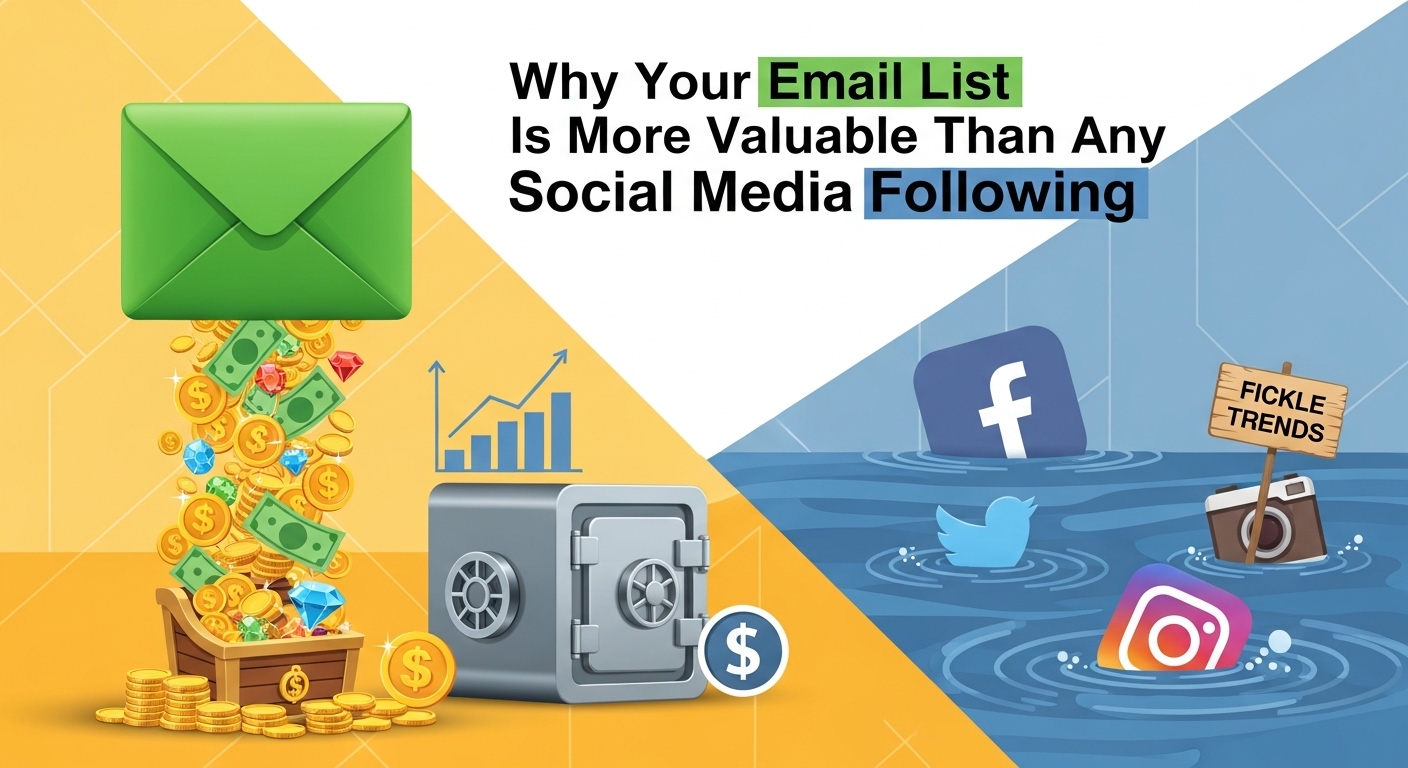
Modern digital marketing often confuses visibility with control, and audience size with audience value, even though these concepts behave very differently when examined through the mechanics of how platforms actually distribute content. Social media has created the illusion that followers represent guaranteed reach, but in reality, follower counts exist inside systems that determine visibility dynamically based on engagement predictions, platform priorities, and monetization structures that do not necessarily align with the interests of creators or businesses. This means that even a large audience does not guarantee that a message will actually reach the people who chose to follow it, because the distribution layer is not stable or neutral.
Email operates on an entirely different principle. Instead of relying on algorithmic interpretation, it creates a direct communication channel between sender and subscriber, where access is granted explicitly and maintained independently of platform systems. This distinction between rented attention and owned communication is what ultimately determines long-term value, consistency, and revenue potential in digital strategy.
To understand why email consistently outperforms social media in business impact, it is necessary to examine not just surface-level engagement metrics, but the underlying structural mechanics that govern attention, trust, and conversion.
The Fundamental Difference Between Ownership and Platform Dependency
Social Media as Algorithm-Controlled Distribution
Social media platforms function as closed environments where content distribution is determined by algorithmic ranking systems that evaluate user behavior, predicted engagement, and platform-level optimization goals. This means that content is not distributed evenly or predictably, even among followers, because visibility is continuously adjusted based on how the platform interprets relevance at a given moment.
In practice, this creates a situation where:
- Followers are not guaranteed viewers
- Engagement is inconsistent across posts
- Reach fluctuates even when audience size remains stable
This dependency on algorithmic interpretation introduces volatility that makes long-term planning difficult, especially for businesses that rely on predictable communication.
Email as a Direct Access Channel
Email removes this intermediary layer entirely. Once a user subscribes, communication occurs through a direct inbox connection that is not influenced by engagement-based filtering systems. Messages are delivered based on subscription status rather than algorithmic prioritization.
This creates a fundamentally different structure where:
- Reach is predictable rather than variable
- Communication is controlled by the sender
- Audience access remains stable over time
The result is not just improved delivery, but a shift in control dynamics that affects every aspect of digital strategy.
Why Social Media Followers Do Not Guarantee Real Attention
Algorithmic Filtering and Visibility Loss
One of the most misunderstood aspects of social media growth is the assumption that following an account guarantees exposure to its content. In reality, platforms filter content aggressively, prioritizing posts that maximize engagement signals rather than ensuring equal distribution across all followers.
This means visibility depends on factors such as:
- Historical engagement behavior
- Content format preferences
- Time-of-day interaction patterns
- Platform monetization incentives
Even highly engaged followers may not consistently see content, which breaks the assumed relationship between audience size and actual reach.
Attention Fragmentation Across Feeds
Social media environments are designed to maximize time spent on platform, which leads to highly competitive attention ecosystems. A single feed contains a mixture of content types competing for limited cognitive attention.
This includes:
- Friends’ updates
- Sponsored advertisements
- Recommended content
- Viral media trends
Because of this saturation, individual posts must compete not only with direct competitors but with unrelated content optimized for engagement, reducing sustained attention on any single creator.
Why Email Marketing Produces Consistent Reach and Engagement
Inbox Delivery Without Algorithmic Interference
Email communication bypasses feed-based ranking systems entirely. When a message is sent, it is delivered directly to subscribers’ inboxes, subject only to basic filtering mechanisms such as spam detection rather than engagement-based suppression.
This creates a stable delivery environment where reach is determined by:
- Subscriber retention
- Email deliverability health
- Sender reputation
Unlike social platforms, reach does not fluctuate based on content performance metrics alone.
Intent-Based Audience Behavior
Email subscribers represent an intent-driven audience because they voluntarily opt into receiving communication. This opt-in behavior signals a higher level of interest compared to passive social media following.
In general, email audiences exhibit:
- Higher engagement rates
- Stronger content relevance perception
- Greater willingness to take action
This is not accidental—it is a direct result of audience self-selection.
Occasional Bullet Point Summary for Clarity
While email’s advantages are structural, they can be summarized as:
- Direct communication without algorithm interference
- Higher intent due to opt-in behavior
- Consistent visibility across time
- Stable long-term audience access
These factors combine to create a communication channel that behaves predictably even as audience size scales.
Conversion Efficiency: Why Email Outperforms Social Media
Pre-Qualified Audience Dynamics
Email subscribers are typically pre-qualified leads because they have already expressed interest in receiving updates. This creates a natural filter that improves conversion probability before any marketing message is sent.
Unlike social media audiences, where engagement is often passive or incidental, email audiences are already partially committed to the communication relationship.
Focused Attention Environment
Email operates in a low-distraction environment compared to social feeds. There are no competing posts, suggested content loops, or algorithmic interruptions within the message view itself, which allows for deeper cognitive processing of the content.
This increases:
- Reading completion rates
- Click-through behavior
- Conversion likelihood
Structured Communication Sequences
Email allows for sequential messaging systems that build persuasion over time rather than relying on single exposure interactions. These include onboarding flows, nurture sequences, and promotional campaigns that guide subscribers through structured decision-making pathways.
Email as a Compounding Business Asset
Long-Term Value Accumulation
Unlike social media posts that reset visibility with each new publication, email lists accumulate value over time. Each subscriber adds to a database that can be reactivated repeatedly, making the list increasingly valuable as it grows.
Reusability of Audience Without Dependency
An email list can be activated for multiple purposes without rebuilding visibility from scratch. This includes:
- Product launches
- Educational campaigns
- Promotional offers
- Brand updates
This reusability transforms email from a communication tool into an infrastructure asset.
Trust Formation and Relationship Depth
Private Communication Enhances Perceived Value
Email feels more personal because it exists within a private communication channel rather than a public feed. This perception increases attention quality and message seriousness.
Consistency Builds Authority Over Time
Repeated communication through email reinforces familiarity. Familiarity increases trust, and trust directly influences conversion behavior.
Monetization Efficiency and Revenue Control
Direct Monetization Pathways
Email enables direct monetization without platform dependency. Businesses can send offers, launch products, and promote services without needing algorithmic amplification.
Higher Revenue Per Subscriber
Because email audiences are more intentional and engaged, each subscriber typically generates more revenue over time compared to a social media follower.
Comparative Analysis of Email vs Social Media
| Factor | Email List | Social Media Following |
| Ownership | Full control | Platform-controlled |
| Visibility | Stable | Algorithm-dependent |
| Conversion | High | Variable |
| Longevity | Long-term asset | Short-term exposure |
| Monetization | Direct | Indirect |
This comparison highlights a consistent pattern: email consistently outperforms social media in control, predictability, and revenue efficiency.
Strategic Role in Modern Marketing Systems
Social media and email are not interchangeable systems; they serve different roles within a complete digital strategy. Social media primarily functions as an acquisition channel for attention, while email functions as a retention and conversion engine.
A sustainable strategy typically follows this structure:
- Social media attracts attention
- Email captures and owns attention
- Email converts attention into revenue
Without email, social media attention remains fragmented and difficult to monetize consistently.
Conclusion: Why Email Lists Define True Audience Value
The distinction between email lists and social media followers ultimately comes down to control, stability, and economic predictability. Social media provides exposure but does not guarantee access, while email provides direct ownership of communication with an audience that has explicitly opted in to receive messages.
This makes email not just a marketing channel, but a foundational business asset that compounds in value over time, supports predictable revenue systems, and protects against the volatility inherent in algorithm-driven platforms.
In practical terms, social media builds visibility, but email builds businesses.
FAQs
Why is an email list more valuable than social media followers?
Because it provides direct, stable access to an opt-in audience without algorithmic interference, making communication and conversion more reliable.
Do social media followers still matter?
Yes, but primarily for visibility and discovery rather than long-term ownership or predictable revenue generation.
How does email improve conversion rates?
Email improves conversion by targeting pre-qualified audiences in a focused environment with sequential messaging capabilities.
Is email marketing still relevant today?
Yes, it remains one of the highest ROI channels due to direct audience access and consistent engagement behavior.
What is the main advantage of email over social media?
Ownership of audience and control over communication without reliance on external platforms.