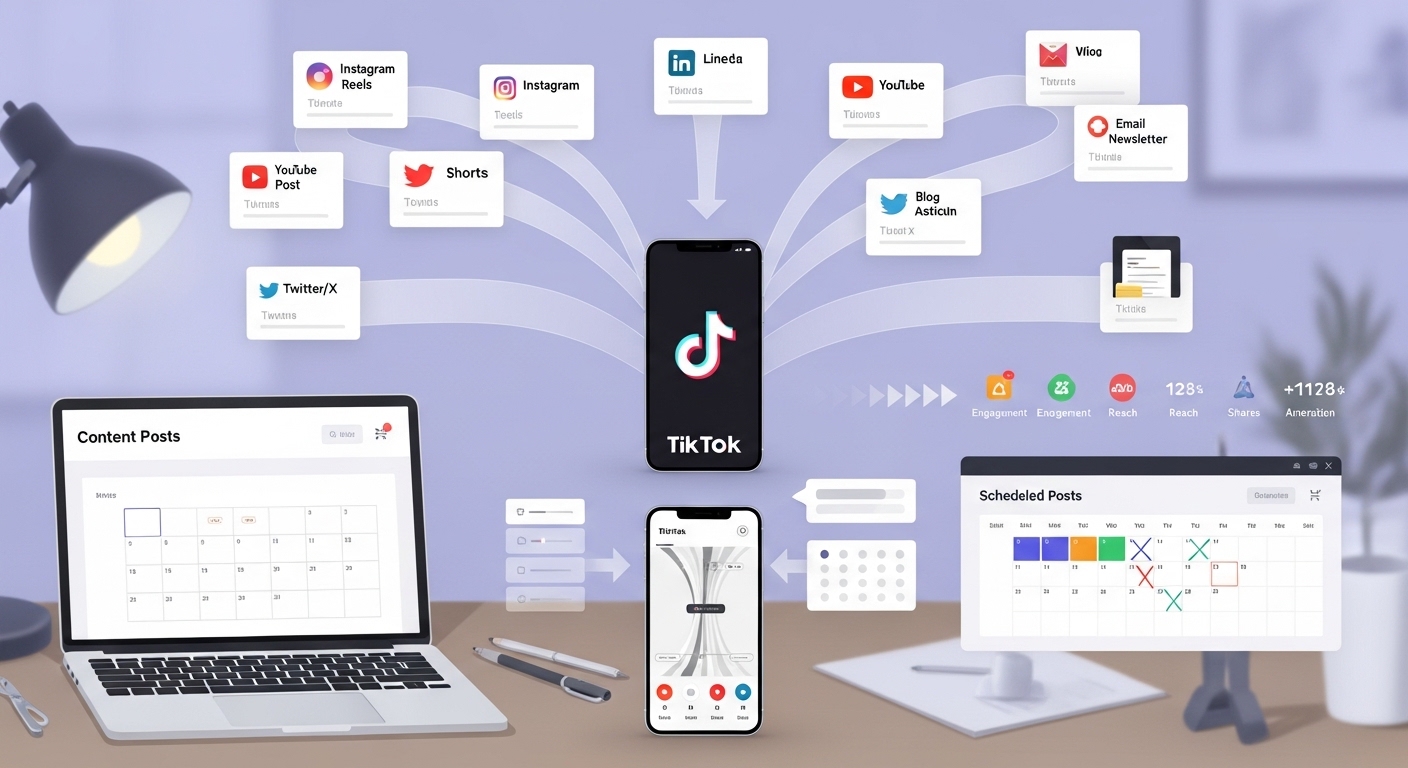
Content creation today is less about originality in isolation and more about strategic distribution of ideas across multiple platforms. Most creators operate under the pressure of constant output, believing they need a new idea for every post, every day, on every platform. This mindset leads to burnout, inconsistency, and often, mediocre execution.
In reality, high-performing creators and brands do something very different. They extract maximum value from a single piece of content by systematically adapting it across platforms. Instead of creating more, they multiply what already exists.
A single TikTok video is often treated as a standalone post, but in a structured system, it becomes the foundation for an entire week of marketing content. The idea is not repetition but transformation—each platform receives a version tailored to its format, audience behavior, and algorithmic preferences.
This approach reframes content from being disposable to being expandable. One idea is no longer one post; it becomes a content ecosystem that works across video, text, long-form, and email channels.
Understanding Content Repurposing
Content repurposing is the process of transforming a single piece of content into multiple formats while preserving its core message. It is not duplication. It is adaptation.
Most creators misunderstand repurposing and simply repost identical content across platforms. This rarely works because each platform has its own consumption behavior, content structure, and engagement patterns.
Instead, effective repurposing focuses on reshaping content to match context while maintaining the original insight. A TikTok video, for example, may be fast-paced and emotional, while a LinkedIn post derived from it will be reflective and analytical.
The goal is not to say the same thing everywhere—it is to say the same idea in different languages of content.
Key principles of content repurposing include:
- Preserving the core message while changing format
- Adapting tone to platform-specific audiences
- Extracting multiple content angles from one idea
- Extending content lifespan beyond a single post cycle
When executed properly, repurposing turns content creation into a leverage system rather than a repetitive task. One idea can fuel multiple days, platforms, and audience touchpoints without requiring additional conceptual effort.
Why TikTok Works as a Content Foundation
TikTok is uniquely suited to serve as a content “seed” because of how it compresses storytelling into short, high-impact formats. Unlike long-form platforms that require structured planning, TikTok thrives on immediacy, clarity, and emotional engagement.
A typical strong TikTok contains multiple reusable components that can later be extracted and expanded into separate content pieces.
Core elements inside a TikTok often include:
- A strong attention-grabbing hook in the first seconds
- A problem, insight, or narrative structure
- A single clear idea or transformation
- A conclusion or call-to-action
Each of these elements can independently become its own content asset when repurposed correctly. The hook can become a headline, the insight can become a blog section, and the narrative can be expanded into a thread or newsletter.
Another reason TikTok works well as a foundation is its feedback loop. Performance data arrives quickly, allowing creators to identify which ideas resonate before investing in deeper repurposing.
Benefits of using TikTok as a content seed include:
- Fast validation of ideas through engagement
- High-density storytelling in short format
- Easy extraction of scripts and transcripts
- Strong emotional and visual hooks for adaptation
This makes TikTok not just a platform, but a starting engine for a broader content system.
The Content Repurposing Framework
A structured approach is necessary to turn one TikTok into a full week of content. Without a system, repurposing becomes inconsistent and inefficient. The framework can be understood in four stages: deconstruction, mapping, transformation, and scheduling.
Deconstruction involves breaking the TikTok into its smallest meaningful parts. This allows you to see the content not as a video, but as modular components that can be reused.
Key breakdown elements include:
- Hook or opening line
- Core message or idea
- Supporting explanation or story
- Emotional trigger or insight
- Call-to-action or conclusion
Once broken down, the next step is mapping. Each component is assigned to a platform where it fits best based on audience behavior and format.
Mapping examples include:
- Hook → LinkedIn opening line or blog headline
- Core idea → Instagram caption or X thread theme
- Story → Blog expansion section
- Insight → Email newsletter core message
Transformation comes next, where each version is rewritten or restructured rather than copied. This ensures alignment with platform expectations and improves engagement performance.
Finally, scheduling turns repurposing into a system rather than a reactive process. Content is distributed across multiple days to maintain consistency and maximize reach.
Framework summary:
- Break content into core components
- Assign components to platforms
- Rewrite for each platform context
- Schedule across a 7-day cycle
Turning One TikTok Into a 7-Day Content System
A single TikTok can be strategically extended into a full week of content by assigning each day a distinct platform adaptation. This ensures consistent visibility without requiring new ideas every day.
Day 1: TikTok (Core Content)
The week begins with the original TikTok, which acts as the foundation. This version should prioritize clarity and engagement, focusing on a strong hook and a single clear idea.
The goal is to maximize immediate performance while generating reusable material.
Key focus areas:
- Strong opening hook
- Clear single message
- Emotional or practical value
- Engagement-driven CTA
Once published, the content is transcribed and analyzed for repurposing.
Day 2: Instagram Reel + Story Breakdown
On the second day, the TikTok is adapted into an Instagram Reel. While the video remains similar, minor adjustments improve platform alignment, such as pacing and caption structure.
Instagram Stories are then used to break the idea into smaller pieces, creating additional touchpoints with the audience.
Key adaptations include:
- Adjusted pacing for Instagram consumption behavior
- Caption optimization for clarity and engagement
- Story slides breaking down key insights
- Interactive elements like polls or questions
Day 3: YouTube Shorts Adaptation
YouTube Shorts requires optimization for search and retention. The same TikTok content is re-edited with a stronger emphasis on discoverability and structured engagement.
Unlike TikTok, YouTube Shorts benefits from clearer metadata and keyword-driven presentation.
Optimization focus:
- SEO-friendly title structure
- Strong retention-focused opening
- Clear topic positioning
- Improved description formatting
Day 4: X (Twitter) Thread Expansion
By day four, the content shifts into text-based storytelling. The TikTok script is expanded into a structured thread on X, where each tweet represents a segment of the original idea.
This format allows for deeper explanation and narrative progression.
Typical thread structure:
- Hook tweet to capture attention
- Context-setting tweets
- Value breakdown tweets
- Insight or takeaway conclusion
Day 5: LinkedIn Insight Post
LinkedIn requires a professional reframing of the same idea. The TikTok concept is positioned as a lesson, observation, or business insight rather than entertainment content.
The tone becomes more reflective and structured, focusing on credibility and value.
Key adjustments include:
- Professional tone adaptation
- Emphasis on business or productivity relevance
- Simplified storytelling with insight focus
- Reduced emotional exaggeration
Day 6: Blog Post Expansion
At this stage, the content is expanded into a long-form blog post. The TikTok serves as the central thesis, while the blog adds depth, examples, and structured explanation.
This transformation turns a short video into evergreen SEO content.
Blog expansion elements:
- Structured headings and subtopics
- Detailed explanations of core idea
- Supporting examples and applications
- SEO optimization for discoverability
Day 7: Email Newsletter Version
The final transformation converts the TikTok into an email newsletter. This version is more personal, conversational, and direct, designed to build connection and drive action.
Unlike public platforms, email allows for intimacy and focused messaging.
Newsletter structure:
- Personal introduction or framing
- Core idea from TikTok
- Simplified explanation
- Key takeaway or reflection
- Call-to-action or closing note
Platform Optimization Principles
Each platform interprets content differently, which makes adaptation more important than duplication. A successful repurposing system respects these differences rather than ignoring them.
Key optimization differences include:
- TikTok: fast pacing, emotional hooks, trend-driven engagement
- Instagram: visual storytelling and aesthetic presentation
- YouTube Shorts: searchability and retention optimization
- X: structured thinking and thread-based storytelling
- LinkedIn: professional insight and credibility building
- Email: personal connection and conversion focus
Understanding these differences ensures that content performs optimally in each environment rather than being diluted through repetition.
Tools and Systems for Scaling Repurposing (Detailed)
Repurposing content manually is feasible at a small scale, but it becomes inefficient and inconsistent as content volume increases. When creators or brands attempt to manage multiple platforms without a structured system, the process quickly turns into fragmented work—copying, rewriting, reformatting, and posting without a clear workflow. To scale effectively, repurposing must shift from an ad-hoc creative activity into a repeatable system. This is where tools and structured workflows become essential. They reduce manual effort, maintain consistency, and ensure that every piece of content passes through the same transformation pipeline.
Core Tools That Enable Efficient Repurposing
A scalable repurposing system relies on a combination of tools, each serving a specific function in the content lifecycle. Instead of treating content creation as a single task, these tools break it into manageable stages.
1. Transcription Tools
Transcription tools convert video content into written text, which becomes the foundation for repurposing. Since TikTok and similar platforms are primarily video-based, transcription is the first step in unlocking reusable content.
These tools allow creators to extract:
- Spoken scripts from videos
- Key phrases and hooks
- Natural language storytelling structure
- Raw material for rewriting
Once transcribed, the content is no longer locked in video format—it becomes editable and adaptable for blogs, threads, emails, and captions.
2. AI Writing and Adaptation Tools
AI tools are used to transform raw transcripts into platform-specific versions. Instead of manually rewriting content multiple times, AI helps generate variations tailored to different formats and tones.
These tools are typically used for:
- Rewriting TikTok scripts into blog sections
- Converting spoken language into professional tone
- Creating multiple variations of the same idea
- Adjusting length and complexity for different platforms
The value here is not automation alone, but speed of iteration. Creators can test multiple versions quickly before finalizing content.
3. Scheduling and Publishing Platforms
Once content is adapted, it must be distributed efficiently across platforms. Scheduling tools allow creators to plan and automate publishing rather than manually posting in real time.
These platforms help with:
- Multi-platform posting from a single dashboard
- Pre-scheduling content for optimal timing
- Maintaining consistent publishing frequency
- Reducing manual posting workload
This ensures that repurposed content is not only created but also systematically delivered.
4. Content Management Systems (CMS)
A CMS acts as the central hub for organizing ideas, scripts, drafts, and published content. Without organization, repurposing becomes chaotic, especially when one idea generates multiple outputs.
A strong CMS supports:
- Tracking content from idea to publication
- Organizing assets by platform and format
- Storing reusable content components
- Maintaining version control for adaptations
This creates visibility across the entire content pipeline, making it easier to manage scaling efforts.
5. Template Libraries
Templates are one of the most powerful but underrated systems in repurposing workflows. Instead of reinventing structure each time, templates provide repeatable frameworks for different content formats.
Common template types include:
- TikTok script structures
- LinkedIn post frameworks
- X (Twitter) thread formats
- Blog outline structures
- Email newsletter layouts
By using templates, creators reduce cognitive load and ensure consistency across all repurposed content.
The Structured Repurposing Workflow
Tools alone are not enough. They must be integrated into a clear workflow that defines how content moves from creation to distribution. A structured system ensures that every piece of content follows the same transformation path.
A typical repurposing workflow includes:
Step 1: Record TikTok Content
The process begins with creating the original short-form video. This serves as the “source asset” that will be repurposed across all platforms.
Step 2: Transcribe and Extract Script
The video is converted into text using transcription tools. This step unlocks the raw material for repurposing and allows deeper analysis of the content structure.
Step 3: Break Content into Components
The transcript is divided into key elements such as hook, main idea, supporting points, and conclusion. This modular breakdown makes adaptation easier and more precise.
Step 4: Adapt Using Templates
Each component is then rewritten using platform-specific templates. This ensures that every version fits the expectations of its target audience and format.
Step 5: Schedule Across Platforms
Finally, the adapted content is distributed using scheduling tools. Each version is assigned to a platform and publication time, creating a structured content calendar.
Why Systems Matter More Than Individual Tools
While tools improve efficiency, systems ensure scalability. A tool helps you complete a task faster, but a system determines how consistently and effectively that task is repeated over time. Without a system, repurposing becomes fragmented—some content gets adapted, some gets skipped, and consistency breaks down. With a system in place, every piece of content follows the same predictable pipeline.The real transformation happens when content creation is no longer treated as a creative scramble but as an operational workflow.
Benefits of a One-to-Many Content Strategy
The shift from single-use content to repurposed systems creates significant strategic advantages for creators and brands. It improves efficiency while increasing output reach.
A one-to-many content strategy fundamentally changes how content is produced and distributed. Instead of treating each idea as a single post with limited lifespan, it reframes every piece of content as a reusable asset that can generate multiple outputs across platforms. This shift reduces creative pressure while increasing strategic leverage.
Reduced Content Production Pressure
One of the most immediate benefits is the significant reduction in the constant pressure to “come up with something new.” In traditional content workflows, creators often operate in a cycle of daily ideation, creation, and posting, which leads to cognitive fatigue and inconsistent output quality.
With a one-to-many system, the workload shifts from idea generation to idea expansion. A single TikTok, for example, becomes the source material for multiple posts rather than requiring separate ideas for each platform.
This means:
- Less time spent brainstorming new concepts daily
- Reduced creative burnout and decision fatigue
- More structured and predictable content workflow
- Ability to focus on quality instead of constant output
Over time, this creates a more sustainable production rhythm where content creation feels systematic rather than reactive.
Increased Visibility Across Platforms
A major limitation of single-use content is that it only reaches one audience segment on one platform. A one-to-many strategy solves this by distributing the same core idea across multiple channels, each with its own audience behavior and discovery system.
This multiplies exposure without requiring additional conceptual effort.
In practice, this means:
- One idea appears in multiple feeds and ecosystems
- Different audience groups encounter the same message in different formats
- Platform algorithms independently amplify the content
- The probability of discovery increases significantly
Instead of relying on a single platform’s algorithm for reach, creators diversify visibility channels, which reduces dependency risk and improves overall brand presence.
Higher Return on Each Content Idea
In traditional content creation, the value of an idea is limited to the performance of a single post. Once published, its lifecycle often ends quickly. A one-to-many strategy changes this dynamic by extracting multiple assets from one core idea.
This effectively increases the “content ROI” because each idea generates several outputs instead of just one.
This leads to:
- More content pieces per idea without additional ideation cost
- Extended lifecycle of high-performing concepts
- Better utilization of research, scripting, and production effort
- Compounding value from strong ideas over time
In simple terms, instead of a 1:1 output ratio (one idea = one post), the system shifts toward a 1:many ratio where a single idea can fuel a week or more of content.
Improved Consistency in Messaging
Consistency is one of the most important factors in building a recognizable brand, but it is often difficult to maintain when content is created from scratch every time. Messaging tends to drift, tone varies, and strategic focus becomes fragmented.
A one-to-many approach solves this by anchoring all content variations to a single core idea. Every platform adaptation is derived from the same source, which ensures alignment across all channels.
This creates:
- Unified brand voice across platforms
- Repetition of core ideas in different formats (reinforcing retention)
- Stronger positioning through message consistency
- Reduced risk of contradictory or scattered communication
Instead of each post standing alone, every piece becomes part of a coordinated narrative system.
Better Audience Retention and Recognition
When audiences encounter the same core idea in multiple formats across different platforms, it strengthens memory retention and improves recognition. This is a psychological effect rooted in repeated exposure and contextual reinforcement.
Unlike simple repetition, this strategy uses variation with consistency, meaning the message stays the same while the delivery adapts.
This results in:
- Increased familiarity with brand ideas and messaging
- Higher likelihood of audience recall over time
- Stronger association between creator and core concepts
- More trust built through repeated exposure in different contexts
Over time, audiences begin to recognize not just individual posts, but the underlying themes and perspectives of the creator or brand. This is what turns content into identity rather than isolated communication.
Common Challenges and Solutions in Content Repurposing
Content repurposing is highly efficient, but it is not frictionless. Most difficulties arise not from the concept itself, but from execution—specifically how creators misinterpret adaptation as duplication or fail to account for platform-specific communication styles.
Perception of Repetition
One of the most common psychological barriers is the fear that repurposing the same idea across platforms will make the content feel repetitive or redundant. Creators often assume that audiences will notice and react negatively to seeing similar ideas multiple times.
In practice, this concern is usually overstated. Different platforms function as separate ecosystems with limited audience overlap. A user consuming content on TikTok may never see the LinkedIn version of the same idea, and vice versa. Even when overlap exists, context changes significantly enough that the content feels new.
The real issue is not repetition itself, but unintentional duplication without adaptation. When content is posted identically across platforms, it ignores user expectations and reduces engagement. However, when the same idea is reshaped, repetition becomes reinforcement rather than redundancy.
Key clarification points:
- Audience overlap between platforms is generally low
- Context changes how content is perceived
- Repetition becomes harmful only when format is not adapted
- Strategic repetition actually strengthens memory and recognition
In other words, the problem is not saying the same thing again—it is saying it the same way again.
Tone Inconsistency Across Platforms
Another major challenge is tone mismatch. Each platform has its own communication culture, and a message written for one environment often feels unnatural in another if not adjusted properly.
For example, TikTok content is typically casual, fast-paced, and emotionally driven. LinkedIn, on the other hand, expects structured reasoning, professional framing, and reflective insight. Email sits somewhere in between, requiring a personal but clear narrative tone.
When creators directly transfer content without adjusting tone, the result feels disconnected from the platform’s native style. This reduces trust, engagement, and readability.
Key aspects of tone inconsistency include:
- Overly casual content appearing unprofessional on business platforms
- Overly formal content feeling rigid on short-form social platforms
- Emotional tone not matching informational intent
- Lack of audience alignment in voice and delivery
The core issue is not the message, but the delivery mismatch between platform expectations and communication style.
Rewriting vs Copying Confusion
A frequent mistake in repurposing workflows is assuming that minor edits are enough. Many creators simply copy content and make superficial adjustments, such as shortening or reformatting sentences. This approach does not qualify as true repurposing.
Effective repurposing requires rewriting from the perspective of the target platform. This means reconstructing the message rather than reshaping the same sentence structure.
When content is properly rewritten, it adapts to:
- Platform-specific attention spans
- Reading or viewing behavior
- Content hierarchy expectations
- Algorithmic preferences
Copying preserves structure but breaks context. Rewriting preserves meaning while rebuilding structure.
Without this distinction, repurposed content often feels artificial or forced, reducing performance even if the idea itself is strong.
Lack of Structural Consistency
Another challenge is inconsistency in how content is formatted across platforms. Even when the message is correct, poor structure can make it difficult to consume or engage with.
Each platform has implicit formatting rules. TikTok relies on pacing and visuals. LinkedIn depends on paragraph clarity. X (Twitter) thrives on segmented thought progression. Email requires linear storytelling.
When these structural expectations are ignored, content becomes harder to follow, even if the idea is valuable.
Common structural issues include:
- Long unbroken paragraphs on fast-scrolling platforms
- Overuse of short fragments in long-form environments
- Missing hierarchy in information presentation
- Lack of visual or textual pacing
Structure is not cosmetic—it directly impacts how content is understood and retained.
Message Dilution Through Poor Adaptation
A subtle but serious challenge is message dilution. This happens when the core idea becomes weaker as it is adapted across platforms. Instead of reinforcing the original message, each version slightly distorts it until the central insight is no longer clear.
This typically occurs when creators prioritize format over meaning. In trying to fit content into different platforms, they unintentionally strip away important context or nuance.
Signs of message dilution include:
- Loss of clarity between versions
- Inconsistent framing of the same idea
- Over-simplification of key insights
- Weak or unclear takeaway
The solution is not simplification, but controlled adaptation—keeping the core idea intact while adjusting presentation.
Effective solutions include:
- Rewriting content fully for each platform instead of editing lightly
- Adjusting tone intentionally based on audience expectations
- Using structured templates to maintain consistency without rigidity
- Prioritizing message integrity over format similarity
These solutions ensure that content remains both consistent in meaning and optimized in performance.
Conclusion
Content creation becomes significantly more powerful when treated as a system rather than a series of isolated efforts. A single TikTok is not just a video—it is a multi-platform asset that can generate value for an entire week when properly repurposed.
he main reason these issues keep appearing is simple: creators try to reuse content directly instead of rebuilding it strategically. Repurposing only works when the idea is treated as stable, but the execution is flexible.
Once that distinction is understood, repetition stops being a risk, tone becomes manageable, and adaptation becomes a structured process rather than a creative struggle. By breaking down content into components, mapping it across platforms, and adapting it strategically, creators can move from constant production to structured amplification. This shift reduces burnout while increasing impact.
The real advantage lies not in creating more content, but in extracting more value from what already exists.