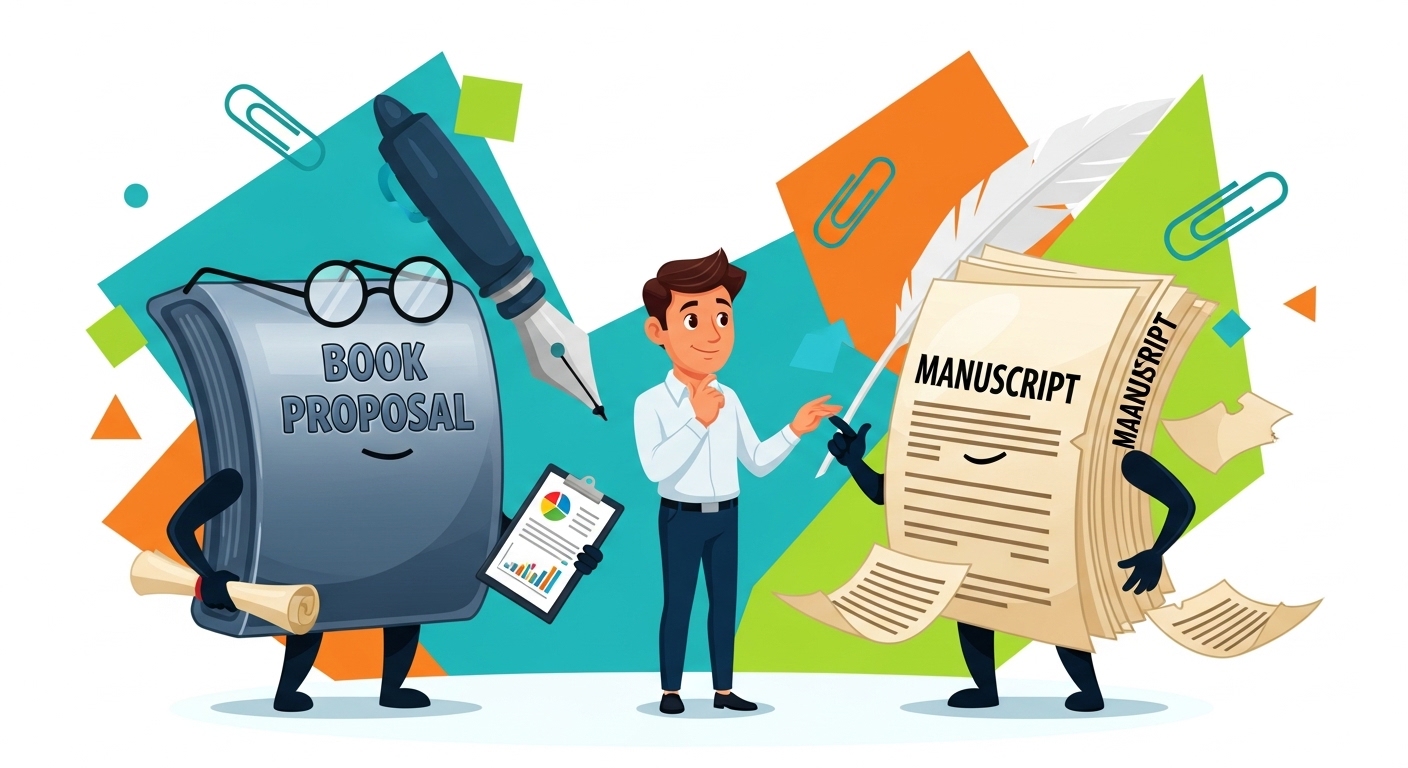
The confusion between a book proposal and a manuscript submission is one of the most persistent misunderstandings among new writers entering the publishing world. On the surface, both seem to serve the same purpose: getting a book noticed and eventually published. But in practice, they operate at completely different stages of the publishing process, answer different questions, and are evaluated using entirely different criteria.
Treating them as interchangeable can quietly undermine even a strong book idea. Publishers and agents are not just looking at what you have written—they are evaluating how you are presenting it, and whether you are speaking the correct “language” of submission at the right moment in the process.
To understand the difference properly, it helps to look at each one not as a document, but as a function within the publishing pipeline.
The Book Proposal: A Strategic Case for Why the Book Should Exist
A book proposal is not the book itself, nor is it a draft of the book. It is closer to a structured argument designed to convince industry professionals that a book deserves to exist in the market. It is used primarily in nonfiction publishing, where ideas, expertise, and market demand often matter as much as—or even more than—the finished manuscript.
When an agent or publisher reads a proposal, they are not evaluating storytelling quality. Instead, they are assessing whether the idea is commercially viable, whether it fills a gap in the market, and whether the author has the credibility or platform to carry the subject.
In that sense, a book proposal behaves like a business document disguised in creative language. It explains what the book will be, why it matters, and who it is for, without requiring the entire manuscript to be completed.
A strong proposal often contains several key components that work together to reduce uncertainty in the mind of the publisher:
- A clearly defined concept that explains the book’s central idea in precise terms
- A structured chapter outline that shows the direction and scope of the project
- Sample material that demonstrates tone, clarity, and writing ability
- A positioning section that situates the book within its competitive market
However, what matters more than the structure is the intent behind it. Every section exists to answer one underlying question: Is this book worth investing in before it is fully written?
The Manuscript Submission: The Completed Reality of the Book
A manuscript submission represents the opposite end of the publishing process. Instead of proposing an idea, it delivers the fully developed execution of that idea. It is the complete book in its finished or near-finished form, written in full and structured as the reader will eventually experience it.
Unlike a proposal, which asks for approval to proceed, a manuscript asks for evaluation of quality. At this stage, there is no abstraction or forecasting. The book either works as a finished piece of writing or it does not.
This is why manuscripts are essential in fiction publishing. A novel cannot be judged fairly based on an outline because the success of fiction depends on execution—voice, pacing, emotional depth, character development, and narrative tension. These elements only become visible when the full manuscript is read.
In nonfiction, manuscripts are often required when the content is highly narrative-driven, deeply researched, or already completed before submission. In such cases, the publisher is no longer evaluating potential—they are evaluating performance.
Where a proposal is predictive, a manuscript is definitive.
The Real Difference Lies in Function, Not Format
At a surface level, both documents are related to the same goal: publication. But their roles inside the publishing ecosystem are fundamentally different.
A book proposal functions as a persuasive tool designed to open a conversation. It is about convincing someone that a book should be written or acquired. A manuscript submission, on the other hand, is a proof-based document that determines whether the work meets editorial and commercial standards.
This difference becomes clearer when you consider what each one answers in the mind of an agent or publisher. A proposal answers whether the idea is worth pursuing, while a manuscript answers whether the execution is strong enough to publish.
This separation also explains why nonfiction and fiction are treated so differently in publishing. Nonfiction is often idea-led, meaning the concept itself carries commercial weight. Fiction is execution-led, meaning the writing itself is the product.
Why Publishers Treat Them as Separate Entry Points
Publishing is a risk-managed industry. Every acquisition involves financial, editorial, and market uncertainty. Because of this, publishers use different evaluation tools depending on what they are trying to measure.
In nonfiction, the proposal is often enough because it allows publishers to assess market demand, author expertise, and concept relevance before committing to a full manuscript. In fiction, however, no such shortcut exists because the success of the book depends entirely on how well it is written. This creates a natural division in submission strategy. The proposal reduces uncertainty about market viability, while the manuscript reduces uncertainty about creative quality.
The Most Common Misunderstandings Among Writers
Many new writers unintentionally blur the line between these two formats, which leads to avoidable rejection or weak submissions. One common mistake is treating a proposal like a shortened version of the book itself. This often results in excessive detail that dilutes the central pitch instead of strengthening it.
Another frequent issue is submitting a proposal for fiction where a full manuscript is expected. In such cases, the absence of complete storytelling makes it impossible for agents to evaluate the work properly.
There is also the opposite problem: sending a full manuscript for nonfiction without any framing or market positioning. While the writing may be strong, the lack of context can make it difficult for publishers to understand where it fits in the market landscape.
At its core, the issue is not quality but alignment—using the wrong format for the wrong stage of evaluation.
How to Think About the Decision Between Them
Choosing between a book proposal and a manuscript submission is not a matter of preference or convenience. It is a decision grounded in how publishing professionals evaluate value at different stages of acquisition. The key lies in understanding what is being assessed: potential or execution.
At a structural level, the publishing industry separates ideas that can be evaluated conceptually from works that must be evaluated experientially. This distinction determines whether a writer begins with a proposal or completes a full manuscript before approaching agents and publishers.
Understanding When a Book Proposal Is the Correct Entry Point
A book proposal becomes the appropriate starting document when the core value of the book exists in its idea, argument, or market relevance. In this scenario, publishers are not yet concerned with how the book reads from beginning to end. Instead, they are evaluating whether the concept is strong enough to justify development into a full-length work.
This is especially common in nonfiction publishing, where books are often built around expertise, frameworks, insights, or research-based arguments. In these cases, the “book” is essentially an expansion of a central idea rather than a pre-existing narrative structure.
A proposal is therefore used when the book can be understood, judged, and potentially acquired based on its conceptual strength alone. It allows publishers to assess demand, audience fit, and commercial viability before committing to production.
What a Proposal Is Evaluating
At this stage, the focus is not on literary completion but on strategic validation. A proposal is designed to answer questions such as whether the topic has a clear readership, whether the author is positioned to credibly deliver the material, and whether similar books already exist in the market.
It also allows publishers to determine whether the idea fills a gap or adds a new angle to an established category. In other words, the proposal is less about reading experience and more about market logic.
Understanding When a Manuscript Must Be Completed First
A manuscript becomes necessary when the value of the book cannot be separated from its execution. In these cases, the idea alone is insufficient for evaluation because the quality of the final written work is what defines success.
This is most common in fiction, narrative nonfiction, memoir, and other forms of writing where structure, voice, pacing, and emotional development are essential to the reader’s experience. Unlike concept-driven books, these works cannot be accurately assessed in abstract form.
A manuscript represents the complete realization of the book. It allows publishers to evaluate how effectively the story or argument unfolds across its entire structure, not just its premise.
What a Manuscript Is Evaluating
When reviewing a manuscript, publishers are focused on how the work performs in its finished state. This includes consistency of voice, narrative flow, structural coherence, and the ability to sustain engagement from beginning to end.
In fiction especially, this evaluation is critical because even a strong premise can fail if the execution does not deliver emotional or narrative impact. The manuscript is therefore the only reliable evidence of the book’s effectiveness.
The Core Principle That Separates Both Decisions
At the deepest level, the distinction comes down to how the book is meant to be sold internally within publishing systems. A proposal operates on persuasion—it sells the promise of a book that will be developed. A manuscript operates on demonstration—it proves that the book already exists in its completed form and functions as intended.
This is why the two formats are not interchangeable. They serve different cognitive roles in the decision-making process of agents and publishers.
A proposal is used when confidence in the idea is enough to move forward. A manuscript is required when confidence must be built through reading the complete work.
How This Distinction Shapes Publishing Decisions
This separation influences every stage of the publishing workflow, from initial agent review to final acquisition discussions. It determines what material is expected, how risk is assessed, and what criteria are used to approve a project.
In practical terms, it ensures that nonfiction projects are evaluated efficiently at the conceptual level, while fiction and narrative-driven works are judged based on their full artistic and structural execution.
Ultimately, understanding this distinction allows writers to approach publishing with clarity. Instead of guessing what to submit, they align their material with the exact stage of evaluation required by the industry.
One-Glance Comparison
| Element | Book Proposal | Manuscript Submission |
| Purpose | Sell the concept of the book | Present the completed book |
| Stage | Early / pre-writing or partial writing | Final or near-final stage |
| Focus | Market potential and positioning | Writing quality and execution |
| Evaluation basis | Commercial viability | Editorial assessment |
| Outcome | Potential acquisition | Publication decision |
FAQ: Book Proposal vs Manuscript Submission
Is a book proposal the same as a manuscript draft?
No. A proposal is not a draft of the book. It is a structured pitch that explains the concept, market position, and sample execution.
Can fiction be submitted through a proposal?
In most cases, no. Fiction requires a complete manuscript because publishers need to evaluate the full narrative execution.
Why do nonfiction books often use proposals instead of full manuscripts?
Because nonfiction is often concept-driven, publishers can evaluate demand and viability without requiring the entire book upfront.
Do agents prefer proposals or manuscripts?
It depends on genre. Agents working in nonfiction often prefer proposals, while fiction agents expect full manuscripts.
Which one should a new writer focus on first?
It depends on the book type. If the project is narrative-driven, focus on completing the manuscript. If it is idea-driven nonfiction, start with a proposal.
Final Perspective
The difference between a book proposal and a manuscript submission is not simply procedural—it reflects how publishing decisions are structured at a fundamental level. One exists to justify investment. The other exists to evaluate quality.
Understanding this distinction allows writers to approach publishing with far more precision. Instead of guessing what to send, they can align their work with industry expectations, improving both clarity and acceptance potential.
In publishing, timing and format matter almost as much as the writing itself.