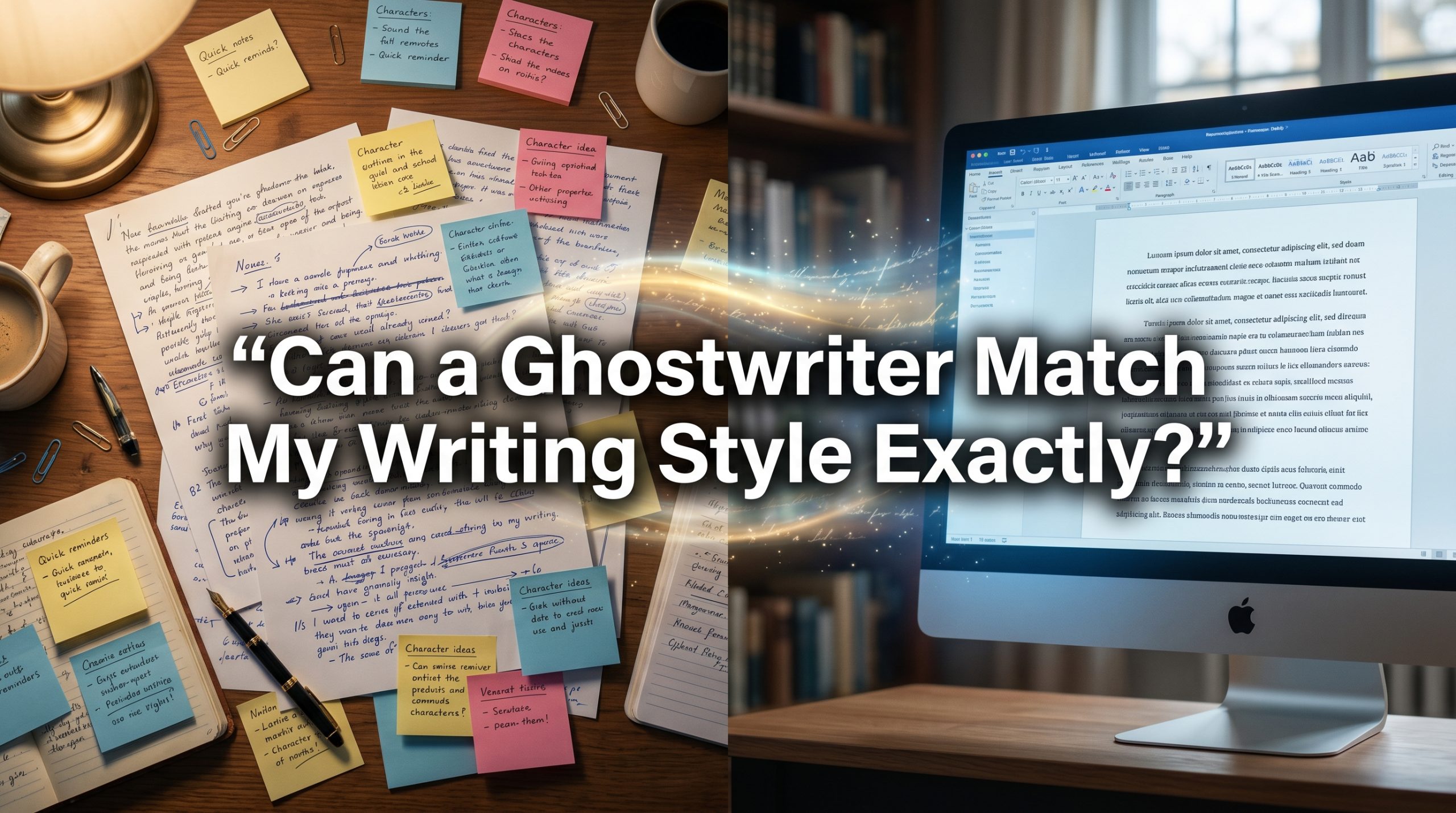
Hiring a ghostwriter is often a major decision for authors, entrepreneurs, executives, and professionals who want to transform ideas into polished, publication-ready content without personally managing every stage of the writing process. Whether the goal is a book, memoir, business manuscript, or thought leadership piece, a recurring concern emerges early in the process: can a ghostwriter genuinely replicate your writing style in a way that feels authentic and indistinguishable from your own voice?
This concern is rooted in the fact that writing is closely tied to identity. The rhythm of your sentences, the vocabulary you naturally choose, and the tone you consistently use all contribute to what readers recognize as your voice. Because of this, many people worry that outsourcing writing may dilute authenticity or create content that feels disconnected from their personality or brand.
This tension becomes even more relevant when writing is connected to broader goals such as publishing success and audience growth. For example, even in strategies like Building a Street Team to Market Your Book, consistency of voice matters because readers need to feel a genuine connection to the author behind the work. If the written material does not reflect that connection, even strong marketing efforts can lose impact.
In reality, professional ghostwriting is built precisely to preserve and replicate voice rather than replace it. The process is less about invention and more about careful observation, adaptation, and alignment with how you naturally communicate. Understanding how this works requires a closer look at what writing style actually consists of and how it can be accurately captured and reproduced.
What Writing Style Really Means
Many people assume writing style is simply about vocabulary or sentence structure. While those elements matter, writing style is much more complex than the words that appear on the page. Writing style is the combination of habits, choices, and patterns that define how you communicate ideas. It includes the rhythm of your sentences, your preferred level of detail, the way you organize thoughts, and the emotional tone that naturally emerges in your writing. Some writers communicate with directness and brevity. Their writing is concise, efficient, and focused on delivering information quickly. Others naturally write with reflection and depth, building ideas gradually and exploring concepts in detail.
Style also includes tone. Some writers sound conversational and approachable, while others project authority and formality. Some lean toward storytelling, using anecdotes to illustrate points, while others rely on analysis and logical structure. Even pacing contributes to style. Certain writers create momentum with shorter paragraphs and rapid transitions, while others use slower, more deliberate progression. Beyond these technical elements, writing style is influenced by personal experience, professional background, worldview, and emotional tendencies. This is what makes each writer’s voice distinctive. For a ghostwriter, matching style means understanding all of these layers rather than simply mimicking surface-level language patterns.
Why Matching Writing Style Is More Challenging Than It Appears
Replicating someone’s writing style is not as simple as copying their sentence length or repeating familiar phrases. The challenge lies in the fact that writing style often reflects subconscious habits. Most people are not fully aware of how they write. They do not consciously decide to use certain rhythms, transitions, or structures. These patterns develop naturally over years of communication. A writer may instinctively begin with context before introducing a conclusion. Another may present conclusions immediately and support them with examples afterward. Some naturally rely on metaphor, while others prefer straightforward explanation.
This creates one of the biggest challenges in ghostwriting. Clients often know when something feels wrong, but they may struggle to explain why. They might say the draft does not “sound like them” without being able to identify the exact issue. This is why style matching requires more than technical writing ability. It requires observation, analysis, adaptability, and often multiple rounds of refinement. A ghostwriter must identify the patterns the client cannot easily describe and translate them into written content that feels authentic.
How Professional Ghostwriters Learn Your Voice
Studying Existing Writing Samples
The foundation of voice matching begins with reviewing the client’s previous written work. Professional ghostwriters carefully examine blog posts, articles, books, speeches, newsletters, emails, and even social media captions to identify recurring stylistic patterns. This analysis helps reveal the writer’s natural sentence length, vocabulary preferences, pacing, and structural habits. By studying enough material, the ghostwriter can begin to understand how the client communicates ideas on the page. These writing samples act as a blueprint, offering valuable insight into the tone and rhythm that define the client’s voice and creating the groundwork needed for accurate style adaptation.
Analyzing Patterns and Building a Voice Profile
After collecting writing samples, ghostwriters analyze them in depth to identify consistent communication patterns. They pay close attention to sentence flow, paragraph structure, transitions, emotional tone, and the way ideas are introduced and developed. For instance, some writers naturally begin with storytelling before moving into analysis, while others prefer direct, structured explanations. These repeated habits help the ghostwriter create what is often called a voice profile. This profile becomes a practical reference point, allowing the ghostwriter to replicate not just surface-level wording but the deeper stylistic framework that shapes how the client naturally expresses ideas.
Conducting Interviews and Conversations
Written material alone cannot always reveal the full personality behind a client’s communication style. This is why interviews are such an important part of the process. Through direct conversation, ghostwriters gain insight into how clients explain concepts naturally when they are not consciously writing for publication. They observe tone, pacing, emphasis, vocabulary, and thought organization. The way a person speaks often uncovers expressions and communication habits absent from polished written work. These interviews help ghostwriters capture authenticity by translating natural spoken patterns into writing that feels personal, fluid, and true to the client’s intended voice.
Interpreting and Drafting the First Version
Once sufficient research has been gathered, the ghostwriter begins drafting. This first version is rarely expected to be perfect. Instead, it serves as an informed interpretation of the client’s style based on analysis and interviews. The ghostwriter applies the identified patterns to create content that reflects the client’s tone, rhythm, and structure as closely as possible. This stage requires both technical skill and intuition. The challenge is balancing accuracy with readability, ensuring the draft feels authentic while remaining polished. The first draft establishes the direction for the collaboration and provides a foundation for further refinement.
Refining Through Feedback and Revision
The final stage of voice adaptation happens through revision. Client feedback is essential because it highlights subtle differences between approximation and authenticity. A client may notice when phrasing feels too formal, when explanations unfold differently than they would naturally present them, or when the emotional tone feels slightly off. Each round of feedback helps the ghostwriter adjust and refine the writing. Over time, this collaborative process sharpens alignment. With every revision, the ghostwriter develops a stronger understanding of the client’s communication style, allowing the final content to sound increasingly natural, accurate, and fully representative of their voice.
Can a Ghostwriter Match Your Style Exactly?
Writing is dynamic. It shifts based on mood, purpose, audience, and context. Even if you were to write the same article twice, subtle stylistic differences would likely appear. This means expecting a ghostwriter to reproduce your voice with mechanical precision is unrealistic. However, this does not mean ghostwriters cannot capture your writing style successfully. A skilled ghostwriter can replicate the recognizable essence of your voice with remarkable accuracy. They can create content that reflects your tone, thought patterns, and communication habits so naturally that readers experience it as authentically yours.
Readers are not comparing every sentence against your previous work. They are asking whether the content feels consistent with your perspective and believable in your voice. In many cases, ghostwritten work can even feel stronger than self-written content because it combines your ideas with professional editorial precision.
The Factors That Influence Style-Matching Success
A ghostwriter’s ability to successfully capture your writing style depends on several important factors. While professional skill plays a major role, the quality of collaboration between the client and ghostwriter often determines how authentic the final result feels. Style matching is not something that happens automatically. It requires the right materials, clear communication, adaptability, and experience. Understanding these factors helps set realistic expectations and improves the likelihood of producing content that genuinely reflects your voice.
The Quality and Variety of Writing Samples
One of the most significant factors in successful style matching is the quality and range of writing samples provided by the client. A ghostwriter can only analyze what they are given. If the available material is limited to one short article or a few social media posts, it becomes difficult to identify consistent patterns in tone, sentence structure, pacing, and thought organization. On the other hand, a wide collection of blog posts, articles, speeches, emails, interviews, and longer-form writing gives the ghostwriter a much clearer picture of how the client naturally communicates across different contexts.
Variety is just as important as quantity. Writing often changes depending on the platform and audience. A professional article may sound very different from a personal email or an informal social media post. Seeing these variations helps the ghostwriter understand which stylistic qualities remain consistent regardless of format. These recurring traits form the foundation for accurate voice replication and allow the writer to identify the deeper habits that define your communication style.
The Specificity of Client Feedback
Even the most experienced ghostwriter relies on feedback to refine their understanding of a client’s voice. Specific feedback is essential because it provides direct guidance on what feels authentic and what does not. Simply stating that a draft “doesn’t sound right” offers very little insight into what needs adjustment. It leaves too much room for interpretation and often slows the revision process.
Constructive feedback should identify exactly what feels off. For example, telling a ghostwriter that the tone feels too formal, the language is more technical than you would use, or the pacing feels rushed gives them clear direction for revision. This level of detail helps the ghostwriter adjust with precision.
The revision stage is where style alignment becomes sharper. Each piece of thoughtful feedback reveals more about your natural communication preferences. Over time, this collaborative exchange allows the ghostwriter to move from approximation toward a much more accurate representation of your voice.
The Complexity of Your Writing Style
Not all writing styles are equally easy to replicate. The complexity of your voice plays a significant role in how accurately it can be matched. Writers with clear, straightforward, and consistent communication patterns are generally easier for ghostwriters to adapt to. If your writing tends to be structured, direct, and professionally neutral, identifying and reproducing those patterns is relatively manageable.
More complex writing styles require greater skill and analysis. If your writing is highly literary, deeply philosophical, emotionally layered, or filled with unique structural quirks, capturing those nuances becomes more challenging. Some writers rely heavily on metaphor, unusual transitions, subtle emotional undertones, or unconventional rhythms that are difficult to reproduce naturally.
A distinctive writing voice often demands more time, more drafts, and closer collaboration. While skilled ghostwriters can still adapt successfully, highly individualized styles require a more deliberate and refined approach.
The Experience and Adaptability of the Ghostwriter
Experience is one of the strongest indicators of style-matching success. Writing well and ghostwriting well are not the same skill. Many writers can produce polished content, but not all possess the flexibility required to disappear into someone else’s voice.
An experienced ghostwriter has usually worked with clients across multiple industries, formats, and communication styles. This exposure develops stylistic adaptability and strengthens their ability to recognize subtle voice patterns quickly. They understand how to adjust sentence rhythm, tonal consistency, vocabulary level, and structural flow to align with different personalities and purposes.
Less experienced ghostwriters may rely too heavily on their own writing habits. Even when their work is technically strong, it can feel disconnected from the client’s authentic voice. This is why reviewing a ghostwriter’s portfolio and asking about their process for voice adaptation is so important. Demonstrated versatility often separates average results from exceptional ones.
The Strength of Communication Between Client and Ghostwriter
The relationship between client and ghostwriter significantly influences style-matching success. Strong communication creates clarity, trust, and efficiency throughout the writing process. A ghostwriter who understands your goals, audience, expectations, and communication preferences is far more likely to produce work that feels authentic.
Open dialogue allows questions to be addressed early. It gives the ghostwriter opportunities to clarify uncertainties and prevents misunderstandings that could affect tone or structure. It also encourages a more collaborative environment where feedback can be exchanged honestly and productively.
When communication is weak or inconsistent, the process becomes more difficult. Assumptions replace clarity, revisions increase, and the final result may feel less aligned with your expectations. Successful ghostwriting is rarely a one-sided transaction. It works best when both parties engage actively and treat the project as a creative partnership focused on capturing your voice accurately.
Choosing the Right Ghostwriter
Selecting the right ghostwriter is one of the most critical decisions in the entire writing process because it directly determines how accurately your voice, tone, and ideas will be represented in the final work. A strong ghostwriter does more than write well; they adapt, interpret, and translate your thinking into written form that feels natural and authentic. This requires a combination of skill, experience, communication ability, and stylistic flexibility. Choosing the wrong person can result in content that feels disconnected from your identity, while the right match can produce writing that feels like a refined extension of your own voice.
Evaluating Stylistic Versatility
One of the first things to look for in a ghostwriter is stylistic versatility. A writer who has experience working across different industries, tones, and formats is generally better equipped to adapt to your unique voice. This flexibility indicates that they are not locked into a single writing style and can shift between formal, conversational, analytical, or narrative approaches depending on the client’s needs.
Versatility is important because no two clients write the same way. A ghostwriter may need to match a corporate executive’s structured, authoritative tone in one project and then switch to a reflective, personal storytelling style in another. Reviewing a portfolio can reveal whether the writer has successfully handled this range. The more diverse their past work appears, the more likely they are to adapt effectively to your voice.
Understanding Their Voice Adaptation Process
A strong ghostwriter should be able to clearly explain how they approach voice matching. This process is not guesswork; it is a structured method that typically involves analyzing writing samples, identifying patterns, conducting interviews, and refining drafts through feedback.
When discussing a potential collaboration, it is important to ask how they study a client’s voice. Do they begin with written material? Do they rely on interviews to understand natural speech patterns? How do they ensure consistency throughout a long-form project like a book? A professional ghostwriter will have a clear, repeatable process for capturing tone and style rather than relying on intuition alone.
Understanding their process helps you evaluate whether their approach aligns with your expectations and whether they are capable of handling the complexity of your writing style.
Reviewing Writing Samples and Past Work
Writing samples provide one of the most reliable ways to assess a ghostwriter’s capability. These samples reveal not only writing quality but also adaptability. A strong ghostwriter should be able to produce content that feels consistent within different tones and subject areas.
When reviewing samples, it is important to look beyond surface-level fluency. Pay attention to whether the writing feels natural, whether the tone is consistent throughout, and whether the structure adapts to the purpose of the content. A versatile ghostwriter will not sound the same in every sample; instead, their voice should shift appropriately depending on context.
If possible, ask for samples that are closer in style or industry to your own project. This gives a clearer indication of how well they may be able to match your specific voice.
Using Trial Assignments to Test Compatibility
A short paid trial assignment can be one of the most effective ways to evaluate a ghostwriter before committing to a larger project. This allows both parties to test compatibility in a real working scenario. It also provides insight into how well the ghostwriter interprets your instructions and adapts to your tone.
During a trial, you can assess how quickly they understand your style, how accurately they reflect your voice in writing, and how open they are to feedback. It also reveals how efficiently they revise content based on your input.
This step reduces risk and helps ensure that the collaboration is built on practical results rather than assumptions. Many successful long-term ghostwriting relationships begin with a small test project that confirms alignment.
The Importance of Communication Style
Communication plays a central role in determining whether a ghostwriter can accurately capture your voice. A writer who communicates clearly, asks thoughtful questions, and actively seeks clarification is far more likely to produce content that aligns with your expectations.
Good communication ensures that both sides understand the goals of the project, the intended audience, and the desired tone. It also helps prevent misunderstandings that could lead to misaligned drafts or unnecessary revisions.
A ghostwriter who listens carefully during discussions is better equipped to translate your ideas into writing that reflects your personality. They are able to pick up subtle cues about how you think, how you express yourself, and what matters most in your communication style.
Collaboration as a Key to Success
While technical writing skill is important, successful ghostwriting depends just as much on collaboration. The relationship between client and ghostwriter should function as a partnership where ideas, feedback, and refinements are continuously exchanged.
A ghostwriter cannot fully capture your voice in isolation. They rely on your input to refine tone, adjust structure, and align with your expectations. Likewise, you depend on their expertise to shape your ideas into clear and compelling writing.
When both sides engage actively in the process, the final result is significantly stronger. Strong collaboration ensures that the writing does not just resemble your voice on the surface but reflects it accurately in depth, structure, and emotional tone.
Why Exact Imitation Is Not Always the Best Goal
Many clients begin a ghostwriting collaboration expecting their writing style to be reproduced with complete precision, but in practice, exact imitation is not always the most effective or desirable outcome. Professional ghostwriting is centered on authentic representation rather than mechanical copying, meaning the goal is to preserve the essence of your voice while ensuring the writing remains clear, engaging, and structurally sound. In many cases, a writer’s natural style may include patterns that unintentionally reduce clarity, such as repetition, overly complex phrasing, or inconsistent flow between ideas. If these elements are replicated exactly, the final content may remain faithful in tone but weaker in readability.
For this reason, a skilled ghostwriter does not simply preserve every aspect of the original style without adjustment. Instead, they refine and shape the writing so that it maintains your personality and intent while improving coherence, structure, and overall communication effectiveness. This often results in content that feels like a more polished, refined version of your natural voice rather than a direct copy of it. Ultimately, the success of ghostwriting should not be measured by whether every sentence mirrors how you might have written it, but rather by whether the final piece accurately reflects your ideas, tone, and identity while communicating them in a clear and compelling way. When that balance is achieved, the collaboration can be considered successful.
How You Can Help a Ghostwriter Match Your Style
The process of matching a writing style is not one-sided, and the client’s involvement plays a crucial role in determining how accurately a ghostwriter can replicate their voice. Style matching is inherently collaborative, and the more material and context you provide, the easier it becomes for the ghostwriter to understand your natural communication patterns. Supplying a wide range of writing samples such as articles, speeches, interviews, emails, and transcripts allows the ghostwriter to observe how your tone and structure shift across different situations, which leads to a more complete and accurate voice profile. Equally important is providing clarity about your target audience, since the way you communicate with corporate professionals may differ significantly from how you address general readers, and this context directly influences tone, vocabulary, and level of complexity.
Another essential factor is the quality of feedback during the drafting process. Instead of simply stating that something feels off, it is far more effective to explain what specifically does not align with your expectations, such as whether the tone feels too formal, the pacing feels unnatural, or the language appears more complex than your usual style. This level of detail allows the ghostwriter to make precise adjustments rather than broad assumptions. When communication remains open, consistent, and specific throughout the process, it significantly improves alignment and ensures that the final content reflects your voice more accurately and effectively.
Frequently Asked Questions
Can a ghostwriter match my writing style exactly?
A ghostwriter can closely replicate your writing style, but exact imitation is rarely perfect because writing is influenced by subconscious habits, tone shifts, and context. The aim is to capture your natural voice so the final content feels authentic, consistent, and recognizably yours rather than mechanically copied.
How long does it take to learn my writing style?
It depends on the amount of material provided and the complexity of your voice. In most cases, a ghostwriter begins understanding your style early in the process, but full alignment usually develops through drafts, revisions, and ongoing feedback.
What do I need to provide for accurate style matching?
You should share a variety of writing samples such as articles, emails, blogs, or speeches, along with clear information about your audience and goals. The more context and examples you provide, the easier it becomes to match your voice.
Why does ghostwritten content sometimes feel different?
Differences often occur when subtle tone or structure preferences have not been fully captured yet. It can also happen when the ghostwriter improves clarity and flow, which may slightly refine your natural style while still keeping your voice intact.
Is ghostwriting ethical?
Yes, ghostwriting is widely accepted in publishing and business as long as there is transparency between the client and writer. The ideas remain yours, while the ghostwriter helps express them in a clear and professional form.
Final Thoughts
A ghostwriter can come remarkably close to matching your writing style, but expecting exact duplication is rarely realistic. Writing is shaped by personality, experience, thought patterns, and natural expression, all of which make every writer’s voice unique. Even your own writing may vary depending on the audience, subject, or purpose of the content. This is why professional ghostwriting is less about copying every sentence pattern and more about understanding the deeper qualities that define how you communicate.
What matters most is whether the final piece feels authentic to both you and your readers. A skilled ghostwriter studies your existing work, listens carefully to your ideas, and adapts their writing to reflect your tone, structure, and perspective. Through collaboration and revisions, they refine the content until it captures the essence of your voice while maintaining professional clarity and polish. The result should feel natural, consistent, and aligned with how you would express those ideas yourself.
The success of this process depends heavily on communication. Providing writing samples, sharing clear expectations, and offering thoughtful feedback allows a ghostwriter to better understand your style and produce work that truly represents you. When the right ghostwriter is chosen and the process is approached as a partnership, the final content becomes more than a simple imitation. It becomes an authentic extension of your ideas, crafted with the precision and expertise needed to connect with your audience effectively.