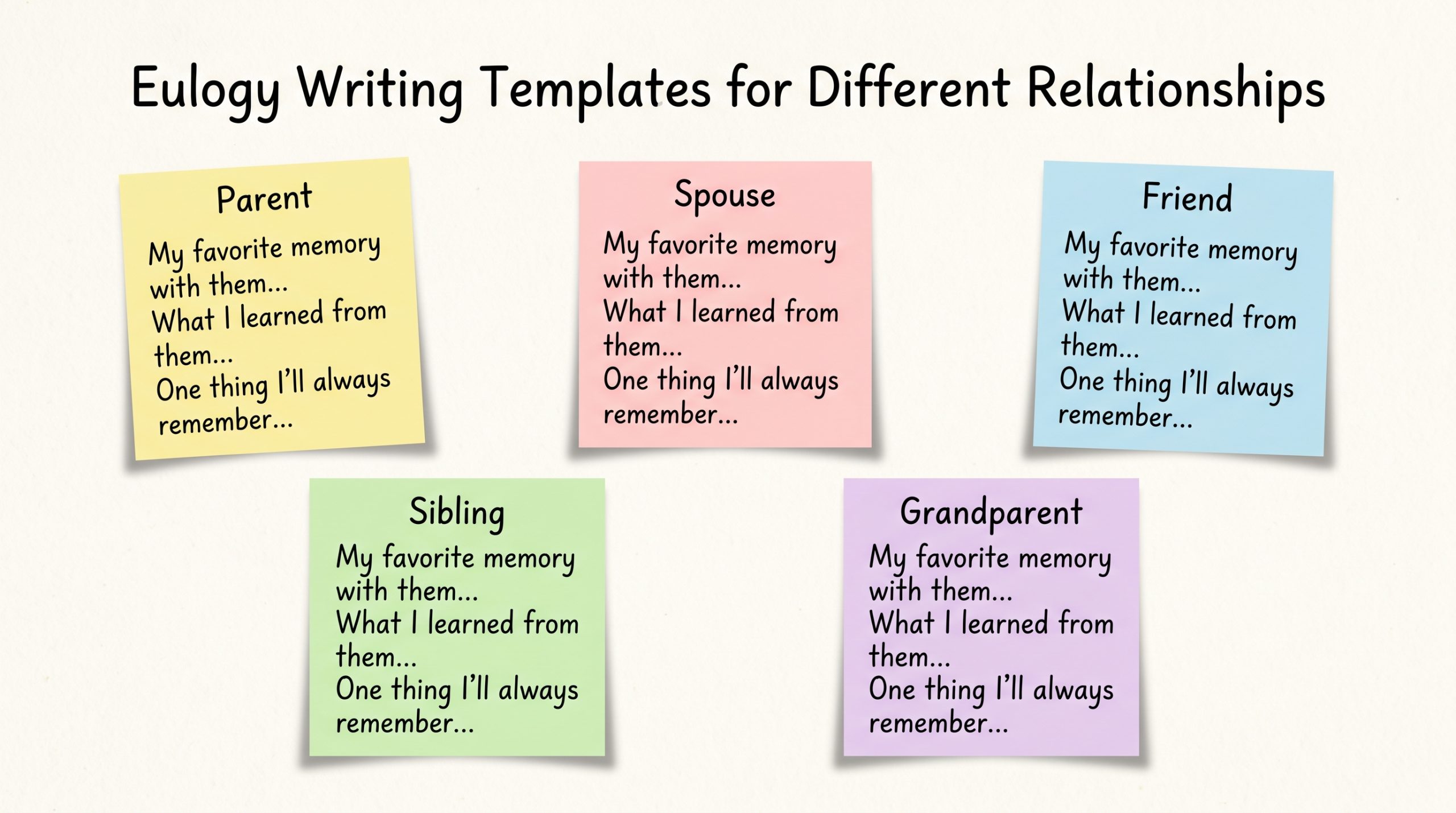
Writing a eulogy is a form of narrative preservation under emotional pressure. It involves structuring memory into a coherent form while still preserving emotional authenticity and personal truth. Unlike most forms of writing, it operates under a dual constraint: it must remain clear and understandable for listeners while also reflecting the speaker’s lived emotional experience without distortion. Because relationships vary in depth, duration, and role, the way a eulogy is structured shifts naturally depending on who is being remembered.
This same principle of structured communication also appears in corporate speech writing for executives, where complex ideas must be organized into clear, purposeful messaging that remains both authentic to the speaker and effective for the audience. In both cases, the challenge is not simply expression, but disciplined translation of meaning into language that holds emotional and informational clarity under pressure.
A strong eulogy is not defined by dramatic phrasing or literary ornamentation. It is defined by careful selection of meaningful details, arranged in a logical emotional progression that reflects the essence of the relationship rather than attempting to document a complete life history. Templates exist not to standardize grief, but to provide structural stability when emotional clarity is difficult to maintain.
Core Architecture Behind Eulogy Writing and Its Narrative Structure
Before working with relationship-specific eulogy templates, it is essential to understand the underlying architecture that shapes almost every effective eulogy. While the content changes depending on who is being remembered, the structural logic remains consistent because it follows a natural emotional progression: acknowledgment, meaning-making, and resolution.
A eulogy is not simply a speech about a person’s life. It is a structured form of narrative writing that belongs to the broader genre of speech writing and personal storytelling, where memory is shaped into spoken language under emotional conditions. It functions as both a literary composition and a spoken performance, requiring attention to tone, pacing, and clarity in a way that is similar to professional creative writing, yet deeply grounded in real-life experience.
In many ways, eulogy writing also overlaps with other forms of structured writing, such as reflective essays, memoir writing, and even aspects where ideas must be organized into a coherent emotional and logical flow for an audience. The key difference is that eulogy writing operates under emotional intensity, where precision and sensitivity become equally important writing skills.
This requires balancing emotional expression with clarity, especially in situations where both speaker and audience may be experiencing grief. For that reason, most eulogies organically follow a three-part structure: the opening, the middle narrative section, and the closing reflection. This structure mirrors established principles found in many writing genres, where a clear beginning, development, and conclusion help guide the reader or listener through a complete emotional and intellectual journey.
Because of this, eulogy writing is not only a personal act of remembrance but also a disciplined form of structured communication writing, where storytelling techniques, tone control, and narrative selection work together to create meaning.
Opening: Setting Context and Emotional Grounding
The opening of a eulogy serves a critical stabilizing function. It is the moment where the speaker establishes presence, acknowledges the emotional reality of the gathering, and introduces the individual being remembered in a way that immediately orients the audience.
At this stage, clarity matters more than emotional intensity. The purpose is not to deliver a highly emotional statement but to create a sense of shared understanding. The speaker typically begins by identifying themselves and their relationship to the deceased, which helps the audience contextualize the perspective from which the speech is being delivered.
This section often includes a direct acknowledgment of loss. This acknowledgment does not need to be elaborate; in fact, simplicity is often more powerful because it reflects emotional honesty without overcomplication. The language used here is usually restrained, respectful, and grounded. It sets the tone for everything that follows.
Another important function of the opening is psychological pacing. It allows both the speaker and the audience to transition into the emotional space of remembrance. A well-constructed opening prevents emotional overload by gently guiding listeners into the subject matter rather than confronting them with intensity immediately.
In structured terms, the opening performs three key roles: it establishes identity, acknowledges loss, and prepares the emotional frame for storytelling. Without this foundation, the rest of the eulogy can feel disconnected or disorganized.
Middle: Memory, Narrative Construction, and Meaning Formation
The middle section is the most substantial and emotionally layered part of a eulogy. It is where abstract grief is transformed into concrete memory. Instead of general statements about who the person was, this section relies on specific experiences, stories, and observed behaviors that reveal character through action.
This part of the eulogy often moves between storytelling and reflection. A single memory may be followed by an interpretation of what it revealed about the person’s values, personality, or influence. This interplay between narrative and meaning is what gives the eulogy depth and emotional resonance.
Narrative Development Through Specific Memories
Effective eulogies avoid vague descriptions such as “they were kind” or “they were generous” unless these qualities are supported by real examples. Instead, the speaker draws on lived moments—small interactions, repeated behaviors, or defining experiences—that demonstrate these traits in action.
These memories serve a dual purpose. First, they help the audience visualize the person being remembered. Second, they create emotional connection by grounding abstract qualities in relatable human experience. This is where the eulogy becomes less of a speech and more of a shared reconstruction of life.
Emotional Layering and Meaning-Making
As the narrative progresses, the speaker begins to interpret the memories. This is where meaning is constructed. A single story might illustrate resilience, humor, compassion, or leadership depending on how it is framed. The goal is not to list events but to identify patterns in behavior that define the person’s character.
This section often moves fluidly between past and present reflection. The speaker may recall an event and then connect it to how it is still relevant emotionally today. This creates continuity between memory and current experience, allowing grief to be expressed in a structured way.
Balancing Detail and Emotional Flow
A well-written middle section avoids both extremes: too little detail makes the eulogy feel generic, while excessive detail can overwhelm the emotional flow. The strongest eulogies select a limited number of meaningful stories and explore them deeply rather than attempting to cover the entire life history.
This selective approach ensures coherence while maintaining emotional impact. It also respects the time and attention of the audience, who are processing the speech in real time.
Closing: Legacy, Reflection, and Emotional Resolution
The closing section of a eulogy serves as the emotional and narrative resolution point. It is where the speech transitions from storytelling to reflection, and from individual memory to collective meaning. While grief does not end in this section, it is reframed into something that can be carried forward.
Transition from Personal to Collective Memory
One of the primary functions of the closing is to shift perspective. The speaker moves from personal recollection to shared impact. This often involves acknowledging how the individual influenced others beyond the speaker’s personal relationship.
This shift is important because it broadens the emotional scope of the eulogy. It allows the audience to see the person not only through a single relationship but as part of a larger social and emotional network.
Expression of Legacy and Continuity
Legacy in a eulogy is not limited to achievements or accomplishments. It often includes values, habits, beliefs, or emotional influence that continue to exist in others. This may be expressed through family traditions, professional impact, or personal inspiration.
The closing often highlights how the person’s presence continues indirectly—through memory, behavior, or the lives they influenced. This helps transform grief into continuity, which is a central function of eulogy writing.
Emotional Resolution Without Finality
Unlike other forms of writing, a eulogy does not aim for closure in a final sense. Instead, it offers emotional resolution in the form of acceptance and remembrance. The speaker acknowledges loss while also affirming that the relationship and its meaning persist in memory.
This balance between absence and presence is what gives the closing its emotional weight. It allows the audience to leave with a sense of continuity rather than abrupt emotional ending.
Structural Summary
A eulogy’s structure can be understood as a controlled emotional progression:
- The opening establishes context and emotional grounding
- The middle develops memory into narrative meaning
- The closing transforms personal grief into shared legacy
Together, these sections create a complete emotional arc that helps both speaker and audience process loss through structured remembrance rather than unorganized expression.
Eulogy Template for a Parent
A parent eulogy carries layered emotional complexity because it reflects both personal upbringing and lifelong influence. It often blends childhood memory with adult perspective, creating a dual narrative of dependence and understanding.
Opening Reflection on Parental Role
The introduction typically begins with direct acknowledgment of the parent and their role in the speaker’s life. This may include a simple statement of gratitude or recognition of their passing. The tone is respectful and grounded, avoiding excessive emotional buildup at the start.
Childhood Memories and Foundational Influence
This section focuses on formative experiences. It may include everyday routines, discipline, guidance, or small gestures that shaped personal development. The goal is to illustrate influence through lived experience rather than abstract praise.
Character Traits and Life Lessons
Here, the eulogy shifts toward interpretation. Instead of just recalling events, it identifies consistent traits such as patience, resilience, discipline, or kindness. These traits are supported by stories rather than statements.
Legacy and Continuing Presence
The closing often emphasizes how the parent’s values continue through family behavior, decisions, or traditions. It may also include a personal statement about ongoing emotional connection or gratitude.
Eulogy Template for a Friend
A friend’s eulogy is typically more conversational and narrative-driven. It often reflects shared experiences rather than structured life analysis. The emotional tone is usually balanced between humor, affection, and loss.
How the Friendship Began
This section often introduces the origin of the relationship. It may describe how the friendship formed, the circumstances that brought both individuals together, or the early impressions that defined the bond.
Shared Experiences and Personal Stories
This is the core of a friend’s eulogy. It includes anecdotes, travel memories, conversations, or defining shared moments. These stories are essential because they reveal personality more effectively than general descriptions.
Personality and Emotional Impact
Instead of formal traits, this section highlights how the friend behaved in real situations—how they reacted under pressure, how they supported others, or how they influenced the speaker’s life.
Emotional Closure and Memory Continuation
The conclusion reflects on absence and memory. It may acknowledge grief while also emphasizing how the friendship continues through memory, habits, or shared experiences that remain meaningful.
Eulogy Template for a Partner
A partner eulogy is one of the most emotionally intimate forms of remembrance. It often blends love, companionship, shared identity, and future loss into a single narrative.
Relationship Acknowledgment and Emotional Grounding
The opening typically acknowledges the depth of the relationship and its significance in the speaker’s life. It may include a direct expression of love or emotional dependency.
Shared Life Journey
This section covers the evolution of the relationship—how it began, key milestones, and shared experiences such as challenges, achievements, or everyday routines. The focus is on partnership rather than individual identity.
Emotional Qualities and Connection
Here, the eulogy explores emotional depth. It may describe trust, companionship, communication, or emotional safety within the relationship. These qualities are often supported by small but meaningful memories.
Continuing Emotional Presence
The closing reflects on ongoing emotional connection. It does not necessarily resolve grief but acknowledges continuity of love, memory, and emotional influence.
Eulogy Template for a Colleague or Professional Contact
Professional eulogies prioritize contribution, conduct, and workplace impact. They are more structured and less emotionally expressive but still respectful.
Professional Introduction and Role
The opening identifies the individual’s position, responsibilities, and contribution within the organization. It sets a formal tone appropriate for workplace audiences.
Work Ethic and Contributions
This section highlights achievements, reliability, leadership qualities, or teamwork. It focuses on observable professional behavior rather than personal anecdotes.
Workplace Relationships and Influence
Here, the eulogy may include brief reflections on collaboration, mentorship, or team dynamics. It remains professional but acknowledges human connection within work environments.
Organizational Legacy
The closing emphasizes the individual’s lasting impact on the organization, such as processes improved, teams influenced, or cultural values reinforced.
Eulogy Template for a Mentor or Community Member
This type of eulogy emphasizes guidance, influence, and collective impact. It often extends beyond personal relationships into broader social contribution.
Introduction and Role in Community
The opening describes how the individual contributed to a community, group, or field. It frames their identity in terms of service or mentorship.
Guidance and Teaching Moments
This section focuses on examples of mentorship, advice, or support provided to others. It often includes specific stories that illustrate influence.
Values and Personal Philosophy
Here, the eulogy reflects on the principles the individual represented, such as integrity, generosity, discipline, or leadership.
Continuing Influence
The closing emphasizes how their teachings or values continue through the people they influenced, creating a sense of ongoing presence.
FAQs
What makes a good eulogy structure?
A strong eulogy balances introduction, personal storytelling, and reflection on legacy. Structure helps organize emotion into clarity.
How long should a eulogy be?
Most spoken eulogies last between 5 and 10 minutes, depending on speaking pace and emotional pauses.
Should a eulogy be formal or emotional?
It depends on the relationship. Parents and partners often require more emotional depth, while professional eulogies remain more formal.
Can I include humor in a eulogy?
Yes, especially for friends or close relationships. Humor should feel natural and respectful rather than forced.
What if I struggle to write a eulogy?
Using a template helps organize thoughts. Focus on specific memories rather than trying to write perfectly structured sentences.
Conclusion
Eulogy writing is ultimately about transforming memory into structured expression. Templates provide a framework that supports emotional clarity, especially during grief when organizing thoughts becomes difficult. However, the most meaningful eulogies are not defined by structure alone but by the honesty of the memories they preserve. Whether written for a parent, friend, partner, colleague, or mentor, the goal remains consistent: to honor a life in a way that feels authentic, specific, and enduring.