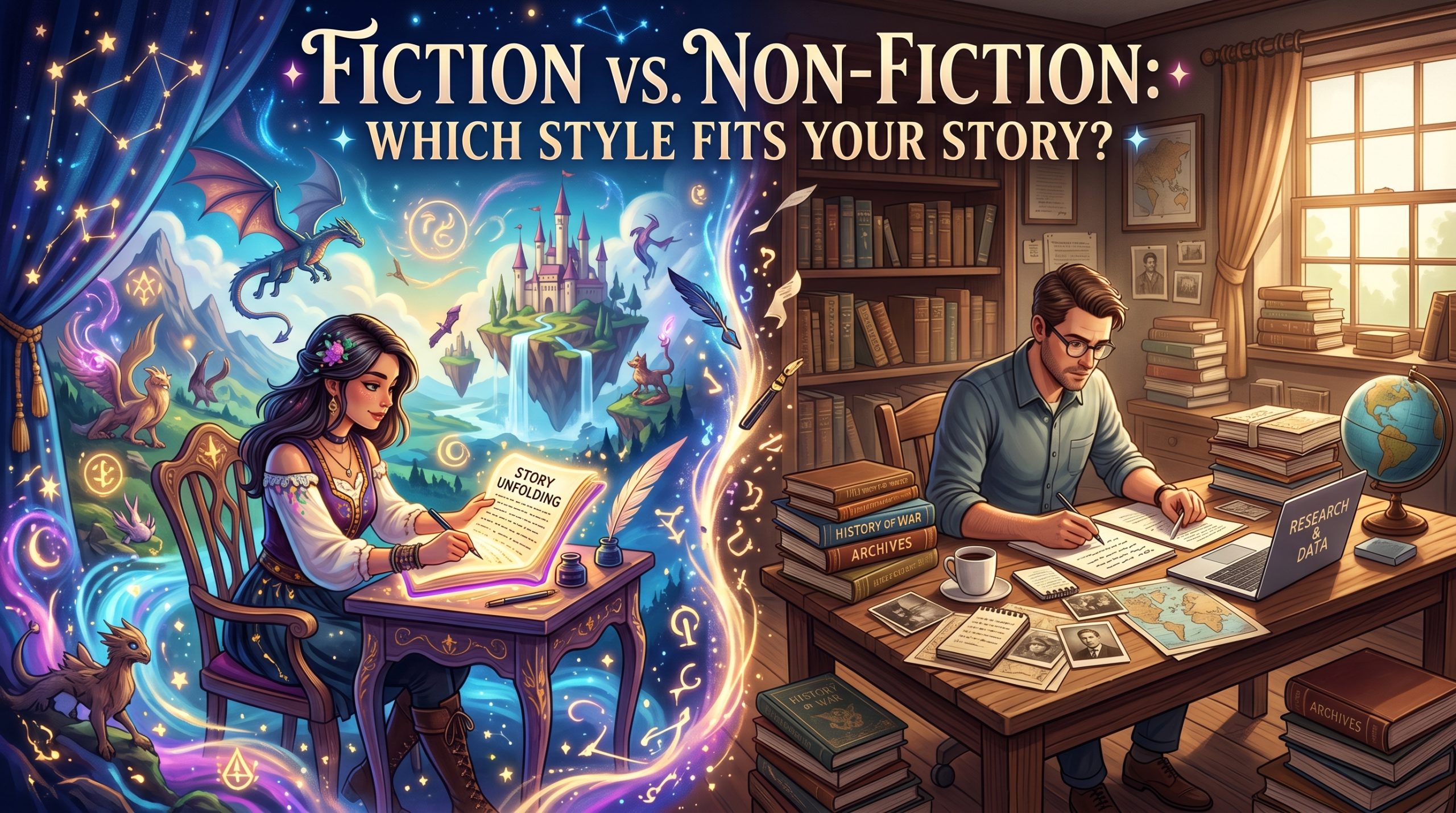
Fiction is built on imagination. It allows you to create characters, events, and worlds that may not exist in reality, but still feel emotionally real. Its strength lies in storytelling freedom—you can shape conflict, dialogue, and outcomes in a way that heightens drama and explores deeper themes without being restricted by factual accuracy. This freedom is often what makes a first chapter in fiction powerful, because it can immediately drop the reader into tension, mystery, or emotional movement.
Non-fiction, on the other hand, is rooted in reality. It focuses on real events, real people, and verifiable information. Its power comes from truth and credibility. Even when it uses narrative techniques, its foundation must remain accurate and evidence-based. In the context of writing a strong opening chapter, non-fiction relies on clarity, purpose, and relevance to instantly show the reader why the subject matters.
The key difference lies in intent. Fiction aims to create experience and emotion through invented scenarios, while non-fiction aims to inform, explain, or document actual events. However, modern writing often blends both approaches, especially in memoirs, historical writing, and narrative non-fiction, where storytelling techniques are used to make real events more engaging and help strengthen the opening hook.
Ultimately, the right choice depends on what you want your reader to take away—imagination and emotional immersion, or understanding and real-world insight. In both cases, mastering How to Write a Compelling First Chapter That Hooks Readers Instantly is what ensures your message lands with impact from the very first page.
Deeper Writing Techniques for Both Fiction and Non-Fiction
Once you understand the difference between fiction and non-fiction, the real craft begins in how you actually write them. Strong writing in both styles depends less on inspiration and more on technique—how scenes are structured, how information is delivered, and how the reader is guided through meaning without losing engagement.
| Aspect | Fiction | Non-Fiction |
| Core purpose | Entertain, imagine, emotionally engage | Inform, explain, document reality |
| Source of content | Imagination and creativity | Facts, research, real events |
| Structure | Flexible, story-driven | Logical, evidence-based |
| Character role | Central to narrative | Secondary or real-life based |
| Reader expectation | Emotional immersion | Clarity and understanding |
| Language style | Expressive and layered | Clear and precise |
Fiction Writing Techniques That Strengthen Storytelling
Fiction becomes compelling when it feels alive on the page. That sense of life is created through controlled tension, layered character work, and carefully shaped narrative movement rather than exposition.
Show internal change through behavior, not explanation
One of the most effective fiction writing techniques is showing transformation through action. Instead of telling the reader that a character is afraid, conflicted, or growing, you let those states appear through behavior.
A character who avoids eye contact, delays decisions, or reacts unusually under pressure reveals far more than a direct statement ever could. This technique keeps the reader emotionally involved because they are interpreting meaning rather than being handed it.
Use micro-conflicts inside larger scenes
Strong fiction rarely relies on one big conflict per chapter. Instead, it builds smaller tensions inside ordinary moments. A conversation can carry disagreement beneath polite language. A simple task can feel unstable because something is slightly off.
These micro-conflicts create texture. They make the world feel unpredictable, even when nothing dramatic is happening on the surface.
Control information release strategically
Fiction works best when information is revealed in layers. If everything is explained too early, curiosity disappears. Instead, details should arrive at the exact moment they become emotionally or narratively relevant.
This technique creates forward momentum. The reader keeps moving because understanding is always slightly ahead of them, never fully complete.
Use subtext in dialogue instead of direct meaning
In strong fiction, dialogue rarely says exactly what it means. Characters often avoid truth, disguise intention, or speak around emotional truths.
This creates depth because readers begin reading between the lines. What is unsaid becomes as important as what is spoken, adding tension to even simple exchanges.
Non-Fiction Writing Techniques That Build Authority and Engagement
Non-fiction succeeds when it is both trustworthy and readable. The challenge is balancing factual accuracy with narrative flow so the reader stays engaged without losing clarity.
Structure information in a narrative flow, not just sections
Even though non-fiction is informational, it becomes more effective when structured like a story. Instead of presenting disconnected facts, ideas should build logically toward understanding.
Each section should naturally lead into the next, creating a sense of progression rather than isolated explanations.
Anchor facts in real examples or lived experiences
Dry information is easily forgotten. When facts are supported by examples, case studies, or real-world scenarios, they become easier to understand and remember.
This technique turns abstract ideas into concrete understanding. It also helps maintain reader attention across longer explanations.
Balance authority with simplicity
Non-fiction writing often struggles when it becomes overly complex or overly simplified. The strongest approach is clarity without dilution.
This means using precise language while avoiding unnecessary jargon. The reader should feel informed, not overwhelmed.
Use narrative elements without losing factual integrity
Non-fiction can still use storytelling tools such as pacing, scene setting, and emotional framing. However, every narrative element must remain grounded in truth.
For example, instead of listing events, you can present them as a sequence the reader can follow, making the information feel more engaging while staying accurate.
Shared Techniques That Work for Both Styles
Despite their differences, fiction and non-fiction share several core writing principles that determine overall quality.
Strong opening moments create reader trust
Whether fictional or factual, the beginning of a piece must establish relevance quickly. Readers decide early whether the content is worth their attention, so the opening should immediately signal purpose and direction.
Clarity always outweighs complexity
Complex writing does not automatically mean strong writing. In both styles, clarity ensures that meaning is not lost. Readers should never have to struggle to understand the basic idea behind a sentence or scene.
Emotional relevance improves retention
Even in non-fiction, emotional connection improves how information is received. In fiction, it is essential. In both cases, readers remember what they feel more than what they simply read.
Consistency in tone builds immersion
Shifting tone too frequently breaks engagement. Whether the writing is imaginative or factual, maintaining a consistent voice helps the reader stay anchored in the experience.
Why Mastering Both Styles Improves Overall Writing
Understanding both fiction and non-fiction techniques strengthens writing ability across all formats. Fiction improves creativity, emotional depth, and narrative control. Non-fiction improves clarity, structure, and logical thinking.
Writers who can move between both approaches gain flexibility. They can make factual writing more engaging and make creative writing more grounded. This combination is especially powerful in modern storytelling, where readers expect both meaning and readability.
When to Blend Fiction and Non-Fiction
Modern writing often exists between categories. Blending techniques can make content more engaging without sacrificing truth.
Narrative non-fiction approach
This style uses storytelling methods—scene building, pacing, and character focus—while remaining factually accurate. It is common in biographies, documentaries, and historical writing.
Memoir-style storytelling
Memoirs rely on real experiences but often use fictional techniques to structure memory into compelling narrative arcs.
Why blending is effective
Blending allows writers to keep factual integrity while improving emotional engagement, making complex or historical content more accessible.
Frequently Asked Questions (FAQs)
What is the main difference between fiction and non-fiction?
Fiction is based on imagination and creative storytelling, while non-fiction is grounded in real events, facts, and verified information.
Can fiction be based on real events?
Yes, fiction is often inspired by real experiences, but it reshapes them creatively to enhance emotion, structure, or thematic depth.
Can non-fiction use storytelling techniques?
Absolutely. Non-fiction often uses narrative flow, scene building, and emotional framing to make information more engaging while staying accurate.
Which is easier to write: fiction or non-fiction?
Neither is objectively easier. Fiction requires creativity and narrative control, while non-fiction requires research accuracy and clarity.
Can I mix fiction and non-fiction in one book?
Yes, many modern books blend both styles, especially memoirs and narrative non-fiction, as long as factual integrity is maintained where required.