For years, most self-published authors have focused heavily on eBook royalties, often treating print formats as a secondary stream of income. But that mindset is quietly shifting. Paperback and hardcover books are no longer just “extra formats”—for many authors, they represent a stable, long-term revenue channel that behaves very differently from digital sales.
In 2026, Amazon introduced changes that didn’t alter the headline royalty rate for print books, but significantly affected how much authors actually earn. At first glance, nothing seemed dramatic. The 60% royalty structure remained intact. But behind the scenes, adjustments in printing costs, regional pricing, and production variables created a ripple effect across the entire ecosystem.
For paperback and hardcover authors, this isn’t just a technical update—it’s a strategic turning point. Profit margins are tighter, pricing decisions carry more weight, and small inefficiencies in formatting or production can now directly reduce income.
Understanding these changes is no longer optional. It’s the difference between maintaining profitability and unknowingly losing money on every sale.
Understanding KDP Print Royalties Before 2026
To understand what changed, it’s important to first look at how print royalties have traditionally worked on Amazon KDP.
Unlike eBooks, which operate on a percentage-based system with delivery fees, print books follow a more production-driven model. The formula is straightforward:
Royalty = (List Price × 60%) – Printing Cost
At its core, Amazon gives authors 60% of the list price, then subtracts the cost of physically producing the book. What remains is the author’s profit per sale.
This structure makes print fundamentally different from eBooks. There are no digital delivery fees, but there are tangible production expenses—paper, ink, binding, and logistics—all of which directly influence earnings. Before 2026, printing costs were relatively stable and predictable. Authors could calculate margins once and rely on them for extended periods. Pricing strategies were easier to maintain, and profit projections were more consistent.
That stability is what the 2026 changes disrupted.
Amazon KDP Royalty Changes 2025 2026 for Paperback Books
The Amazon KDP royalty changes 2025 2026 for paperback books represent a significant economic shift for independent publishers. While the core 60% royalty rate remains the industry standard, the actual net profit per unit has been redefined by updated printing cost algorithms. Throughout late 2025 and into 2026, Amazon adjusted both fixed and per-page costs to reflect evolving global supply chain pressures and rising material expenses. For paperback authors, this means the threshold for profitability has moved. To maintain the same income per sale as in previous years, many creators are now required to re-evaluate their list prices or optimize their page layouts to minimize production overhead and preserve their margins.
What Changed in 2026: A Shift Beneath the Surface
Amazon did not reduce the 60% royalty rate. That’s what makes these changes easy to overlook. However, the actual earnings authors receive per book have shifted due to increases in printing costs and adjustments in how those costs are calculated.
Several underlying factors contributed to this change. Rising global production expenses, material costs, and logistical pressures led to updates in Amazon’s print pricing model. These updates vary depending on page count, ink usage, trim size, and even regional distribution. Hardcover books, which Amazon has been expanding as a format, also saw revised cost structures. While they offer higher retail pricing potential, their production costs increased as well, making profitability more sensitive to pricing decisions.
The result is a subtle but important reality: even if your book’s list price stays the same, your profit margin may shrink.
Printing Costs: The Real Driver of Profit
The most important factor affecting print royalties in 2026 is no longer the percentage—it’s the cost of production.
Printing costs are influenced by several variables, and each one now plays a more critical role in determining your final earnings.
Page count is one of the biggest drivers. A longer book requires more paper and ink, increasing production costs. Even a difference of 20 to 30 pages can noticeably affect profit margins, especially in lower-priced books. Ink type is another major factor. Black-and-white interiors are significantly cheaper than color printing. Authors who include images, charts, or design elements often see higher production costs, which reduce net earnings.
Trim size and formatting choices also matter. Larger formats or inefficient layout designs can increase page count unnecessarily, which indirectly raises printing expenses. These variables were always part of the equation, but in 2026, their impact is more pronounced. Small inefficiencies that were once negligible can now erode profits over time.
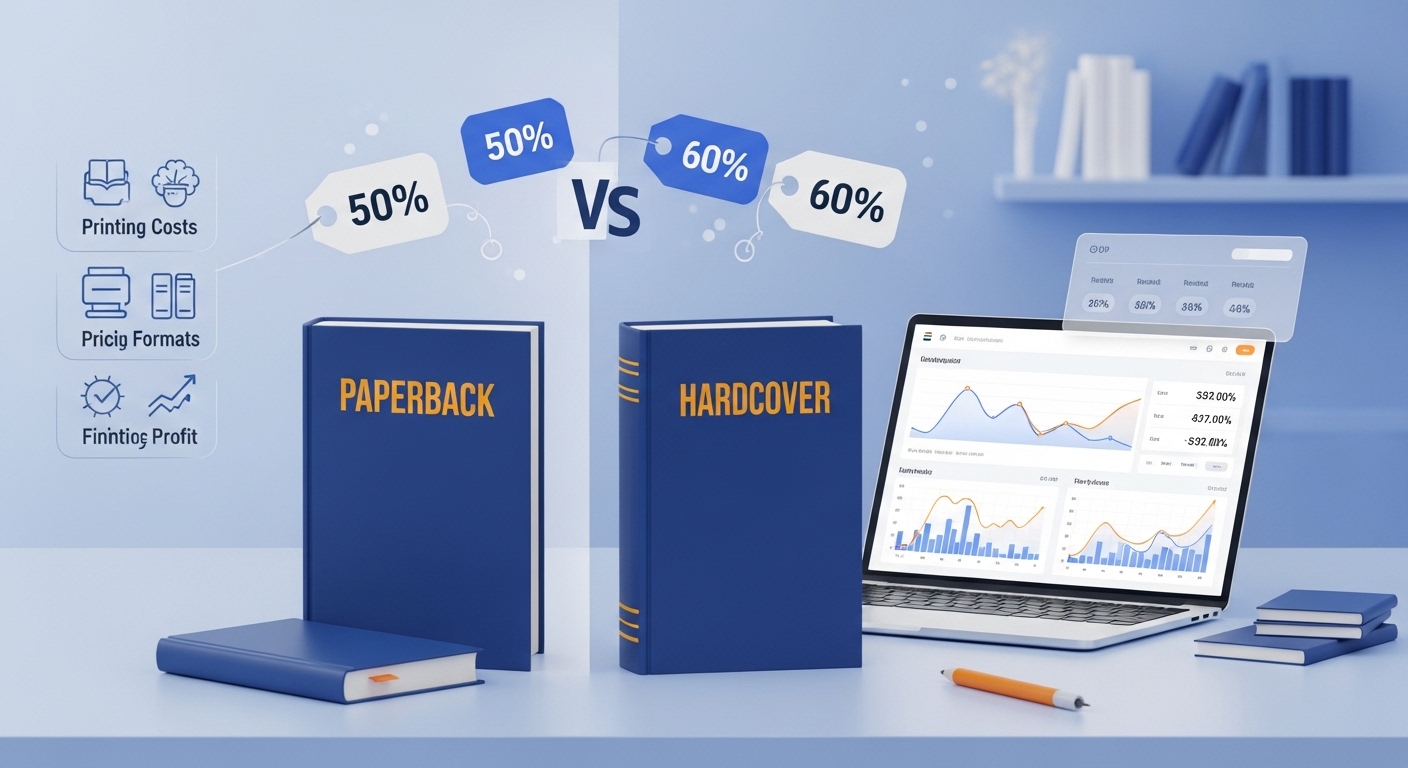
Paperback vs Hardcover: A Strategic Comparison
Choosing between paperback and hardcover formats is no longer just about presentation—it’s a financial decision.
| Factor | Paperback | Hardcover |
| Production cost | Lower | Higher |
| Retail price | Lower | Higher |
| Profit margin potential | Moderate | High (if priced well) |
| Audience expectation | Broad, price-sensitive | Premium, value-driven |
Paperbacks remain the most accessible format. They are easier to price competitively and appeal to a wider audience. However, their lower price point means margins are tighter, especially with increased printing costs.
Hardcovers, on the other hand, offer higher pricing potential. Readers often associate them with quality, authority, and collectibility. This allows authors to charge more, which can offset higher production costs. But the trade-off is volume—hardcovers typically sell fewer copies than paperbacks.
The key is not choosing one over the other blindly, but understanding how each format fits into your broader publishing strategy.
Real Earnings: Before vs After the Changes
To understand the impact of 2026 changes, consider a simple example.
Imagine a 250-page paperback priced at $12.99. Before the cost adjustments, the printing cost might have been low enough to leave a comfortable margin after Amazon’s 60% share.
After the changes, even a modest increase in printing cost—say $0.50 to $1.00 per book—can reduce your profit per sale significantly. Over hundreds of copies, that difference becomes substantial.
This is what makes the shift so important. The royalty formula hasn’t changed, but the outcome has. Authors who don’t adjust their pricing or production strategy may find themselves earning less without realizing why.
Pricing Strategy in 2025: More Important Than Ever
Pricing has always played a role in publishing, but in 2025 it has become a decisive factor in whether your print book is profitable or quietly losing money. With increased production costs, authors can no longer rely on “competitive pricing” alone. The margin for error has narrowed, and even small miscalculations can compound into significant losses over time.
At its core, pricing now sits at the intersection of three forces: printing cost, reader psychology, and market positioning. Ignoring any one of these creates imbalance. Price too low, and your margins disappear. Price too high, and your sales velocity drops. The goal is not to chase the lowest or highest number—it is to find the point where profit and demand meet sustainably.
The First Layer: Understanding Your True Cost
Before setting any price, authors need clarity on actual production cost. This includes not just the base printing cost, but how that cost behaves relative to your list price.
For example, if your paperback costs $4.50 to print and you price it at $9.99, your margin is already constrained before Amazon’s royalty split is applied. In such a scenario, even a slight increase in printing cost can reduce your earnings disproportionately.
This is where many authors go wrong—they price based on what competitors are charging rather than what their own book costs to produce. Two books may look identical in the marketplace but have completely different profit structures due to page count, formatting, or ink usage.
The Second Layer: Market Expectations and Price Anchoring
Readers don’t evaluate your price in isolation. They compare it instantly with similar books in the same category. This creates what is known as a pricing anchor.
If most books in your genre are priced between $12.99 and $14.99, placing your book at $9.99 may increase conversions but could also signal lower quality. On the other hand, pricing at $17.99 without strong credibility signals (reviews, branding, authority) may reduce trust and hurt sales.
This is where pricing becomes a positioning tool. It tells the reader what kind of book they are about to buy:
- Lower pricing suggests accessibility and quick consumption
- Mid-range pricing signals balance and mainstream appeal
- Higher pricing implies depth, authority, or specialization
The key is alignment. Your price must match both your content and your audience’s expectations.
The Third Layer: Profit vs Volume Trade-Off
Every pricing decision creates a trade-off between how much you earn per sale and how often your book sells.
Lower-priced books tend to move faster. They reduce hesitation and encourage impulse buying, especially in competitive genres. However, because margins are smaller, you need higher volume to generate meaningful income. Higher-priced books operate differently. They sell fewer copies but generate more profit per transaction. This model works best when the book delivers clear, high-value content that justifies the price.
Here is a simplified comparison:
| Pricing Level | Example Price | Sales Behavior | Profit per Sale | Risk Level |
| Low | $8.99–$10.99 | Higher volume, faster sales | Lower margin | Risk of underpricing |
| Mid-range | $11.99–$14.99 | Balanced sales and profit | Moderate margin | Most competitive zone |
| High | $15.99–$19.99+ | Lower volume, niche buyers | Higher margin | Risk of low conversions |
This table highlights a key insight: there is no universally “correct” price. The right price depends on how you want your book to perform.
Why Underpricing Is More Dangerous in 2025
In previous years, authors could afford to underprice slightly and still maintain reasonable margins. That buffer has now shrunk.
With higher printing costs, underpricing can push your profit per book dangerously low—or even into negative territory if not calculated properly. This is especially common among new authors who price aggressively to compete without understanding their cost structure. The problem is not just immediate loss. Over time, underpricing limits your ability to scale. Even if your book sells well, the total revenue remains capped because each sale contributes less to your overall income.
Why Overpricing Can Backfire
While underpricing is risky, overpricing without justification creates a different problem: reduced conversion. Readers are willing to pay more, but only when they perceive clear value. If your book lacks strong reviews, a professional presentation, or a compelling positioning angle, a higher price can create hesitation.
This doesn’t mean higher pricing is wrong—it means it must be supported. Books that succeed at higher price points typically have:
- Strong branding or authority
- Clear niche targeting
- High perceived usefulness or depth
Without these, even a well-written book can struggle simply because the price feels misaligned.
Finding the Optimal Price Point
The most effective pricing strategy is rarely static. It evolves based on performance, feedback, and positioning.
Instead of asking “What is the best price?”, a better approach is to ask:
- Does this price cover my costs with a healthy margin?
- Does it align with my genre’s expectations?
- Does it reflect the value my book provides?
When all three align, you reach a price point that is both competitive and profitable.
In many cases, this falls within a middle range where both volume and margin are balanced. However, niche books or premium content may intentionally operate outside this range.
How Genre Influences Pricing Flexibility
Not all books operate under the same pricing constraints. Genre plays a major role in determining how much flexibility you have.
Fiction, especially in popular categories like romance or thrillers, is highly price-sensitive. Readers have many options, and even small price differences can influence buying decisions. This limits how much authors can increase prices without affecting sales. Non-fiction offers more flexibility. Readers are often willing to pay more for information, especially if it solves a specific problem or provides clear value.
Technical and academic books operate in a different space altogether. These audiences are less price-sensitive because the content serves a specialized need. Higher pricing is often expected, making it easier to maintain margins even with increased production costs. Understanding your genre is essential because it defines the boundaries within which your pricing strategy can succeed.
The Hidden Pressure on Low-Content and High-Content Books
The 2026 changes affect different types of books in different ways.
Low-content books, such as journals, planners, and notebooks, operate on already thin margins. Because they are typically priced low and rely on volume, even small increases in printing costs can significantly reduce profitability. Authors in this space must be especially careful with pricing and production efficiency.
High-content books, such as textbooks or illustrated guides, face a different challenge. They often require more pages and higher-quality printing, which increases costs. However, they also have greater pricing flexibility because of their perceived value.
In both cases, the key challenge is the same: aligning cost structure with pricing strategy to maintain profitability.
Expanded Distribution: More Reach, Less Profit
Amazon offers expanded distribution, allowing print books to reach bookstores, libraries, and other retailers. While this increases visibility, it comes at a cost.
Royalties are lower under expanded distribution, and printing costs can vary depending on the distribution channel. This creates a trade-off between reach and profit.
For some authors, especially those focused on branding or wide exposure, expanded distribution can be worthwhile. For others, particularly those focused on maximizing income per sale, it may not be the best option.
The decision should be strategic, not automatic.
Smart Adjustments Authors Should Make
Adapting to the 2026 changes requires a more deliberate approach to publishing.
Start by recalculating royalties for existing books. Even if your pricing worked before, it may no longer be optimal.
Review your formatting to ensure efficiency. Reducing unnecessary pages can improve margins without affecting content quality.
Consider adding or optimizing hardcover editions where appropriate, especially for books with strong perceived value.
Most importantly, treat pricing as a variable rather than a fixed decision. Testing different price points can reveal what actually works in your specific niche.
Building a Sustainable Print Income Strategy
Print publishing should not be treated as a secondary consideration. When managed correctly, it can provide a stable and scalable income stream. A strong strategy often involves combining formats. eBooks can drive volume and discovery, while paperbacks and hardcovers provide higher-value sales and long-term credibility.
Print books also serve as physical assets. They enhance author branding, increase perceived authority, and open opportunities beyond digital platforms. Sustainability comes from balance—optimizing both reach and margin rather than focusing on one at the expense of the other.
Looking Ahead: The Future of KDP Print
The 2026 changes are unlikely to be the last. As production costs and market dynamics continue to evolve, further adjustments are expected. This means authors need to think long-term. Static strategies will become less effective, while adaptable approaches will gain importance. Premium formats, efficient production, and strategic pricing will likely play a larger role in future profitability. Authors who understand these dynamics early will be better positioned to stay competitive.
Conclusion: Adapting Is No Longer Optional
Amazon didn’t change the royalty percentage for print books in 2026, but it changed something more important—the economics behind it.
Higher printing costs mean tighter margins. Tighter margins mean pricing and production decisions carry more weight than ever before.
Authors who ignore these changes may continue publishing without realizing their profits are shrinking. Those who adapt—by refining pricing, optimizing production, and thinking strategically—will maintain and even improve their earnings.
In today’s self-publishing landscape, success is no longer just about writing a good book. It’s about understanding the system that turns that book into income.
FAQ
Did Amazon reduce print royalty rates in 2026?
No, the 60% rate remains the same, but increased printing costs reduce actual earnings.
Are hardcover books worth it now?
Yes, if priced correctly. They offer higher margins but require strategic positioning.
Should I raise my book price?
In many cases, yes—but only if it aligns with your genre and audience expectations.
Do printing costs affect all books equally?
No, they vary based on page count, ink type, and formatting.
Are low-content books still profitable?
They can be, but margins are tighter, making efficiency and pricing more critical.
Is expanded distribution a good option?
It depends on your goals—greater reach comes with lower profit per sale.