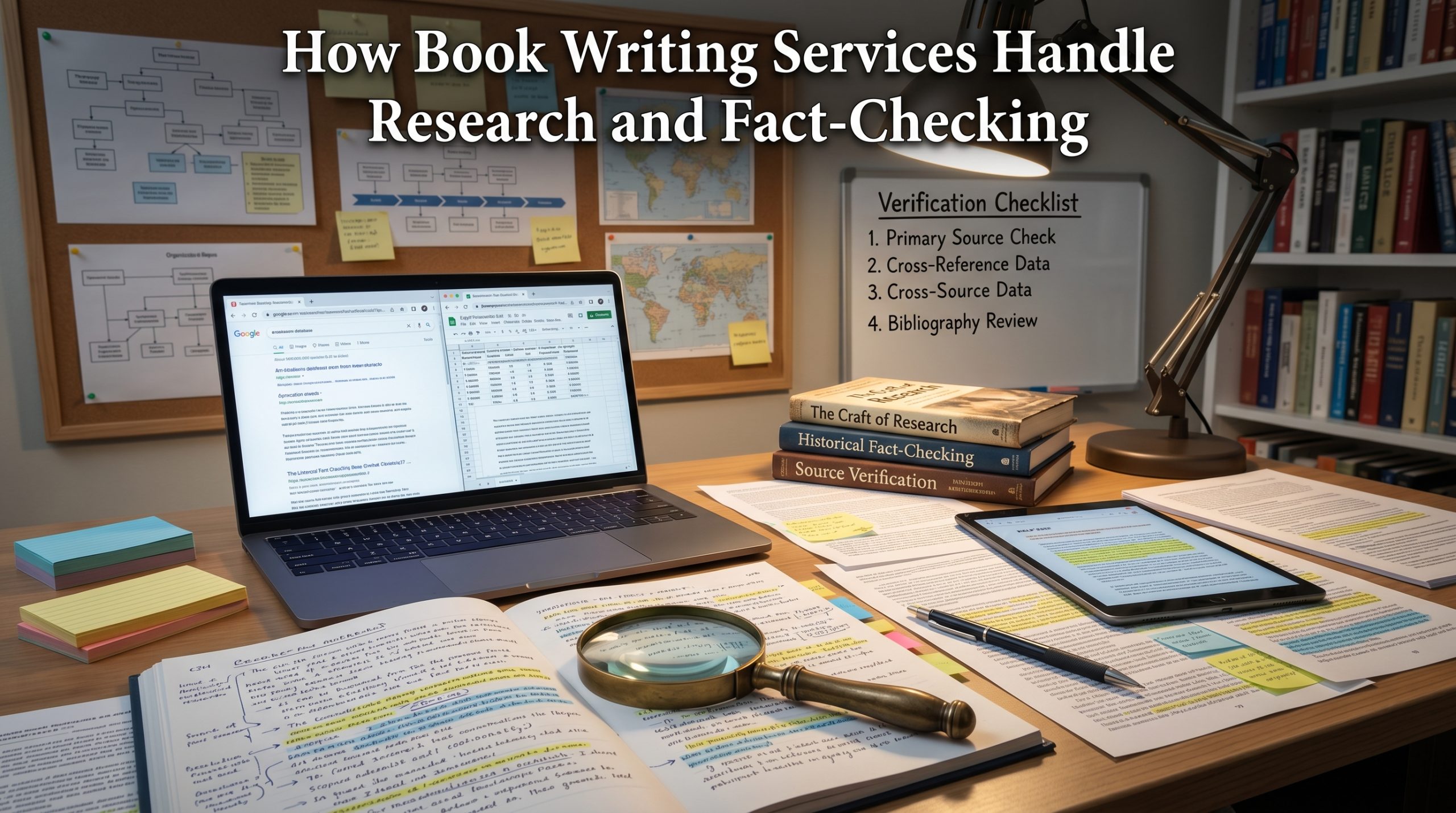
Book writing services operate within a structured production system where research and fact-checking are not optional enhancements but core components of the writing process. This is especially important in nonfiction, business writing, memoir development, and thought leadership content, where credibility directly determines how a book is received in the market. Readers today expect accuracy, consistency, and verifiable information, which means every claim included in a manuscript must pass through multiple layers of validation before publication.
This process becomes even more relevant when viewed alongside modern publishing strategies such as global distribution options for self-published authors, where books are released across international marketplaces. In such environments, factual accuracy is not just a quality concern but a commercial necessity, as books are exposed to a wider and more diverse audience that may critically evaluate the content based on regional knowledge, industry standards, and cultural expectations.
Within professional writing services, research begins at the conceptual stage and continues throughout drafting and editing. Fact-checking is integrated into every phase to ensure that the manuscript maintains both narrative flow and informational accuracy. This structured approach allows authors to publish confidently across global platforms without risking credibility issues that could arise from unverified or inconsistent content.
Why Fact-Checking Impacts Book Quality and Sales
Fact-checking directly influences how a book is perceived in the market because it determines whether readers consider the content reliable, authoritative, and worth recommending. In today’s publishing environment, readers are far more informed and critical, especially in nonfiction categories such as business, self-help, health, psychology, and personal development. A single factual inconsistency can undermine an entire argument, no matter how strong the writing style or narrative structure may be.
A well-researched book builds authority and trust, which becomes the foundation for long-term success. When readers feel confident that the information is accurate and responsibly presented, they are more likely to engage deeply with the content and view the author as a credible voice in their field. This perception directly affects reader reviews and ratings, which are often the first point of evaluation for new audiences browsing online platforms.
Fact-checked content also strengthens long-term credibility, which extends beyond a single book. Authors who consistently produce accurate work are more likely to be cited, invited for interviews, or recognized within professional and media circles. This creates a compounding effect where one credible publication leads to broader visibility and authority over time.
Additionally, accuracy influences repurchase and recommendation rates. Readers who trust a book are more likely to buy other titles by the same author and recommend the work to peers, colleagues, or social networks. Word-of-mouth remains one of the most powerful drivers of book sales, and it is heavily dependent on perceived reliability.
In contrast, factual errors can quickly damage an author’s reputation and reduce commercial success, even if the writing style is strong. Inaccuracies often lead to negative reviews, loss of trust, and reduced engagement, which can permanently affect how future books are received in the market.
Research as the Foundation of Book Development
In professional book writing services, research begins before the first draft is written. The goal is not just to gather information but to define the factual boundaries of the manuscript.
Topic Mapping and Scope Definition
The first stage of research involves identifying what the book will and will not cover. Writers and researchers break down the subject into thematic areas, ensuring that the manuscript remains focused and does not drift into unsupported claims or irrelevant content. This stage is especially important in nonfiction books where authority and clarity are critical.
At this point, research is often structured into content outlines, subtopics, and supporting arguments. Each section of the book is mapped to a specific informational requirement so that the writing process remains anchored to verifiable material.
Source Identification and Data Collection
Once the structure is defined, researchers begin collecting data from credible sources. These may include academic publications, industry reports, verified databases, interviews, whitepapers, and primary documentation, depending on the subject matter.
A strong writing service does not rely on a single category of source. Instead, it triangulates information across multiple references to ensure consistency. This reduces the risk of bias or incomplete interpretation, particularly in business, health, or technical writing where accuracy is essential.
How Fact-Checking Is Integrated Into the Writing Process
Fact-checking in professional book writing is not a final step added at the end of the project. It is a continuous process that runs parallel to drafting and editing.
Layered Verification During Drafting
As chapters are written, claims and factual statements are reviewed in real time. This means that writers do not wait until the manuscript is complete to verify accuracy. Instead, each section undergoes internal validation before moving forward in the writing process.
This layered approach ensures that errors are caught early, reducing the risk of structural rewrites later. It also allows inconsistencies between chapters to be identified and corrected before they affect the overall narrative flow.
Editorial Cross-Checking
After the initial draft is completed, editorial teams conduct a second layer of fact-checking. This stage focuses on verifying statistics, names, dates, quotations, and any data-driven statements included in the manuscript.
Editors often cross-reference multiple sources to ensure that information is not only accurate but also contextually appropriate. In professional publishing environments, this stage is critical for maintaining credibility, especially in nonfiction and educational books.
Sensitivity and Risk Review
For certain categories of books—such as biographies, memoirs, or business-related publications—fact-checking also includes a sensitivity review. This ensures that claims do not unintentionally misrepresent individuals, organizations, or events.
In some cases, legal or compliance advisors may also be involved to review potentially sensitive content before publication. This is especially common in corporate publishing or books tied to public figures.
The Role of Ghostwriters in Research Accuracy
In many ghostwriting and book development services, ghostwriters are not just responsible for writing—they also play a key role in interpreting and structuring research.
A professional ghostwriter translates raw information into readable narrative form while maintaining factual integrity. This requires balancing storytelling with accuracy, ensuring that the final manuscript is both engaging and credible.
Ghostwriters often conduct interviews, review internal documents, and synthesize information provided by clients. However, they typically work within a framework where factual verification is shared between the writer, editor, and sometimes the client themselves.
Tools and Techniques Used in Fact-Checking
Modern book writing services rely on a layered fact-checking system that combines editorial judgment, research methodology, and digital verification tools. The purpose is not only to detect errors but to prevent inaccuracies from entering the manuscript in the first place. This process is especially important in nonfiction, business writing, memoirs, and educational books where credibility directly affects reader trust and market performance.
Rather than depending on a single verification method, professional teams use multiple overlapping techniques. Each technique serves a specific role in strengthening factual accuracy, consistency, and originality across the manuscript.
Cross-Referencing Multiple Authoritative Sources
Cross-referencing is one of the most fundamental techniques in professional fact-checking. It involves validating a single claim or piece of information against multiple independent and credible sources before it is accepted into the manuscript.
In practice, this means that a statement is never treated as reliable based on one reference alone. Writers and editors compare information across academic publications, industry reports, official websites, and verified databases to identify consistency or discrepancies. If multiple sources confirm the same data, confidence in its accuracy increases significantly.
This method is particularly important in fields where information can vary depending on interpretation or reporting bias, such as economics, health, technology, and social research. Cross-referencing helps ensure that the final manuscript reflects a balanced and reliable version of the truth rather than a single-source perspective.
Verifying Statistics Through Original Datasets or Reports
Statistical verification goes beyond simply quoting numbers from secondary sources. Professional book writing services prioritize tracing data back to its original source, such as government publications, research institutions, corporate filings, or verified datasets.
This process ensures that numbers have not been misinterpreted, outdated, or taken out of context. In many cases, secondary articles may summarize data incorrectly or omit important conditions attached to the original findings. By going directly to the source, writers ensure that statistical references are both accurate and contextually correct.
This technique is especially critical in business books, market analysis, and self-help content where statistics are often used to support key arguments or claims. Proper verification prevents misleading conclusions and strengthens the credibility of the entire manuscript.
Using Plagiarism Detection Tools to Ensure Originality
Plagiarism detection tools are used to ensure that the manuscript maintains originality and does not unintentionally replicate existing published content. These tools scan the text against large databases of published books, articles, academic papers, and online content to identify similarities.
In professional book writing workflows, originality is not just about avoiding direct copying. It also involves ensuring that phrasing, structure, and idea presentation are sufficiently distinct from existing material. Plagiarism tools help flag potential overlaps so that writers can revise and rephrase content where necessary.
This step is particularly important in ghostwriting and content-heavy nonfiction projects where writers frequently synthesize information from multiple sources. It ensures that the final manuscript is both legally safe and professionally unique.
Maintaining Internal Fact Sheets for Consistency Across Chapters
Internal fact sheets are structured documents used to track verified information throughout the writing process. They act as a centralized reference system that ensures consistency across all chapters of the book.
These sheets typically include confirmed data points, character details (in biographies or memoirs), terminology definitions, and key factual statements that appear multiple times in the manuscript. By maintaining a single source of truth, writers avoid contradictions and inconsistencies that can weaken credibility.
This method is especially useful in long-form books where multiple sections may reference the same events, statistics, or concepts. Internal fact sheets help ensure that once a fact is verified, it remains consistent throughout the entire manuscript without variation.
Consulting Subject Matter Experts for Technical Validation
Subject matter expert (SME) consultation is a high-level fact-checking technique used when content requires specialized knowledge. This is common in technical writing, scientific topics, finance, healthcare, and industry-specific business books.
In this process, experts with domain-specific knowledge review sections of the manuscript to verify accuracy, clarify complex concepts, and correct potential misinterpretations. Their input ensures that the content aligns with real-world practices and established knowledge within the field.
This step adds an additional layer of credibility because it introduces external validation beyond the writing team. It also reduces the risk of technical inaccuracies that may not be obvious to general writers or editors.
Together, these techniques form a multi-layered fact-checking system that ensures manuscripts produced by professional book writing services are not only well-written but also accurate, consistent, and credible across every section.
Why Fact-Checking Impacts Book Quality and Sales
Fact-checking directly influences how a book is perceived in the market because it determines whether readers consider the content reliable, authoritative, and worth recommending. In today’s publishing environment, readers are far more informed and critical, especially in nonfiction categories such as business, self-help, health, psychology, and personal development. A single factual inconsistency can undermine an entire argument, no matter how strong the writing style or narrative structure may be.
A well-researched book builds authority and trust, which becomes the foundation for long-term success. When readers feel confident that the information is accurate and responsibly presented.
They are more likely to engage deeply with the content and view the author as a credible voice in their field. This perception directly affects reader reviews and ratings, which are often the first point of evaluation for new audiences browsing online platforms.
- Reader reviews and ratings
- Long-term credibility of the author
- Media and professional recognition
- Repurchase and recommendation rates
Fact-checked content also strengthens long-term credibility, which extends beyond a single book. Authors who consistently produce accurate work are more likely to be cited, invited for interviews, or recognized within professional and media circles. This creates a compounding effect where one credible publication leads to broader visibility and authority over time.
Additionally, accuracy influences repurchase and recommendation rates. Readers who trust a book are more likely to buy other titles by the same author and recommend the work to peers, colleagues, or social networks. Word-of-mouth remains one of the most powerful drivers of book sales, and it is heavily dependent on perceived reliability.
In contrast, factual errors can quickly damage an author’s reputation and reduce commercial success, even if the writing style is strong. Inaccuracies often lead to negative reviews, loss of trust, and reduced engagement, which can permanently affect how future books are received in the market
FAQs
Do all book writing services include fact-checking?
Not all services offer full fact-checking. High-quality professional services usually include it as part of their editorial process, especially for nonfiction books.
Who is responsible for verifying facts in a ghostwritten book?
Responsibility is usually shared between the writer, editor, and sometimes the client, depending on the contract and subject matter.
How do writers verify information for nonfiction books?
They use credible sources such as academic research, official reports, interviews, and verified databases to ensure accuracy.
Can fact-checking delay book publishing?
Yes, thorough fact-checking can extend timelines, but it significantly improves credibility and reduces long-term risk.
Is fact-checking necessary for fiction books?
It is less critical but still used for historical accuracy, technical details, and real-world references.
Conclusion
Book writing services treat research and fact-checking as foundational pillars of the publishing process rather than optional editorial steps. By integrating verification into every stage of development—from outline creation to final editing—they ensure that manuscripts are not only well-written but also accurate, credible, and publishable at a professional standard.
In a publishing environment where trust directly influences readership and reputation, strong research practices are not just a quality control measure but a core part of successful book creation.