If you’ve ever found yourself staring at your manuscript’s word count—either nervously watching it climb or wondering why it’s still so low—you’re not alone. One of the most common (and quietly stressful) questions writers ask is: How long should a book actually be? The answer isn’t as simple as a single number. Word count isn’t just a technical detail—it’s a signal. It tells agents, editors, and readers what kind of experience to expect. Too short, and your story might feel underdeveloped. Too long, and it can seem unfocused or difficult to market.
But here’s the part many writers overlook: the “right” length isn’t about hitting a random target. It’s about aligning your story, your genre, and your audience expectations in a way that feels intentional and satisfying. Let’s break that down in a way that actually helps you make decisions—not just follow rules.
Why Word Count Matters More Than You Think
At first glance, word count might seem like a publishing industry obsession. But there are real reasons it matters. From a storytelling perspective, length affects pacing, depth, and structure. A 50,000-word novel moves differently than a 120,000-word one. It forces different choices about character development, world-building, and narrative scope.
From a publishing standpoint, word count directly impacts production costs, pricing, and marketability. Longer books are more expensive to print and riskier for publishers—especially if the author is new. And from a reader’s perspective, word count shapes expectations. A reader picking up a thriller expects a fast-paced, tightly written story. A reader diving into epic fantasy expects immersion and scale.
So while creativity should always lead, word count acts as a framework that keeps your book aligned with its intended experience.
General Word Count Guidelines by Genre
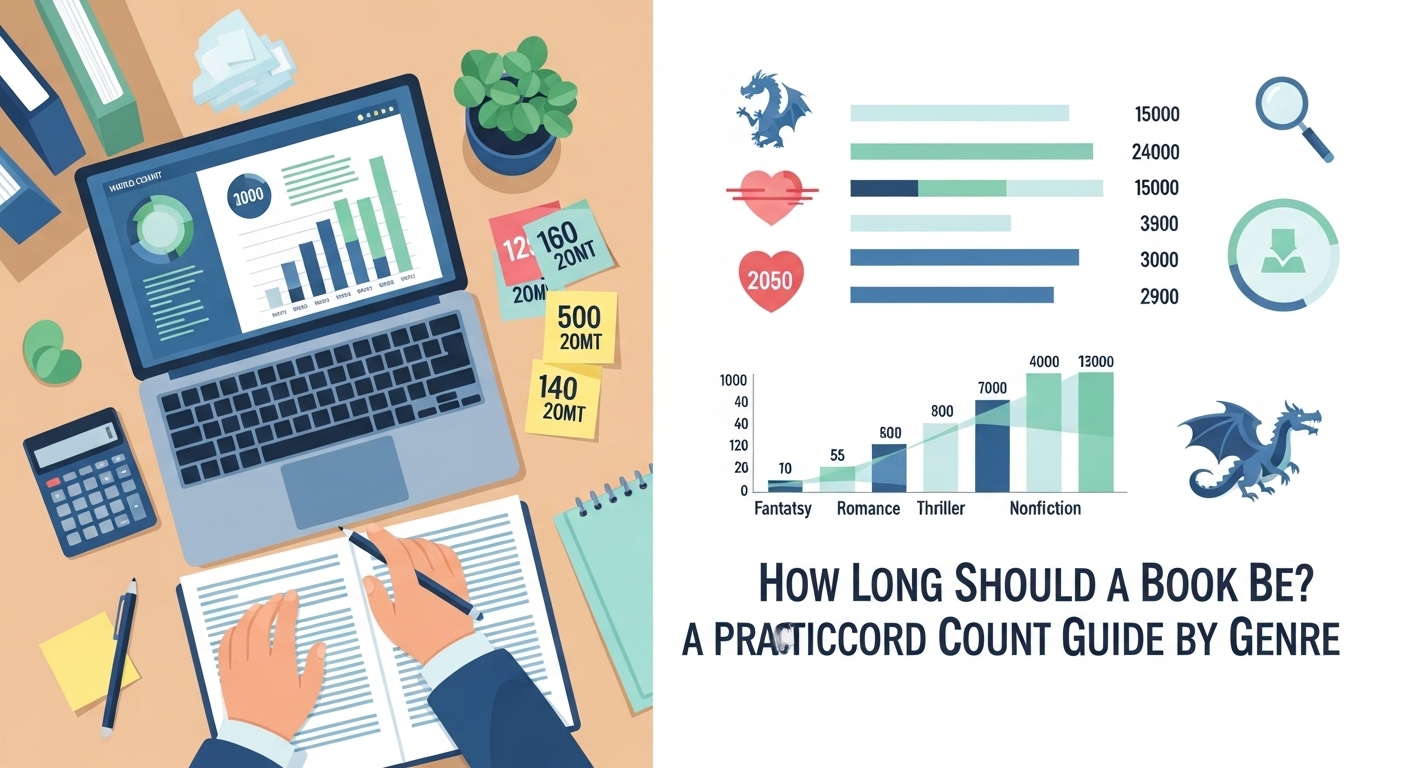
Before diving deeper, it helps to see the landscape at a glance. These are typical ranges—not rigid rules, but strong reference points.
| Genre | Typical Word Count |
| Literary Fiction | 70,000 – 100,000 |
| Commercial Fiction | 80,000 – 100,000 |
| Mystery/Thriller | 70,000 – 90,000 |
| Romance | 60,000 – 90,000 |
| Science Fiction | 90,000 – 120,000 |
| Fantasy | 90,000 – 130,000 |
| Young Adult (YA) | 50,000 – 80,000 |
| Middle Grade (MG) | 30,000 – 50,000 |
| Memoir | 60,000 – 90,000 |
| Nonfiction | 50,000 – 80,000 |
These ranges exist because they reflect what readers are used to—and what publishers know they can successfully sell.
But numbers alone don’t tell the full story.
The Hidden Logic Behind Genre Length
Each genre has its own internal rhythm, and that rhythm naturally influences word count. Take fantasy and science fiction, for example. These genres often require extensive world-building—new rules, settings, and systems that don’t exist in reality. That takes space. Readers expect to be immersed, not rushed. On the other hand, a thriller thrives on urgency. The pacing is tight, the chapters are often shorter, and the focus stays on forward momentum. Adding unnecessary length can actually weaken the experience.
Romance novels prioritize emotional development and relationship arcs. They don’t need massive world-building, but they do need enough space for the connection to feel authentic. Literary fiction tends to sit somewhere in between. It may not rely on plot-heavy structures, but it often explores deeper themes, character psychology, and language—requiring a different kind of narrative space. When you understand why a genre leans toward a certain length, it becomes much easier to shape your own manuscript accordingly.
Debut Authors vs. Established Writers: The Unspoken Difference
Here’s something rarely stated outright: word count expectations are stricter for new writers. If you’re a debut author, staying within standard ranges is especially important. A 150,000-word manuscript from an unknown writer raises concerns—about pacing, editing, and market risk. Established authors, on the other hand, often have more flexibility. Once a writer has proven they can sell books, publishers are more willing to take chances on longer or unconventional projects. This doesn’t mean you need to limit your creativity. It simply means you should be strategic. Think of word count as part of how you present yourself professionally.
When Your Book Is Too Short
A manuscript that falls below the expected range can feel incomplete—even if the writing itself is strong.
This often happens when:
- The plot resolves too quickly
- Subplots are missing or underdeveloped
- Characters lack depth or growth
- Key scenes are summarized instead of shown
If your book feels short, the solution isn’t to “add words” randomly. It’s to expand meaningfully.
Ask yourself:
- Are there emotional beats that need more space?
- Could relationships be explored more deeply?
- Are there opportunities to increase tension or stakes?
Sometimes, a short manuscript is a sign that the story hasn’t fully unfolded yet.
When Your Book Is Too Long
On the opposite end, an overly long manuscript often signals a lack of focus.
Common issues include:
- Repetitive scenes or descriptions
- Subplots that don’t contribute to the main story
- Slow pacing in the middle sections
- Overextended world-building
Cutting words can be painful, but it’s also one of the most powerful ways to strengthen your writing.
Instead of asking, “What can I remove?” try asking, “What isn’t serving the core story?”
When you start editing with intention, you’ll often find that clarity improves alongside length.
The “Right Length” Is About Reader Experience
It’s easy to get caught up in hitting a specific number, but the real goal is creating a satisfying reading experience. A well-paced 70,000-word novel can feel richer than a bloated 110,000-word one. Likewise, a dense, immersive 120,000-word fantasy can feel effortless if the story justifies its length.
The key question is: Does the story feel complete?
Not rushed. Not stretched. Complete.
When readers reach the final page, they shouldn’t feel like something was missing—or like the journey took longer than it needed to.
How to Decide the Ideal Length for Your Book
Instead of guessing, you can approach this strategically.
Start by identifying your genre and studying comparable books. Look at recently published titles, especially from debut authors. Their word counts are often the most relevant benchmarks.
Then evaluate your own manuscript honestly. Does it align with those expectations? If not, is there a clear reason why?
Finally, consider your goals. If you’re aiming for traditional publishing, staying within standard ranges gives you a stronger chance. If you’re self-publishing, you have more flexibility—but reader expectations still matter.
A Note on Novellas and Shorter Works
Not every story needs to be a full-length novel. Novellas—typically between 20,000 and 50,000 words—occupy a unique space. They’re shorter, more focused, and often driven by a single central idea. While they can be harder to place in traditional publishing, they’ve gained popularity in digital formats and certain genres like romance and speculative fiction. If your story feels tight and complete at a shorter length, forcing it into a full novel can actually weaken it.
Word Count and Pacing: The Invisible Connection
One of the most overlooked aspects of word count is how closely it ties to pacing. A longer book naturally allows for slower build-up, deeper exploration, and more layered storytelling. A shorter book demands efficiency—every scene must carry weight.
If your pacing feels off, word count is often part of the issue.
- If the story drags, it may be too long for its structure
- If it feels rushed, it may need more development
Balancing length and pacing is what transforms a manuscript from functional to compelling.
FAQ: Word Count Questions Writers Often Ask
Can I break the word count rules?
Yes—but only if there’s a strong reason. Breaking expectations works best when the story justifies it and the execution is exceptional.
Is 50,000 words enough for a novel?
It can be, especially for certain genres or literary works. However, it’s on the shorter side for most adult fiction.
What if my manuscript is 120,000 words?
That’s acceptable in genres like fantasy or science fiction. In others, it may need tightening—especially if you’re a debut author.
Do agents reject based on word count alone?
Not always, but it can influence their decision. A manuscript far outside standard ranges raises concerns before they even start reading.
Should I edit for word count before querying?
Absolutely. Your manuscript should be as polished and market-ready as possible, including its length.
Final Thoughts
Word count isn’t a rulebook—it’s a guide. It reflects how stories function within genres, how readers engage with them, and how the publishing industry operates. Instead of treating it as a restriction, think of it as a tool. It helps you shape your story into something that feels complete, intentional, and aligned with its audience.
In the end, the “right” length is the one that allows your story to fully breathe—no more, no less. And when you find that balance, your manuscript doesn’t just meet expectations—it stands out because it understands them.