Most people approach Amazon KDP with a short-term mindset. They create a single low content book such as a planner, journal, or workbook, upload it, and expect consistent sales to follow. When results don’t come quickly, they assume the platform is saturated or that passive income through KDP is no longer possible.
The reality is very different.
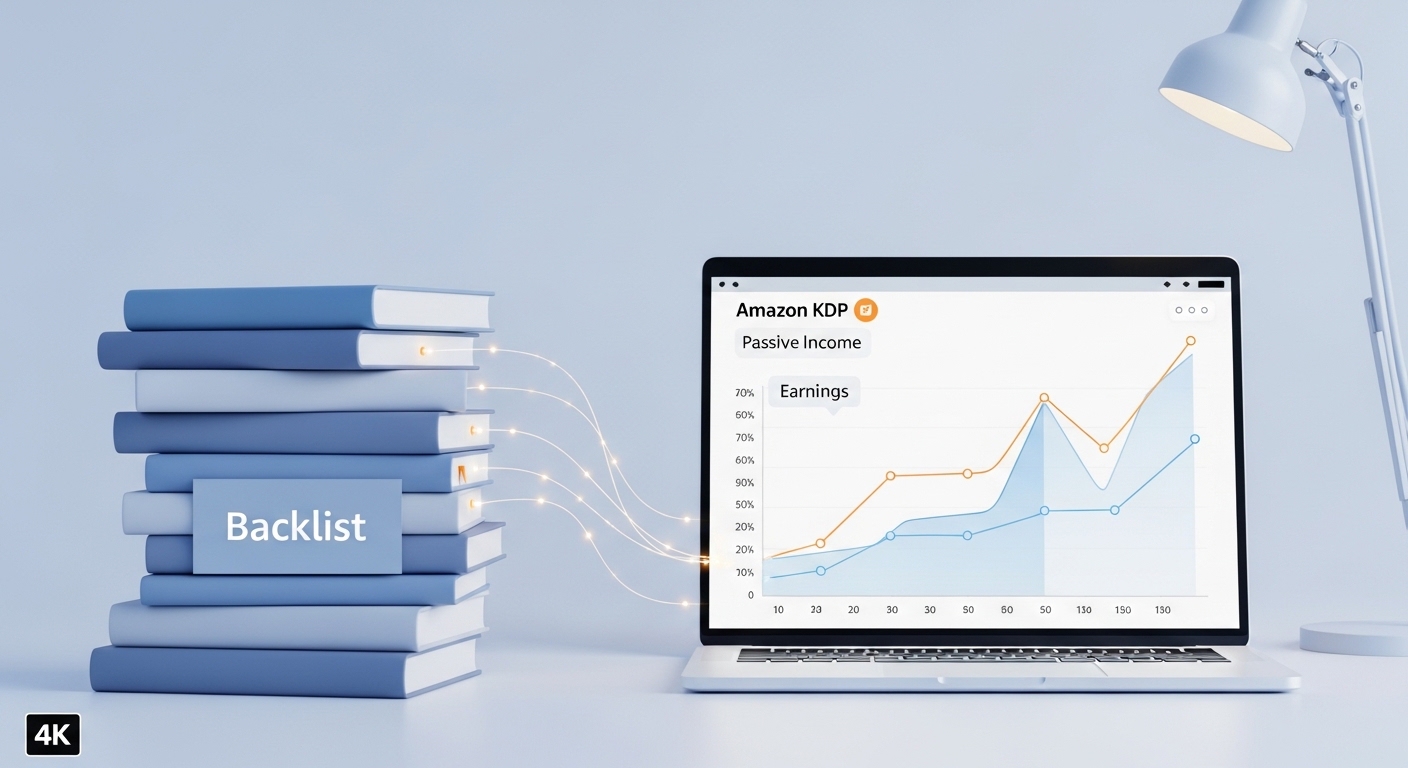
Amazon KDP is not a “one-book income model.” It is a catalog-driven ecosystem where long-term earnings come from building a structured backlist. A KDP backlist strategy focuses on creating multiple interconnected low content books that continue generating sales long after publication. Unlike traditional active income models where effort stops income, KDP works in reverse. The effort is concentrated upfront in research, design, and publishing. Once your books are live, Amazon handles distribution, printing, and global sales automatically. Over time, each book becomes a digital asset that works independently.
However, the real transformation happens when multiple books are combined into a system. A single planner might generate occasional sales. But a structured backlist of planners, journals, and workbooks within a niche can generate continuous daily revenue without active involvement. This is what true Amazon KDP passive income looks like—not a single viral book, but a structured ecosystem that compounds over time. In this guide, you will learn exactly how to build that system: how to choose niches, structure a backlist, optimize keywords, design scalable books, and turn low content publishing into a long-term income engine.
What Is a KDP Backlist and Why It Matters for Passive Income
A KDP backlist refers to all previously published books that continue generating sales over time. In traditional publishing, backlists often account for the majority of long-term revenue because older books remain available indefinitely.
On Amazon KDP, this effect is amplified because the platform operates as a search engine. Every book you publish is indexed permanently unless removed. That means your older planners, journals, and workbooks continue appearing in search results long after launch.
A true backlist is not accidental. It is intentionally structured so that each book contributes to a broader niche ecosystem. Instead of standalone products, your books become interconnected assets that reinforce each other.
Why Backlists Are More Powerful Than Single Book Publishing
A single low content book is limited by one keyword set, one audience segment, and one visibility channel. A backlist removes those limitations.
When you publish multiple books in a structured niche, you multiply your visibility. Each book targets a different keyword variation, audience segment, or use case.
For example, within the productivity niche, one book may target entrepreneurs, another students, another freelancers, and another habit-building beginners. Although all belong to the same niche, they occupy different search spaces.
This creates a compounding effect where your catalog dominates multiple areas of Amazon search results simultaneously.
The Passive Income Reality of KDP Backlists
Passive income on KDP does not come from one book. It comes from systemized publishing.
A backlist creates income through three mechanisms:
First, older books continue selling without updates. Second, new books increase visibility of older listings through Amazon’s internal recommendation system. Third, keyword coverage expands over time, increasing total search exposure.
This combination is what turns KDP into a passive income system rather than an active hustle.
Why Most KDP Publishers Fail to Build a Backlist
Random Publishing Without Strategy
Most beginners approach KDP as a creative outlet rather than a structured business. They publish whatever idea comes to mind without considering how it fits into a larger system. One week they create a fitness journal. The next week a gratitude planner. Then a random workbook unrelated to both. While each product may be functional, they are not connected. This fragmentation prevents compounding growth because Amazon cannot associate the books with a single niche authority.
Lack of Keyword Structure in Low Content Books
Another major issue is ignoring keyword strategy. Many publishers focus on design first and keywords last—or not at all.
Without proper Amazon KDP keyword research for low content books, listings fail to rank consistently. Even good designs remain invisible if they are not aligned with search demand.
A backlist depends heavily on keyword layering. Each book must serve a different search intent while staying within the same niche ecosystem.
Short-Term Thinking in a Long-Term System
KDP is often misunderstood as a quick income method. Many expect results within days or weeks. When that doesn’t happen, they abandon the process.
However, backlist building is fundamentally long-term. The system compounds slowly at first, then accelerates as more books are added. Most successful publishers only see significant results after building multiple interconnected listings.
Choosing the Right Niche for a Scalable KDP Backlist Strategy
A strong KDP backlist niche is not defined by popularity alone. It must support long-term expansion. The ideal niche has three qualities: consistent demand, multiple subcategories, and strong buyer intent. Without these, scaling becomes impossible because there are no logical directions for expansion.
Examples of High-Performance KDP Niches
Some of the most effective niches for building a KDP passive income system include productivity, fitness, mental wellness, education, and personal development.
Productivity works particularly well because it naturally expands into planners, trackers, and journals. Fitness allows expansion into workout logs, meal planners, and progress trackers. Mental wellness supports gratitude journals, mindfulness planners, and reflection workbooks.
Each of these niches contains multiple branching opportunities, which is essential for backlist growth.
The Expansion Principle of KDP Niches
A scalable niche is defined by how many directions it can grow into.
For example, productivity can expand into daily planners, weekly planners, goal-setting journals, habit trackers, time-blocking systems, and reflection workbooks. Each of these becomes a separate book within the same ecosystem.
This expansion capability is what allows a backlist to scale from a few books to dozens or even hundreds over time.
Structuring a KDP Backlist for Maximum Growth
Building a Niche Architecture System
A successful KDP backlist is structured like an architecture, not a random collection.
At the top level is the core niche. Beneath that are subcategories, and beneath those are individual books. This hierarchical structure ensures clarity and consistency across your entire catalog.
Instead of asking “what book should I create next,” you operate from a predefined system where every book has a defined role.
Planning Multiple Books Before Publishing
One of the key differences between amateurs and professionals is planning depth.
Beginners publish one book at a time. Professionals plan entire clusters of books in advance.
A structured backlist strategy often involves mapping out 10–30 books before the first upload. This ensures continuity and eliminates randomness.
Avoiding Internal Competition Between Books
If multiple books target identical keywords, they end up competing against each other instead of supporting each other.
A proper backlist assigns unique keyword focus to every book. This ensures each listing occupies its own space within Amazon search results while contributing to the overall ecosystem.
Design Strategy for Scalable KDP Publishing
Why Design Consistency Builds Brand Authority
Design is one of the most underestimated elements in KDP publishing. Consistent design across your catalog builds recognition, which increases trust and conversions.
When customers recognize your visual identity, they are more likely to purchase multiple books from your catalog.
Interior Structure Consistency for Better UX
Interior design consistency improves usability. If each book follows a different layout structure, users become confused and less engaged.
Consistent layouts improve user experience, which leads to better reviews and higher ranking signals on Amazon.
Scaling Through Reusable Templates
Once a strong design system is created, it can be reused across multiple books. This significantly reduces production time and allows faster expansion of your backlist.
This is how large KDP publishers scale efficiently without redesigning each book from scratch.
Publishing in Series to Strengthen Your KDP Backlist
Publishing in series is one of the most effective ways to strengthen a KDP backlist strategy because it fundamentally changes how customers perceive your books. Instead of viewing each planner, journal, or workbook as an isolated product, buyers begin to see a connected system that offers continuity, structure, and long-term value.
This perception matters because it increases trust and perceived professionalism. A standalone low content book often competes on price and basic utility. However, a series signals that the creator has invested in building a complete framework rather than a single idea. This naturally elevates the perceived value of each individual book within the series.
From a behavioral perspective, series publishing also reduces hesitation during purchase decisions. When a customer understands that a book is part of a structured collection—such as “Volume 1,” “Volume 2,” or themed progressions—they are more likely to commit because the product feels intentional and expandable rather than random.
In practical terms, series publishing helps you transform isolated listings into a unified catalog. This strengthens your overall Amazon KDP passive income system by increasing engagement and improving long-term discoverability.
H3: Repeat Buyer Behavior in KDP Systems
One of the most powerful advantages of series-based publishing is the creation of repeat buyer behavior. When customers purchase a book that delivers real value, they naturally develop trust in the creator’s work. If the experience is positive, they are significantly more likely to explore additional books within the same series or niche.
This creates a structured repeat revenue cycle inside your KDP catalog. Instead of relying solely on new customer acquisition, you begin to benefit from returning buyers who already understand your content style and quality level.
Over time, this behavior strengthens your backlist in several ways. Each new series entry reinforces the previous ones, increasing internal traffic between listings. Customers who enter through one book often discover others through Amazon recommendations or related product placements.
This results in a natural “ecosystem effect,” where your catalog functions less like individual products and more like a guided pathway. The longer the series grows, the stronger this loop becomes, turning occasional buyers into consistent repeat customers.
KDP Keyword Strategy for Backlist SEO Growth
Distributing Keyword Intent Across Multiple Books
A successful KDP SEO strategy for low content books depends heavily on how keywords are distributed across your backlist. One of the most common mistakes beginners make is repeating the same keywords across multiple listings. This creates internal competition and limits overall visibility.
Instead, a structured backlist assigns each book a unique keyword focus within the same niche. This ensures that every listing targets a different search intent while still contributing to the broader ecosystem.
For example, within a productivity niche, one book might target “daily planner for entrepreneurs,” while another focuses on “weekly time management journal,” and another on “habit tracker for beginners.” Although all books belong to the same category, they occupy different keyword spaces.
This approach prevents overlap while significantly expanding your total search coverage. Rather than competing against yourself, each book strengthens a different segment of the market, allowing your catalog to appear in a wider variety of search results.
Expanding Amazon Search Visibility Over Time
As your KDP backlist grows, your presence within Amazon’s search ecosystem expands naturally. Each new book adds additional keyword entry points, category placements, and ranking opportunities. Over time, this accumulation creates a much broader visibility footprint than a single-book strategy could ever achieve.
This expansion is not immediate but compounding. Early on, individual books may have limited reach. However, as more listings are added with strategic keyword separation, your catalog begins to appear across multiple search queries simultaneously. This significantly increases organic traffic without requiring proportional increases in marketing effort.
Another important effect is reduced dependence on paid advertising. While Amazon Ads can accelerate visibility, a strong backlist eventually generates consistent organic traffic through keyword coverage alone. Older books continue ranking, while new books open additional pathways into the ecosystem.
This is the core foundation of Amazon KDP SEO optimization for low content books—building a structured network of listings that collectively dominate search visibility over time rather than relying on the performance of a single product.
Scaling a KDP Backlist Into a Passive Income System
Transition From Manual Creation to System-Based Publishing
At the early stage of a KDP journey, publishing is usually a fully manual process. Every book is created independently, meaning you repeat the same cycle each time: researching the niche, designing interiors, formatting layouts, creating covers, and optimizing listings. While this approach is necessary at the beginning, it quickly becomes a limitation when your goal shifts toward scaling a KDP backlist for passive income.
As publishing matures, the focus naturally moves away from isolated creative effort and toward structured systems. Instead of treating every book as a new project, successful publishers begin building repeatable frameworks that allow faster and more consistent production.
This shift typically includes:
- Developing reusable interior templates for planners, journals, and workbooks
- Standardizing cover design structures to maintain brand consistency
- Creating a repeatable workflow for keyword research and niche selection
- Streamlining listing creation for faster Amazon uploads
These systems reduce friction in the publishing process. Rather than starting from zero each time, you are refining and reusing components that have already been tested. This not only improves efficiency but also ensures consistency across your entire catalog.
Over time, many publishers also introduce outsourcing into their workflow. Tasks such as formatting, cover adjustments, or even keyword research can be delegated. This allows the focus to shift from execution to strategy—identifying profitable niches, expanding the catalog, and optimizing the overall backlist structure.
The result of this transition is significant. Publishing stops being a slow, manual task and becomes a scalable production system capable of continuously generating new low content books without compromising quality. This is the foundation of a sustainable Amazon KDP passive income system, where output is determined by structure rather than time.
Turning Your Catalog Into a Digital Asset Portfolio
A well-developed KDP backlist should not be seen as a simple collection of books. Instead, it functions more accurately as a digital asset portfolio, where each book contributes independently while also strengthening the overall system.
Each published planner, journal, or workbook acts like a small asset with multiple income-generating roles. It can:
- Generate direct sales from Amazon search traffic
- Increase visibility through keyword rankings
- Strengthen niche authority within a category
- Support cross-selling with related books in your catalog
Individually, each book may seem small. However, when combined, these assets begin to compound in value. A single book might produce inconsistent income, but a portfolio of structured books creates stability through diversification.
This portfolio effect becomes even more powerful over time. As more books are added, income becomes less dependent on any single listing. Instead, revenue is distributed across multiple products that perform differently depending on search trends, seasonal demand, and keyword fluctuations.
Another important shift happens as the catalog grows: dependency on active effort decreases. Early-stage publishing requires constant input, but a mature backlist begins to operate more independently. Older books continue generating sales, optimized listings maintain visibility, and new releases reinforce the overall system.
In practical terms, this means the strength of the system starts to matter more than individual effort. The more structured and interconnected the catalog becomes, the more resilient it is to competition and market changes. Over time, this transforms KDP publishing into a long-term passive income model, where the focus is no longer on single-book success but on building and maintaining a self-sustaining asset ecosystem.
How a KDP Backlist Generates Passive Income Compounding Visibility Across Amazon Search
A KDP backlist generates passive income primarily through compounding visibility within Amazon’s search ecosystem. Each book you publish functions as an independent entry point into the marketplace, indexed under its own set of keywords, categories, and browsing signals. On its own, a single planner, journal, or workbook has limited reach—it can only appear for a narrow range of search queries and compete within a specific slice of demand.
However, when multiple books are strategically built within the same niche, something important happens: visibility begins to compound. Instead of relying on one listing to attract traffic, you now have multiple assets appearing across different keyword variations. One book may rank for “daily productivity planner,” another for “weekly goal tracker,” and another for “habit journal for beginners.” Together, they form a distributed presence across Amazon search results.
Over time, this structure strengthens itself. Older books continue generating consistent sales because they accumulate historical ranking signals such as clicks, reviews, and conversion data. Meanwhile, new books expand your keyword footprint, introducing fresh entry points into your catalog. This creates a layered system where visibility is no longer dependent on a single product but distributed across an entire ecosystem of listings.
The result is a compounding effect: as your backlist grows, your overall discoverability increases exponentially rather than linearly. Each new book does not just earn independently—it also reinforces the performance of your existing catalog, allowing older titles to continue earning while newer ones expand reach.
Multi-Entry Traffic System for Buyers
A strong KDP backlist also functions as a multi-entry traffic system, meaning customers can enter your ecosystem through multiple different books rather than a single listing. Instead of depending on one product to capture attention, your catalog provides several pathways for discovery across Amazon search, recommendations, and related listings.
For example, a customer searching for a fitness planner may land on one of your books, but Amazon’s algorithm can simultaneously suggest your related journals, trackers, or habit-based workbooks. This interconnected visibility creates a network effect where each book supports the others.
This structure increases conversion probability because buyers are not limited to a single decision point. They can explore multiple related products within the same niche, increasing the chances of purchase across your catalog. It also improves customer lifetime value, as satisfied buyers often return to purchase additional books from the same creator.
When combined with compounding visibility, this multi-entry system forms the foundation of a scalable Amazon KDP passive income model. Instead of relying on one-time sales, income becomes distributed across many listings that continuously attract, convert, and retain buyers within your niche ecosystem—even while you are not actively working on it.
Final Perspective on Building a KDP Backlist System
A KDP backlist is not a quick-win strategy. It is a structured publishing system that compounds over time. While early stages may feel slow, growth accelerates as the catalog expands.
When executed correctly, it transforms KDP into a long-term passive income system where each book contributes to a larger digital asset portfolio that continues earning independently.