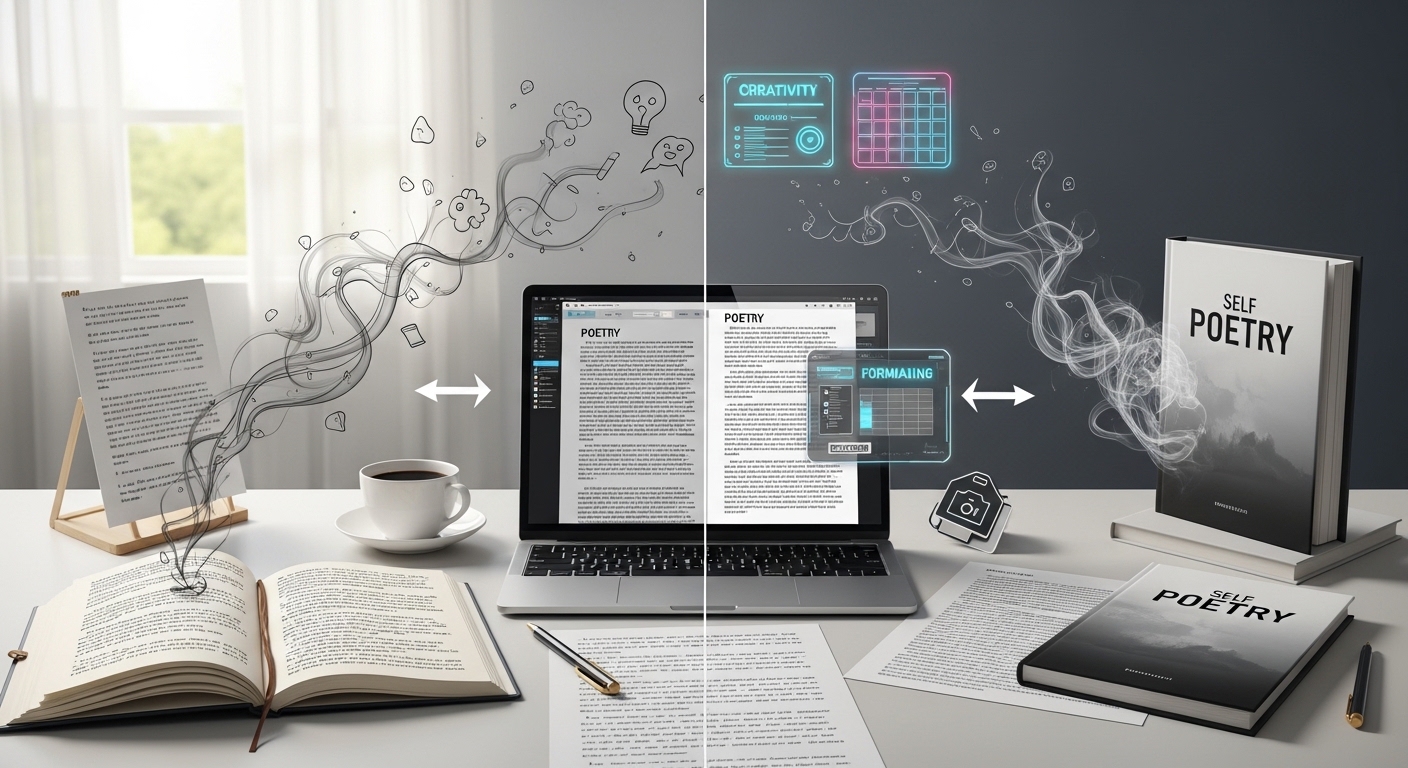
Self-publishing a poetry collection in 2026 is no longer a niche experiment reserved for a small circle of writers. It has become a legitimate, flexible, and highly creative path for poets who want full control over their work. However, it is also one of the most misunderstood forms of publishing because poetry behaves differently from fiction or nonfiction in both creation and consumption.
A poetry collection is not just a compilation of poems. It is a carefully constructed emotional experience. Every line break, every page turn, and every sequence of poems contributes to how readers interpret your voice. Unlike other genres, poetry depends heavily on rhythm, visual layout, and emotional pacing rather than narrative structure or informational value.
Self-publishing gives poets the freedom to shape all of these elements. But that freedom also comes with responsibility. You are not only the writer—you are also the editor, designer, strategist, and publisher.
This guide breaks the entire process into clear, structured steps while also focusing on the deeper creative and strategic thinking behind each stage. The goal is not just to help you publish a poetry book, but to help you create one that feels intentional, professional, and emotionally resonant.
Understanding What Makes a Poetry Collection Work in 2026
A poetry collection in 2026 is not judged the same way it was a decade ago. Readers are no longer engaging with poetry only in academic or literary spaces. They discover it through digital previews, social sharing, sample pages, and algorithm-driven recommendations. Because of this, a poetry book is no longer just a printed body of work—it is a discoverable reading experience shaped by attention, clarity, and emotional flow.
What matters most today is not simply how strong individual poems are, but how effectively they work together when experienced as a complete collection. Readers decide very quickly whether a book feels worth continuing, and that decision is shaped by structure as much as by writing quality.
A successful modern poetry collection feels intentional from the first few pages. Even if it is deeply personal or experimental, it still gives the reader a sense of direction. There is a recognizable voice, a consistent emotional atmosphere, and a rhythm that makes the reading experience feel cohesive rather than fragmented.
Cohesion Is Now About Reader Experience, Not Just Theme
In older publishing advice, cohesion was often explained as having a central theme—love, grief, identity, nature, and so on. While theme is still important, it is no longer enough on its own.
In 2026, cohesion is defined more by how the reader experiences continuity across poems rather than whether all poems fall under the same topic. Two collections can explore similar themes but feel completely different depending on how they are arranged and how consistently they maintain tone and voice.
Readers expect a collection to feel stable as they move through it. That does not mean every poem should feel similar, but it does mean the transitions between poems should feel intentional rather than abrupt.
A strong collection typically ensures:
- Emotional tone does not shift randomly without purpose
- Similar ideas are grouped or spaced in a way that feels deliberate
- The reading pace feels controlled rather than uneven
- No section feels disconnected from the rest of the book
This is especially important today because most readers sample poetry before committing to a full read. If early pages feel inconsistent, they rarely continue.
Preparing to Self-Publish Your Poetry Collection
Before moving into the step-by-step process, it’s important to understand that self-publishing a poetry collection is not a single task—it’s a layered process that combines creativity, organization, and decision-making.
Many poets approach publishing with the mindset that once the poems are written, the hardest part is over. In reality, writing is only one phase. What comes next is shaping those poems into a cohesive book that readers can engage with from beginning to end.
This is where the process becomes more intentional.
You are no longer just writing poems—you are building a complete collection. That means thinking about structure, flow, presentation, and how each piece contributes to the overall experience. Without this stage, even strong poetry can feel scattered or incomplete when placed into book form.
At the same time, it’s important not to overcomplicate the process. Self-publishing can feel overwhelming when viewed as a whole, but it becomes manageable when broken down into clear, focused steps. Each stage builds on the previous one, gradually transforming your ideas into a finished book.
Before you begin, keep a few guiding principles in mind:
- Your goal is not to include everything you’ve written, but to create a cohesive experience
- Clarity and structure matter just as much as creativity
- The reader’s journey through your book should feel intentional
- Every decision—from poem selection to layout—should support the overall vision
With this foundation in place, the process becomes far more straightforward.
Now, let’s move step by step through how to turn your poetry into a professionally structured and self-published collection.
Step 1: Defining the Core Theme and Emotional Direction
Every impactful poetry collection begins with clarity of purpose. Without a central idea or emotional direction, poems can feel scattered, even if they are individually strong.
The theme does not have to be overly literal. It can be abstract, emotional, or conceptual. What matters is that it provides a sense of unity.
Many poets choose themes such as love, grief, identity, memory, or transformation. Others explore more nuanced directions like silence, distance, healing, or fragmentation of self.
Instead of thinking of the theme as a strict category, think of it as an emotional atmosphere that surrounds the entire collection.
A useful way to refine your theme is to ask:
- What emotional experience do I want the reader to leave with?
- What ideas appear repeatedly in my writing without intention?
- What personal or universal tension am I exploring through my poems?
Once the core direction is clear, it becomes easier to decide what belongs in the collection and what does not.
Step 2: Selecting and Refining Your Poems
Once your theme is defined, the next stage is selection. This is often more difficult than writing itself because it requires emotional distance from your own work.
Not every poem you’ve written will fit into the collection, even if it is technically strong. The key criterion is alignment with the overall direction.
At this stage, you are not just choosing “good poems.” You are choosing poems that work together.
A strong selection process usually involves reading your entire body of work multiple times and grouping poems based on emotional or thematic similarity. This helps reveal patterns that may not be obvious at first.
You may find that some poems naturally strengthen each other when placed side by side, while others feel out of place even if they are well written.
Typical selection criteria include:
- Relevance to the central theme
- Emotional consistency with the collection
- Variation in tone without disrupting cohesion
- Strength of individual impact
Once selected, refinement becomes essential. Poetry thrives on precision, and even small changes can significantly improve rhythm and clarity.
Step 3: Structuring the Flow of the Collection
The order of poems plays a critical role in shaping the reader’s experience. A poetry collection is not read randomly—it is experienced sequentially.
A well-structured collection often feels like a gradual unfolding of emotion or thought. Even without a narrative, there is usually a sense of movement.
Many poets structure their collections by emotional intensity, starting with accessible poems and gradually moving toward more complex or emotionally heavy pieces. Others structure them thematically, grouping similar ideas together before transitioning to another emotional space.
There is no single correct structure, but there are principles that consistently improve readability and impact.
A strong structure often includes:
- A powerful opening poem that establishes tone
- A middle section that expands or deepens the theme
- A variation in pacing to avoid emotional monotony
- A closing poem that leaves resonance or reflection
The ordering process is often iterative. Poems may be rearranged multiple times before the right flow emerges.
Step 4: Editing Poetry With Precision and Intent
Editing poetry is not about correcting grammar alone. It is about refining expression, rhythm, and emotional clarity.
Unlike prose, poetry often relies on intentional ambiguity, but that does not mean it should be unclear or unpolished. Every word carries weight.
During editing, focus on both macro and micro elements. On a larger scale, ensure the poem communicates its intended emotion. On a smaller scale, refine line breaks, word choice, and pacing.
Reading poems aloud is one of the most effective editing techniques because poetry is inherently rhythmic. It allows you to hear inconsistencies that may not be visible on the page.
Key editing considerations include:
- Eliminating unnecessary or redundant words
- Strengthening imagery and metaphor clarity
- Maintaining consistent tone and voice
- Ensuring line breaks support rhythm and meaning
Editing is often a slow and repetitive process, but it is essential for creating a polished final collection.
Step 5: Designing the Interior Layout for Poetry
Unlike other genres, poetry is visually sensitive. The way poems appear on the page directly affects how they are read and interpreted.
Line breaks, spacing, and page composition are not decorative—they are part of the meaning.
A poorly formatted poetry book can disrupt rhythm and dilute emotional impact, even if the writing is strong.
Good interior design focuses on clarity and intentional spacing rather than visual complexity. White space is especially important because it gives readers time to pause and absorb meaning.
Key layout considerations include:
- Preserving original line breaks exactly as intended
- Using consistent typography throughout the collection
- Allowing sufficient spacing between poems
- Ensuring readability across devices and print formats
A well-designed interior allows the poetry to breathe, enhancing rather than competing with the words.
Step 6: Creating a Cover That Reflects the Collection’s Identity
The cover of a poetry collection carries significant weight because it sets the emotional expectation before a single poem is read.
Unlike fiction covers that often depict scenes or characters, poetry covers tend to rely on abstraction, symbolism, or minimalism.
The goal is not to explain the content but to evoke its emotional tone.
A strong poetry cover typically reflects:
- The emotional mood of the collection
- The simplicity or complexity of the writing style
- The conceptual depth of the themes
Design elements such as color, texture, and typography play a major role in shaping first impressions. Even subtle design choices can influence how readers perceive the seriousness or intimacy of the work.
Step 7: Preparing the Manuscript for Publication
Once the collection is finalized, preparation for publication involves ensuring technical readiness.
This includes formatting the manuscript correctly, verifying consistency across all poems, and checking for layout issues that may appear in print or digital formats.
At this stage, attention to detail becomes crucial. Even small formatting errors can disrupt the reading experience.
Preparation often includes:
- Final proofreading of all poems
- Standardizing spacing and formatting
- Checking page alignment and breaks
- Testing readability across different formats
A clean, well-prepared manuscript reduces production issues and ensures a smoother publishing process.
Step 8: Choosing the Right Publishing Format
Poetry collections can be published in multiple formats, each offering different advantages. Print editions often provide the most impactful experience due to the visual and tactile nature of poetry.
Digital formats, however, offer accessibility and global reach.
Many poets choose to release both formats simultaneously to maximize audience reach while preserving artistic presentation.
Common format considerations include:
- Print editions for aesthetic and collectible value
- Digital editions for convenience and distribution
- Hardcover versions for premium positioning
- Paperback versions for affordability and accessibility
Each format serves a different reader expectation.
Step 9: Pricing and Positioning Your Poetry Collection
Pricing poetry requires balancing accessibility with perceived value. Unlike commercial fiction, poetry is often considered a niche category, which influences reader expectations.
Pricing should reflect:
- Length and depth of the collection
- Production quality
- Target audience engagement level
- Comparable works in the market
A well-positioned poetry book does not rely on low pricing alone. Instead, it communicates artistic value and emotional depth.
Step 10: Launching and Sharing Your Poetry Collection
Publishing your poetry collection is not the end of the process. It is the beginning of reader engagement.
Poetry thrives on connection, reflection, and emotional resonance. Sharing your work effectively involves more than simply announcing its release.
Successful approaches often include:
- Sharing individual poems to build anticipation
- Explaining the emotional inspiration behind the collection
- Engaging with readers who respond to your work
- Creating a consistent presence around your writing
Readers of poetry often form personal connections with the author’s voice, making engagement especially important.
Frequently Asked Questions
How long should a poetry collection be?
There is no fixed length, but most collections fall between 40 and 100 pages depending on structure and depth.
Do I need a theme for my poetry book?
A theme is not mandatory, but it significantly improves cohesion and reader experience.
Can I publish poems that were previously shared online?
Yes, as long as you hold the rights and the poems fit within the collection’s structure.
Is self-publishing poetry profitable?
It can be, but success depends heavily on audience engagement and long-term consistency.
Final Thoughts
Self-publishing a poetry collection is a deeply creative and highly intentional process. It requires more than writing—it requires curation, design awareness, and emotional clarity.
A strong poetry book is not just a set of poems placed together. It is a carefully shaped experience that guides readers through emotion, reflection, and meaning.
When approached with patience and precision, self-publishing allows poets to fully express their voice without compromise. The result is not just a book, but a lasting emotional artifact that resonates with readers long after they finish the final page.