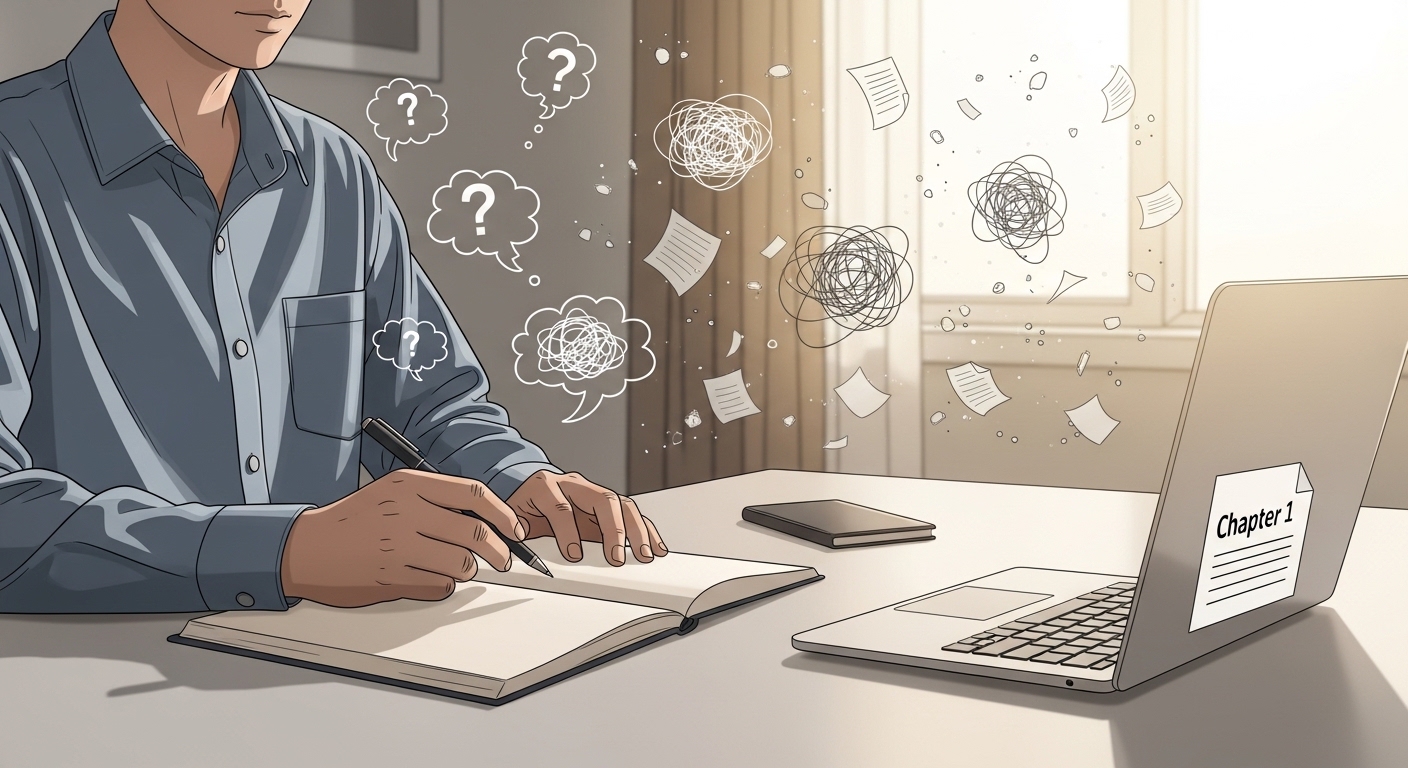
Most aspiring authors don’t struggle with a lack of ideas—they struggle with too many of them. The mind keeps circling the same questions: Is this idea good enough? What if the writing is bad? Should I plan more before starting? This cycle of overthinking creates a strange paralysis where the desire to write exists, but actual writing never begins.
Overthinking is one of the most common barriers in creative writing, especially in long-form projects like novels, memoirs, or nonfiction books. It disguises itself as “planning” or “preparation,” but in reality, it delays execution. The result is a growing distance between intention and action.
To start writing a book, the problem is rarely skill. It is often mental friction—fear of imperfection, lack of structure, and an internal demand for certainty before beginning. The truth is, writing a book does not begin with clarity. Clarity is something that emerges through writing itself.
This guide breaks down how to stop overthinking and actually start writing your book in a structured, realistic way using practical writing psychology, creative workflow strategies, and sustainable habits.
Why Writers Get Stuck in Overthinking Loops
Overthinking in writing is rarely random. It is usually driven by a combination of perfectionism, information overload, and fear of failure. Modern writers are exposed to thousands of examples of “successful books,” writing systems, plotting methods, and editing frameworks. While helpful, this abundance often creates confusion rather than clarity.
One major cause is the illusion that planning must be complete before writing begins. Many writers believe they need a perfect outline, a flawless concept, or a fully structured narrative arc before they can start. This creates a mental bottleneck where progress depends on achieving unrealistic certainty.
Another hidden cause is self-comparison. Seeing polished books or experienced authors can make beginners feel unprepared. Instead of writing, they pause to “improve readiness,” which often turns into avoidance behavior.
Overthinking also thrives when writing becomes tied to identity. If the book is seen as a reflection of personal worth, every sentence feels high-stakes. This increases hesitation and slows down the natural flow of ideas.
Understanding the Psychology Behind Writing Resistance
At its core, writing resistance is not about laziness—it is about cognitive overload. The brain tries to reduce uncertainty by thinking more, but writing actually requires tolerance for uncertainty.
When someone tries to write a book, they are essentially managing multiple layers at once: idea generation, sentence construction, narrative flow, audience expectations, and internal judgment. This creates mental congestion.
Instead of producing output, the mind cycles through evaluation loops such as:
- Is this idea strong enough?
- Should I restructure the chapter first?
- What if I choose the wrong direction?
These questions feel productive, but they delay execution. Writing improves only when thinking shifts from evaluation mode to generation mode.
A key insight here is that clarity is not a prerequisite for writing—it is a byproduct of writing. The more you write, the more structure naturally emerges.
The Core Shift: From Thinking to Writing
To stop overthinking and actually start writing your book, the most important shift is behavioral, not intellectual. You are not trying to think your way into writing—you are trying to write your way into clarity.
This requires accepting that the first draft is not meant to be correct. It is meant to exist. Once something exists, it can be shaped, refined, and improved. What does not exist cannot be edited.
Many writing coaches refer to this as “permission to be messy,” but practically it means reducing the emotional weight of early drafts. The goal is momentum, not perfection.
A helpful way to reframe this shift is:
| Overthinking Mode | Writing Mode |
|---|---|
| Planning endlessly | Writing imperfectly |
| Seeking certainty | Accepting uncertainty |
| Editing mentally | Editing after drafting |
| Avoiding mistakes | Expecting mistakes |
This shift alone is often enough to unlock initial progress.
How to Start Writing Your Book Without Overplanning
Starting a book does not require a complete roadmap. It requires a starting point small enough that your mind cannot overanalyze it.
Instead of thinking in terms of chapters or structure, begin with raw material. This could be a scene, an idea fragment, a memory, or even a single concept explained in simple language. The key is to bypass the internal critic by lowering the entry barrier.
Once writing begins, structure begins to form naturally. Many experienced authors do not finalize structure before writing; they discover it through writing.
At this stage, the goal is consistency rather than direction. Even writing 300–500 words a day creates enough momentum to break the cycle of hesitation.
Practical Methods to Break Overthinking Patterns
To move from thinking to execution, structured behavioral techniques are necessary. These are not abstract ideas but actionable shifts in writing routine and mindset.
- One effective method is time-boxed writing, where you write for a fixed duration without stopping or editing. This reduces the opportunity for internal criticism to interfere with output.
- Another approach is writing “bad first drafts” intentionally. By allowing imperfection from the beginning, you reduce pressure and increase fluency.
- Freewriting can also help. This involves writing continuously without structure, allowing thoughts to flow without judgment. Over time, this helps reduce mental resistance.
- Finally, reducing exposure to excessive writing advice can prevent analysis paralysis. Too much information often reinforces hesitation instead of solving it.
Common Mental Blocks That Prevent Writing
Many writers believe their problem is external—lack of time, tools, or structure. However, most barriers are internal cognitive patterns that reinforce delay. Fear of judgment is one of the strongest barriers. Writers often imagine how readers will respond before anything is even written. This creates premature editing in the mind. Another block is the belief that inspiration must arrive before writing. In reality, inspiration is often triggered by action rather than preceding it. A third common issue is perfectionist structuring, where writers continuously adjust outlines instead of writing actual content. This creates the illusion of productivity without real progress.
Building a Sustainable Writing Habit
Consistency is more important than intensity. Writing a book is not a single creative burst but a sustained process. The goal is to build a routine that removes decision fatigue.
A simple structure often works best:
- Write at the same time daily
- Start with small word targets
- Avoid editing during first draft phase
- Keep writing sessions predictable
The more automatic the habit becomes, the less room there is for overthinking.
Table: Overthinking vs Productive Writing Behavior
| Overthinking Behavior | Productive Writing Behavior |
|---|---|
| Constant planning | Immediate writing |
| Excessive outlining | Minimal structure |
| Self-criticism during drafting | Deferred editing |
| Waiting for motivation | Writing regardless of mood |
| Comparing with others | Focusing on personal progress |
FAQs
Why do I overthink when trying to write a book?
Overthinking usually comes from perfectionism, fear of judgment, and lack of writing confidence. The mind tries to reduce uncertainty by delaying action, which creates mental resistance.
How do I stop thinking too much before writing?
The most effective way is to start writing immediately in a low-pressure format such as freewriting. This bypasses the internal critic and reduces hesitation.
Do I need a full outline before writing my book?
No. While outlines can help, many successful books are developed during the writing process. Overplanning often leads to delays rather than progress.
What if my writing is bad?
First drafts are expected to be imperfect. Quality is developed through revision, not during initial writing. The goal of the first draft is completion, not perfection.
How long does it take to stop overthinking?
It varies, but most writers notice improvement once they build a consistent writing habit and reduce self-editing during drafting.
Final Thoughts
Stopping overthinking and starting a book is less about finding the perfect strategy and more about changing your relationship with writing itself. Writing is not a test of readiness—it is a process of discovery.
Once you begin producing words consistently, clarity naturally emerges. Structure forms, ideas evolve, and confidence builds through action rather than preparation.
The real shift happens when writing stops being something you prepare for and becomes something you simply do.