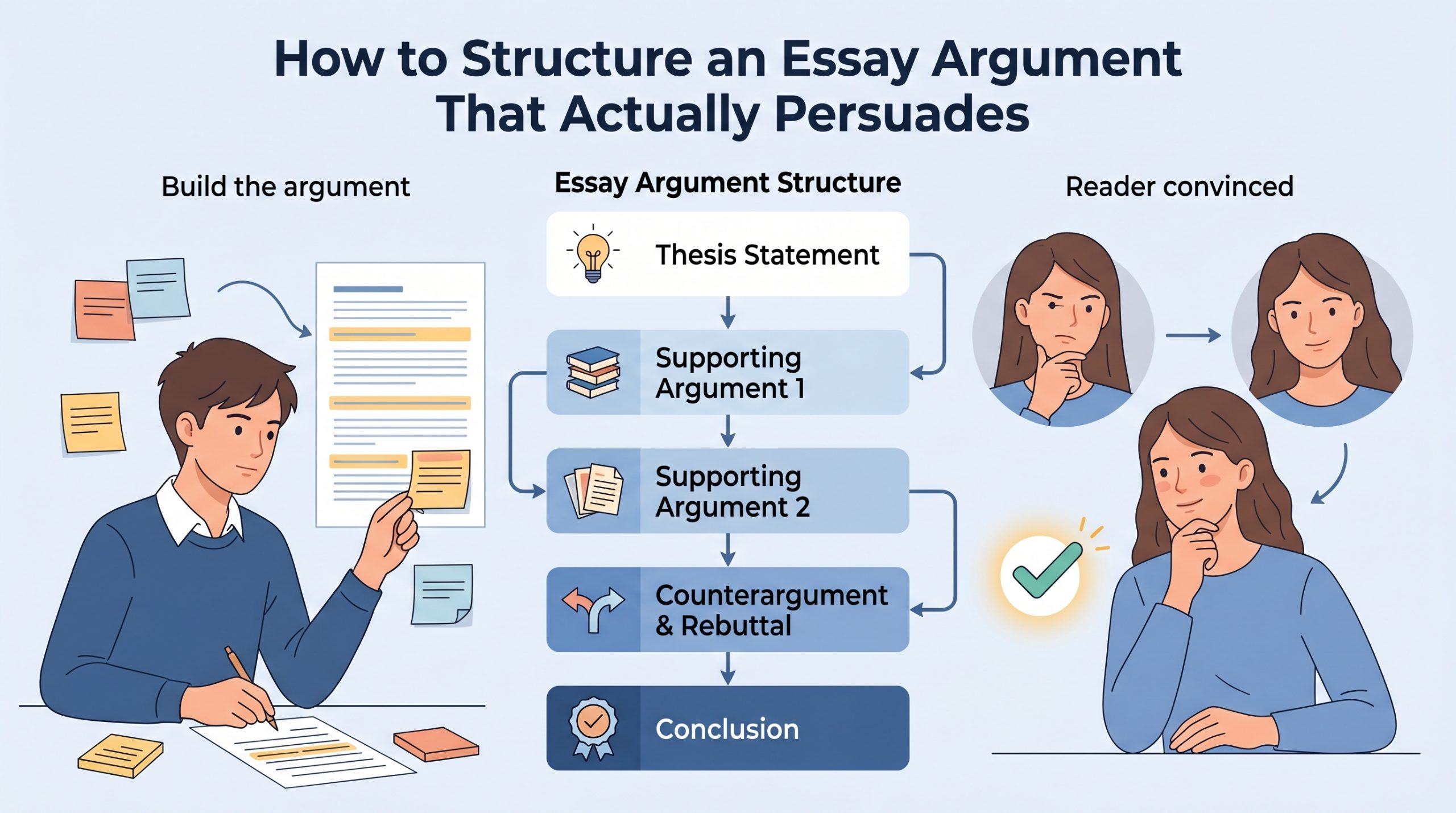
A persuasive essay is not simply a written opinion arranged into paragraphs, nor is it a purely descriptive account of a topic. It sits between two distinct academic modes—analysis and explanation—and is therefore closely related to the distinction explored in Critical Essay vs. Descriptive Essay: When to Use Each and Why It Matters. While a descriptive essay focuses on presenting information in a neutral and observational manner, a critical essay evaluates, interprets, and challenges ideas through structured reasoning. A persuasive essay draws more heavily from the critical approach because its primary goal is not to describe what is, but to argue why something should be accepted as valid, important, or true.
A persuasive essay is, therefore, a carefully constructed line of reasoning designed to guide a reader from uncertainty to acceptance. It does not rely on opinion alone, but on a structured progression of logic where each point builds upon the previous one. Every sentence plays a role in developing reasoning, establishing credibility, and reinforcing the central claim. The writing must feel controlled and intentional, not scattered or reactive. When structured correctly, an essay does not feel like persuasion being imposed on the reader; instead, it feels like a process of conclusion discovery, where the reader arrives at the argument naturally through evidence and logic.
The strength of a persuasive essay lies in how seamlessly it moves from claim to justification. The reader should never feel lost or disconnected from the argument. Instead, they should experience a gradual unfolding of ideas that feels inevitable rather than forced. This is achieved through careful organization, where each paragraph serves a specific purpose in advancing the thesis.
The difference between weak and strong essays rarely lies in the quality of ideas alone. It lies in structure, sequencing, and logical discipline. Even powerful arguments fail when they are scattered, poorly organized, or unsupported by clear reasoning. Strong essays succeed because they follow a controlled system in which the thesis sets direction, evidence provides support, explanation builds meaning, and the conclusion brings everything together into a unified intellectual outcome.
Understanding What an Essay Argument Is Really Trying to Do
The Real Purpose of Persuasive Writing
A persuasive essay is fundamentally an exercise in controlled reasoning. Its purpose is not to express what the writer thinks but to demonstrate why a position is valid. This requires more than stating claims; it requires building a logical path that leads the reader toward agreement.
Unlike casual writing, persuasive essays rely on intellectual discipline. Every idea must contribute to a larger structure. If a point does not advance the argument, it weakens it. The reader should never feel lost or uncertain about why a particular detail is included. Instead, each paragraph should feel like a necessary step toward a conclusion that feels well-supported and logically inevitable.
Argument as a Structured Journey
A strong essay functions like a guided intellectual journey. The introduction sets direction, body paragraphs build momentum, and the conclusion finalizes meaning. This journey must be predictable in structure but not in outcome. The reader should always feel guided but still intellectually engaged.
When structure is missing, essays become fragmented collections of ideas. When structure is present, ideas transform into reasoning. This is why structure is not a formatting choice—it is the foundation of persuasion itself.
Building a Strong Thesis as the Foundation of the Argument
The Thesis as the Central Command Point
The thesis statement is the controlling idea of the entire essay. It defines what the essay is arguing and sets the boundaries for everything that follows. Without a clear thesis, writing becomes descriptive instead of argumentative.
A strong thesis does three things:
- It states a clear position
- It remains specific enough to be supported
- It creates space for reasoning and development
Weak theses are usually too broad, too obvious, or too factual. Strong theses are debatable and structured around interpretation or judgment rather than simple description.
Why Specificity Strengthens Persuasion
Specificity in a thesis improves clarity and focus. When a thesis is vague, the essay lacks direction, and arguments drift into unrelated territory. A focused thesis allows the writer to filter ideas, ensuring only relevant material is included.
For example, instead of a broad claim about education, a stronger thesis isolates a specific angle—such as how digital learning environments reshape student attention spans or academic discipline. This specificity makes the argument easier to develop and more convincing to read.
The Thesis as a Filtering System
The thesis acts like a gatekeeper. Every paragraph, example, and explanation must pass through it. If an idea does not support the thesis, it does not belong in the essay. This filtering process prevents redundancy, confusion, and weak argumentation. In advanced writing contexts, the thesis also functions like a strategic positioning statement. It defines not just what the essay says, but why it matters. This elevates writing from explanation to persuasion.
Structuring Body Paragraphs for Logical Progression
The Principle of Single-Idea Paragraphs
Each body paragraph should focus on one central idea that supports the thesis. This ensures clarity and prevents cognitive overload for the reader. When multiple ideas compete within a single paragraph, the argument becomes fragmented and less persuasive.
A strong paragraph structure typically includes:
- A topic sentence (claim)
- Supporting evidence
- Explanation or interpretation
- Connection back to the thesis
This structure creates a controlled flow of reasoning where each paragraph builds independently but contributes to the overall argument.
Logical Sequencing of Ideas
The order of paragraphs matters as much as their content. Effective essays follow a progression from foundational reasoning to more complex or impactful points. This sequencing builds intellectual momentum.
A common effective pattern is:
- Foundational argument
- Supporting explanation
- Counterpoint or complexity
- Strengthened or refined position
This structure ensures that the reader is gradually guided toward deeper understanding rather than being overwhelmed early.
Why Analysis Is More Important Than Evidence
Evidence supports claims, but analysis creates persuasion. Without explanation, evidence remains disconnected data. Analysis is what tells the reader why the evidence matters and how it supports the argument. Strong essays do not assume meaning—they construct it. Every piece of evidence must be interpreted, contextualized, and linked directly to the thesis.
Using Evidence Strategically to Strengthen Persuasion
Evidence as a Controlled Resource
Evidence is not decoration; it is a strategic tool. Its purpose is to reinforce claims, not overwhelm the reader. Effective writers select evidence carefully based on relevance, clarity, and argumentative value.
Too much evidence can weaken persuasion if it is not properly explained. Too little evidence can make arguments feel unsupported. Balance is key.
Integration Over Insertion
Evidence should never appear as isolated information. It must be integrated into sentences and paragraphs smoothly. This means introducing the source, presenting it clearly, and then explaining its relevance.
Poor integration often looks like a sudden quote or statistic with no explanation. Strong integration turns evidence into part of the argument’s natural flow.
Building Credibility Through Support
Well-chosen evidence increases the credibility of the argument. It shows that the writer’s position is not arbitrary but supported by logic, research, or external validation.
This credibility is especially important in academic writing, where arguments are evaluated not just for ideas but for justification quality.
Creating Transitions That Maintain Argument Flow
Transitions as Structural Connectors
Transitions are the invisible framework of essay structure. They connect paragraphs and guide the reader through the argument. Without them, even well-written ideas feel disconnected.
Transitions can indicate:
- Contrast (however, on the other hand)
- Continuation (furthermore, in addition)
- Cause and effect (therefore, as a result)
- Emphasis (most importantly, significantly)
Maintaining Reader Orientation
Good transitions ensure that the reader never feels lost. They signal where the argument is going and how each idea relates to the previous one. This improves readability and strengthens persuasion by maintaining intellectual continuity.
Advanced Transition Strategy
In higher-level writing, transitions are not just connectors—they are argumentative tools. They subtly reinforce the structure of reasoning by showing relationships between ideas rather than simply linking them.
Strengthening the Conclusion to Reinforce Persuasion
A strong conclusion is not an afterthought but the final stage where the essay’s argument is unified and clarified. It reinforces the thesis by pulling together the main ideas into a coherent ending. Instead of adding new points, it strengthens the overall message by showing how the discussion logically leads to a final understanding. This makes the essay feel complete, intentional, and persuasive rather than unfinished or scattered.
The Conclusion as Synthesis, Not Summary
A conclusion should synthesize rather than simply repeat earlier ideas. Synthesis means combining the main arguments into one clear final insight that reflects how they work together to support the thesis. Instead of listing points again, it shows their connection and collective meaning. This approach gives depth to the essay and helps the reader see the argument as a unified structure rather than separate sections.
Creating Intellectual Closure
Intellectual closure ensures the essay feels complete and logically resolved. It gives the reader a sense that the argument has reached its natural end point. A strong conclusion avoids abrupt endings or unnecessary repetition and instead provides a clear final resolution. This helps the reader leave with confidence in the argument and understanding of its purpose, making the essay feel structured and fully developed.
Expanding Meaning Beyond the Essay
An effective conclusion often extends the argument beyond the essay itself by highlighting its broader relevance or implications. This adds depth by showing why the argument matters in a wider context. It shifts the essay from being just an academic exercise to something more meaningful. By connecting ideas to larger themes or outcomes, the conclusion leaves a lasting impression and strengthens the overall persuasive impact.
Counterarguments and Rebuttals (Very Important)
A persuasive essay becomes significantly stronger when it acknowledges opposing viewpoints instead of ignoring them. This practice demonstrates intellectual fairness and shows that the writer has considered the topic from multiple angles, which immediately increases credibility. Rather than weakening the argument, addressing counterarguments actually reinforces it by proving that the position remains valid even under scrutiny.
To apply this effectively, the writer should first present a reasonable opposing viewpoint, ensuring it is stated fairly and accurately. Next, this viewpoint should be briefly explained so the reader understands its logic and appeal. Finally, it must be refuted using evidence, reasoning, or logical analysis that demonstrates why the original argument is stronger. This structured approach turns potential weaknesses into opportunities for reinforcement, making the essay more balanced, persuasive, and intellectually mature.
Logical Fallacies to Avoid
A well-structured essay can still lose persuasive strength if its reasoning contains logical errors. These errors are known as logical fallacies, and they weaken credibility by introducing flawed thinking into the argument. Recognizing and avoiding them is essential for maintaining clarity, accuracy, and intellectual integrity in persuasive writing.
Ad Hominem
Ad hominem occurs when the writer attacks the person making an argument instead of addressing the argument itself. This weakens persuasion because it shifts focus away from logic and evidence. Rather than disproving the idea, it attempts to discredit the individual, which does not contribute to meaningful reasoning or strengthen the essay’s position.
Strawman Fallacy
The strawman fallacy happens when an opposing argument is misrepresented or simplified in a distorted way to make it easier to refute. Instead of engaging with the real argument, the writer attacks a weaker version of it. This reduces intellectual honesty and makes the essay less credible, as it avoids fair and accurate debate.
False Cause Fallacy
The false cause fallacy arises when a cause-and-effect relationship is assumed without sufficient evidence. It incorrectly links two events as cause and result simply because one follows the other. This type of reasoning weakens an essay because it replaces logical proof with assumption, reducing the reliability of the argument.
Overgeneralization
Overgeneralization occurs when broad conclusions are drawn from limited or insufficient evidence. It simplifies complex issues into absolute statements that are not fully supported. This weakens persuasion because it ignores variation and context, making the argument appear exaggerated or unreliable rather than carefully reasoned.
Complete Essay Structure Overview
| Component | Function | Role in Argument | Common Failure |
| Thesis | Central claim | Guides entire essay | Too broad or descriptive |
| Introduction | Context + direction | Prepares reader | Lacks focus |
| Body Paragraphs | Develop reasoning | Build argument step-by-step | Multiple ideas per paragraph |
| Evidence | Support claims | Adds credibility | No explanation or context |
| Analysis | Interpretation | Creates persuasion | Missing reasoning |
| Transitions | Connect ideas | Ensure flow | Overused generic phrases |
| Conclusion | Final synthesis | Reinforces argument | Simple repetition |
FAQs
What makes an essay argument persuasive?
A persuasive essay is effective when it combines clear reasoning, structured progression, and relevant evidence. The argument must feel logical and guided rather than random or emotional.
Why is structure more important than writing style?
Structure determines how ideas are understood. Even strong writing becomes ineffective if ideas are disorganized or unclear. Structure ensures clarity and logical flow.
How long should a thesis be?
A thesis should usually be one or two sentences. It must be concise but strong enough to clearly define the essay’s central argument.
Can I use multiple arguments in one essay?
Yes, but all arguments must support the same thesis. They should function as interconnected parts of a unified reasoning system.
What is the most important part of a body paragraph?
Analysis is the most important part because it explains how evidence supports the argument. Without analysis, paragraphs remain descriptive rather than persuasive.
How do transitions improve essay quality?
Transitions improve clarity by connecting ideas and guiding the reader through logical progression. They prevent fragmentation and enhance flow.
Should conclusions introduce new ideas?
No. Conclusions should not introduce new arguments. They should synthesize existing points and reinforce the essay’s main message.