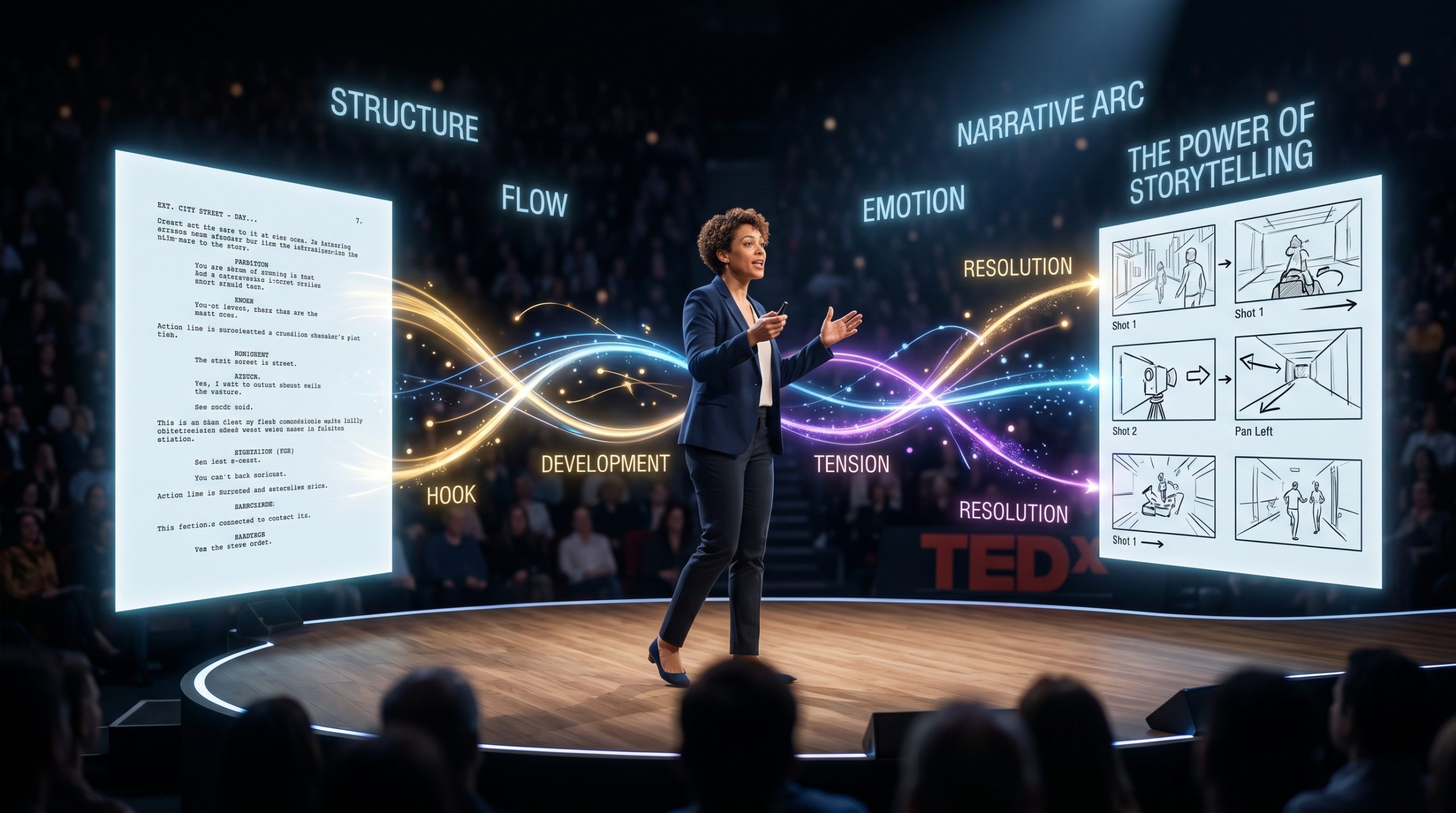
A TED-style talk is not just a speech; it is a deliberately shaped idea delivered in a way that feels personal, focused, and emotionally clear. The difference between a regular presentation and a talk that truly connects is not performance—it is precision. Most speakers assume that adding more information makes them more convincing. In reality, TED-style communication removes excess until only the core idea remains visible and meaningful.
At its foundation, this format is closer to storytelling than traditional public speaking. A strong talk is built around one central idea, not multiple arguments competing for attention. That idea is then developed through structure, lived experience, and emotional clarity. Instead of overwhelming the audience with information, you guide them toward understanding something in a new way.
What makes this style powerful is not complexity but connection. The audience is not there to be impressed—they are there to see a familiar subject differently. This requires a shift in thinking. You are not “delivering content,” you are shaping understanding in real time. Every sentence must support that goal.
In speech writing, storytelling design, and communication strategy, TED-style talks stand out because they combine structure with emotional rhythm. They are carefully engineered, yet they must feel natural. The audience should never feel the construction behind them, only the clarity of the idea being shared.
A strong talk also depends on restraint. What you choose to leave out is just as important as what you include. This is where most speakers struggle—they try to cover everything instead of building focus. TED-style writing is about depth, not width.
- A TED-style talk is built around one clear, focused idea
- Connection and clarity matter more than information volume
- Storytelling and structure work together to shape understanding
Finding the Core Idea of Your TED-Style Talk
Every strong TED-style talk begins with a single idea that can be explained in one sentence. This is not the topic itself but the transformation or insight behind it. For example, “education” is a topic, but “why curiosity matters more than curriculum” is an idea. The second version has direction, tension, and meaning.
The most common mistake speakers make is starting with a broad subject instead of a sharpened idea. Broad subjects lead to unfocused talks. A strong TED-style talk requires narrowing, not expanding. You are not trying to cover everything—you are trying to reveal something specific that changes perception.
A useful approach in writing for speeches, essays, and narrative communication is testing the idea through clarity filters:
| Question | Purpose |
| Can I explain this idea in one sentence? | Tests clarity |
| Does this idea challenge a belief or assumption? | Tests depth |
| Can I support it with real experience or observation? | Tests credibility |
| Will someone think differently after hearing it? | Tests impact |
If your idea fails any of these, it is still too broad or too weak.
A strong TED-style idea usually has tension built into it. It challenges what people think they already know. That tension becomes the backbone of your talk, guiding structure and storytelling choices. Without it, the talk becomes informational instead of transformative.
Structuring a TED-Style Talk for Maximum Connection
TED-style structure is not as rigid like academic writing. It is fluid but intentional. The goal is not to present information in separated sections, but to gradually shape understanding so the audience feels like they are discovering the idea in real time. A strong talk moves like a guided thought process rather than a lecture. Every stage has a purpose, and each one builds pressure, clarity, or emotional connection until the final shift in understanding.
This approach closely aligns with creative writing disciplines, such as how to write a script for short films, where structure is not about rigid segmentation but about guiding the audience through emotion, pacing, and meaning in a way that unfolds naturally on screen or in speech.
1. Hook the Audience
The hook is the entry point of your talk, and it determines whether people stay mentally engaged or disconnect. This is not where you introduce your topic in a formal way. Instead, it is where you create curiosity, tension, or emotional interest immediately. A strong hook interrupts normal thinking patterns and makes the audience want to know more.
Effective hooks usually come in three forms: a surprising statement that challenges expectations, a question that cannot be answered immediately, or a short personal moment that feels unfinished. The key is that the audience should not feel like they are being “informed” yet—they should feel like something is unfolding.
A weak hook explains context too early. A strong hook delays explanation and focuses on emotional or intellectual curiosity first. It creates a gap in understanding that the rest of the talk will gradually fill.
2. Introduce the Idea
Once attention is captured, the next step is to introduce the core idea clearly. This is where the talk shifts from curiosity to direction. The idea should be simple enough to state in one sentence but strong enough to carry the entire talk.
This stage is not about proving the idea yet—it is about naming it. The audience should now understand what the talk is fundamentally about, even if they do not fully grasp its meaning yet. Clarity is more important than detail at this stage.
A common mistake is over-explaining here. Instead of expanding, you define the idea cleanly and let it stand on its own. Think of this as setting the foundation. If the foundation is unclear, everything built on top becomes unstable.
3. Build Tension or Challenge Assumptions
This is the turning point of the talk. Once the idea is introduced, you must create tension around it. That tension comes from challenging what the audience already believes, or revealing complexity they did not expect.
This is where depth begins. You are no longer just presenting an idea—you are questioning it, testing it, or showing why it matters more than it first appears. This stage is what transforms a simple topic into a meaningful insight.
Tension can be created in different ways: showing contradiction, presenting a problem, or introducing a personal struggle related to the idea. The goal is to make the audience slightly uncertain so they stay engaged and want resolution.
Without this stage, the talk feels flat because there is no emotional or intellectual movement.
4. Provide Insight Through Examples
Once tension is established, you begin resolving it through insight. This is where examples, stories, or observations become essential. The purpose is not to add information but to deepen understanding.
Good examples do not just illustrate the idea—they reveal it from a different angle. A personal story, for instance, should not exist for entertainment alone; it should clarify why the idea matters in real life. Each example should feel like another layer of the same concept, not a new direction.
This stage is where abstract thinking becomes concrete. The audience starts connecting the idea to real experiences, which makes it more memorable. The strongest talks often use a mix of personal experience and general observation to balance emotion and logic.
5. Resolve with a Shift in Understanding
The ending of a TED-style talk is not a summary. It is a transformation. The goal is not to repeat what was said but to change how the audience interprets it. A strong ending gives the audience a new perspective that feels like a natural conclusion to everything they have heard.
This shift often comes from reframing the original idea in a broader or more personal way. Instead of closing the talk, you expand its meaning. The audience should leave with a feeling of “I didn’t think about it like that before.”
Weak endings simply restate key points. Strong endings change perspective. That difference is what makes a talk memorable.
Transitions Between Sections
Transitions are the invisible structure that holds the entire talk together. Even if each section is strong on its own, poor transitions make the talk feel fragmented. A transition is not just a sentence—it is a logical and emotional bridge between ideas.
Good transitions maintain flow by connecting thought to thought rather than jumping between unrelated points. They often refer back briefly to the previous idea before introducing the next one, creating continuity.
In strong TED-style speaking, transitions feel natural, almost like the speaker is thinking out loud. This smooth progression is what allows the audience to stay engaged without feeling like the talk is segmented or forced.
Building Emotional Connection Through Storytelling
TED-style talks rely heavily on storytelling because stories convert abstract ideas into lived experience. Facts inform, but stories make people care. Without emotional connection, even the strongest idea feels distant.
A good story in a talk does not need complexity. It needs clarity and purpose. Every story must exist to serve the central idea. If it does not reinforce the message, it becomes noise.
In speech writing and narrative design, storytelling is not about entertainment—it is about alignment between emotion and meaning. The story should not distract from the idea; it should reveal it.
Effective stories usually include:
- A moment of tension or challenge
- A clear emotional shift
- A connection back to the main idea
Personal experiences are especially powerful because they create authenticity. The audience does not need perfection—they need truth that feels relatable.
Using Language That Feels Natural and Conversational
Language in a TED-style talk is not about sounding impressive—it is about being understood instantly without effort. The moment language feels forced, overly formal, or unnecessarily complex, the connection with the audience weakens. A strong talk sounds like a clear thought being shared in real time, not a prepared lecture being delivered from memory.
The core principle is simplicity with intention. Simple language does not mean basic ideas; it means removing anything that gets in the way of meaning. Every sentence should feel direct, almost like you are speaking to one person rather than addressing a large audience. This creates intimacy, even in a public setting, which is a defining feature of TED-style communication.
Short, clear sentences
Short sentences improve rhythm, clarity, and emotional pacing. They prevent the audience from getting lost in long chains of explanation. In spoken delivery, shorter sentences also give natural breathing space, which makes the talk easier to follow.
But “short” does not mean fragmented. The goal is controlled flow—ideas should move step by step, not all at once. Each sentence should carry one clear thought, allowing the audience to process meaning without effort. This is especially important when explaining complex or abstract ideas.
Everyday language where possible
TED-style talks work best when they use language people already understand in daily life. The goal is not to impress with vocabulary, but to build understanding through familiarity. When speakers use everyday words, the audience feels included rather than intimidated.
This does not mean avoiding depth. It means translating depth into accessible expression. A strong speaker takes a complex idea and makes it feel natural, as if it was always simple once explained properly. That transformation is what creates connection.
Direct phrasing instead of abstract wording
Abstract wording creates distance. Direct phrasing creates clarity. Instead of describing ideas in vague or conceptual terms, TED-style communication prefers concrete expressions that point to real situations, actions, or emotions.
For example, instead of saying “human behavior is influenced by cognitive bias,” a more effective phrasing would focus on what that looks like in real life. This shift from abstraction to reality is what makes ideas stick in memory.
Direct phrasing also reduces interpretation gaps. The audience does not need to “decode” meaning—they understand it immediately, which keeps attention focused on the message rather than the wording.
Avoiding unnecessary jargon
Jargon creates separation between the speaker and the audience. It may sound professional, but it often reduces clarity. In TED-style writing, technical or specialized terms should only be used when they are absolutely necessary to the idea.
When jargon is unavoidable, it must be explained immediately in simple language. The explanation should feel natural, not like a definition being read from a dictionary. The goal is to keep the audience inside the flow of the talk, not force them to step outside it to understand meaning.
Tone: reflective, not performative
Tone is one of the most important elements of TED-style communication. The talk should not feel like a performance where the speaker is trying to impress. Instead, it should feel reflective, as if the speaker is sharing a thought process with the audience.
This reflective tone creates authenticity. It makes the talk feel honest, grounded, and human. Rather than presenting conclusions as fixed truths, the speaker guides the audience through how those conclusions were reached.
When tone is reflective, the audience feels included in the thinking process. This is what transforms a speech into a shared experience rather than a one-way delivery of information.
Table: TED-Style Talk vs Traditional Speech
| Element | TED-Style Talk | Traditional Speech |
| Focus | One central idea | Multiple points |
| Tone | Conversational and reflective | Formal and structured |
| Structure | Narrative-driven | Outline-driven |
| Goal | Shift perspective | Deliver information |
| Language | Simple and precise | Technical or complex |
| Engagement | Emotional + intellectual | Mostly informational |
Designing Flow and Rhythm in Your Talk
Flow in a TED-style talk is not something that happens by chance. It is deliberately constructed through pacing, sentence structure, emotional movement, and the way ideas are layered over time. A strong talk does not feel like a sequence of points being delivered one after another. Instead, it feels like a continuous thought unfolding in front of the audience. The listener should not feel “segments”—they should feel movement.
At the core of this movement is rhythm. Rhythm is what keeps attention alive. It determines whether the audience stays emotionally engaged or begins to mentally drift. A well-designed talk rises and falls in intensity, much like storytelling. Some moments are calm and explanatory, others are emotionally rich, and others are reflective. This variation prevents fatigue and keeps the audience connected to both meaning and feeling.
Rhythm comes from balancing key elements
A TED-style talk depends on three main components working together in rotation: explanation, storytelling, and reflection. Each serves a different purpose, and none should dominate the entire talk.
- Explanation builds clarity. It helps the audience understand the idea in simple, structured terms.
- Storytelling creates emotional engagement. It turns abstract ideas into lived experience.
- Reflection deepens meaning. It gives the audience space to interpret and internalize what they’ve heard.
When a talk relies too heavily on explanation, it becomes mechanical and flat. When it leans only on storytelling, it may feel engaging but lacks direction. When it becomes purely reflective, it risks becoming abstract and disconnected from real-world grounding. The strength of TED-style writing lies in shifting between these modes smoothly, so the audience is always mentally and emotionally engaged without feeling overwhelmed or lost.
The role of pacing in maintaining attention
Pacing refers to how quickly or slowly ideas are delivered and how much space is given between them. A fast-paced section can build energy and urgency, while slower pacing allows deeper understanding. Effective talks do not maintain a constant speed; they adjust pace based on emotional and intellectual needs.
For example, when introducing a key idea, slower pacing helps ensure clarity. When building tension or moving through a story, slightly faster pacing maintains momentum. When delivering a reflective or important insight, slowing down again allows the message to land more deeply.
Poor pacing often makes talks feel rushed or monotonous. Good pacing makes the audience feel guided rather than pushed.
Why pauses are part of structure, not silence
Pauses are often misunderstood as empty gaps, but in TED-style communication they function as structural elements. A well-placed pause gives the audience time to process meaning, absorb emotion, and mentally connect ideas.
Without pauses, even strong ideas can feel overwhelming or blurred together. With pauses, each idea gains weight and clarity. A pause after a key statement signals importance. A pause before a shift in direction prepares the audience for change. These moments of silence are not interruptions—they are part of the rhythm.
Turning information into experience through rhythm
In public speaking and communication design, rhythm is what transforms raw information into something memorable. Information alone is quickly forgotten, but information delivered with emotional timing and structured flow becomes an experience.
A well-designed TED-style talk does not just tell the audience what to think—it controls how they move through ideas emotionally and intellectually. Flow ensures continuity, rhythm ensures engagement, and together they turn a simple message into something that feels alive in the moment it is delivered.
Editing Your TED-Style Script
Editing is where the real strength of a talk emerges. The first draft is usually too long, too scattered, or too detailed. The goal of editing is not refinement—it is reduction.
Every sentence must earn its place. If it does not support the central idea or emotional direction, it must be removed.
A strong editing process focuses on:
- Removing repetition
- Strengthening clarity
- Simplifying language
- Increasing emotional impact
Many writers improve their talk more by cutting content than adding it.
FAQ: Writing a TED-Style Talk
What makes a TED-style talk different from a regular speech?
A TED-style talk focuses on one central idea and builds emotional and intellectual connection through storytelling rather than information overload.
How long should a TED-style talk be?
Most talks range from 10 to 18 minutes, which requires tight writing and careful focus on clarity over quantity.
Do all TED-style talks need stories?
Not all, but most strong talks include at least one meaningful story to ground abstract ideas in real experience.
What is the most important part of a TED-style talk?
The core idea. If the idea is weak or unclear, no structure or storytelling can fix it.
How do I make my talk more engaging?
Use simple language, strong storytelling, emotional rhythm, and clear structure. Avoid overloading the audience with information.