There is a recurring claim that surfaces in literary discussions, classrooms, and digital commentary: poetry is dead. It tends to arrive wrapped in a kind of cultural nostalgia, as if poetry once belonged to a more meaningful or intellectually richer era and has since been pushed to the margins by faster, louder, more visual forms of communication. The assumption usually carries a quiet disappointment—that in a world driven by algorithms, short attention spans, and endless content streams, poetry simply no longer has a place.
But that assumption doesn’t hold up under closer observation.
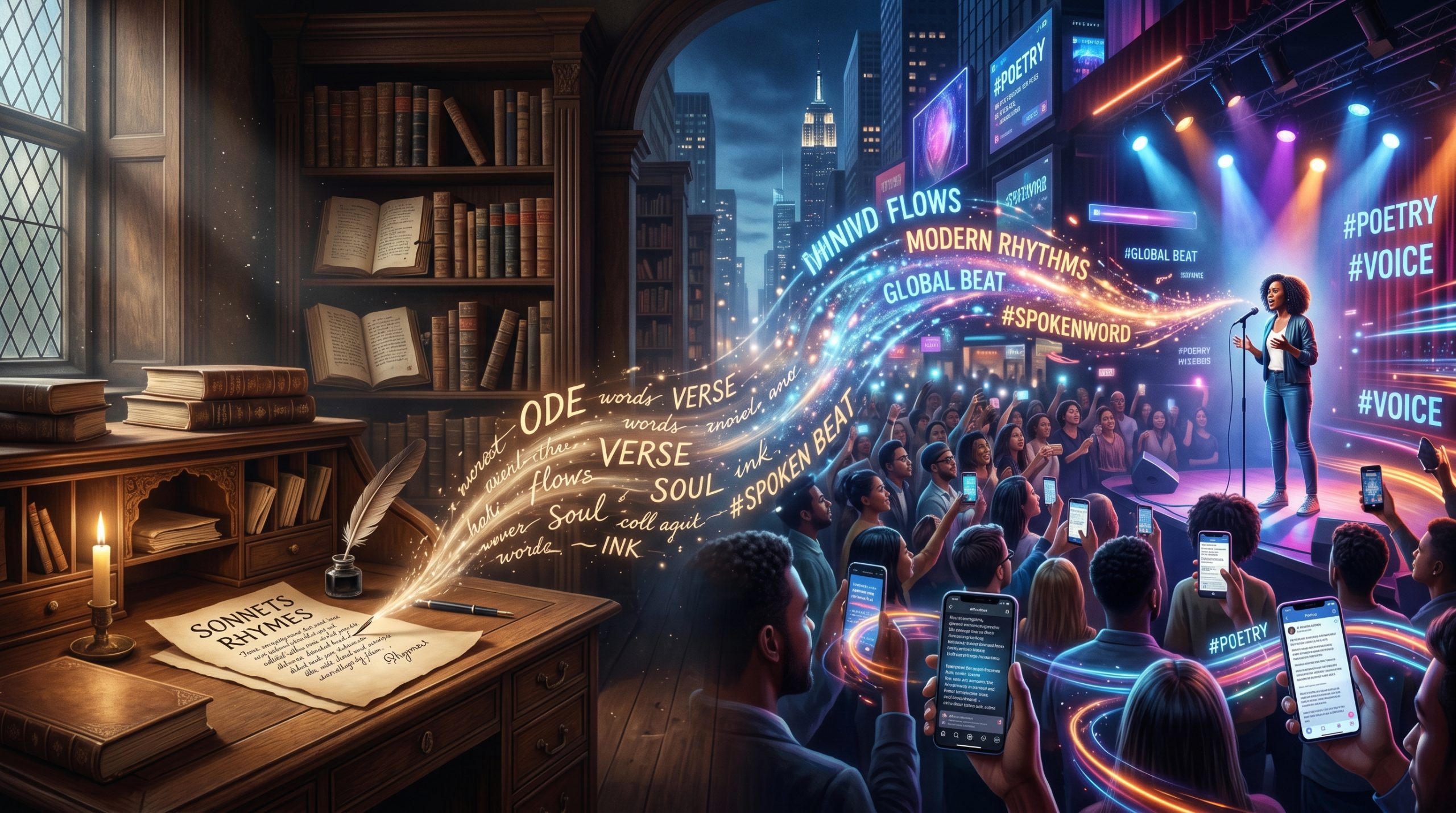
What has actually happened is far more interesting than the decline. Poetry has not disappeared—it has redistributed itself across culture in unexpected and often invisible ways. It no longer lives only in printed collections or academic syllabi; instead, it moves fluidly through digital timelines, spoken word performances, private journaling practices, therapeutic spaces, and even commercial storytelling. Far from fading, poetry has expanded its reach, adapting to environments where emotional expression must be immediate, compact, and deeply resonant.
In many ways, poetry now operates alongside entirely different narrative traditions. Just as a form like How Hard-Boiled Mystery Builds Tension Without Giving Away the Ending relies on controlled pacing, withheld information, and carefully constructed emotional pressure to sustain reader engagement, modern poetry also depends on precision and restraint—but in a different emotional register. Where hard-boiled fiction builds suspense through narrative distance and tension, poetry builds intensity through compression, stripping language down until only emotional truth remains. Both forms, in their own way, understand that what is left unsaid can be as powerful as what is spoken.
This is why the question of poetry today is no longer about survival. It is about visibility, relevance, and transformation. Poetry writing is not fading into irrelevance; it is becoming more embedded in everyday communication than ever before, often without being recognized as poetry at all. From social media captions that read like fragmented verse, to spoken word performances that circulate as viral clips, to deeply personal reflections shared in digital spaces, poetry has become part of how people process experience in real time.
So the more meaningful question is not whether poetry has disappeared, but why it feels more present, more emotionally necessary, and more widely consumed now than at almost any other point in recent cultural history.
The Myth of “Dead Poetry” and Where It Comes From
The idea that poetry is declining usually comes from a very narrow definition of what poetry is supposed to look like. For a long time, poetry was tied to printed books, academic study, and canonical authors. It was something you encountered in classrooms, often analyzed rather than felt.
When reading habits shifted toward faster, more visual, and digital forms of content, poetry was wrongly assumed to have lost relevance. Compared to novels or films, it appeared less commercially dominant. Compared to social media content, it seemed too slow, too dense, too “academic.”
But this interpretation misses a crucial shift: poetry didn’t disappear from culture—it escaped its traditional boundaries.
Today, poetry is no longer confined to textbooks or literary journals. It lives in captions, reels, spoken performances, song lyrics, wellness writing, and short-form digital storytelling. The medium changed, not the need for it.
Why Poetry Never Actually Went Away
Poetry is one of the oldest forms of human expression. Long before novels, blogs, or even formal prose, people used rhythm, metaphor, and structured language to remember stories, express grief, celebrate love, and transmit cultural memory.
What makes poetry resilient is not institutional support but emotional necessity. Humans do not stop needing language that captures what ordinary speech cannot.
Even when poetry seems absent in mainstream attention, it continues to function in everyday life:
- In music lyrics that people memorize and emotionally attach to
- In slogans and advertising that rely on rhythm and metaphor
- In personal journaling and reflective writing
- In rituals, prayers, and spoken traditions
- In moments of grief, love, and transformation where ordinary language fails
Poetry has never been absent. It has simply been less visible in certain formats.
The Digital Renaissance of Poetry
The idea that poetry has faded becomes harder to sustain once you look at how it now circulates across digital platforms. Rather than disappearing, poetry has adapted to the rhythms of online life, where emotional impact must often be delivered quickly, yet still feel meaningful. This shift is not a reduction in poetic value but a transformation in how poetic expression is delivered and consumed. The internet has essentially rebuilt the ecosystem of poetry around immediacy, accessibility, and emotional resonance.
Short Free Verse Poems Paired with Visual Imagery
One of the most common forms of modern digital poetry is the short free verse poem presented alongside visual content. These poems typically abandon strict rhyme schemes or formal structure in favor of raw, flexible expression. What makes them particularly powerful in digital spaces is their pairing with images—photographs, minimalist designs, or aesthetic backgrounds that reinforce the emotional tone of the text.
This combination creates a layered experience where meaning is not only read but also visually felt. The image amplifies mood, while the words provide emotional direction, resulting in a compact but immersive poetic moment that fits naturally into scrolling behavior.
Spoken Word Performances Shared as Short Videos
Spoken word poetry has found a strong second life in video-based platforms, where performance becomes as important as the text itself. In this format, poetry is no longer silent on a page; it is embodied through voice, pacing, pauses, and physical expression. Short-form videos intensify this experience by capturing emotionally charged excerpts that can be consumed quickly but leave a lasting impact.
The performer’s tone, facial expressions, and rhythm of delivery add emotional depth that written text alone cannot fully convey. This has made spoken word particularly effective for reaching audiences who may not traditionally engage with written poetry but connect deeply with performance-driven storytelling.
Minimalist Text Capturing Emotional Truth in Few Lines
Another dominant digital poetry style relies on extreme brevity. These poems strip language down to its emotional core, often consisting of only a few lines that capture a single moment, feeling, or realization. The strength of this format lies in its restraint; rather than elaborating, it suggests, allowing readers to fill in emotional gaps with their own experiences.
This minimalist approach resonates strongly in fast-paced digital environments, where attention is limited but emotional recognition is immediate. A few carefully chosen words can communicate longing, heartbreak, nostalgia, or hope with surprising intensity, proving that depth is not dependent on length.
Relatable Reflections on Identity, Relationships, and Mental Health
Modern poetry has also become a space for personal and collective reflection on lived experiences, particularly around identity, relationships, and mental health. These poems often read like intimate thoughts articulated in real time, addressing themes such as self-discovery, emotional struggle, love, loss, and internal conflict. Their relatability is a key reason for their widespread engagement online.
Readers often see their own experiences mirrored in these expressions, creating a sense of shared emotional understanding. In this way, poetry functions not only as art but also as a form of connection, validation, and emotional articulation in a digitally connected but emotionally fragmented world.
Compression of Meaning Without Loss of Depth
At the heart of this transformation is a fundamental shift in how meaning is constructed and delivered. Modern poetry has adapted to the constraints of digital attention spans without sacrificing emotional or intellectual depth. Instead of long-form elaboration, it relies on compression—distilling complex emotional states into concise, powerful expressions.
This compression does not simplify experience; rather, it intensifies it by removing unnecessary layers and focusing on emotional essence. In a digital environment saturated with information, this ability to convey depth in minimal space has become increasingly valuable, positioning poetry as one of the most efficient forms of emotional communication available today.
Why Poetry Feels More Relevant in Modern Life
One of the strongest reasons poetry is in demand today is emotional saturation. Modern life is fast, fragmented, and constantly mediated through screens. People are exposed to enormous amounts of information but have fewer spaces to process it meaningfully.
Poetry fills that gap because it does something most other forms of communication do not: it slows meaning down without requiring long attention spans.
A few lines of poetry can:
- Express grief without explanation
- Capture identity without biography
- Describe love without narrative structure
- Communicate anxiety without clinical language
This emotional efficiency is exactly why poetry has regained cultural relevance. It is not competing with novels or essays—it is fulfilling a different need altogether.
The Rise of Spoken Word and Performance Poetry
Another major reason poetry is thriving is the rapid rise of spoken word culture, which has fundamentally reshaped how poetry is experienced and understood. Unlike traditional written poetry, which exists primarily on the page, spoken word emphasizes voice, rhythm, pacing, and physical presence. It turns poetry into a lived performance rather than a quiet act of reading, where meaning is carried not only by words but also by tone, silence, and bodily expression.
This shift has expanded poetry far beyond literary spaces. Spoken word events, slam poetry competitions, and digital performances have introduced poetry to audiences who may never actively seek out poetry books. In many cases, people encounter poetry first as performance—through videos, live shows, or viral clips—before they ever associate it with written collections. This has significantly broadened poetry’s cultural reach and relevance.
What makes this form especially powerful is its reintroduction of something modern media often lacks: the human voice as a direct emotional transmission. In a digital environment dominated by text, images, and rapid scrolling, spoken word restores vocal intimacy. It allows emotion to be heard, not just interpreted, creating a more immediate and embodied experience of language.
In this sense, spoken word poetry also shares interesting parallels with certain narrative traditions in literature. Much like fiction books, where tone, cadence, and emotional restraint are used to build atmosphere and tension, spoken word relies heavily on delivery and rhythm to shape meaning. However, where genres such as detective fiction or noir storytelling often control suspense through narrative distance, spoken word collapses that distance entirely, placing emotion directly in front of the audience without filters.
Spoken Word Poetry in Contemporary Literary Genres
Within modern literary classification, spoken word is increasingly recognized as part of broader hybrid genres that blur the line between performance and text. It often overlaps with contemporary poetry, narrative poetry, and even elements of autobiographical writing, since many spoken word pieces draw directly from personal experience and lived reality.
Unlike structured poetic forms found in traditional poetry collections, spoken word leans toward expressive storytelling. It shares characteristics with flash fiction and micro-narrative writing, where brevity and emotional intensity carry more weight than formal structure. This makes it especially relevant in a cultural moment where readers are drawn to condensed yet impactful storytelling formats.
Emotional Realism and Character-Driven Expression
One of the defining strengths of spoken word poetry is its emotional realism. Many performances function almost like character monologues, where the speaker becomes both narrator and subject. This aligns it loosely with literary approaches found in character-driven fiction, where internal experience matters more than external plot progression.
Instead of building traditional story arcs, spoken word often focuses on emotional arcs—shifts in vulnerability, realization, or confrontation. This makes it feel closer to lived experience than constructed narrative, which is a key reason for its strong resonance among modern audiences.
Digital Storytelling and Viral Literary Forms
The rise of spoken word has also been deeply influenced by digital storytelling platforms. Short-form video content has turned poetry into a highly shareable medium, where emotionally intense performances can reach global audiences within hours. This has created a new category of literary visibility that sits between performance art and online content creation.
In this environment, spoken word often intersects with viral storytelling, micro-literature, and social media narratives, where emotional impact is prioritized over traditional publishing structure. As a result, poetry is no longer confined to books or staged events—it now exists as part of a constantly circulating digital literary ecosystem.
When viewed through this lens, spoken word poetry is not simply a modern variation of an old form. It is a hybrid literary movement that merges performance, storytelling, and emotional expression into a single experience. It expands the boundaries of poetry while also redefining what contemporary literary engagement looks like in a digital-first world.
Poetry and Mental Health: A Growing Connection
One of the most significant drivers of poetry’s modern demand is its increasing role in mental health and emotional well-being.
Therapists, counselors, and wellness practitioners often use poetry as a tool for emotional articulation. This is because poetry allows individuals to express experiences that are difficult to explain in structured psychological language.
People use poetry to:
- Process trauma
- Understand grief
- Express anxiety or depressions
Unlike clinical language, poetry does not require precision. It allows ambiguity, metaphor, and emotional contradiction—all of which are central to human experience.
This therapeutic dimension has made poetry especially relevant among younger generations who are more open about emotional vulnerability and mental health discussions.
Social Media and the Democratization of Poetry
One of the most transformative changes in the poetry landscape is accessibility. In the past, publishing poetry required acceptance by literary journals or publishing houses. Today, anyone can share a poem instantly with a global audience. This democratization has reshaped both who writes poetry and who consumes it.
Modern poetry audiences include:
- Teenagers discovering emotional expression
- Young adults exploring identity and relationships
- Writers outside academic literary circles
- Readers who do not traditionally consume books
This accessibility has removed the barrier between “poet” and “reader.” Many people now engage in both roles simultaneously.
As a result, poetry is no longer seen as an elite literary form but as a shared expressive language.
Why Poetry Works So Well in a Fast-Paced World
At first glance, it might seem contradictory that poetry is thriving in a world dominated by short attention spans. But in reality, poetry is uniquely suited to this environment.
Modern attention is fragmented, but emotional needs are not. People still want meaning, reflection, and emotional connection—but they want it quickly and impactfully.
Poetry provides:
- Immediate emotional resonance
- Short-form readability
- High interpretive depth
- Flexibility of meaning
A single poem can be consumed in seconds but contemplated for hours. That balance is rare in modern content formats.
The Evolution of Poetic Style in Contemporary Writing
Modern poetry does not always resemble classical structures with strict rhyme schemes or meter. Instead, it often embraces free verse, fragmented syntax, and conversational tone. This shift has made poetry more relatable and inclusive. Contemporary poets often write in a voice that feels personal rather than formal, making poetry feel closer to everyday speech.
Common features of modern poetic style include:
- Minimal punctuation or unconventional structure
- Line breaks that mimic thought patterns
- Everyday language with emotional depth
- Strong reliance on imagery and metaphor
- Intimate, confessional tone
This evolution has expanded poetry’s appeal beyond academic readership into mainstream cultural spaces.
Is Traditional Poetry Losing Ground?
While modern poetry is flourishing, traditional poetry publishing has indeed changed. Book sales alone may not reflect the full cultural impact of poetry today.
However, this is less a decline and more a redistribution of attention. Poetry is no longer centralized in books or literary magazines. Instead, it exists across multiple platforms and formats simultaneously.
What appears to be decline in one area is actually expansion across many others.
Why People Still Write and Read Poetry
Despite rapid technological change and shifting content habits, the core reason people engage with poetry has not fundamentally changed. Poetry continues to exist because it fulfills a need that ordinary language often fails to meet.
When emotions become too layered, too intense, or too deeply personal, people naturally turn toward poetic expression as a way to make sense of what they are feeling. It provides a linguistic space where complexity is not simplified but instead expressed more honestly and directly.
At its core, poetry continues to serve as a form of self-expression. It allows individuals to give shape to thoughts and emotions that might otherwise remain unspoken. In many cases, people use poetry to externalize internal experiences—transforming abstract feelings into structured language that can be seen, shared, and understood.
Poetry also functions as a tool for emotional clarity. When emotions feel overwhelming or contradictory, writing or reading poetry can help organize them into something more understandable.
The act of shaping feelings into words often brings a sense of relief or insight, even when the situation itself remains unchanged. In this way, poetry becomes less about decoration and more about emotional processing and psychological grounding.
It is also a way to document lived experience. Unlike factual writing, poetry captures not just what happened but how it felt to experience it. This makes it especially valuable for preserving memory, identity, and personal history. A poem can hold a moment in time with emotional precision that straightforward narration often cannot achieve, giving people a way to record their inner lives as much as their external events.
Beyond individual use, poetry acts as a means of connection with others. When someone reads a poem that reflects their own emotions or experiences, it creates an immediate sense of recognition. This shared understanding builds emotional bridges between strangers, communities, and generations. Poetry becomes a quiet form of communication that says, “this is what it feels like,” without needing explanation or justification.
Finally, poetry provides a space for reflection and imagination. It slows down thought in a world that often moves too quickly, allowing readers and writers to pause and consider perspectives beyond the immediate moment. This reflective quality makes poetry not just an expressive tool, but also a mental environment where ideas, emotions, and possibilities can be explored more freely.
The Future of Poetry: Expansion, Not Decline
Looking forward, poetry is likely to become even more integrated into digital and hybrid forms of communication. We may see more AI-assisted poetry, interactive poetic media, and immersive storytelling experiences that blend text, sound, and visuals.
However, at its core, poetry will remain unchanged. It will continue to rely on metaphor, rhythm, and emotional compression to communicate meaning.
The future of poetry is not about survival. It is about adaptation.
Conclusion
The claim that poetry is dead does not hold up under close examination. What has actually happened is a transformation in where and how poetry exists. It has moved from exclusive literary spaces into everyday digital life, from printed pages into spoken performances, from formal structures into fluid, personal expression.
Poetry is not fading—it is expanding into new cultural territories where emotional expression is more needed than ever.
In a world overwhelmed by speed, data, and constant communication, poetry remains one of the few forms of language that slows us down just enough to feel what we are actually experiencing.
And that is not the sign of something dying. It is the sign of something deeply alive.
FAQ: Poetry in the Modern World
Is poetry still relevant today?
Yes. Poetry remains highly relevant because it adapts to modern communication platforms and continues to meet emotional and expressive needs.
Why do people say poetry is dead?
This belief usually comes from comparing traditional poetry publishing to modern digital content trends, not from actual cultural absence.
What type of poetry is popular now?
Free verse, spoken word poetry, and short-form digital poetry are currently the most widely consumed styles.
Is social media good or bad for poetry?
Social media has expanded poetry’s reach significantly, making it more accessible and diverse in both writers and audiences.
Why is poetry important in mental health?
Poetry helps individuals express emotions that are difficult to articulate, making it a useful tool for reflection and emotional processing.
Will poetry disappear in the future?
No. Poetry is likely to evolve further, but its core function—expressing complex human emotion—remains timeless.