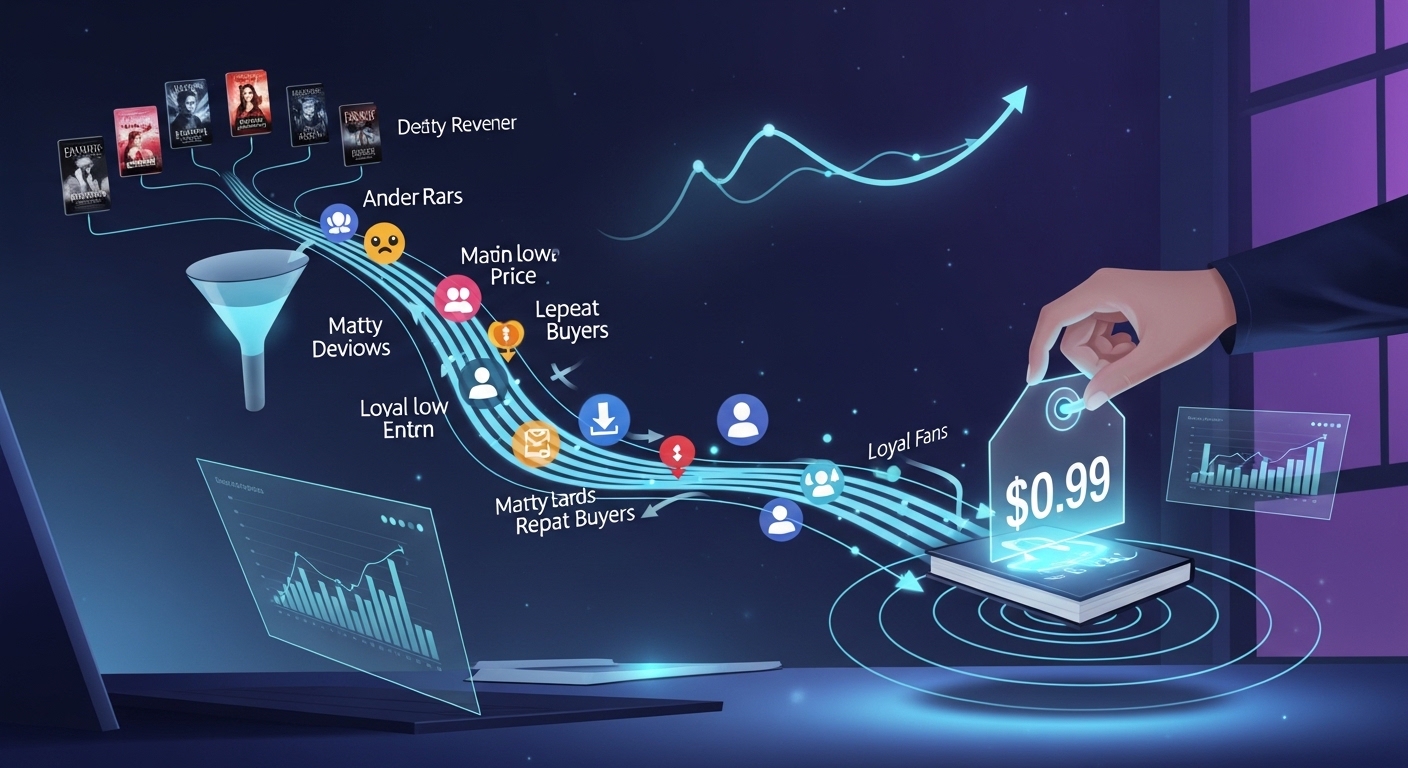
When most beginners start with Kindle Direct Publishing (KDP), they assume success depends mainly on three things: choosing the right niche, designing a good cover, and finding keywords. While all of those matter, there is one factor that quietly controls everything else in the background — your KDP pricing strategy.
Pricing on Amazon KDP is not just a financial decision. It is a ranking signal, conversion trigger, and visibility multiplier all at once. The Amazon ecosystem is built in a way where pricing influences how often your book is clicked, how often it is purchased, and ultimately how it performs in Amazon’s search algorithm.
This is why two books in the same niche, with similar covers and keywords, can perform completely differently — simply because one is priced at $0.99 and the other is priced at $4.99.
Many new publishers overlook this and assume higher pricing automatically equals higher profit. In reality, the Amazon KDP pricing strategy is far more complex. A higher price per sale does not matter if the book does not get consistent visibility or traffic from Amazon search results.
This is where the controversial but widely used $0.99 KDP pricing strategy comes in.
At first glance, it looks like a mistake. Why would anyone deliberately lower their royalty per sale in Kindle Direct Publishing? Why would you earn less per book when the goal is passive income?
The answer is simple but powerful: Amazon rewards momentum, not just margins.
In this article, we will break down in detail:
- How KDP pricing strategy affects Amazon book ranking
- Why $0.99 can improve Kindle Direct Publishing visibility
- The psychology behind low pricing in Amazon KDP
- When low pricing works and when it fails
- How to scale from low pricing to long-term passive income
By the end, you will understand not just how to price a book — but how pricing interacts with Amazon’s algorithm, buyer behavior, and long-term KDP royalties.
How KDP Pricing Strategy Impacts Amazon Book Ranking and Visibility
To understand why KDP’s pricing strategy matters, you first need to understand how Amazon evaluates books.
Amazon does not treat books as static products. Instead, it continuously tracks behavioral signals such as:
- Click-through rate (CTR) from search results
- Conversion rate (how many clicks turn into purchases)
- Sales velocity over time
- Customer engagement and repeat discovery
All of these signals feed into the Amazon book ranking system, which determines how visible your book is in search results and recommendations.
Now here is where pricing becomes important.
A lower-priced book — especially in the $0.99 to $1.99 range — often reduces buyer hesitation. When users are browsing Kindle Direct Publishing listings, they are more likely to take a risk on a cheaper book, especially if they are unfamiliar with the author.
This leads to a higher conversion rate, which then sends a positive signal to Amazon’s algorithm. Over time, this can improve:
- Organic keyword ranking in Amazon search
- Placement in “Customers Also Bought” sections
- Visibility in related low content book categories
- Overall Kindle Direct Publishing discoverability
So even though pricing seems like a revenue decision, it actually plays a major role in Amazon KDP visibility and ranking performance.
Why Starting at $0.99 Can Improve KDP Performance in the Early Stage
One of the most effective but misunderstood KDP pricing strategies is launching a new book at $0.99.
The reason is simple: new books have no data.
When you publish a book on Kindle Direct Publishing, Amazon initially has no idea how to categorize it in terms of performance. It does not know:
- Whether users will click it
- Whether users will buy it
- Whether it should rank it higher or lower
This is where early sales become critical.
A $0.99 price point reduces friction and encourages experimentation from buyers. People are far more willing to try a low-cost book than a higher-priced one, especially in competitive niches like:
- Low content books on Amazon
- Journals and planners
- Self-help workbooks
- Productivity trackers
These early purchases generate initial sales data. That data is extremely important because it helps Amazon decide whether your book should be:
- Ranked higher in search results
- Shown to more users
- Included in recommendation loops
In other words, $0.99 is not about profit — it is about activation of Amazon’s ranking system.
The Real Trade-Off in KDP Pricing Strategy: Profit vs Momentum
Every Amazon KDP pricing strategy involves a trade-off between two competing forces:
- Profit per sale (royalty per book)
- Sales volume and visibility
At higher prices like $4.99 or $6.99, you earn more per sale. However, you often face:
- Lower conversion rates
- Higher buyer hesitation
- Slower ranking growth
At lower prices like $0.99 or $1.99, you earn less per sale, but you often gain:
- Higher conversion rates
- Faster keyword ranking improvements
- More exposure in Amazon search
This creates a compounding effect that many beginners miss.
A book that sells frequently at low price often performs better long-term than a higher-priced book that rarely sells. This is because Amazon’s algorithm rewards consistency and engagement, not just pricing.This is why experienced publishers treat KDP pricing strategy as a system, not a static decision.
When $0.99 KDP Pricing Strategy Works Best
The $0.99 strategy is not universal, but it is extremely effective in specific conditions.
It works best when:
- You are launching a new Kindle Direct Publishing book
- You are testing a new niche or keyword set
- You are entering a competitive Amazon KDP category
- You are building a portfolio of low content books on Amazon
- You need fast ranking signals for validation
However, the success of this strategy depends heavily on execution quality.
Even at $0.99, your book still needs:
- Strong Amazon KDP keyword optimization
- High-quality, clickable cover design
- Clear niche targeting with search intent alignment
Without these, low pricing alone will not generate results.
When Low Pricing Becomes a Weak KDP Strategy
While $0.99 can be powerful, it is not always the best long-term approach.
In certain niches, especially:
- Business journals
- Premium productivity planners
- Self-development workbooks
- Specialized educational content
Pricing too low can reduce perceived value. Many buyers associate price with quality, even on Amazon Kindle Direct Publishing.
If your book looks too cheap, it may actually lose conversions in premium niches.
Another issue is scalability. Once a book gains traction, staying at $0.99 limits your Amazon KDP income potential significantly.
That is why pricing must evolve as your book matures.
Got it — I’ll keep each section’s explanation in paragraph form, but convert the last paragraph of each phase into clean bullet points for clarity and AEO readability.
Three-Phase KDP Pricing Strategy for Long-Term Growth
A strong KDP pricing strategy is not something you set once and forget. It evolves as your book moves through different stages of performance on Amazon Kindle Direct Publishing. The most effective publishers don’t think in terms of a single “perfect price”—they think in phases. Each phase has a different goal, a different mindset, and a different role in building long-term Kindle Direct Publishing income.
Phase 1: Launch Phase ($0.99–$1.99)
The launch phase is the most misunderstood stage of any Amazon KDP pricing strategy because beginners often focus on profit too early. In reality, this phase is not about maximizing KDP royalties at all—it is about generating movement in the Amazon system. When a book is newly published, it has no sales history, no ranking authority, and no behavioral data. Amazon does not yet know how to position it in search results or whether it deserves visibility.
This is where the $0.99–$1.99 range becomes powerful. At this stage, lower pricing reduces friction for buyers and increases the likelihood of early sales, especially in competitive niches like low content books on Amazon. These early sales are not just revenue—they are signals. They tell Amazon’s algorithm that the book is relevant, clickable, and worth testing with more impressions.
At this stage, the real purpose of pricing is not profit but validation and ranking activation:
- Generate early Amazon KDP sales to trigger initial momentum
- Help Amazon’s algorithm test and categorize your book in search results
- Validate whether your keywords, niche choice, and cover actually convert in a real market
Phase 2: Growth Phase ($2.99–$4.99)
Once a book begins to generate consistent sales and shows early signs of ranking stability, it enters the growth phase of your Kindle Direct Publishing pricing strategy. This is where the focus shifts from pure visibility to a balance between income and performance. At this stage, the book is no longer “unproven”—it has some level of Amazon traction, and your goal becomes strengthening that position while improving profitability.
Pricing in the $2.99–$4.99 range is often where most successful KDP books stabilize. It allows you to earn more meaningful KDP royalties per sale while still maintaining enough affordability to keep conversion rates healthy. However, the key here is not just raising the price—it is observing how the market reacts. If sales remain stable after a price increase, it indicates that your book has established value perception and ranking strength.
In this phase, pricing becomes a balancing act between revenue and stability:
- Increase royalty per sale while maintaining consistent conversion rates
- Strengthen Amazon book ranking through stable sales performance
- Optimize pricing based on real data instead of assumptions or guesswork
Phase 3: Scaling Phase ($4.99 and above)
The scaling phase represents the long-term goal of any serious KDP pricing strategy. At this point, the book is no longer dependent on low pricing to generate visibility because it already has established ranking signals, sales history, and possibly even reviews. The focus now shifts toward maximizing Amazon KDP income and extracting consistent passive revenue from an already validated product.
In this phase, pricing moves above $4.99 and sometimes higher depending on niche expectations and perceived value. Because the book already has ranking authority, it can sustain higher pricing without losing all its traffic. The advantage here is that every sale now generates significantly higher KDP royalties, turning the same traffic into more efficient income.
At this stage, the goal is to maximize profitability while leveraging existing momentum:
- Increase KDP royalties by moving into higher pricing brackets
- Leverage established Amazon ranking to maintain steady organic traffic
- Extract long-term passive income from a proven, validated book asset
Psychology Behind Amazon KDP Pricing Strategy
Pricing in Kindle Direct Publishing is not just a financial decision — it is a psychological trigger that directly influences how buyers behave on Amazon.
A book priced at $0.99 creates a completely different mental response compared to one priced at $4.99 or higher. The actual difference is small in money terms, but in the buyer’s mind, it changes everything.
Lower pricing tends to:
- Reduce decision friction and hesitation
- Encourage impulse-based purchases
- Increase perceived accessibility and “low risk”
How Buyers Actually Think on Amazon
Most Kindle Direct Publishing purchases are not carefully analyzed decisions. They are fast, intent-driven actions influenced by emotion, convenience, and visual trust signals.
In most cases, buyers decide within seconds based on:
- Cover design (first impression matters most)
- Title clarity (does it solve a clear need?)
- Price perception (is it worth trying instantly?)
Among these, pricing acts as the final “yes or no” trigger. Even if a book looks good, a higher price can slow down or stop the purchase decision.
Why Small Price Changes Matter So Much
In Amazon KDP, even minor pricing adjustments can significantly change performance. This happens because pricing directly impacts conversion rate — and conversion rate is one of the signals Amazon uses to rank books.
A lower price can:
- Increase clicks-to-sales conversion
- Improve early sales velocity
- Strengthen keyword ranking over time
That improved performance feeds back into the system, giving the book more visibility in search results and recommendations.
The Core Psychology Behind KDP Pricing
At its core, pricing in Kindle Direct Publishing works because it shapes perceived risk.
When a book is cheaper:
- The buyer feels safer trying it
- The decision becomes faster
- The perceived value becomes “good enough” without overthinking
This is why many successful publishers use lower pricing during the early stage of their KDP pricing strategy. It is not about earning less — it is about lowering resistance long enough to build momentum inside Amazon’s ranking system.
How to Scale from $0.99 to Higher KDP Income
The goal of the $0.99 strategy is not to stay there forever.
Once your book gains traction:
- Gradually increase price to $2.99 or $3.99
- Monitor changes in Amazon conversion rates
- Identify the “sweet spot” for maximum profit per niche
Some books continue performing well even after price increases, especially when:
- They rank high in Amazon search
- They have strong keyword authority
- They already have sales history and reviews
This is how low pricing evolves into long-term Kindle Direct Publishing income.
Final Thoughts: Is $0.99 the Best KDP Pricing Strategy?
The $0.99 KDP pricing strategy is not about undervaluing your work — it is about understanding how Amazon Kindle Direct Publishing actually behaves.
In 2026, success in Amazon KDP depends on:
- Keyword optimization
- Conversion-driven ranking
- Strategic pricing adjustments
- Long-term portfolio building
When used correctly, $0.99 is not a discount tactic — it is a strategic launch mechanism for Amazon ranking and visibility.
The key is not staying low forever, but using low pricing to generate momentum, then scaling intelligently based on real performance data.