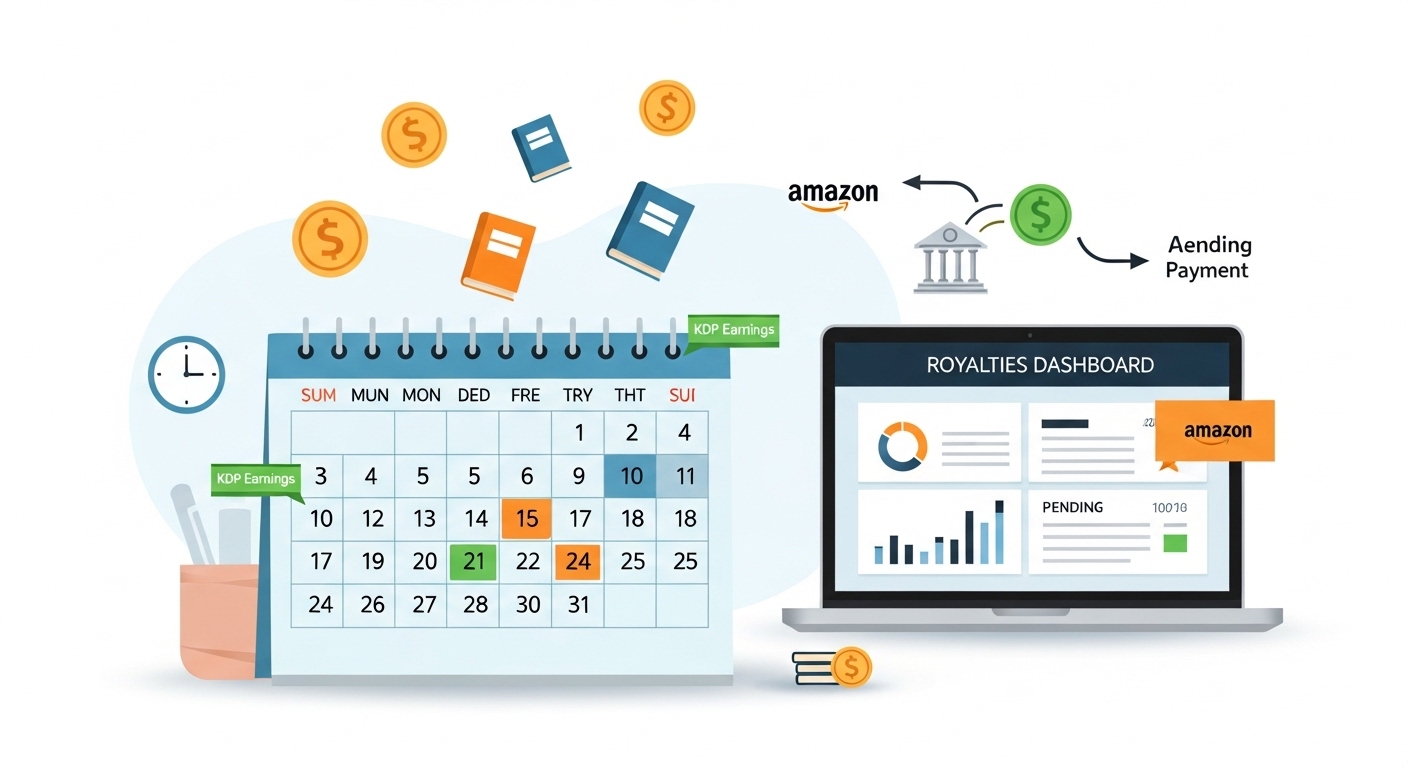
The foundational rule of the Kindle Direct Publishing (KDP) payment system is the 60-day lag. While we live in an era of instant digital transactions, Amazon maintains a two-month buffer between the end of a sales month and the actual distribution of funds. This means that your earnings are essentially “held” for two full calendar months before they are cleared for transfer to your bank account.
To visualize this, imagine you launch a book in January. Every sale made between January 1st and January 31st is tallied into a single “January Earnings” report. Once January ends, the 60-day clock begins. You will wait through the entirety of February and nearly the entirety of March. Your payment for those January sales will typically arrive at the very end of March.
This delay is not arbitrary. It provides a necessary window for the platform to handle several administrative tasks:
Managing Returns: Digital and physical products are subject to return policies. If a reader buys an eBook and returns it forty-eight hours later, that royalty must be deducted. The 60-day window ensures that the final amount paid to the author is “clean” and doesn’t require complex claw-backs from future earnings.
Finalizing Print Costs: For paperback and hardcover books, the royalty is calculated after subtracting the cost of printing. Since printing happens on demand, the system needs time to synchronize the manufacturing data with the sales data.
Verification of Sales: The platform must verify that sales are legitimate and not the result of fraudulent activity or “botting” before releasing large sums of money.
Payment Methods and Their Impact on Timing
While the 60-day rule is the baseline, the physical method by which you receive your money can add further delays or even prevent payment altogether if certain conditions aren’t met. There are three primary ways to receive your royalties, and each carries its own set of rules regarding speed and minimum balances.
Electronic Funds Transfer (EFT) and Direct Deposit
For authors in supported regions (such as the US, UK, Canada, and the EU), EFT is the most efficient choice. This method is often referred to as “Direct Deposit.” One of the biggest advantages of EFT is that it generally has no minimum payment threshold. If you earn $2.00 in a month, Amazon will still send that $2.00 to your bank account once the 60 days have passed.
Once the payment is initiated at the end of the month, the money typically appears in your account within 1 to 5 business days. However, it is important to note that international transfers can sometimes be subject to “holding” periods by your local bank, which is outside of the publisher’s control.
Wire Transfers
In countries where EFT is not available, authors must rely on wire transfers. Wire transfers are significantly more restrictive than direct deposit. First, they carry a minimum threshold, usually $100 (or the equivalent in local currency). If you earn $90 in January, you will not receive a wire transfer in March. You will have to wait until your cumulative earnings hit $100. Furthermore, wire transfers can take 5 to 10 business days to clear, and your bank may charge an incoming wire fee that eats into your profits.
Physical Checks
The most traditional—and slowest—method is the physical paper check. Like wire transfers, checks require a $100 minimum threshold per marketplace. If you sell books in the US store and the UK store, you must earn $100 in each store to receive two separate checks; they do not aggregate automatically for check payments. Once mailed, a check can take anywhere from 2 to 4 weeks to arrive, depending on the reliability of your local postal service.
Expanded Distribution: The 90-Day Exception
If you are a paperback author, you may have opted into Expanded Distribution. This allows your book to be ordered by bookstores, libraries, and academic institutions through third-party distributors like IngramSpark. While this increases your reach, it also complicates your payment schedule.
Because these sales involve an “intermediary” (the third-party distributor), the reporting process is much slower. Sales made through Expanded Distribution are typically paid out 90 days after the month in which the sale occurred.
If you are looking at your reports and wondering why your paperback royalties seem lower than expected, it is often because the Expanded Distribution sales haven’t “hit” the report yet. These sales are usually reported in a lump sum once a month, whereas regular sales appear in near real-time. This can lead to a staggered payment experience where you receive your “standard” royalties at the end of month two, and your “expanded” royalties at the end of month three.
Kindle Unlimited and the Global Fund
For authors enrolled in KDP Select, a significant portion of income may come from Kindle Unlimited (KU). In this model, authors are paid per page read rather than per book sold. This introduces a unique variable into the payment schedule: the KDP Select Global Fund.
Each month, the total amount of money available for KU authors is announced. Because this fund size fluctuates based on subscription revenue, your “Estimated Royalties” for page reads are truly just estimates until the middle of the following month.
- The Announcement: Around the 15th of the month following the sales month, the final “per-page rate” is determined.
- The Payout: Once that rate is set and your total KENP (Kindle Edition Normalized Pages) is verified, these earnings follow the standard 60-day payment cycle.
For many authors, this means their end-of-month payout is a combination of eBook sales, paperback sales, and KU page-read royalties, all bundled into one or several deposits.
Navigating the Payment Dashboard and Reports
To stay on top of your finances, you must become familiar with the KDP Reports dashboard. This is where you can track exactly where your money is in the pipeline.
The “Payments” Tab
The Payments tab is your most accurate source of truth. It lists every payment that has been processed, the date it was sent, the marketplace it came from, and the status (e.g., “Paid,” “Pending,” or “Failed”). If a payment is “Pending,” it means the 60-day window has closed and the bank transfer has been initiated.
The “Prior Months’ Earnings” Report
This report is essential for reconciling your bank statements. It provides a breakdown of your finalized earnings after returns and taxes have been accounted for. It is usually available by the 15th of the month following the month of sale. For example, your finalized January report will be ready by February 15th. This report tells you exactly how much you should expect to see in your bank account at the end of March.
Logistics and Comparisons: Payout Requirements
| Feature | Direct Deposit (EFT) | Wire Transfer | Physical Check |
| Minimum Threshold | $0 / £0 / €0 | $100 / £100 / €100 | $100 / £100 / €100 |
| Wait Time (Post-Sales Month) | 60 Days | 60 Days | 60 Days |
| Processing Time | 1–5 Business Days | 5–10 Business Days | 10–30 Business Days |
| Best For | Authors in US/UK/EU/CA | Authors in non-EFT regions | Legacy authors/No bank access |
Common Hurdles: Why Your Payment Might Be Missing
Even if you’ve done everything right, there are moments when the payment doesn’t arrive as expected. Before contacting support, check these common “payment killers”:
Tax Interview Expiration: Every author must complete a digital tax interview. If your tax information is incomplete or expired, your payments will be placed on a legal hold.
Threshold Not Met: If you are receiving checks or wires, remember the $100 limit is per marketplace. You might have $150 total across the globe, but if no single store has reached $100, no payment will be triggered.
Bank Account Changes: If you change your bank account and forget to update your KDP profile before the 20th of the month, the system will attempt to send the money to your old, closed account. This usually results in a “Failed” status and can take weeks to resolve.
Exchange Rate Fluctuations: If you are being paid in a currency different from the marketplace where the sale occurred (e.g., selling in the UK but getting paid in USD), the final amount may vary slightly from your reports due to the exchange rate used on the day of the transfer.
Frequently Asked Questions (FAQ)
1. Does Amazon pay royalties every month?
Yes, provided you have sales and have met any necessary thresholds. Once you have been publishing for more than 60 days, you will begin receiving a monthly deposit for the sales made two months prior.
2. What happens to my royalties if I don’t meet the $100 minimum for a check?
Your royalties are never lost. They simply carry over and accumulate in your account. As soon as your total earnings for that marketplace cross the $100 mark, the payment will be scheduled for the next available cycle.
3. Are taxes deducted from my royalty payments automatically?
This depends on your country of residence and your tax treaty status. For US-based authors, taxes are generally not withheld, and you are responsible for paying them annually. For international authors, there may be a 30% withholding tax unless a tax treaty exists between your country and the United States.
4. Why did I receive multiple small deposits instead of one big one?
Amazon pays out royalties per marketplace. If you sold books in the US, the UK, and Germany, you might see three separate deposits in your bank account, often arriving within a day or two of each other.
5. Can I change my payment method at any time?
Yes, you can update your banking information or change from check to EFT in your account settings. However, changes must usually be made before the middle of the month to take effect for that month’s payment cycle.
6. Do pre-orders count toward my January sales if they were placed in December?
No. Royalties for pre-orders are earned and reported in the month the book is actually released and the customer’s credit card is charged.
Final Thoughts for the Business-Minded Author
Mastering the KDP royalty payment schedule is an essential rite of passage for any self-published creator. While the 60-day delay can be frustrating when you are first starting out, it eventually creates a reliable, monthly “payday” that rewards your past efforts. By choosing the right payment method—ideally Direct Deposit—and keeping your tax and banking information current, you can ensure that your hard-earned money moves from the digital dashboard to your bank account with as little friction as possible. Treat your publishing career like the business it is, track your “Prior Months’ Earnings”