Choosing how to distribute your self-published book is one of the most important strategic decisions you’ll make as an author. In 2026, this decision is no longer just about where your book appears—it directly affects your visibility, income potential, reader reach, and long-term growth.
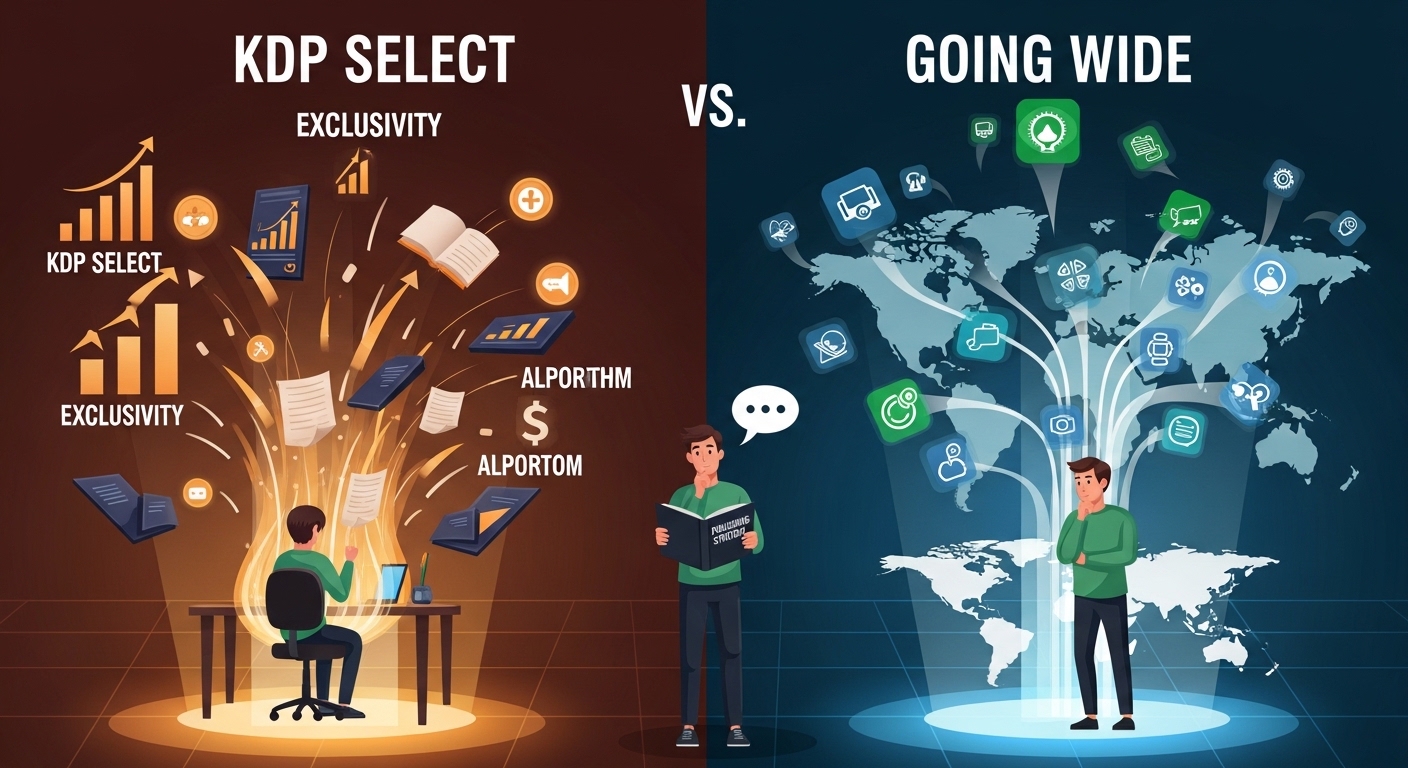
At the center of this decision are two distinct approaches: enrolling in KDP Select or choosing to publish wide, meaning distributing your book across multiple platforms instead of remaining exclusive to one ecosystem.Each path offers clear advantages, but they are built on very different models. One prioritizes concentration and algorithmic leverage, while the other focuses on reach and diversification. Neither is universally better—the right choice depends on your goals, genre, publishing style, and how you want to build your author career.
This guide breaks down both strategies in depth so you can make an informed decision based on what actually works right now.
Understanding the Core Difference
Before comparing the two strategies, it’s important to understand what separates them at a fundamental level.
What Is KDP Select?
KDP Select is an optional program within Amazon’s publishing ecosystem that requires exclusive digital distribution. When you enroll your eBook, you agree not to sell it on any other platform for a 90-day renewable period.
In exchange, you gain access to:
- Kindle Unlimited (subscription-based reading)
- Promotional tools like limited-time deals and free days
- Increased visibility within Amazon’s ecosystem
This model works by concentrating your book’s performance in one place, allowing algorithms to push it more aggressively when it gains traction.
What Does “Going Wide” Mean?
Going wide means distributing your book across multiple retailers instead of staying exclusive.
This includes platforms such as:
- Apple Books
- Kobo
- Barnes & Noble
- Google Play Books
You retain full control over your distribution and are not tied to exclusivity agreements.
The wide model prioritizes global reach and platform independence, allowing your book to exist wherever readers prefer to buy.
How KDP Select Works in 2026
KDP Select has evolved into a system heavily influenced by reader engagement metrics. It is no longer just about publishing—it’s about how readers interact with your book inside Amazon’s ecosystem.
Algorithm-Driven Visibility
Books enrolled in KDP Select benefit from increased exposure when they perform well. The system favors:
- High read-through rates
- Strong early engagement
- Consistent borrowing activity
This creates a feedback loop. The more your book is read, the more it is recommended.
The Role of Kindle Unlimited
One of the biggest advantages of KDP Select is access to Kindle Unlimited, where readers pay a subscription and authors are compensated based on pages read.
This model changes reader behavior:
- Readers are more willing to try new authors
- Longer books can generate more revenue through page reads
- Series perform particularly well due to continuous reading
For certain genres, this can significantly outperform traditional sales models.
Promotional Leverage
KDP Select offers built-in promotional tools that can drive visibility:
- Free promotions to increase downloads and visibility
- Discount campaigns to boost rankings
- Internal recommendation systems that amplify performance
These tools are most effective when used strategically rather than randomly.
How Going Wide Works in Today’s Market
Going wide takes a fundamentally different approach compared to exclusive distribution. Instead of concentrating all your efforts into a single platform, it focuses on building a presence across multiple ecosystems. In 2026, this strategy is increasingly shaped by global reading habits, platform diversity, and long-term discoverability rather than short-term algorithm boosts.
Readers today are not confined to one marketplace. They access books through different apps, devices, and regional stores, which means visibility across platforms can significantly influence how far your book travels. Going wide allows you to tap into this fragmented but expansive reading environment, positioning your work wherever your potential audience already exists.
Rather than relying on one system to generate momentum, wide publishing distributes that opportunity across several channels. This changes how growth happens—it becomes less about spikes and more about gradual accumulation.
Diversified Income Streams
One of the strongest advantages of going wide is the ability to generate income from multiple sources at the same time. Instead of depending on a single platform’s performance, your book can earn through various storefronts, each contributing differently based on audience behavior.
This diversification creates a more balanced revenue structure. If one platform experiences a decline in visibility or engagement, others can continue to generate sales, reducing the overall impact on your earnings. Over time, this leads to a more stable and predictable income pattern.
Wide distribution also allows you to observe where your book performs best. Some platforms may respond more strongly to your genre or writing style, giving you valuable insights into where to focus your efforts in the future.
Key benefits of diversified income include:
- Reduced reliance on a single platform for revenue
- Multiple sales channels operating simultaneously
- Greater financial stability over time
- Flexibility to adapt based on performance trends
This approach is particularly useful for authors who want to build a sustainable income rather than rely on short-term surges.
Global Reach and Market Expansion
One of the most significant advantages of going wide in today’s market is access to international readers. Different regions have different platform preferences, and limiting your distribution can mean missing out on entire segments of the global audience.
By publishing across multiple platforms, your book becomes available in markets where alternative ecosystems dominate. This expands your reach beyond a single region and allows your work to connect with readers who may never encounter it otherwise.
This is especially valuable in a publishing landscape where digital access continues to grow globally. Readers are discovering books in ways that go beyond traditional storefronts, and wide distribution ensures your presence aligns with those behaviors.
Going wide is particularly effective for:
- Reaching international audiences across different regions
- Connecting with niche markets that exist outside major platforms
- Engaging readers who prefer non-Amazon ecosystems
- Expanding discoverability through multiple storefronts
Over time, this broader exposure can significantly increase your readership and create opportunities that would not exist within a single-platform strategy.
Long-Term Brand Building
Wide publishing is often associated with long-term growth because it prioritizes consistency over rapid spikes in visibility. Instead of relying on one system to drive performance, it builds your presence gradually across multiple platforms.
This approach strengthens your identity as an author by making your work accessible in more places. Readers begin to encounter your books in different environments, reinforcing recognition and credibility over time.
It also reduces dependency. When your success is spread across several platforms, you are less affected by changes in any one system. This creates a more resilient publishing strategy that can adapt as the market evolves.
The long-term advantages of this approach include:
- Building a recognizable author presence across platforms
- Reducing reliance on a single distribution system
- Creating steady and sustainable growth
- Establishing a broader and more loyal reader base
While this strategy may take longer to show results, it often leads to a stronger and more stable foundation for your publishing career.
Going wide is not about immediate impact—it is about reach, flexibility, and long-term positioning. For authors willing to invest time and consistency, it offers a path that prioritizes control and sustained growth over short-term gains.
KDP Select vs. Going Wide: A Strategic Comparison
| Factor | KDP Select | Going Wide |
| Distribution | Exclusive to Amazon | Multiple platforms |
| Visibility | Algorithm-driven | Platform-dependent |
| Revenue Model | Sales + page reads | Direct sales |
| Risk | High dependency | Diversified |
| Growth Style | Fast spikes | Gradual scaling |
When KDP Select Is the Better Choice
KDP Select tends to perform best in specific situations where its strengths align with your publishing strategy.
It is often ideal when:
- You are writing in high-demand genres with strong Kindle Unlimited readership
- You plan to publish consistently and build momentum quickly
- You want to leverage Amazon’s internal algorithms for visibility
- You are focusing on short-term growth and rapid exposure
In these cases, exclusivity becomes an advantage rather than a limitation.
When Going Wide Makes More Sense
Going wide is better suited for authors who prioritize independence and long-term scalability.
It works well when:
- Your audience exists across multiple platforms
- You want to build a global presence
- You prefer stable, diversified income over algorithm-driven spikes
- You are thinking long-term rather than launch-focused
This approach requires more patience but often leads to more control over your publishing career.
Hybrid Strategies: Can You Do Both?
Many authors are no longer choosing one strategy permanently. Instead, they are using hybrid approaches.
A common method is:
- Launching in KDP Select to gain early traction
- Moving wide after the exclusivity period ends
This allows authors to benefit from both short-term visibility and long-term reach.
However, this strategy requires careful timing and planning to avoid losing momentum.
Key Factors to Consider Before Choosing
Before deciding, evaluate your situation realistically. The right choice depends on how your goals align with each model. Instead of treating this as a simple preference, it’s more effective to break down the decision into specific factors that directly influence performance and long-term outcomes.
Your Genre and Its Performance in Subscription Models
Not all genres behave the same way, especially when it comes to subscription-based ecosystems. Some genres naturally perform better in environments where readers consume content rapidly and continuously, while others rely more on direct purchases and long-term value.
For example, fast-paced fiction genres with strong reader demand tend to benefit from high-volume reading behavior. Readers in these categories are more likely to explore multiple books in a short time, which aligns well with subscription-driven systems. On the other hand, more niche or specialized content may not see the same level of engagement within those models.
Understanding how your genre performs helps you avoid forcing your book into a system where it may struggle. Instead, it allows you to position your work where reader behavior already supports its success.
Your Publishing Frequency and Long-Term Plans
Your publishing rhythm plays a significant role in determining which strategy will work best for you. Authors who publish consistently often benefit from systems that reward ongoing activity and momentum. Each new release strengthens the performance of previous ones, creating a compounding effect over time.
In contrast, authors who publish less frequently may find it more effective to focus on broader distribution. A single book needs to maintain visibility over a longer period, and being available across multiple platforms can support that.
Your long-term plans matter just as much as your current output. If you intend to build a large catalog, your strategy may differ from someone who plans to release only a few carefully crafted books. Aligning your distribution model with your publishing pace ensures that your efforts remain sustainable.
Your Tolerance for Risk Versus Stability
Every distribution strategy involves a trade-off between concentration and diversification. Choosing one approach over the other often comes down to how comfortable you are with risk.
A concentrated strategy can deliver faster results, but it also creates dependency. If performance drops within that system, it can have a noticeable impact. On the other hand, a diversified approach spreads your presence across multiple platforms, reducing reliance on any single source.
Neither option is inherently better. Some authors prefer the potential for rapid growth, even if it comes with uncertainty. Others value steady, predictable progress, even if it takes longer to build.
Understanding your tolerance for risk helps you choose a strategy that not only performs well but also aligns with your mindset and expectations.
Your Willingness to Manage Multiple Platforms
Managing distribution across multiple platforms requires more time, attention, and organization. Each platform may have its own requirements, performance patterns, and optimization techniques.
Authors who prefer a streamlined approach often lean toward a single ecosystem because it simplifies management. Everything—from performance tracking to updates—happens in one place.
In contrast, authors who are comfortable handling multiple systems can take advantage of wider distribution. While this approach demands more effort, it also offers greater control and flexibility.
Your decision should reflect how much time and energy you are willing to invest in managing your publishing process. Choosing a strategy that fits your workflow makes it easier to stay consistent and focused over time.
There is no universal answer—only the strategy that fits your specific goals, resources, and long-term vision as an author.
How to Decide: A Practical Decision Framework
Choosing between KDP Select and going wide can feel complicated at first, especially when both strategies seem equally viable. The key is to stop looking for a universal answer and instead evaluate what actually aligns with your current position as an author. In 2026, distribution strategy is less about “which is better” and more about “which fits your goals right now.”
Every author enters self-publishing with a different starting point. Some are looking for rapid visibility, while others are focused on long-term growth. Some write frequently, while others publish occasionally. These differences matter because each strategy rewards a different kind of approach.
KDP Select tends to favor authors who are willing to work within a single ecosystem and maximize its internal advantages. Going wide, on the other hand, supports authors who want independence and are willing to build visibility across multiple platforms over time. Neither path is passive—both require intentional execution.
To make the decision clearer, it helps to simplify the process by focusing on what you want your publishing strategy to achieve in the next 6–12 months. When you narrow your focus like this, the choice becomes far more practical and less overwhelming.
A simple way to approach this decision is to evaluate your priorities:
- If your priority is fast visibility and early traction, KDP Select is often the stronger option
- If your focus is long-term growth and platform independence, going wide is more suitable
- If you are publishing frequently and building a series, exclusivity can amplify results
- If you prefer flexibility and control over distribution, wide publishing offers more freedom
This framework works because it removes guesswork. Instead of trying to predict outcomes, you are aligning your decision with your current publishing behavior and goals.
Another useful way to think about this is through risk and stability. KDP Select concentrates your success into one system, which can produce faster results but also increases dependency. Going wide spreads your reach across multiple platforms, which may take longer to build but creates a more stable foundation over time.
Before finalizing your decision, take a moment to reflect on your current situation. Ask yourself where your audience is, how often you plan to publish, and how much time you are willing to invest in managing your distribution. These answers will guide you toward the strategy that feels not only logical, but sustainable.
Real-World Scenarios: Which Strategy Fits You?
Understanding theory is helpful, but most authors make decisions based on their actual situation. The effectiveness of KDP Select or going wide often depends less on the strategy itself and more on how well it matches your current stage as a writer.
For new authors, visibility is usually the biggest challenge. Without an existing audience, getting readers to discover your book can be difficult. In this case, KDP Select offers a clear advantage because it provides built-in exposure through its internal system. Readers browsing within that ecosystem are more likely to encounter new work, especially if it gains early engagement.
More established authors often face a different challenge. Instead of discovery, they focus on expanding reach and building a broader presence. For them, going wide can be more effective because it allows access to multiple reader bases across different platforms.
Your publishing style also plays a major role. Authors who write in series or produce content consistently tend to benefit more from concentrated ecosystems where readers can move quickly from one book to another. On the other hand, authors who publish less frequently may benefit from a wider distribution strategy that keeps their work available in multiple places over time.
Here’s how different scenarios typically align:
- A new author with no audience → benefits from KDP Select for initial visibility
- A writer with an existing following → can leverage wide distribution more effectively
- A series-based fiction author → often performs better within subscription-driven ecosystems
- A nonfiction or niche writer → may reach a broader audience by going wide
These examples are not rules, but they provide a practical way to evaluate your own situation. When you recognize where you fit, the decision becomes much easier.
Long-Term Career Impact: Thinking Beyond One Book
Your distribution strategy does not just affect a single release—it shapes how your entire author career develops over time. This is why it is important to think beyond immediate results and consider where each path leads in the long run.
KDP Select is often associated with faster growth in the early stages. It allows authors to gain traction quickly, especially when their books align with reader demand. However, this growth is closely tied to one ecosystem. Your visibility, income, and reader access are all connected to how well you perform within that system.
Going wide, by contrast, builds more gradually. It may take longer to see significant results, but it creates a broader and more diversified presence. Over time, this can lead to greater stability because your success is not dependent on a single platform.
Both approaches can lead to successful careers, but they require different mindsets. One focuses on maximizing short-term momentum, while the other emphasizes long-term positioning and independence.
When thinking about your future as an author, consider how you want your career to evolve:
- Do you want rapid growth within a focused system?
- Or do you want steady expansion across multiple platforms?
Answering this question will help you choose a path that aligns not just with your current goals, but with your long-term vision.
Common Strategy Mistakes to Avoid
Many authors struggle with distribution strategy not because the options are unclear, but because they approach the decision with incorrect assumptions. These mistakes often lead to frustration, especially when results do not match expectations.
One of the most common issues is choosing a strategy without fully understanding how it works. For example, enrolling in KDP Select without understanding reader behavior within subscription models can lead to disappointing outcomes. Similarly, going wide without a clear plan for reaching readers across platforms can result in low visibility.
Another frequent mistake is switching strategies too quickly. Both KDP Select and wide publishing require time to generate results. Constantly changing direction can reset momentum and make it difficult to build consistency.
Authors also sometimes ignore genre-specific trends. Different genres perform differently depending on the distribution model, and failing to consider this can lead to poor performance regardless of effort.
To avoid these issues, keep the following in mind:
- Understand how your chosen strategy actually works before committing
- Give your strategy enough time to produce results
- Avoid switching too frequently without clear reasoning
- Consider how your genre behaves within each model
Being aware of these pitfalls allows you to approach your strategy with more clarity and confidence.
When and How to Switch Strategies
One of the biggest misconceptions about distribution strategy is that it is permanent. In reality, many successful authors adjust their approach over time as their goals and audience evolve.
Switching strategies can be highly effective when done at the right time. For example, some authors begin with KDP Select to build early visibility and gather reviews. Once they establish momentum, they expand to other platforms to increase reach.
Others take the opposite approach, starting wide to build a diverse presence and later experimenting with exclusivity for specific titles or series.
The key is timing. Switching too early can disrupt progress, while switching strategically can open new opportunities without sacrificing existing gains.
When considering a transition, think about:
- Whether your current strategy has reached its limit
- If your audience is growing beyond a single platform
- Whether your goals have shifted over time
A well-timed transition allows you to benefit from both approaches without being locked into one path.
Quick Checklist Before You Decide
Before making your final decision, it helps to step back and evaluate the most important factors that influence your strategy. This ensures that your choice is based on clarity rather than assumption.
Take a moment to review the following:
- Where your target audience is most likely to read
- How frequently you plan to publish new books
- Whether your content fits a subscription-based model
- Your preference for speed versus long-term stability
This checklist acts as a final filter, helping you confirm that your decision aligns with your goals, your writing style, and your long-term plans.
Frequently Asked Questions
Is KDP Select still worth it in 2026?
Yes, especially for authors who can generate consistent engagement and leverage Kindle Unlimited effectively.
Can I switch from KDP Select to wide publishing?
Yes. After the 90-day exclusivity period ends, you can distribute your book elsewhere.
Which strategy makes more money?
It depends on your genre and execution. Some authors earn more through page reads, while others perform better with direct sales across multiple platforms.
Do I need multiple books to succeed with either strategy?
Having multiple books helps in both cases, but it is particularly important for maximizing results in KDP Select.
Final Thoughts
KDP Select and going wide represent two different philosophies of self-publishing.
One focuses on concentration, speed, and algorithmic growth.
The other emphasizes reach, independence, and long-term stability.
Neither is inherently better. The right choice depends on how you want to build your career as an author.
If your goal is rapid visibility and leveraging a powerful ecosystem, KDP Select offers clear advantages. If your focus is long-term growth and control, going wide provides a more flexible path.
The most successful authors in 2026 are not those who blindly choose one strategy—they are the ones who understand both and apply them strategically over time.