For many self-published authors, Kindle Unlimited (KU) feels both exciting and confusing at the same time. On one hand, it offers access to a massive pool of readers who can discover your book without paying upfront. On the other, the way authors actually get paid often feels unclear—sometimes even unpredictable.
Unlike standard eBook sales where you earn a fixed royalty per purchase, Kindle Unlimited operates on a completely different model. You’re not paid when someone downloads your book. You’re paid when they read it.
That shift—from purchase-based earnings to engagement-based earnings—changes everything. If you’ve ever wondered why your KU income fluctuates from month to month, or how Amazon decides what each page is worth, you’re not alone. The per-page payout system is one of the most talked-about—and misunderstood—aspects of Kindle Direct Publishing.
This guide breaks it down in a practical, real-world way so you can understand not just how it works, but how to make it work in your favor.
What Kindle Unlimited Actually Pays You For
Kindle Unlimited does not pay authors for downloads. It pays for pages read.
When a reader borrows your book through KU, nothing is earned at that moment. The earnings begin only when the reader starts reading and continues as they progress through the book.
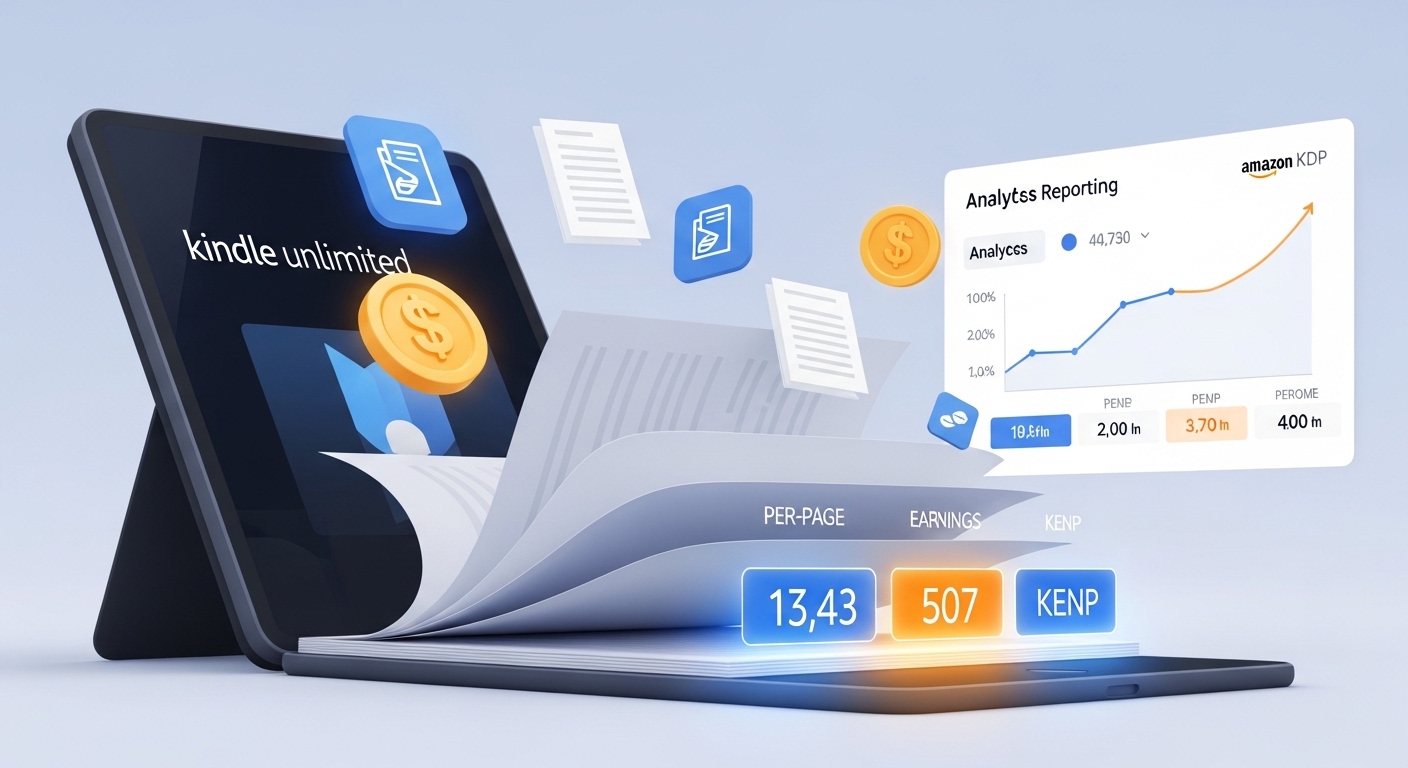
Amazon uses a standardized metric called KENP (Kindle Edition Normalized Pages) to track how much of your book is read. This system ensures that all books are measured consistently, regardless of formatting differences.
For example, a 300-page book in KU is not based on your uploaded file’s page count. Instead, Amazon calculates a normalized page count to ensure fairness across all titles.
Every page a reader reads contributes to your total KU earnings for the month.
How the Per-Page Rate Is Determined
Here’s where things become more complex—and more interesting.
The per-page rate in Kindle Unlimited is not fixed. It changes every month based on a global calculation.
Amazon sets aside a monthly fund called the KDP Select Global Fund. This fund is then distributed among all authors enrolled in Kindle Unlimited based on the total number of pages read across the platform.
The formula works like this:
Per-page rate = Total global fund ÷ Total pages read by all readers
This means your earnings depend on two variables:
- The size of the global fund
- The total number of pages read across all KU books
If more readers are active and reading more pages, the payout per page may decrease slightly. If fewer pages are read overall, the per-page rate can increase.
This dynamic model is why KU earnings fluctuate even when your own page reads stay consistent.
Typical Kindle Unlimited Per-Page Rates
While the exact rate changes monthly, it generally falls within a predictable range.
| Month Trend | Average Per-Page Rate |
| Lower range | ~$0.0035 |
| Mid range | ~$0.0040 |
| Higher range | ~$0.0045 |
To put that into perspective:
- A 300-page book read completely could earn around $1.20 per full read
- A 500-page book could generate around $2.00 per full read
These numbers may seem small per page, but they add up quickly with volume.
Why KU Earnings Fluctuate (Even When You Do Everything Right)
One of the most frustrating aspects of Kindle Unlimited is inconsistency. You might have the same number of page reads in two different months but earn slightly different amounts.
This happens because the system is influenced by platform-wide activity.
Several factors contribute to these fluctuations:
- Changes in the monthly global fund
- Seasonal reading behavior (more reading during holidays, for example)
- Growth in KU subscribers
- Overall increase or decrease in total pages read
In other words, your earnings are tied not just to your book’s performance, but to the entire Kindle Unlimited ecosystem.
The Real Economics: KU vs Direct Sales
A common question authors ask is whether Kindle Unlimited is more profitable than selling eBooks directly.
The answer depends on reader behavior.
In a direct sale:
- You earn a fixed royalty (usually 70% if priced correctly)
- Income is immediate and predictable
In Kindle Unlimited:
- Earnings depend on how much of your book is read
- Income is variable but can scale with engagement
Here’s a simplified comparison:
| Model | Payment Trigger | Income Stability | Scaling Potential |
| eBook Sales | Purchase | High | Limited by price |
| Kindle Unlimited | Pages read | Variable | High with volume |
KU rewards engagement, not just interest. A book that keeps readers hooked can outperform a book that sells once but isn’t fully read.
Why Completion Rate Matters More Than Book Length
A longer book does not automatically mean higher earnings.
What matters more is how much of your book readers actually finish.
For example:
- A 500-page book with a 50% completion rate earns less than
- A 300-page book with a 90% completion rate
This shifts the focus from simply writing longer books to writing more engaging ones.
Authors who understand this tend to structure their content differently. They prioritize pacing, clarity, and reader retention over unnecessary length.
The Role of Read-Through in Series
Kindle Unlimited becomes especially powerful when used with book series.
If a reader enjoys your first book and continues to the next, your earnings multiply across multiple titles.
This is known as read-through rate, and it is one of the most important drivers of KU income.
Instead of relying on a single book, you build a chain of engagement:
- Book 1 attracts the reader
- Book 2 continues the experience
- Book 3 deepens engagement
Each step generates additional page reads, increasing your total earnings per reader.
This is why many successful KU authors focus on series rather than standalone books.
Strategies to Increase Your KU Earnings
Success in Kindle Unlimited isn’t random—it’s behavioral. The system rewards engagement, completion, and consistency. Authors who treat KU like a traditional sales channel often struggle, while those who understand how readers actually consume content tend to scale faster.
Below are refined, practical strategies broken down into focused areas that directly influence your page reads and long-term KU income.
Optimize Your Book Opening for Immediate Engagement
The first few pages of your book determine whether you earn anything at all. In KU, a borrowed book that isn’t read is worth zero.
Readers typically decide within the first 5–10 pages whether to continue. That means your opening must establish momentum quickly. Slow introductions, excessive backstory, or delayed value can lead to early drop-offs.
Strong openings usually do one of two things effectively: they either create curiosity (common in fiction) or deliver immediate clarity and relevance (common in non-fiction). The goal is simple—give the reader a reason to keep turning pages.
Authors who consistently perform well in KU often rewrite their opening chapters multiple times, not for style, but for retention.
Engineer Pacing to Maximize Completion Rate
In Kindle Unlimited, pacing is directly tied to income. Every section of your book either moves the reader forward or risks losing them.
A common mistake is overloading the middle of the book with unnecessary content. Readers don’t drop off because the book is bad—they drop off because it slows down.
Effective pacing involves:
- Eliminating repetition or filler
- Structuring chapters to maintain forward movement
- Ending sections in a way that encourages continuation
In fiction, this often means maintaining tension or unresolved elements. In non-fiction, it means delivering value consistently without long, unfocused explanations.
Think of pacing as retention design. The smoother the reading experience, the higher your completion rate—and the higher your earnings.
Leverage Series Structure to Multiply Earnings
One of the most powerful strategies in KU is building a series instead of relying on standalone books.
When a reader finishes one book and immediately moves to the next, your earnings compound. Instead of earning from a single read, you earn across multiple books from the same reader.
This creates what’s known as read-through—a key driver of long-term income.
To make this work effectively:
- Each book should naturally lead into the next
- Endings should create curiosity or continuation
- The series should feel cohesive, not disconnected
Even a modest read-through rate can significantly increase total revenue per reader. This is why many high-earning KU authors focus heavily on series-based publishing.
Align Book Length With Reader Expectations
Longer books can generate more page reads, but only if readers actually finish them.
A common misconception is that increasing word count automatically increases earnings. In reality, it often reduces them if it affects completion rate.
The better approach is alignment:
- Match your book length to genre expectations
- Avoid stretching content beyond its natural scope
- Focus on delivering a complete experience rather than maximizing pages
A tightly written 250-page book that readers finish will often outperform a 500-page book that readers abandon halfway.
In KU, efficiency beats excess.
Use Strategic Pricing to Influence Borrowing Behavior
Even though KU readers don’t pay per book, your list price still matters.
Price acts as a signal. A very low price may suggest lower value, while a higher price can position your book as more premium or authoritative. This perception can influence whether a reader chooses to borrow your book over others.
Most successful KU authors position their books within a competitive but credible range, ensuring that price supports the book’s perceived quality.
It’s not about maximizing price—it’s about reinforcing positioning.
Publish Consistently to Maintain Visibility
Kindle Unlimited rewards activity. Authors who publish regularly tend to remain more visible within Amazon’s ecosystem.
Each new release creates:
- A spike in visibility
- Increased cross-promotion for existing books
- Renewed reader interest in your catalog
Consistency doesn’t mean rushing content. It means maintaining a steady publishing rhythm that keeps your work in front of readers.
Over time, this builds momentum. Instead of relying on a single book, you create a growing body of work that continuously generates page reads.
Strengthen Read-Through With Back Matter Optimization
What happens after a reader finishes your book is just as important as what happens during it.
Back matter—the section at the end of your book—is a critical tool for guiding readers to your next title.
Effective back matter includes:
- Clear links to the next book in the series
- A compelling reason to continue reading
- Minimal friction in accessing the next title
Many authors lose potential earnings simply because they don’t guide readers forward. A well-structured back matter section can significantly improve read-through rates.
Focus on High-Retention Genres and Reader Expectations
Not all genres perform equally in Kindle Unlimited. Some naturally encourage continuous reading, while others are more transactional.
Genres that typically perform well include:
- Romance
- Thriller and mystery
- Fantasy and sci-fi
- Serialized non-fiction
These genres benefit from binge-reading behavior, where readers consume multiple books in sequence.
Understanding genre expectations helps you align structure, pacing, and length with what readers already enjoy—making it easier to retain attention and increase page reads.
Continuously Refine Based on Performance Data
Kindle Unlimited provides insights through page read data, and this information is valuable if used correctly.
Instead of guessing what works, pay attention to patterns:
- Which books generate the most page reads?
- Where do readers seem to drop off?
- Which series drives the highest read-through?
This allows you to refine future content based on actual reader behavior rather than assumptions.
The most successful KU authors treat publishing as an iterative process. They improve with each release, gradually optimizing for higher engagement and better earnings.
Increasing your Kindle Unlimited earnings is not about chasing the per-page rate—it’s about maximizing reader engagement. Every strategy ultimately connects back to one principle: the longer and more consistently readers stay engaged with your content, the more you earn.
Authors who design their books with this in mind—focusing on retention, flow, and continuity—turn KU from an unpredictable system into a scalable income stream.
Is Kindle Unlimited Worth It in 2026?
Kindle Unlimited is still one of the most powerful tools available to self-published authors—but only when used the right way. It’s not a universal solution, and its effectiveness depends entirely on how your content fits into its engagement-based model.
At its core, KU rewards reading behavior, not just interest. You don’t earn when someone downloads your book—you earn when they keep reading it. That means success on KU is less about visibility alone and more about retention and consistency.
This is why KU works exceptionally well for certain types of authors. Fiction writers, especially those creating series, tend to benefit the most. Readers in these genres often binge-read, moving from one book to the next. That continuous reading multiplies earnings without needing to constantly acquire new readers. High-engagement storytelling—books that hold attention and maintain pace—naturally performs better in this system.
On the other hand, KU is less effective for content that doesn’t encourage extended reading. Short standalone books limit total page reads, which caps earnings. Highly niche non-fiction can also struggle, especially when readers are looking for quick, specific answers rather than a full reading experience. In these cases, a direct sales model may be more profitable.
Final Thoughts: Understanding the System Gives You an Edge
Kindle Unlimited is not just a different payment model—it’s a different way of thinking about publishing. Instead of focusing solely on selling books, you’re building reader engagement. Instead of earning per transaction, you’re earning per experience. The per-page rate may fluctuate, but the underlying principle remains constant: the more readers engage with your content, the more you earn. Authors who understand this shift—and adapt their strategy accordingly—are the ones who consistently succeed in the KU ecosystem.
FAQ: Kindle Unlimited Payouts
1. How much does Kindle Unlimited pay per page?
The rate typically ranges between $0.0035 and $0.0045 per page, depending on the month.
2. Do I get paid when someone downloads my book?
No, payment only occurs when pages are actually read.
3. What is KENP?
KENP stands for Kindle Edition Normalized Pages, which standardizes page counts across all books.
4. Why does my KU income change every month?
Because the per-page rate depends on a global fund and total pages read across all KU books.
5. Are longer books more profitable in KU?
Only if readers actually finish them. Completion rate matters more than length.