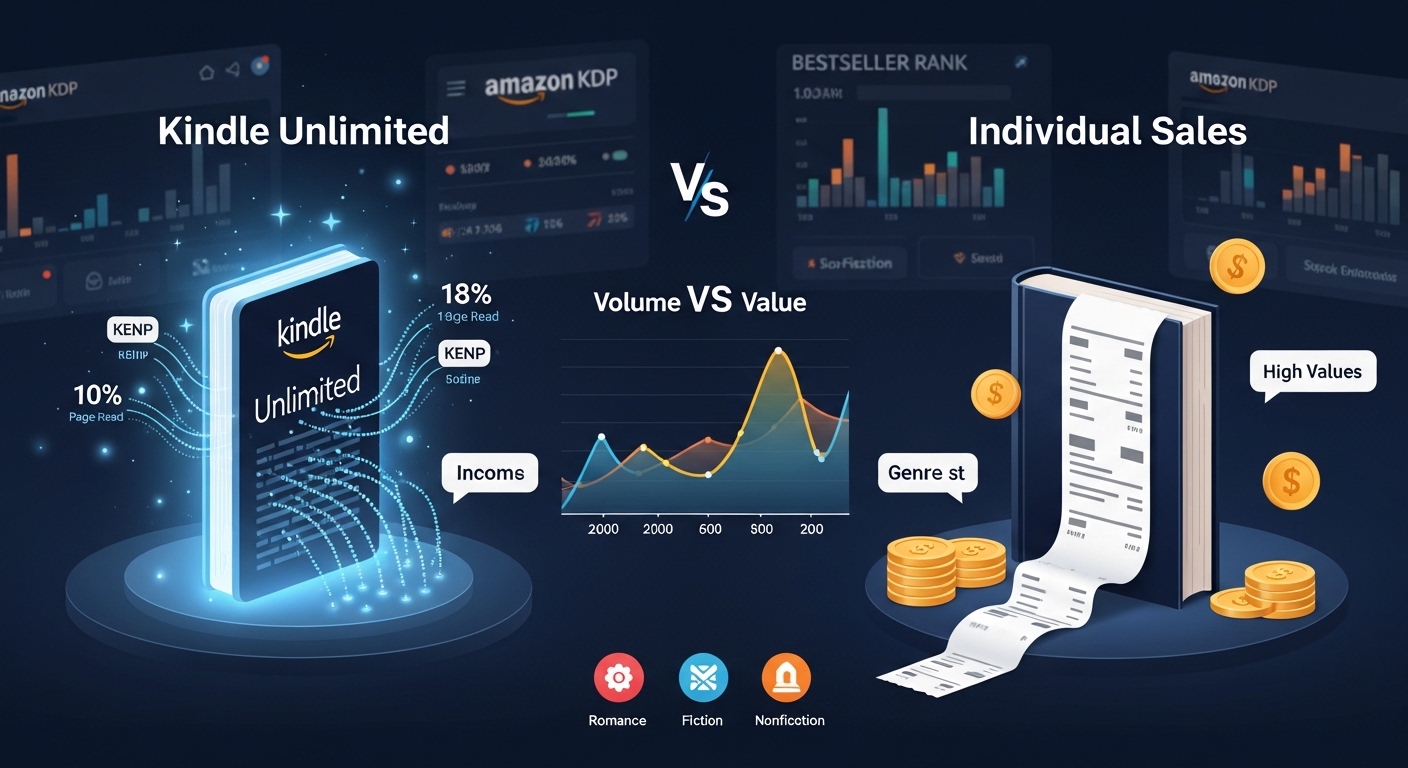
The question of whether Kindle Unlimited (KU) or individual ebook sales generate more income is no longer a simple publishing preference—it has become a core strategic decision that shapes how authors build their entire KDP business. In 2026, Amazon’s publishing ecosystem is mature, highly competitive, and driven by algorithmic behavior rather than passive visibility. That means your monetization model directly affects not just your earnings, but also your discoverability, reader reach, and long-term scalability.
At surface level, KU looks attractive because it removes friction for readers. They don’t need to buy your book; they simply read it through a subscription and you get paid per page. On the other hand, individual sales offer immediate, fixed royalties per purchase, which feels more stable and predictable. But neither system is universally superior. The real outcome depends on genre dynamics, reader psychology, catalog structure, and how your books interact with Amazon’s ranking systems.
To understand which earns more, you have to go deeper than surface comparisons. You need to analyze how readers in different genres behave, how Amazon distributes visibility, and how income compounds across multiple books rather than single titles.
Understanding the Core Difference Between KU and Individual Sales
Kindle Unlimited: Engagement-Based Monetization
Kindle Unlimited is built on a subscription model where readers do not buy books individually. Instead, they pay a monthly fee to access a large library. Authors are compensated based on pages read, which means earnings depend entirely on how long readers stay engaged with your content.
This fundamentally changes publishing strategy. In KU, your book is not just competing for clicks—it is competing for attention duration. A reader starting your book is not enough; they must continue reading for you to earn meaningful revenue. This makes retention the central performance metric.
From an algorithmic perspective, KU also influences visibility. Books that generate strong reading completion rates tend to get better internal traction because Amazon interprets engagement as quality. This creates a feedback loop where better retention leads to better visibility, which leads to more reads.
Individual Sales: Conversion-Based Monetization
Individual ebook sales operate on a traditional transaction model. A reader pays once, and the author earns a fixed royalty. The advantage is predictability. Every sale has a known value, and income is not dependent on how long the book is read.
However, this model introduces a higher barrier at the point of purchase. The reader must commit financially before engaging with your content. This makes conversion optimization extremely important—cover design, title clarity, description quality, and perceived value all directly impact earnings.
In algorithmic terms, sales performance also affects ranking. High conversion rates signal relevance, which improves visibility. But unlike KU, the engagement phase does not influence earnings after purchase.
Genre Behavior: The Most Important Factor Most Authors Ignore
The biggest mistake in comparing KU and sales is ignoring genre behavior. Amazon does not treat all categories equally, and readers in different genres behave in fundamentally different ways.
Fiction Genres: Where Kindle Unlimited Dominates
Fiction, especially genre fiction, is where Kindle Unlimited performs strongest. Romance, thriller, fantasy, and serialized fiction thrive in subscription environments because readers consume books continuously.
Real-world KU Fiction Example
Consider a romance author writing a 5-book series. In KU, a reader who enjoys Book 1 often immediately continues to Book 2, 3, and beyond without financial hesitation. This creates exponential page-read accumulation.
If one book generates 200,000 pages read in a month, and the author has 5 interconnected books, total earnings scale dramatically because engagement compounds across the series rather than stopping at a single transaction.
In contrast, individual sales would require five separate purchases, which introduces friction between each book. Even highly engaged readers may hesitate before buying each installment separately.
This is why KU often outperforms sales in fiction-heavy catalogs—it rewards continuous reading behavior rather than isolated purchases.
Nonfiction Genres: Where Individual Sales Usually Win
Nonfiction behaves very differently. Readers are not typically consuming books for entertainment loops but for information, solutions, or reference value. This changes everything about monetization.
Real-world Nonfiction Sales Example
Consider a nonfiction book on Amazon SEO strategies or business growth. A reader purchasing this type of book often intends to keep it as a long-term reference. They are less likely to read it cover-to-cover in one sitting and more likely to return to specific sections.
In this case, Kindle Unlimited underperforms because page-read accumulation is lower and fragmented. A reader might open the book, extract key insights, and stop reading. This reduces KU earnings potential.
However, the same book can perform extremely well in direct sales because perceived value is higher. A $4.99 or $9.99 purchase feels justified for long-term access to structured knowledge.
Hybrid Reality: Why Most Successful Authors Use Both Systems
In 2026, the most effective KDP strategy is rarely exclusive. Authors who perform well typically operate in a hybrid ecosystem where different books or formats serve different monetization models.
For example, a fiction author might place a series in KU while also publishing standalone companion guides for direct sales. A nonfiction author might use KU for introductory books while selling premium, in-depth guides separately.
This hybrid approach allows authors to capture both engagement-based income and conversion-based income, reducing dependency on a single system.
Amazon Algorithm Behavior: How Monetization Impacts Visibility
Amazon’s algorithm does not treat KU and sales equally in isolation. Instead, it evaluates performance signals differently depending on reader behavior.
In Kindle Unlimited
The algorithm heavily prioritizes:
- Reading completion rate
- Pages read per session
- Return engagement across books
High engagement signals lead to stronger visibility inside KU recommendation loops.
In Individual Sales
The algorithm prioritizes:
- Click-through rate from search
- Conversion rate after clicks
- Review sentiment and volume
This means KU rewards attention depth, while sales rewards conversion efficiency.
Understanding this difference is critical because it determines how your book gains traction over time.
SEO Layering: Reader Intent and Search Behavior
In 2026, SEO on Amazon is no longer just about keywords. It is about intent matching. Readers search with specific expectations, and Amazon’s system interprets relevance based on behavioral outcomes.
KU-Driven Search Intent
KU readers often search with exploratory intent:
- “romance books like…”
- “fast-paced thriller series”
- “fantasy series to binge”
These searches align with consumption-heavy behavior, making KU books more discoverable in series-based niches.
Sales-Driven Search Intent
Sales-oriented readers search with functional intent:
- “how to start a business”
- “Amazon SEO guide”
- “personal finance strategies”
These readers are more selective and expect higher informational value before purchasing.
Understanding search intent allows authors to position books correctly within the monetization model that best matches their niche.
Income Scenarios: KU vs Sales in Real Numbers
Fiction Scenario (KU Dominant)
A thriller series with 4 books in KU:
- Each book generates 120,000–200,000 pages/month
- Series effect increases binge reading
- Income scales through cumulative page reads
In this scenario, KU can outperform sales by 2–4x because readers consume multiple books in one flow.
Nonfiction Scenario (Sales Dominant)
A business strategy ebook priced at $6.99:
- 500–1,000 monthly sales with strong SEO
- High conversion from search intent traffic
- Limited KU engagement
Here, direct sales outperform KU because readers want ownership and reference access.
Long-Term Strategy: What Actually Builds Stable Income
The most important realization in 2026 is that stable income on KDP does not come from choosing between Kindle Unlimited and individual sales. It comes from building catalog depth, where multiple books work together as a connected system. A single book, regardless of how well it performs, rarely produces consistent monthly royalties on its own. Stability emerges when several strategically positioned books begin generating income simultaneously through different mechanisms.
Below is a deeper breakdown of how each component contributes to long-term income stability.
KU Generates Passive Engagement Income
Kindle Unlimited functions as a behavior-based income system, meaning earnings are tied to how long readers stay engaged with your content rather than whether they purchase it. This creates what is often described as “passive engagement income,” because revenue continues to accumulate as long as readers are actively consuming your books within the KU ecosystem.
In practical terms, KU rewards attention. A reader does not need to buy your book; they only need to start reading it. From that point onward, every page read contributes to your earnings. This structure is especially powerful in genres where binge reading is common, such as romance, thrillers, and fantasy series.
However, the passive nature of KU is often misunderstood. It is not truly passive in the early stages. It requires strong retention design—clear pacing, engaging structure, and consistent narrative flow. If readers drop off early, earnings decline sharply. But once a catalog is established and multiple books begin attracting repeat readers, KU income becomes more stable and less dependent on individual launches.
Over time, KU creates a background layer of income that fluctuates daily but contributes significantly to monthly totals when engagement is strong.
Sales Generate High-Value Transactions
Individual book sales operate on a completely different economic principle. Instead of paying for attention over time, readers pay a fixed price upfront, creating immediate and predictable revenue per transaction. This makes sales a high-value income stream, especially for nonfiction and niche expertise books.
The strength of sales lies in conversion efficiency. When a reader purchases a book, the full royalty value is realized instantly. There is no dependency on reading duration or engagement behavior after the purchase. This makes sales particularly valuable in genres where readers seek information, reference material, or long-term utility.
For example, a well-positioned business or self-help book can generate consistent income through search-driven discovery. Readers who find these books through Amazon search often have strong intent, meaning they are ready to buy rather than casually browse.
Sales also contribute to algorithmic strength. High conversion rates signal relevance to Amazon, which can improve visibility in search rankings. However, unlike KU, income from sales does not compound through reading behavior. Each transaction stands independently.
In a stable KDP system, sales provide the high-value spikes that balance out the more gradual accumulation of KU earnings.
Series Build Compounding Readership Loops
Series-based publishing is one of the most powerful long-term strategies in KDP because it creates compounding readership loops. Instead of treating each book as an isolated product, a series encourages readers to move continuously from one book to the next, increasing both engagement and total revenue per reader.
This compounding effect is especially strong in Kindle Unlimited, where financial friction is removed. Once a reader finishes one book, they can immediately start the next without any additional cost decision. This leads to extended reading sessions and significantly higher page-read accumulation across the entire series.
In sales-driven environments, series still perform well, but the loop depends more on reader satisfaction and willingness to purchase multiple books. While this introduces friction between installments, strong branding and consistent quality can still drive repeat purchases.
The key advantage of series is that they transform a single acquisition into a multi-book engagement cycle. Instead of earning from one interaction, authors earn from a sequence of interactions that can extend over weeks or even months. This is where long-term stability begins to form.
Over time, as more series and related books are added to a catalog, these loops begin to overlap. Readers enter at different points, move across different books, and generate layered income streams that reinforce each other. This is what ultimately produces predictable monthly royalties on KDP.
FAQ: Kindle Unlimited vs Individual Sales
Which is better for beginners?
Kindle Unlimited is often easier for fiction beginners due to lower reader friction, but results still depend on retention quality.
Can nonfiction succeed in Kindle Unlimited?
Yes, but it is usually less efficient unless the book is highly structured for continuous reading.
Do authors have to choose one model?
No. Many successful authors use both depending on book type and audience behavior.
Which earns more overall?
Neither universally wins. Fiction-heavy catalogs often perform better in KU, while nonfiction-heavy catalogs often perform better in sales.
Is KDP still profitable in 2026?
Yes, but profitability depends on strategy, niche selection, and catalog scaling rather than single-book performance.
Final Conclusion: The Real Answer
The comparison between Kindle Unlimited and individual sales is not a battle between two systems—it is a question of alignment. KU rewards attention and continuous reading, while sales reward intent and perceived value.
In 2026, the authors who succeed are not those who choose one model blindly, but those who understand how reader behavior interacts with genre expectations and algorithmic ranking systems.
The real earning potential comes not from choosing KU or sales, but from building a structured publishing system where both models are used strategically to match how readers in your niche actually consume content.