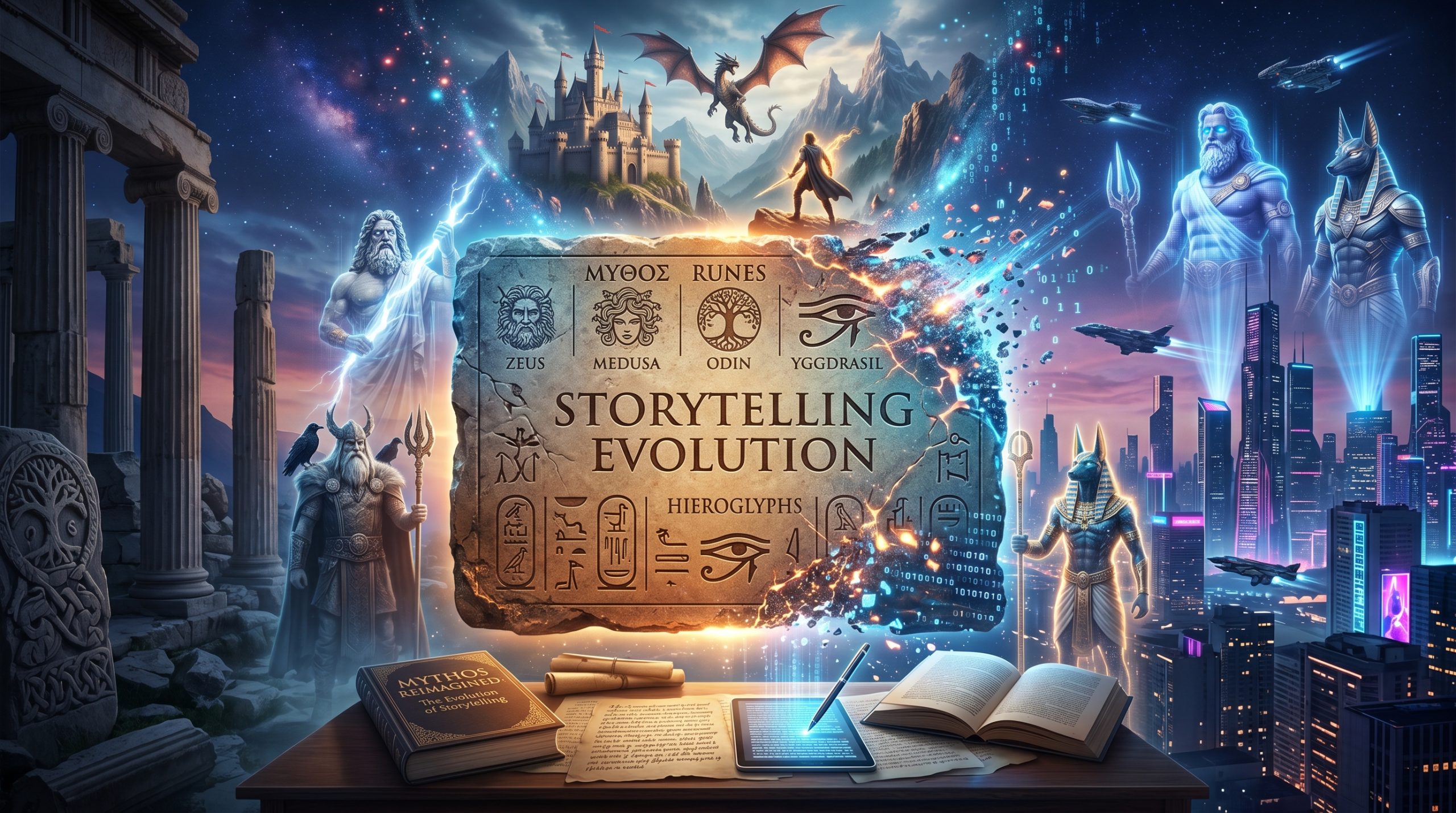
Mythology has never been as distant from modern life as it might appear. Even in a world defined by digital media, streaming narratives, and rapidly evolving literary trends, ancient myths continue to shape the way stories are written, told, and consumed. What once belonged to oral traditions, temple inscriptions, and early literary cultures now appears in bestselling fantasy fiction, layered literary novels, cinematic universes, and even experimental science fiction and dystopian storytelling.
The surprising truth is that mythology has not faded—it has adapted. It has moved through time by transforming itself, absorbing new cultural meanings, and resurfacing in forms that feel relevant to contemporary readers. Whether it is a reimagined Greek tragedy in modern literary fiction, a Norse-inspired world in epic fantasy, or a symbolic retelling of creation myths through speculative technology narratives, mythology remains deeply embedded in how stories are constructed today.
What makes this especially significant is that modern audiences are no longer passive recipients of myth. They are active interpreters. Readers today expect retellings to do more than preserve old narratives—they expect them to reinterpret, question, and reframe them in ways that reflect current emotional, political, and cultural realities.
This shift raises a central challenge for writers: how do you retell ancient stories in a way that feels both authentic to their origins and meaningful to new audiences shaped by entirely different worldviews?
The answer lies in understanding mythology not as fixed content, but as narrative architecture—structures that can be reshaped endlessly without losing their emotional core.
Why Mythology Still Shapes Modern Storytelling
Mythology continues to influence modern storytelling because it is built on emotional universality. The concerns at the heart of ancient myths—identity, power, love, betrayal, ambition, fate, and transformation—are still central to human experience today. While technology, society, and culture evolve, these core emotional patterns remain remarkably stable.
This is why mythological frameworks appear across so many modern genres.
In fantasy fiction, myths often become the foundation for entire worlds, where gods, monsters, and magical systems echo ancient symbolic structures. In literary fiction, mythological themes are often subtle, woven into character psychology and emotional development. In science fiction, myths are frequently reinterpreted through futuristic or technological lenses, turning ancient archetypes into reflections of artificial intelligence, space exploration, or digital consciousness.
Even in young adult fiction, myth-inspired storytelling remains powerful because it naturally aligns with coming-of-age themes—identity formation, moral conflict, and personal transformation.
At its core, mythology persists because it speaks a narrative language that does not expire.
From Retelling to Reinterpretation
One of the most important shifts in modern storytelling is the movement away from simple retelling toward reinterpretation. In earlier literary traditions, myths were often preserved with minor variations. Today, writers are far more interested in reshaping meaning rather than preserving form.
Retelling a myth in the 21st century is not about replicating plot points. It is about engaging with the underlying emotional and philosophical structure of the story and asking new questions of it.
This is especially visible in modern literary fiction, where myth-inspired narratives often focus less on divine events and more on human psychology. A character once portrayed as a hero might be reimagined as morally conflicted. A so-called villain might be given interior depth and emotional justification. A forgotten secondary figure might become the narrative center.
This process transforms mythology from static tradition into living literature.
The Role of Perspective in Modern Myth Retellings
Perspective is one of the most powerful tools in modern mythological adaptation. Changing the narrative viewpoint can completely reshape the meaning of a familiar story.
Ancient myths were often told from dominant or singular perspectives—gods, heroes, kings, or symbolic narrators. Modern retellings frequently challenge this by shifting focus to overlooked or marginalized voices.
This shift is particularly prominent in contemporary fiction, where narrative voice is often used to question authority, reinterpret historical narratives, and explore emotional complexity.
For example, a myth traditionally centered on a heroic conquest might be retold from the perspective of those affected by the hero’s actions. A divine punishment narrative might be reframed through the emotional experience of the punished character rather than the enforcing deity.
This change in perspective does not alter the myth’s core structure—it expands its interpretive possibilities.
Updating Mythological Themes for Contemporary Readers
Modern audiences engage with mythology differently from ancient audiences did. While traditional myths often focused on explaining natural phenomena or reinforcing cultural values, contemporary retellings tend to emphasize psychological depth, ethical ambiguity, and social relevance.
Writers adapting mythology today often connect ancient themes to modern concerns such as identity, inequality, technology, environmental crisis, and cultural displacement.
For instance:
- A myth about divine judgment can be reinterpreted as commentary on surveillance culture or institutional control.
- A story of exile can reflect modern migration and displacement narratives.
- A myth about transformation can explore fluid identity in the digital age.
This approach allows mythology to remain relevant without losing its symbolic foundation.
Mythology Across Modern Literary Genres
One of the most powerful aspects of mythology is its adaptability across genres. It does not belong to a single category of storytelling—it flows across them, reshaping itself depending on the emotional and structural demands of each form. This flexibility is one of the reasons myth-based storytelling continues to thrive in contemporary literature, from mainstream fiction to highly experimental narratives.
In many ways, modern writers engaging with myth are also engaging with The Art of the Fable: How to Use Ancient Storytelling Techniques Today, because both traditions rely on similar narrative principles—compression, symbolism, and meaning-driven structure. Fables and myths share a common storytelling DNA: they reduce complex human experiences into clear, powerful narrative forms that can be adapted endlessly without losing emotional resonance.
In fantasy fiction, mythology provides the structural backbone for world-building, shaping systems of magic, divine hierarchies, and epic conflict. Entire fictional universes are often constructed using mythological logic, where gods, monsters, and heroic journeys mirror ancient narrative patterns. This gives fantasy stories a sense of timelessness, even when the setting is entirely invented.
In science fiction, mythological structures are frequently reimagined through futuristic or technological frameworks. Gods may be transformed into artificial intelligences, fate may be reinterpreted as algorithmic prediction, and creation myths may become narratives about cosmic origins or technological evolution. This fusion of myth and futurism allows writers to explore ancient philosophical questions through modern speculative lenses.
In psychological fiction, myths often operate on a symbolic level, representing internal emotional states, identity conflicts, and subconscious fears. A mythological journey may mirror a character’s psychological transformation, where external events reflect internal change rather than literal adventure. This creates layered storytelling that connects ancient symbolic logic with modern character-driven narratives.
Even in experimental or hybrid storytelling forms, mythological structures continue to offer narrative stability. When stories become fragmented, abstract, or non-linear, myth-inspired frameworks help anchor meaning through recognizable emotional and symbolic patterns. Readers may not consciously identify the mythological influence, but they still respond to its structural familiarity.
In this way, mythology functions not as a fixed tradition but as a flexible narrative system—one that continues to evolve across genres while maintaining its core storytelling intelligence.
Archetypes and Their Modern Transformations
At the core of mythology lies the archetype—a recurring narrative pattern that represents universal human roles and behaviors. Archetypes such as the hero, the trickster, the mentor, and the exile continue to shape modern storytelling, even when they are not explicitly acknowledged.
In contemporary writing, these archetypes are rarely used in their pure form. Instead, they are layered with complexity. A hero may be flawed or uncertain. A mentor may be morally ambiguous. A trickster may represent both creativity and destruction.
This blending of archetypal structure with psychological realism is one of the defining features of modern literary fiction and genre-crossing narratives.
Writers who understand archetypes can use them not as rigid templates, but as flexible narrative tools that enhance emotional resonance.
The Influence of Myth on Modern Genre Fiction
Mythology continues to play a major role in shaping genre fiction, particularly in fantasy and speculative storytelling. Entire literary worlds are often built on myth-inspired frameworks, even when the source material is not directly acknowledged.
In fantasy fiction, mythological influence can be seen in epic quests, divine hierarchies, and symbolic creatures. In dystopian fiction, myths often emerge in the form of societal structures that mirror ancient moral systems. In historical fiction, myth and history frequently overlap, blending cultural memory with narrative interpretation.
This cross-genre influence shows that mythology is not confined to retellings—it is embedded in the structural DNA of modern storytelling.
Why Mythological Retellings Matter Today
Mythological retellings matter because they connect past and present in a way few other narrative forms can. They allow writers to engage with timeless emotional themes while also addressing contemporary cultural realities.
For readers, these stories offer familiarity and novelty at the same time. They recognize the shape of the story even as its meaning shifts. This balance creates a powerful reading experience that feels both grounding and transformative.
For writers, mythology offers a framework for exploring complex ideas without losing narrative clarity. It provides symbolic depth, structural coherence, and emotional universality—all essential elements of effective storytelling.
Conclusion
Mythology in the 21st century is not a preserved artifact—it is a living system of storytelling that continues to evolve with every generation. Ancient stories survive not because they remain unchanged, but because they are constantly being reinterpreted.
Modern writers working across fantasy fiction, literary fiction, science fiction, and beyond are not simply retelling myths. They are reshaping them, questioning them, and rediscovering their relevance in new cultural contexts.
To retell mythology today is to participate in an ongoing creative tradition that stretches across centuries. It is to recognize that these stories were never meant to remain fixed, but to be transformed again and again in response to the changing human experience.
In that sense, mythology is not something from the past.
It is something we are still actively creating.
FAQ
Why is mythology still relevant in modern storytelling?
Because it explores universal human emotions and conflicts that remain unchanged across time, making it adaptable to modern genres and themes.
What is the difference between retelling and reinterpreting mythology?
Retelling preserves original plot structures, while reinterpreting reshapes meaning, perspective, and thematic focus for modern audiences.
Which genres use mythology the most today?
Fantasy fiction, literary fiction, science fiction, dystopian fiction, and young adult literature frequently draw on mythological structures.
How can writers modernize ancient myths effectively?
By shifting perspective, updating thematic relevance, and focusing on emotional and psychological depth rather than literal replication.
Do mythological retellings need to stay faithful to original stories?
Not strictly. Modern retellings often prioritize thematic resonance and reinterpretation over strict narrative accuracy.