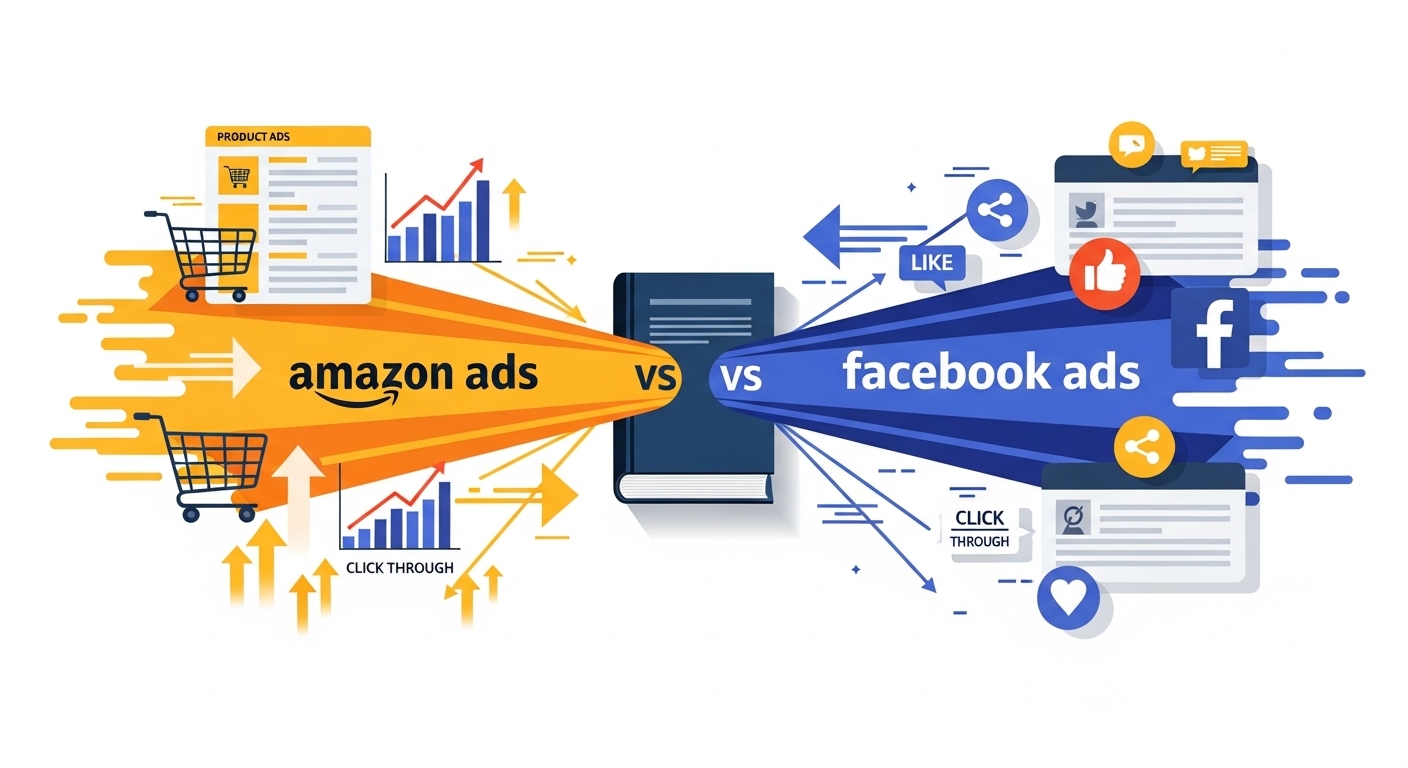
Choosing between Amazon Ads and Facebook Ads is one of the toughest decisions authors face. Amazon’s advertising platform puts your book directly in front of shoppers already browsing or buying books, meaning purchase intent is high. Indeed, over 50% of book buyers visit Amazon early in their purchase journey, and around 77% discover new titles during their browsing sessions—making Amazon one of the top channels for reader discovery.
On the other hand, Facebook Ads (including Instagram through Meta) offer powerful interest‑ and behavior‑based targeting that lets you reach readers by age, interests, and even engagement patterns. While readers on Facebook may not be searching to buy at the moment they see your ad, the platform’s massive reach and creative flexibility can help you build awareness, grow your audience, and nurture future buyers. Recent industry data also shows that Books & Music ads on Facebook achieve some of the highest click‑through rates (CTR) in digital advertising—about 2.34%—with year‑over‑year increases of more than 25%, indicating strong engagement potential when your creative resonates.
Paid Ads for Authors: Understanding the Battlefield
While social media, email newsletters, and word-of-mouth are valuable, they rarely provide enough reach for a new release to stand out. Many readers simply never see books that haven’t been promoted, and relying solely on organic methods can delay discoverability indefinitely. Paid ads fill this gap, allowing authors to place their books in front of readers who are either ready to buy or primed for discovery.
For authors seeking immediate sales or broader exposure, understanding the mechanics of paid ads—and how each platform works—is critical. Ignoring this can mean missing out on thousands of potential readers.
The Metrics That Really Matter
Before spending any ad dollars, authors need to understand the metrics that indicate success:
- Cost-per-click (CPC): How much each click costs
- Return on ad spend (ROAS): The revenue generated for every dollar spent
- Conversion rate: Percentage of clicks that result in a purchase
Tracking these metrics allows you to optimize campaigns over time, reallocate budgets, and understand which platform or targeting method is producing results. Without data, you’re essentially guessing, and guessing rarely produces consistent ROI.
Amazon Ads: Capturing Readers Who Are Ready to Buy
Amazon Ads are built around intent-driven behavior. Readers searching for specific genres, keywords, or competitor books see your ad alongside relevant search results or product pages. The primary formats include:
- Sponsored Products: Appear directly in search results and product pages
- Sponsored Brands: Showcase multiple titles and highlight your author brand
- Lockscreen Ads: Displayed on Kindle devices to capture attention
The targeting options—keywords, categories, and competitor titles—allow authors to reach readers who are actively looking for books, increasing the likelihood of immediate purchases.
Why Amazon Ads Can Skyrocket Conversions
The biggest strength of Amazon Ads is high purchase intent. A reader searching “romantic suspense novels” is already in buying mode, which means clicks are more likely to convert. Integration with your book’s product page also makes it easy for readers to purchase immediately. For new releases, this can lead to an early sales boost, improving visibility within Amazon’s algorithm and attracting more organic buyers.
The Hidden Challenges of Amazon Ads
Amazon Ads aren’t a magic bullet. High-demand keywords can drive up cost-per-click, reducing ROI for new authors. Campaigns also offer limited creative freedom—you can’t use videos or elaborate storytelling in the ads themselves. Success depends heavily on keyword research, bid strategy, and ongoing monitoring. Authors who fail to optimize campaigns often spend more than they earn, making data tracking essential.
Case Example
A romance author targeting keywords like “romantic suspense” and competitor titles sees strong conversions but high CPC for top keywords. By testing long-tail keywords like “small-town romantic suspense,” the author reduces CPC while still attracting a targeted audience, demonstrating how strategic keyword choice impacts ROI.
Facebook Ads: Turning Browsers into Future Fans
How Facebook Ads Discover New Readers
Facebook Ads operate on interest-driven targeting, reaching readers based on demographics, behaviors, hobbies, and even engagement with similar authors. Unlike Amazon, these readers are often in “discovery mode,” scrolling through feeds rather than searching to buy.
The ad formats are highly flexible: single images, carousel ads showcasing multiple books, or short videos teasing a story. This flexibility allows authors to tell their book’s story visually, build anticipation, and engage readers before they even consider a purchase.
The Strength of Creative Freedom
Facebook Ads are ideal for brand-building. Authors can experiment with teasers, book trailers, fan reactions, or interactive content. Video ads, for example, can capture attention within seconds and drive readers to sign up for newsletters or download free chapters.
While immediate book purchases may be lower than Amazon, Facebook creates long-term engagement. Readers who interact with your ads can become loyal fans who buy future releases, follow you on social media, and participate in online communities.
What Makes Facebook Ads Tricky for Authors
The biggest challenge with Facebook Ads is lower purchase intent. Clicks may generate interest, but not all will convert immediately. Ad fatigue is another common issue—audiences quickly become accustomed to seeing the same visuals or messaging, reducing engagement over time. Successful campaigns require ongoing testing and creative refreshes, which can be time-intensive.
Case Example
A fantasy author launches a 15-second animated teaser targeting readers who follow fantasy book clubs on Facebook. While direct sales are modest initially, many viewers sign up for a newsletter. During launch week, these engaged subscribers receive an announcement and purchase the book, showing how Facebook can drive conversions indirectly.
Head-to-Head: Amazon Ads vs. Facebook Ads
Who’s Really in Buying Mode?
Amazon captures readers actively searching for books, making them more likely to purchase immediately. Facebook introduces books to potential readers who may be discovering your genre for the first time.
Precision Targeting Showdown
Amazon relies on keyword and category targeting, while Facebook allows more nuanced audience segmentation using interests, behaviors, and lookalike audiences. Each platform offers unique advantages depending on whether your goal is immediate sales or long-term engagement.
Creative Freedom Battle
Amazon Ads are largely product-focused with limited visual options, whereas Facebook allows creative storytelling through video, carousel, and image-based campaigns. Authors can test different styles to see what resonates with readers.
Cost and ROI Comparison
Amazon’s CPC can be high for competitive keywords but generally converts well due to purchase intent. Facebook CPC may be lower, but ROI depends heavily on audience targeting, creative quality, and testing.
When to Use Each Platform for Maximum Impact
- Amazon: Best for launches, targeting buyers, and boosting direct sales.
- Facebook: Best for brand-building, growing your email list, and nurturing an audience over time.
The Power of Combining Amazon and Facebook Ads
How Hybrid Campaigns Amplify Results
A hybrid strategy often produces the best outcomes. Use Facebook to introduce your book to new readers and build a list of engaged followers. Then retarget these readers with Amazon Ads during your launch, where they are more likely to convert due to high purchase intent.
Example Strategy
Run a Facebook campaign promoting a free chapter or newsletter signup. Once readers join, launch an Amazon Ads campaign targeting these subscribers. This two-step approach maximizes both engagement and conversion, ensuring ad spend is used efficiently.
Smart Budget Allocation for Maximum ROI
Allocate budget based on campaign goals. Amazon Ads are ideal for immediate sales; Facebook Ads are better for long-term engagement and brand awareness. Track metrics separately to identify which platform produces the best returns and adjust spend accordingly.
Common Pitfalls Authors Fall Into With Paid Ads
Ignoring Metrics and Data
Running ads without tracking CPC, CTR, and conversion rates is like throwing money into the wind. Monitoring these metrics allows authors to identify what works, tweak campaigns, and avoid wasteful spending.
Targeting Mistakes That Kill ROI
Audiences that are too broad waste ad spend, while overly narrow targeting limits reach. Finding the balance ensures campaigns reach enough potential readers without unnecessary clicks.
Creative Oversights That Reduce Engagement
Failing to test multiple headlines, images, or ad formats can reduce engagement and ROI. Iterative testing ensures campaigns evolve to match audience preferences.
Launching Ads Without an Optimized Book Page
Even the most compelling ad will fail if your book page is weak. Covers, descriptions, and formatting must be professional to convert clicks into purchases.
Optimizing Campaigns Like a Pro
Key Metrics to Measure Success
Track CPC, ROAS, CTR, and conversion rate for both Amazon and Facebook campaigns. Comparing these metrics helps authors understand which platform delivers the best ROI and informs future campaigns.
Iterative Testing for Better Results
Small adjustments in headlines, visuals, and targeting can produce significant improvements. Run A/B tests to experiment with different ad copy, formats, and audience segments. Over time, this data-driven approach compounds results.
Amazon Ads vs. Facebook Ads — Quick Comparison Table
| Feature | Amazon Ads | Facebook Ads |
|---|---|---|
| Audience Intent | High – readers actively searching to buy | Moderate – readers browsing, discovering new books |
| Targeting | Keywords, categories, competitor titles | Interests, behaviors, demographics, lookalike audiences |
| Creative Options | Limited – product image, title, short copy | Flexible – images, video, carousel, interactive content |
| Typical Click-Through Rate (CTR) | 0.3%–0.6% | ~2.34% (Books & Music category) |
| Conversion Rate | Higher due to purchase intent | Lower for immediate sales, but good for future conversions |
| Cost Per Click (CPC) | ~$0.81–$2.50 (depends on keyword competition) | ~$1.18 median |
| Cost Per Purchase (CPP) | ~$15–$25 (varies by book and keyword) | ~$27.91 median |
| Best Use Case | Boosting direct book sales, launch promotions | Building awareness, growing email lists, long-term engagement |
| Strength | High ROI for ready-to-buy audiences | Creative flexibility and massive reach |
| Limitation | Limited ad formats, competitive keywords | Lower purchase intent, requires ongoing testing |
Conclusion: Which Platform Should You Bet On?
There’s no universal winner. Amazon Ads excel at converting readers ready to buy, while Facebook Ads shine at discovery and long-term engagement. Authors who strategically combine both—Facebook for awareness and Amazon for conversions—often achieve the best results.
Paid ads, when executed thoughtfully, can transform visibility, engagement, and sales. Authors who track performance, test campaigns, and refine strategies will see sustainable growth, even in a crowded marketplace.
FAQ: Your Top Questions About Paid Book Ads
Can I run Amazon and Facebook ads simultaneously?
Yes. Combining both platforms allows you to capture both discovery and purchase-intent audiences, maximizing visibility and conversions.
How much should I spend on book ads?
Start small, test campaigns, and scale based on ROI. Budgets vary depending on your book price, genre, and marketing goals.
Which genres perform better on each platform?
- Amazon: Popular fiction, romance, mystery, and high-search-volume non-fiction
- Facebook: Niche genres, fantasy, memoirs, and visually compelling books
Do video ads perform better than images?
On Facebook, video ads generally capture attention faster and drive more engagement. Success depends on creativity and relevance to your audience.
Should I hire an ad expert?
Optional for beginners, but experts can optimize larger campaigns, handle complex targeting, and improve ROI for multiple titles.