If you’ve spent any time researching ways to make money online, you’ve probably come across Kindle Direct Publishing (KDP). And if you’re like most people, your reaction was likely a mix of curiosity and skepticism. On one hand, you see income reports and success stories. On the other, you wonder if those numbers are real—or if the market is already too saturated to break into.
This blog is not about selling you a dream. It’s about showing you exactly what one realistic month looks like.
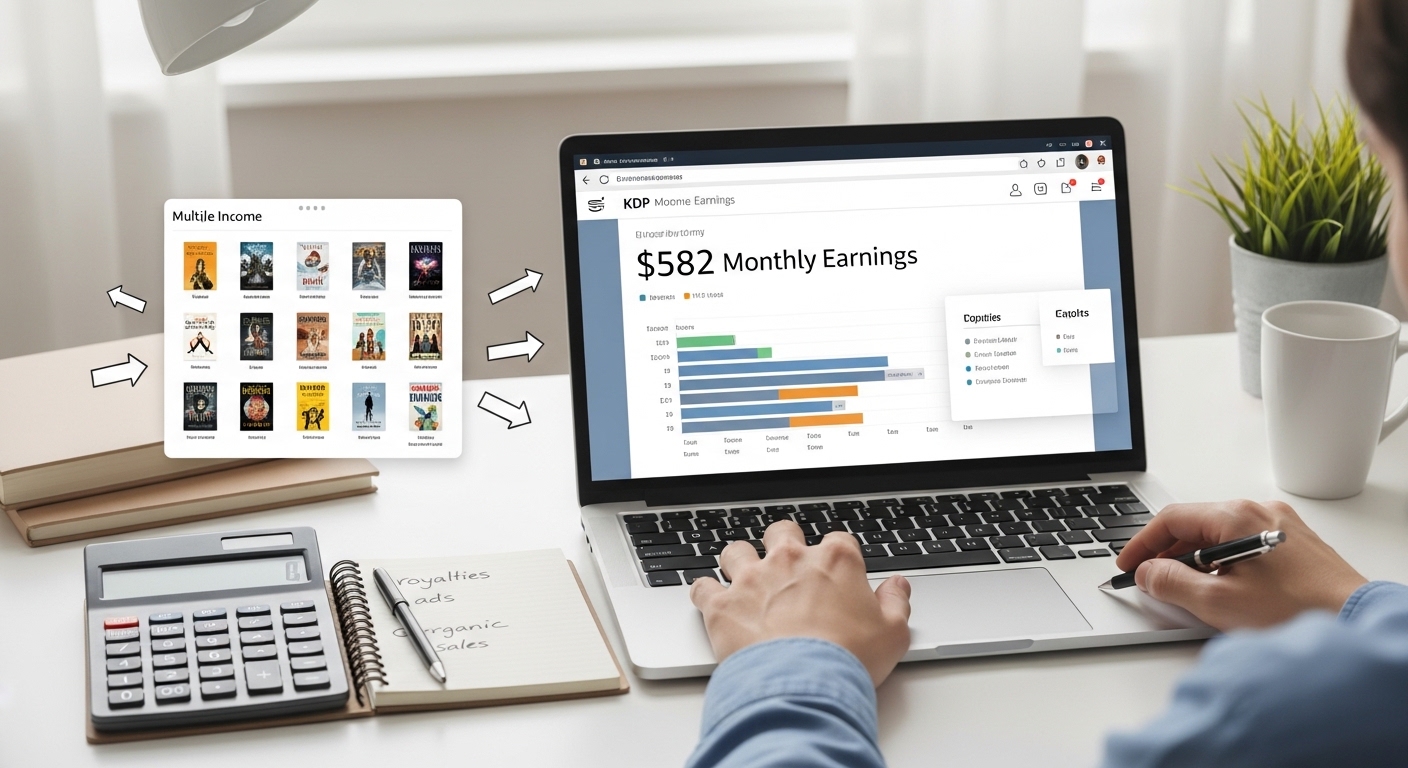
In a recent month, I earned $582 from 17 books on KDP. No viral hit. No massive ad spend. No publishing company behind me. Just a small portfolio of books built over time, with a strategy that finally started to work.
In this post, I’m going to break down:
- Where that $582 actually came from
- What types of books I published
- How those books got traffic and sales
- What I would do differently if I started over
By the end, you’ll have a clear, honest understanding of what it takes to earn your first few hundred dollars on KDP—and whether it’s something worth pursuing.
My KDP Journey: From Zero to My First Consistent Month
Like most beginners, I didn’t start with a winning strategy. I started with guesswork.
My first few books were created based on what I thought people might buy—generic notebooks, overly broad journals, and designs that didn’t stand out. I uploaded them, waited, and… nothing happened. Days turned into weeks, and weeks into months with little to no sales.
At that stage, it’s easy to assume KDP doesn’t work. In reality, I was making three common mistakes: choosing saturated niches, ignoring keyword research, and underestimating the importance of covers.
The turning point came when I stopped treating KDP like a lottery and started treating it like a search-driven platform. Instead of asking, “What should I create?” I started asking, “What are people already searching for—and where is the competition weak?”
That shift changed everything.
I began analyzing listings, studying competitors, and focusing on specific niches instead of broad categories. Slowly, some books started getting traction. Not explosive growth, but consistent, small sales. Over time, those small wins added up—and eventually led to my first $500+ month.
My Exact KDP Income Breakdown ($582 Explained)
Let’s get into the numbers, because this is what most people care about.
The total revenue for the month was $582, but what’s more important is how unevenly that income was distributed.
Top Performing Books vs. The Rest
Out of 17 books, only a handful were responsible for the majority of earnings. This is a pattern you’ll see again and again in KDP publishing.
Roughly 3–4 books generated over 60% of the total income. These were books that:
- Targeted clearer niches
- Had stronger keyword positioning
- Featured more appealing covers
The remaining 13–14 books contributed smaller, inconsistent sales. Some sold a few copies during the month, while others didn’t sell at all.
This is an important reality check: KDP is not about every book performing equally. It’s about building a portfolio where a few winners carry the rest.
Royalties Per Book (What I Actually Earned)
Most of my books were priced in a typical range for low- and medium-content products. That meant royalties per sale were relatively modest.
Some books earned around $1–$3 per sale, depending on pricing and printing costs. Others earned slightly more if they were positioned as higher-value products.
This is why volume matters. You’re not relying on one book to generate high profit—you’re relying on multiple books generating consistent sales over time.
What Kind of Books I Published (All 17 Explained)
Not all KDP books are created equal, and the type of book you publish plays a huge role in your results.
Low-Content vs Medium-Content Books
My portfolio included a mix of:
- Low-content books (notebooks, simple journals)
- Medium-content books (guided journals, structured planners, activity-style books)
Low-content books are easier to produce but harder to differentiate. Medium-content books take more effort but often have higher perceived value and better conversion rates.
Over time, I noticed that medium-content books tended to perform better, especially when they solved a specific problem for a defined audience.
Niches That Worked for Me
The books that performed best weren’t random—they were targeted.
Instead of creating generic “daily planners” or “blank notebooks,” I focused on more specific use cases. Books designed for a particular audience or purpose consistently outperformed broad, unfocused ones.
What made these niches work wasn’t just demand—it was the gap between demand and quality competition. In several cases, I found niches where existing books had poor covers, weak titles, or low-quality interiors. That created an opportunity to stand out without needing massive traffic.
What Failed (And Why It Matters)
Some books didn’t sell at all. And those failures were just as important as the successes.
The common pattern among underperforming books included:
- Entering oversaturated niches
- Choosing vague or broad keywords
- Creating covers that blended in instead of standing out
These failures reinforced a key lesson: effort alone doesn’t guarantee results. Direction matters more than volume.
How My Books Actually Got Sales
A lot of beginners assume that publishing a book automatically leads to sales. It doesn’t. Visibility is everything.
Amazon Organic Traffic
The majority of my sales came from Amazon’s organic search system. This means people were actively searching for something, and my book appeared in the results.
This is where keyword research becomes critical. If your book matches what people are searching for—and your listing is optimized—you have a chance to get consistent traffic without paid ads.
Over time, some of my books began ranking higher for certain search terms. As that happened, sales became more predictable.
Did I Use Ads or Not?
In this case, the $582 month was primarily driven by organic traffic. I either used minimal ads or none at all for most of the books.
This is important because it shows that KDP can work without a heavy advertising budget—but only if your fundamentals are strong. Ads can amplify results, but they won’t fix a weak book or a poorly chosen niche.
My Keyword & Niche Research Strategy
This is arguably the most important part of the entire process.
How I Find Low-Competition Niches
Instead of chasing high-volume, competitive keywords, I focused on finding underserved areas.
My process involved:
- Searching directly on Amazon
- Analyzing the first page of results
- Looking for weak listings (poor covers, low reviews, unclear titles)
If I found a niche where demand existed but quality was lacking, that became a potential opportunity.
What Makes a Profitable Keyword
A good keyword isn’t just popular—it’s strategic. The best opportunities usually have:
- Clear search intent (the buyer knows what they want)
- Visible demand with consistent listings
- Weak or outdated competitors
When these factors align, even a new book has a chance to compete.
My Book Creation Process (Step-by-Step)
Once I identified a niche, the next step was execution.
From Idea to Upload
The process typically looked like this:
First, I validated the idea by checking search results and competition. Then, I created the interior—keeping it simple but purposeful. After that, I designed a cover that clearly communicated the book’s value.
Finally, I uploaded the book to KDP, focusing heavily on the title, subtitle, and keywords. These elements determine whether your book gets discovered in the first place.
Tools I Use
I kept my tool stack simple. Most of the work could be done using accessible design tools and Amazon itself for research.
The key wasn’t using advanced software—it was understanding what the market wanted and executing consistently.
What Actually Makes a Book Sell on KDP
Many beginners focus too much on creating books and not enough on selling them.
Cover Design Matters More Than You Think
Your cover is the first thing people see. If it doesn’t stand out or communicate value instantly, the rest of your work won’t matter.
Some of my early books failed simply because the covers looked generic. Once I improved design quality—even slightly—click-through rates improved.
Listing Optimization (Titles, Keywords, Categories)
A strong listing helps your book get discovered and convinces people to click.
Your title and subtitle should include relevant keywords while still sounding natural. Categories should align with your niche, and your description should clearly explain what the buyer is getting.
Even small improvements in these areas can lead to better visibility and more sales.
What I’d Do Differently If I Started Again
Looking back, there are several things I would change.
Fewer Books, Better Strategy
Instead of rushing to publish as many books as possible, I would focus on fewer, higher-quality projects. A well-researched book in a good niche is worth far more than multiple random uploads.
Avoiding Saturated Niches Early
I wasted time creating books in highly competitive categories where standing out was nearly impossible. Starting with less competitive niches would have accelerated my progress.
Is KDP Still Worth It in 2026?
This is the question most people are really asking—and the honest answer is: yes, but only under the right expectations and approach.
Kindle Direct Publishing is no longer the “easy win” it might have appeared to be a few years ago. The barrier to entry is still low, but the barrier to success has quietly increased. There are more books, more competition, and more people treating it like a real business instead of a casual side experiment.
That doesn’t mean the opportunity is gone. It means the strategy has to evolve.
In 2026, KDP still works—but it rewards people who understand how marketplaces function. It’s less about uploading books and more about positioning products within a search-driven ecosystem. If you approach it with that mindset, there is still room to carve out profitable niches and build consistent income.
Who Should Try KDP
KDP is a strong fit for people who are willing to play a longer game and develop a skill set around publishing, not just content creation.
If you’re someone who is comfortable with experimentation, KDP can be a powerful learning platform. Every book you publish gives you feedback—whether it sells or not. Over time, those insights compound, and your decision-making improves. This is how small portfolios turn into income-generating assets.
It’s especially well-suited for people who:
- Think in terms of systems rather than one-off wins
- Are willing to analyze competitors instead of copying them blindly
- Can stay consistent even when early results are slow
Another advantage is that KDP doesn’t require ongoing maintenance once a book is live. Unlike client work or freelancing, you’re building a catalog. Each book becomes a small digital asset that can generate income over time. For people who prefer building something scalable rather than trading time directly for money, this model has clear appeal.
That said, success comes from iteration. The people who do well are not the ones who publish one book and wait—they’re the ones who publish, learn, adjust, and improve with each release.
Who Should Avoid It
KDP tends to disappoint people who approach it with unrealistic expectations or a lack of patience.
If your goal is immediate income, this is likely not the right path. Even with a solid strategy, it can take weeks—or more often months—for a book to gain traction. There’s a delay between effort and reward, and not everyone is comfortable with that.
It’s also not ideal for people who want a completely passive process from day one. While KDP can become semi-passive over time, the early stages require active thinking—research, positioning, and refinement. Skipping that phase usually leads to poor results.
More specifically, this model struggles for people who:
- Expect fast results without building a foundation
- Avoid learning how keywords, niches, and search intent work
- Upload books randomly without analyzing demand or competition
Each of these behaviors leads to the same outcome: low visibility. And without visibility, even a well-designed book won’t sell.
Another common issue is treating KDP like a volume game without strategy. Publishing large numbers of books can work—but only if each one is backed by research. Uploading dozens of low-quality or poorly targeted books doesn’t increase your chances of success; it just increases the number of assets that won’t perform.
The Reality of KDP in 2026
The biggest shift in KDP is this: it has become a thinking game, not just a publishing game.
In earlier stages, it was sometimes possible to succeed with minimal differentiation. Today, success depends more on:
- Understanding what buyers are searching for
- Identifying gaps in the market
- Creating books that clearly solve a specific need
This doesn’t mean you need to be an expert or a professional designer. But it does mean you need to be intentional. Every decision—niche, title, cover, keywords—affects whether your book gets seen and purchased.
The encouraging part is that most people still don’t go deep enough. That leaves room for those who do.
Frequently Asked Questions
Can you really make passive income with KDP?
Yes, but not immediately. KDP income becomes semi-passive only after you’ve created and optimized multiple books. Early on, it requires active work like research, publishing, and testing.
What does a realistic KDP income look like?
For beginners, income usually starts at $0–$100/month, then grows to $200–$1,000/month as skills and book quality improve. Most earnings come from a small number of well-performing books.
How much can 10–20 books earn on KDP?
Typically between $0 and $500+ per month. A few strong books usually generate most of the income, while others contribute little or nothing.
Why do most KDP books fail to sell?
Because of poor niche selection, weak keywords, and uncompetitive covers. Without visibility and differentiation, books don’t get clicks or sales.
Final Thoughts: Can You Replicate This?
Earning $582 in a month from 17 books is not extraordinary—but that’s exactly why it matters.
It’s realistic.
This kind of result doesn’t require a viral hit or a massive audience. It requires patience, consistency, and a willingness to improve your approach over time. The biggest takeaway from this experience is that KDP rewards strategy more than effort. You don’t need hundreds of books—you need the right books in the right niches.
If you’re willing to approach it with that mindset, then yes, this kind of income is replicable. Not guaranteed, but achievable. And once you reach this level, the real opportunity begins—because now you understand what works, and you can start scaling it.