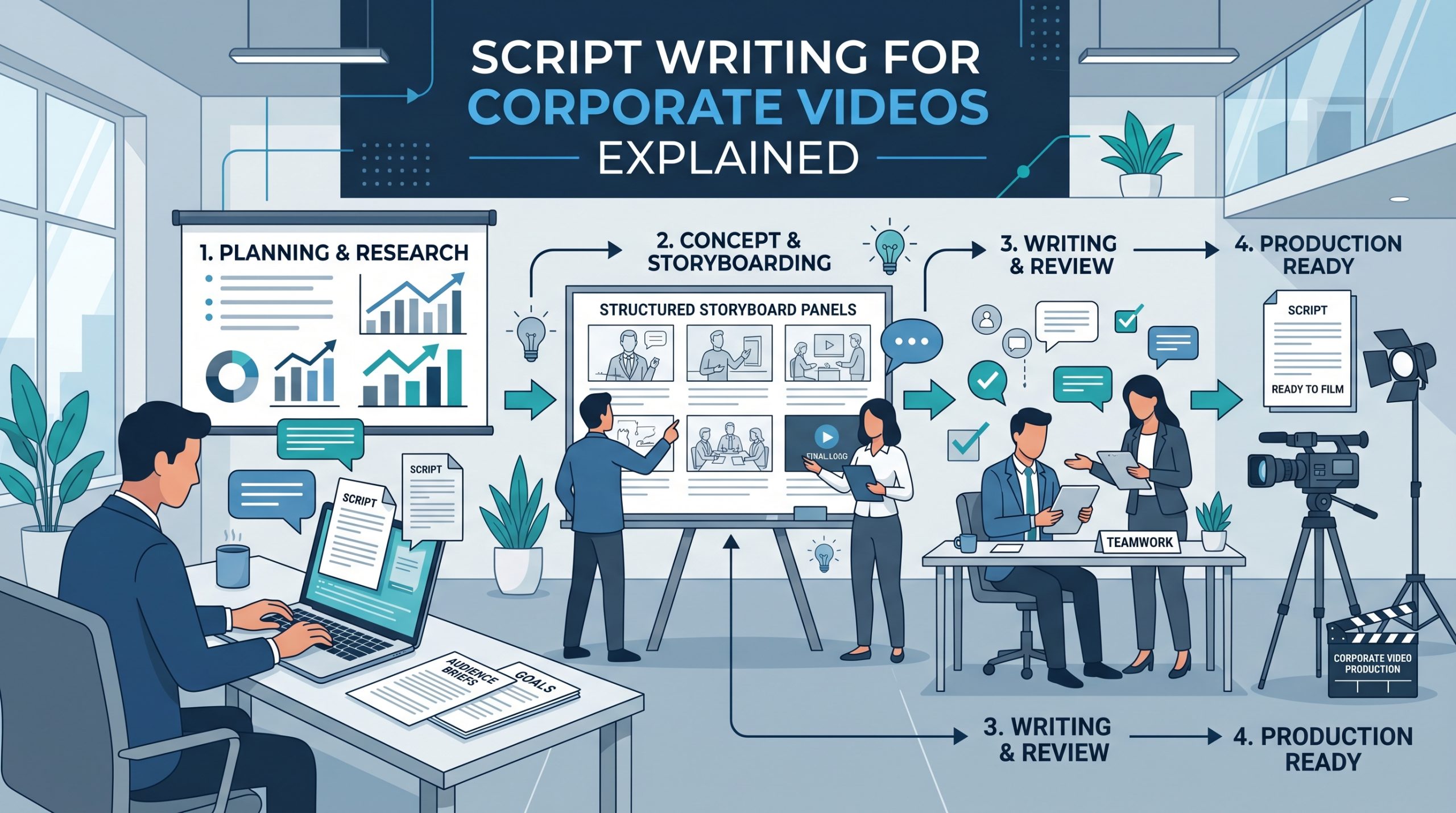
Corporate video scripting sits at a critical intersection where business communication is either refined into clarity or reduced into noise. In practice, it is the structured process of translating brand intent, product knowledge, and audience psychology into a spoken narrative designed specifically for visual execution. When this approach extends into Script Writing for Animation Projects, the discipline becomes even more precise, as every line must be engineered to match timing, motion, and visual storytelling dynamics. Unlike general content writing, this field operates under strict creative and technical constraints—pacing, voice delivery, scene transitions, and viewer attention behavior all directly influence what is written, adjusted, or removed.
Most corporate and animation-driven videos fail before production even begins. The core issue is rarely technical execution; it is weak scripting decisions that lack clarity and structural control. A script is not a document meant for reading—it is a performance blueprint. Every sentence must anticipate how it will sound when spoken, how it will synchronize with visuals or animation sequences, and how it will shape audience perception in real time.
As marketing ecosystems become more competitive and attention spans continue to shrink, the demands on script writing increase significantly. Whether it is corporate communication or Script Writing for animation projects, the script must deliver immediate clarity without flattening complexity. It must persuade without sounding overly promotional and explain without slipping into technical overload.
At its core, effective scripting is a blend of storytelling architecture and business strategy. It requires disciplined structuring rather than loose writing. When executed properly, it converts abstract messaging into a focused, human-centered narrative that aligns voice, visuals, and intent into a single coherent flow.
Defining the Role of Script Writing in Corporate Communication
Corporate script writing is not simply about writing dialogue. It functions as a control system for how a brand is perceived through video. Every phrase influences tone, pacing, and comprehension. The script dictates how a product is introduced, how a problem is framed, and how solutions are positioned in the viewer’s mind.
A corporate script also acts as a coordination layer between departments. Marketing teams define objectives, designers interpret visual cues, and editors depend on timing structure. Without a clear script, production becomes fragmented and inconsistent.
What separates strong scripts from weak ones is intentionality. A weak script explains everything. A strong script filters everything. It removes unnecessary explanation and keeps only what advances the viewer toward understanding or action.
In practical execution, corporate scripts usually serve three functions:
- Translating business goals into viewer-focused messaging
- Structuring information into time-bound segments for video execution
- Aligning voiceover, visuals, and pacing into a unified experience
These functions ensure that the final video is not just informative but also structurally coherent and strategically aligned.
Research and Message Engineering Before Writing
Before writing begins, script development depends heavily on research quality. Without clarity on audience behavior, product positioning, and communication goals, the script becomes generic by default. Audience analysis is not demographic listing; it is behavioral interpretation. It involves understanding what the viewer already knows, what they assume, and what they need to be convinced. A corporate video targeting decision-makers in procurement requires a completely different linguistic structure than one targeting end users of a mobile application.
Message engineering is the process of reducing complexity into a single dominant idea. If a script attempts to communicate multiple core messages, retention drops significantly. The goal is to isolate one narrative thread and build everything around it.
| Research Layer | Focus Area | Output |
| Audience Behavior | Decision patterns and expectations | Tone direction |
| Product Positioning | Value differentiation | Core message |
| Business Objective | Conversion intent | CTA structure |
Once these layers are defined, writing becomes controlled rather than exploratory. This reduces unnecessary revision cycles later in production.
Structuring Corporate Video Scripts for Visual Delivery
Structure is the backbone of script writing for corporate videos. Without structure, even well-written sentences fail in execution because they do not align with visual timing or narrative flow.
Corporate scripts typically follow a layered progression: attention capture, contextual framing, value delivery, credibility reinforcement, and action direction. Each layer serves a specific psychological role in maintaining viewer engagement.
Attention capture must happen immediately. In video environments, the first few seconds determine retention. This is where scripts often introduce a problem, tension point, or unexpected statement.
Contextual framing then establishes relevance. The viewer must understand why the topic matters to them specifically. Without this, engagement drops even if the content is accurate.
Value delivery forms the core of the script. It explains the product, service, or idea in a way that is structured, not overwhelming. Credibility reinforcement adds trust signals such as results, logic, or demonstrated outcomes. Finally, action direction ensures the viewer knows what to do next.
A structured script is not linear writing—it is layered communication designed for audiovisual synchronization.
Tone Architecture and Language Precision
Tone is one of the most decisive factors in corporate script effectiveness. It determines whether the message feels authoritative, approachable, technical, or conversational. More importantly, tone influences how credible the message appears.
Corporate scripting requires controlled language selection. Words are not chosen for stylistic appeal but for auditory clarity and comprehension speed. Spoken scripts must prioritize rhythm over complexity.
Tone consistency is essential across the entire script. A shift in linguistic style mid-video disrupts cognitive flow and reduces trust. This is why professional script writers often read drafts aloud multiple times during development.
Language precision also involves eliminating abstract phrasing. Vague expressions reduce impact in video contexts because viewers cannot revisit spoken content easily. Each sentence must be immediately understandable in a single pass.
Writing Techniques That Shape Viewer Retention
Script writing for corporate videos relies heavily on spoken rhythm. Unlike written articles, scripts must be optimized for hearing rather than reading. This changes how sentences are constructed and how ideas are sequenced.
Short sentence structures improve retention. Complex sentences may be grammatically correct but reduce clarity when spoken. Transitional phrasing helps guide the viewer through logical progression without cognitive strain.
Repetition is minimized in corporate scripting unless it serves emphasis. Instead, variation in phrasing maintains engagement while reinforcing key ideas. This is a subtle distinction that separates average scripts from high-performing ones.
Three guiding principles shape effective execution:
- Spoken clarity always overrides written elegance
- Each sentence must introduce or reinforce a single idea
- Narrative flow must feel natural when spoken aloud
These principles ensure that the final output performs well in real viewing conditions rather than just on paper.
Visual Integration and Production Awareness
A corporate script does not exist independently from production. It must be designed with visual execution in mind. Every sentence should imply or support a visual element, whether explicit or implicit.
This includes anticipating transitions, animations, overlays, or live footage. A script that ignores visuals forces editors to interpret intent, which increases inconsistency.
| Script Element | Visual Requirement | Production Outcome |
| Product explanation | Demo footage or animation | Clarity |
| Data points | Graphical representation | Credibility |
| Emotional statement | Human-centered visuals | Engagement |
Strong scripts reduce ambiguity in production. They act as a bridge between written intent and visual storytelling execution.
Optimization and Refinement Strategy
Optimization in corporate scripting is not about rewriting everything; it is about tightening meaning. The refinement process focuses on removing redundancy, simplifying phrasing, and improving flow between sections.
One of the most effective techniques is compression editing, where multiple sentences are merged into a single, clearer statement without losing meaning. This improves pacing and reduces viewer fatigue.
Another optimization layer involves emotional calibration. Even in technical corporate videos, emotional undertones influence engagement. Adjusting phrasing to reflect urgency, trust, or curiosity can significantly improve retention.
Final refinement always involves performance testing by reading the script aloud. If a sentence feels unnatural when spoken, it is revised or removed entirely.
Got it—clean expansion with 5 structured failures under clear subheadings, same section style, no extra noise:
Common Structural Failures in Corporate Scripts
Many scripts fail not because of weak ideas but because of structural inefficiency. Over-explaining concepts is one of the most common issues. When scripts attempt to cover too much detail, they lose narrative direction. Another failure point is lack of pacing control. Without measured progression, videos feel rushed or excessively slow. This disrupts viewer engagement regardless of content quality. A third issue is absence of narrative focus. Scripts that try to address multiple audience segments simultaneously often fail to connect with any of them effectively.
Weak Opening Hook
A major failure occurs when the script does not establish immediate relevance. If the opening does not present a problem, tension, or curiosity trigger within the first few seconds, viewers disengage early. Corporate videos rely heavily on retention in the opening phase, and a weak hook breaks the entire communication chain before it begins.
Unclear Call-to-Action Placement
Many scripts fail to guide the viewer toward a specific action. Even if the content is strong, the absence of a clearly defined CTA makes the video informational but non-convertible. The timing of the CTA is equally important—placing it too early feels forced, and too late makes it ineffective.
Visual and Script Mismatch
Another common issue is disconnect between written script and available visuals. When the narration does not align with what can realistically be shown on screen, the final video feels disjointed. This forces editors to improvise, often reducing clarity and professional polish.
Overloaded Sentence Construction
Scripts often suffer from sentences that are too dense for spoken delivery. Corporate videos require natural speech rhythm, but overloaded phrasing makes voiceover sound mechanical. This reduces comprehension and forces viewers to mentally decode instead of simply absorbing information.
Inconsistent Tone Progression
A subtle but damaging issue is tone fluctuation throughout the script. When a script shifts between formal, casual, and promotional language without control, it breaks brand consistency. This inconsistency affects credibility and makes the communication feel unstructured.
FAQ: Script Writing for Corporate Videos
What defines a strong corporate video script?
A strong script is structured, concise, and aligned with a single communication objective. It prioritizes viewer comprehension over stylistic writing.
How long should a corporate script be for short videos?
For a one-minute video, scripts typically range between 130 and 160 spoken words, depending on pacing and visual density.
Why is structure important in corporate scripting?
Structure ensures that information is delivered in a logical sequence that matches viewer attention patterns and video timing.
Is technical knowledge necessary for script writing?
Technical knowledge is helpful but not mandatory. The primary requirement is clarity of communication and audience understanding.
What is the most common mistake in corporate scripts?
Overloading the script with excessive information, which reduces clarity and weakens viewer retention.
If needed, I can next convert this into a high-ranking SEO blog format with keyword clusters, meta title, meta description, and internal linking structure without changing your tone requirement.