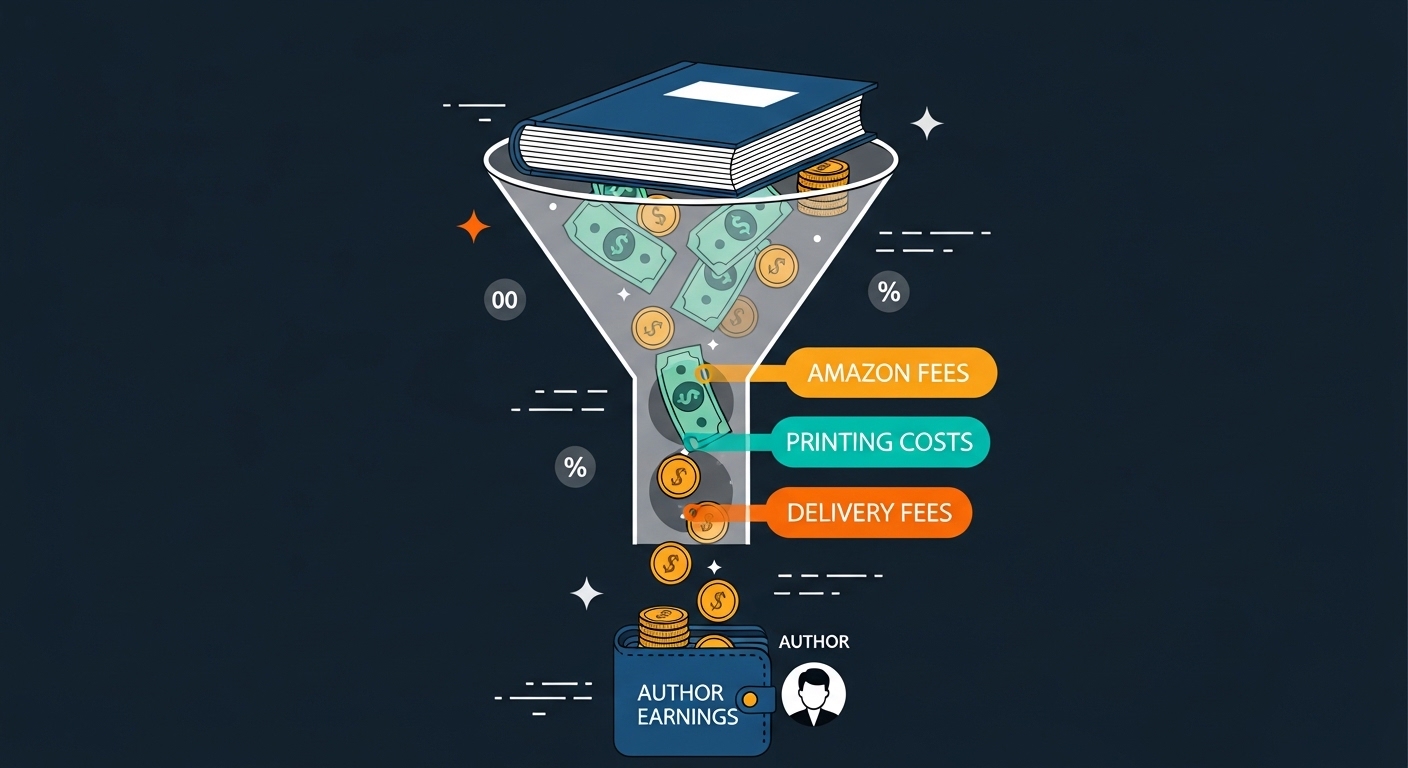
Publishing eBooks on Amazon KDP seems simple on paper: write your book, set a price, select a royalty rate, and watch the income roll in. For many new authors, the expectation is that the royalty percentage directly translates into predictable earnings.
In reality, the final amount you receive is shaped by multiple layers of adjustments—delivery fees, regional pricing variations, taxes, and currency conversion—that operate quietly in the background. What seems straightforward at first is actually a multi-variable system where small deductions collectively influence your net income. Understanding this system isn’t about complexity—it’s about control. The more you know, the more effectively you can optimize pricing, formatting, and positioning to maximize your revenue.
The Royalty Percentage Is Not the Final Number
The royalty rate you select—whether 35% or 70%—is best viewed as a framework rather than a guaranteed payout. Additional factors influence what actually lands in your account.
Even a seemingly attractive 70% royalty operates on a net basis, meaning deductions like delivery fees, taxes, and regional adjustments apply before you see the earnings. Focusing solely on percentages can be misleading; the true measure of success lies in net earnings per sale.
Key Takeaways:
- Royalty rates define structure, not guaranteed income
- Deductions occur before payout calculation
- Higher percentages often come with additional requirements
Understanding this distinction helps authors avoid overestimating income and plan long-term publishing strategies more realistically.
Delivery Fees: The Hidden Deduction
Delivery fees are applied based on file size and are deducted under certain royalty models. Text-heavy books usually incur minimal costs, but visually rich content or complex formatting can significantly increase fees. Over multiple sales, even small per-book deductions accumulate, reducing your net earnings.
Factors affecting delivery fees:
- File size of the eBook
- Inclusion of images, charts, or multimedia
- Complex formatting or embedded elements
Optimizing file size—without sacrificing quality—can reduce these fees while maintaining a strong reader experience. Authors who balance content richness with efficiency often see better net earnings over time.
Pricing Matters: How Your Book Price Impacts Earnings
Pricing plays a central role in determining both royalty eligibility and net income. To qualify for higher royalty percentages, your book must fall within specific pricing tiers. Price too low, and you default to 35%; price too high, and conversion rates may drop.
Pricing also shapes buyer perception, influencing visibility, conversion, and long-term sales. Small adjustments can have a surprisingly large impact on both sales volume and net earnings.
Practical strategies:
- Test pricing within recommended royalty ranges
- Compare similar books in your niche to find market-appropriate pricing
- Adjust based on performance rather than assumptions
Regional Variations: Understanding Global Earnings
Global distribution introduces variability. Earnings differ depending on currency, purchasing power, and regional expectations. The same eBook may generate higher net income in one country than another due to localized pricing and conversion rates.
Regional factors to consider:
- Currency conversion rates
- Market-specific pricing adjustments
- Regional demand patterns
Tracking performance across regions allows authors to identify high-performing markets and make strategic adjustments to maximize global revenue.
Taxes and Currency Conversion: The Invisible Reductions
Taxes, withholding fees, and currency conversions are often overlooked but can meaningfully affect earnings.
- Withholding taxes depend on your country and agreements with the U.S.
- Currency conversion fluctuations can impact the final amount received.
- Payment processing fees may apply depending on your bank and region.
While authors cannot control all deductions, planning for them ensures more accurate forecasting and helps avoid surprises when funds arrive.
Kindle Unlimited: Performance-Based Earnings
Subscription-based models like Kindle Unlimited (KU) introduce a different earning mechanism. Instead of earning per sale, you earn based on pages read by subscribers.
- Earnings are dynamic and depend on engagement rather than fixed pricing.
- Partial reads generate partial royalties.
- Final totals are calculated monthly, creating a natural delay in visibility.
For authors, this model encourages producing engaging, well-structured content. Full reads not only increase KU earnings but also improve reader satisfaction, feedback, and long-term audience growth.
The Compounding Effect of Small Deductions
Individually, delivery fees, taxes, and conversion adjustments may seem minor. Collectively, they shape overall profitability. High-volume authors feel this compounding effect most acutely, highlighting the importance of strategic optimization.
- Multiple deductions interact simultaneously
- Small reductions accumulate over time
- Volume amplifies impact, making net earnings lower than gross projections
Thinking in terms of cumulative effects gives authors a clearer financial picture and helps guide smarter decisions for self-publishing.
What You Actually Keep: A Realistic Example
To illustrate, consider a typical eBook sale:
| Stage | Amount |
| List Price | $4.99 |
| Royalty (70%) | $3.49 |
| Delivery Fee | -$0.20 |
| Taxes/Fees | -$0.30 |
| Net Earnings | ≈ $2.99 |
This example shows the gap between advertised royalties and final income, emphasizing why authors must account for all deductions when forecasting revenue
Here’s a refined, professional, and more engaging version of your “Strategic Optimization” section, with clear explanations instead of just bullet points, making it easier for readers to understand and apply:
Strategic Optimization: How to Maximize Your Net Earnings
While deductions and fees are a normal part of KDP publishing, authors can take proactive steps to maximize their net royalties. Strategic optimization involves making deliberate choices in formatting, pricing, content structure, and regional targeting to ensure that more of each sale actually reaches your account.
1. Optimize File Size
Large eBook files increase delivery costs, which are subtracted from your royalties. By reducing file size without sacrificing quality, you can save money on every sale.
- Compress images where possible and remove unnecessary formatting or redundant elements.
- Avoid embedding oversized media files unless essential for the reader experience.
- Clean, efficient files not only reduce costs but also improve accessibility across devices, ensuring a smoother reading experience and fewer technical issues.
2. Align Pricing With Royalty Thresholds
Your book’s price directly affects which royalty structure applies and how much you retain per sale. Setting prices strategically ensures eligibility for the most favorable royalty rates.
- Set prices within recommended royalty ranges to qualify for higher percentages (typically 70%).
- Monitor market trends and competitor pricing to maintain both competitiveness and profitability.
- Adjust pricing periodically based on performance data, audience feedback, or seasonal trends to maintain optimal revenue.
3. Focus on Engagement
Reader engagement has a direct impact on earnings, especially for Kindle Unlimited and subscription-based models. The more of your book a reader completes, the higher the royalties you receive.
- Structure content for readability and flow, with clear chapters and logical progression.
- Encourage full reads by keeping content engaging, concise, and well-paced.
- High completion rates lead not only to better earnings but also to positive reviews and long-term audience growth.
4. Monitor Regional Performance
Global sales introduce variability in earnings due to currency conversion, regional pricing, and market demand. Paying attention to these differences allows you to make informed adjustments.
- Identify high-performing regions where your book resonates most.
- Adjust pricing, promotions, or marketing strategies for underperforming markets to optimize revenue.
- Understanding regional trends also helps you plan future releases and target your audience more effectively.
In essence, strategic optimization is about aligning your creative decisions with financial outcomes. By focusing on file efficiency, smart pricing, reader engagement, and global performance, you can significantly increase the net royalties from each sale while maintaining a high-quality reader experience.
Strategic Optimization Checklist: How to Maximize Your KDP Earnings
| Optimization Area | Action Steps | Impact on Earnings |
|---|---|---|
| File Size | Compress images, remove unnecessary formatting, avoid large media files | Reduces delivery fees, improves accessibility, ensures faster load times, increases net royalty per sale |
| Pricing & Royalty Thresholds | Set price within 70% royalty range, monitor competitor pricing, adjust periodically | Ensures eligibility for higher royalties, balances sales volume with profitability, maximizes earnings per sale |
| Reader Engagement | Structure content clearly, maintain logical flow, encourage full reads | Improves Kindle Unlimited page-read earnings, boosts completion rates, encourages positive reviews and repeat readers |
| Regional Performance | Track sales by region, analyze currency and conversion effects, adjust marketing and pricing | Optimizes global revenue, identifies high-performing markets, allows targeted strategies to increase net income |
| Content & Formatting | Keep chapters concise, remove filler, balance visuals with readability | Reduces file size, improves reader satisfaction, lowers delivery costs while maintaining content quality |
| Continuous Monitoring | Analyze sales reports, review KU performance, monitor seasonal trends | Allows timely adjustments to pricing, marketing, and content strategies, enhancing long-term profitability |
FAQs About KDP Royalties
Do I keep the full royalty percentage from each sale?
No, delivery fees, taxes, and other adjustments reduce the final payout.
Why do earnings vary between sales?
Factors include region, pricing adjustments, file size, and currency conversion.
Are delivery fees applied to every book?
No, they typically apply based on file size and the selected royalty model.
How does Kindle Unlimited affect earnings?
Income depends on pages read rather than fixed sales.
Can I control all deductions?
Not entirely, but optimization of formatting, pricing, and content structure can improve net revenue.
Final Thoughts: Focus on Net Value, Not Just Gross Sales
Deductions may initially seem like obstacles, but they are part of the system that ensures accurate payouts. Successful authors focus on net outcomes, optimizing pricing, content structure, and engagement to maximize the actual earnings retained.
In the end, it’s not the listed royalty percentage that matters—it’s how much you actually keep. Understanding this transforms Amazon KDP from guesswork into a deliberate, scalable, and profitable publishing process.