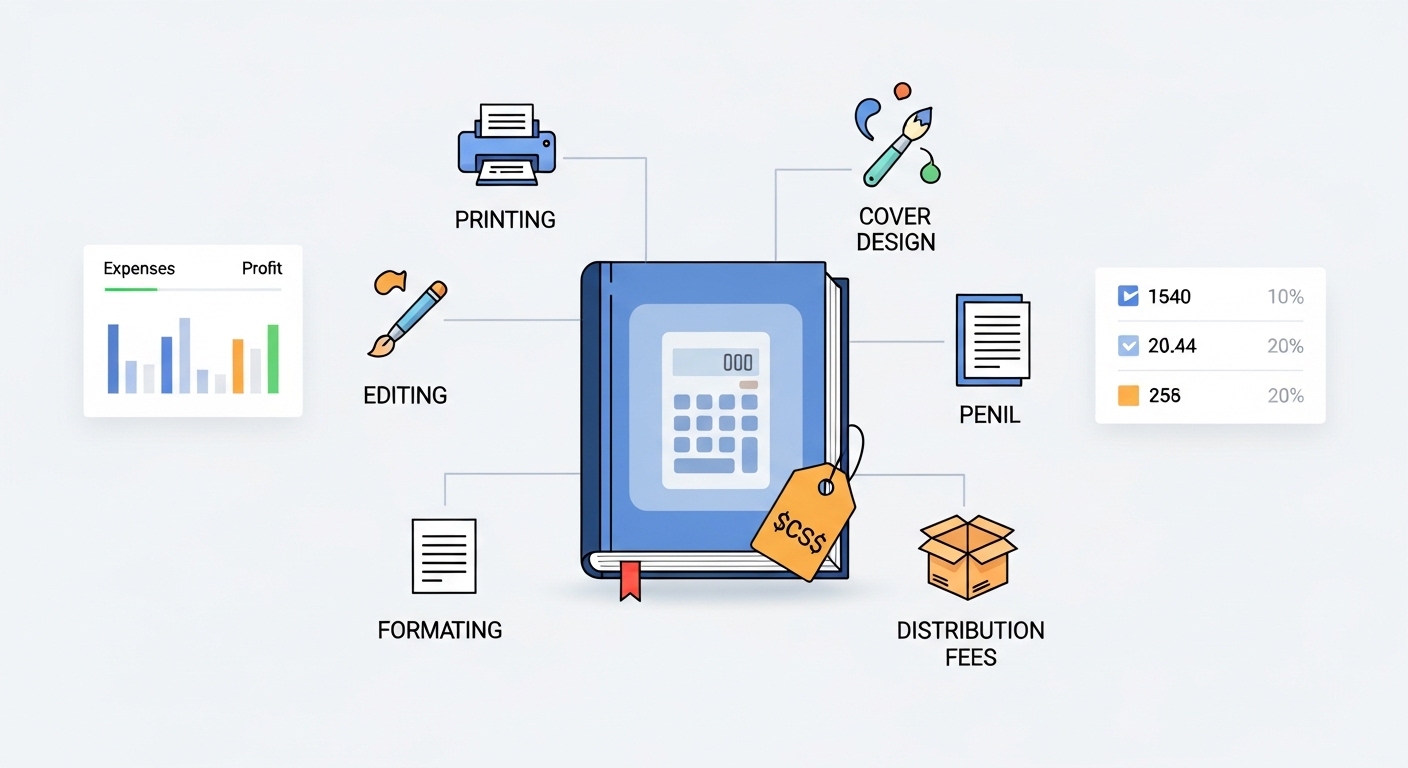
You’ve done the hard part—writing the book. Now comes the part no one really talks about in detail: what does it actually cost to publish a print book, and more importantly, can you make that money back? At first glance, Amazon KDP feels like a zero-cost opportunity. Upload your manuscript, set a price, and start selling. But behind that simplicity lies a more nuanced reality. The platform removes upfront publishing barriers, but producing a professional, market-ready book almost always involves strategic investment.
The good news? These costs are flexible. You can start small, scale gradually, and still build a profitable publishing model—if you understand where your money goes and how to make it work for you.
Breaking Down Real Profit Per Book
Let’s go a step deeper—because understanding per-book profit is only half the equation. What truly matters is how that profit interacts with your initial investment, pricing strategy, and sales volume over time.
Publishing isn’t about a single sale. It’s about building a system where each copy contributes to recovering your costs—and eventually generating consistent income.
A Realistic Earnings Scenario (Expanded)
Let’s revisit the example, but think about it more strategically.
You publish a 250-page paperback priced at $14.99. After printing costs and royalty calculations, your profit lands at roughly $4.49 per book.
On the surface, that number may feel underwhelming. But publishing operates on compounding sales, not one-time transactions.
- At 100 copies, you earn about $449
- At 500 copies, that grows to around $2,245
- At 1,000 copies, you’re looking at $4,490
Now here’s where it becomes interesting: most books don’t sell all their copies at once. Sales happen gradually—over weeks, months, and sometimes years. This turns your book into a long-term income asset, not just a launch-day product.
Understanding Your Break-Even Point
The real financial milestone isn’t your first sale—it’s your break-even point. This is where your total earnings equal your upfront investment. Everything after that becomes profit.Let’s say you invested $800 into your book (editing, cover, formatting, and light marketing). With a $4.49 profit per copy, your break-even point would be:
$800 ÷ $4.49 ≈ 178 copies
That means once you sell around 180 copies, you’ve recovered your entire investment. Every sale after that is pure profit.
This is a critical mindset shift. Instead of asking, “Will my book make money?” you start asking, “How quickly can I reach break-even?”
How Pricing Impacts Your Profit Curve
Now let’s challenge the assumption that $14.99 is the “right” price.
Small pricing changes can significantly impact your earnings. For example:
- At $12.99, your profit might drop to around $3.20 per book
- At $16.99, your profit might increase to around $5.50 per book
That difference might seem minor, but over time it changes your entire financial trajectory.
At $3.20 profit, you’d need 250 sales to earn $800
At $5.50 profit, you’d need only about 145 sales
This is why pricing is not just a marketing decision—it’s a profit optimization strategy.
The key is finding a price that balances:
- Reader expectations
- Perceived value
- Your desired profit margin
The Role of Sales Velocity
Not all books sell at the same speed. Some gain traction quickly, while others build slowly over time. This concept—sales velocity—directly affects how fast you recover your investment.
For example:
- Selling 200 copies in 1 month → fast break-even, quicker reinvestment
- Selling 200 copies over 12 months → slower return, but still profitable
Neither is inherently better. What matters is sustainability. A book that sells consistently over time can become a reliable passive income stream, even if it starts slowly.
Scaling Beyond a Single Book
Here’s where many authors underestimate their earning potential.
If one book earns $4.49 per sale, that’s good. But if you have five books, each earning similar margins, your income multiplies without requiring five times the effort.
Let’s say:
- Book 1 sells 300 copies/year → ~$1,347
- Book 2 sells 300 copies/year → ~$1,347
- Book 3 sells 300 copies/year → ~$1,347
Now you’re earning over $4,000 annually—not from one book, but from a growing catalog
This is how many self-published authors transition from occasional earnings to consistent income. They stop relying on a single title and start building a portfolio.
Hidden Profit Boosters Most Authors Overlook
Beyond pricing and volume, there are subtle ways to increase your per-book profitability.
One of the most effective is reducing page count strategically. Since printing costs are tied to page length, even trimming 20–30 pages can slightly increase your margin per copy without affecting perceived value.
Another overlooked factor is format efficiency. Choosing standard trim sizes and black-and-white interiors keeps printing costs lower, which directly increases your profit per sale.
Even small adjustments like these can improve your margins over hundreds or thousands of copies.
From Break-Even to Profit: The Real Turning Point
Reaching break-even is more than a financial milestone—it’s a psychological one.
Once your costs are covered, your mindset shifts. You’re no longer “recovering an investment”; you’re building profit. This often motivates authors to:
- Increase marketing efforts
- Plan their next book
- Optimize pricing or descriptions
At this stage, your book becomes a self-sustaining asset, capable of funding future projects.
The Bigger Picture: Profit Is a System, Not a Moment
The biggest misconception about KDP earnings is that profit comes from a single successful launch. In reality, it comes from a system:
- A well-priced book
- Consistent sales over time
- Smart cost management
- Expansion into multiple titles
When these elements work together, even a modest $4–$5 profit per book becomes powerful.
Because in publishing, success isn’t about one big sale—it’s about hundreds of small, consistent ones adding up over time.
Cost vs. Profit: When Do You Break Even?
Every publishing decision you make—editing, cover design, formatting—affects your break-even point.
Example: Mid-Range Investment Author
Let’s say you invest moderately in your book:
- Editing: $500
- Cover design: $150
- Formatting: $100
- Marketing: $150
Total investment: $900
With a profit of $4.49 per book, you would need to sell approximately 200 copies to break even.
That number is more achievable than many authors expect—especially if you have a niche topic or targeted audience.
Scenario-Based Budget Plans
Not every author starts at the same level. Some are testing the waters, while others are building a long-term publishing business. Let’s explore three realistic approaches.Beginner Budget: Testing the Market
This approach is ideal if you’re publishing your first book and want to minimize risk. You handle most of the work yourself and keep expenses low.
You might skip professional editing and rely on careful self-editing, beta readers, or writing tools. You design your own cover using basic tools and format the manuscript yourself.
- Estimated cost: $0–$150
- Break-even point: very low
- Risk: higher chance of lower-quality output
This approach works best when your goal is learning the process rather than maximizing profit immediately.
Intermediate Budget: Balanced Investment
This is where many successful self-published authors operate. You invest selectively in areas that directly impact reader experience.
You might hire a freelance editor for basic polishing, invest in a professional cover, and spend a small amount on initial promotions.
- Estimated cost: $300–$800
- Break-even point: moderate (100–200 copies)
- Benefit: better quality and stronger sales potential
This approach strikes a balance between cost control and professionalism, making it ideal for authors who want real results without overspending.
Advanced Budget: Building a Publishing Brand
This approach is for authors treating publishing as a business. Every aspect of the book is optimized for quality and marketability.
You invest in full editing services, premium cover design, advanced formatting, and a structured marketing strategy.
- Estimated cost: $1,000–$3,000+
- Break-even point: higher (300–700 copies)
- Benefit: strong long-term brand positioning and scalability
This level of investment makes sense when you’re building a catalog, series, or authority in a niche.
Hidden Costs Most Authors Don’t Expect
Beyond the obvious expenses, there are subtle costs that can impact your publishing journey.
Time as an Investment
Even if you spend very little money, you’ll invest significant time. Learning formatting, editing your manuscript, designing covers, and promoting your book can take weeks or months.
Time has value. Many authors eventually choose to outsource tasks not because they can’t do them—but because it allows them to focus on writing more books.
Revision and Rework Costs
Sometimes your first version won’t perform well. You may need to redesign your cover, update formatting, or revise your description. These adjustments can add unexpected costs, but they’re often necessary for long-term success.
How Smart Authors Reduce Costs Without Sacrificing Quality
Experienced self-publishers don’t just spend—they spend strategically. Instead of cutting corners, they focus on high-impact investments.
For example, a strong cover often has a direct influence on sales. If your book doesn’t attract attention, readers may never even click to read the description. Similarly, clean editing ensures positive reviews, which improve credibility and long-term visibility.
At the same time, some areas allow flexibility. Formatting can often be learned, especially for simple books. Marketing can start small and scale as your book gains traction.
Real Author Income Scenarios
To understand the financial potential, let’s look at how different types of authors approach KDP print publishing.
Scenario 1: Niche Nonfiction Author
An author writes a practical guide targeting a specific audience, such as freelancers or small business owners. The book is priced at $12.99 with a $4 profit margin.
By focusing on a clear audience and using targeted promotion, the author sells 300 copies over six months.
- Total revenue: ~$1,200
- Initial investment: $500
- Profit: ~$700
This approach shows how niche targeting can lead to steady, predictable income.
Scenario 2: Fiction Author Building a Series
A novelist publishes the first book in a series with a strong cover and moderate investment. Initial sales are slow, but as more books are released, visibility increases.
The first book acts as a gateway, bringing readers into the series. Over time, cumulative sales across multiple books generate consistent income.
This highlights an important truth: one book rarely defines success—your catalog does.
Scenario 3: Low-Budget First-Time Author
A first-time author publishes with minimal investment, focusing on learning the process. Sales are modest, but the experience gained leads to better decisions in future books.
The second book performs significantly better due to improved quality and strategy.Maximizing Return on Investment: Turning Your Book into a Profitable Asset
If your goal is to make money from your book, every decision you make—from editing to pricing—should be guided by one principle: return on investment (ROI). Publishing isn’t just a creative process anymore; it’s a strategic one. Many first-time authors fall into the trap of minimizing costs at all stages. While that may feel safe, it often leads to a product that struggles to compete. A more effective mindset is to ask: where does each dollar I invest create the greatest impact on sales and long-term earnings?
When you look at successful self-published books, a clear pattern emerges. High-performing titles don’t necessarily have the biggest budgets—but they invest in the right areas. These areas directly influence visibility, credibility, and conversion—the three pillars that determine whether your book earns or disappears.
The Psychology Behind Book Sales and ROI
Before diving into specific investments, it’s important to understand how readers behave. Most buying decisions happen in seconds. A potential reader scrolls through search results, sees your book, and makes a quick judgment based on limited information.
That judgment is shaped by three core elements:
- First impression (cover and title)
- Perceived value (description, positioning, price)
- Trust signals (reviews, writing quality, presentation)
If any one of these elements fails, the sale is lost. This is why ROI in publishing isn’t about spending more—it’s about strengthening each of these decision points.
Investing in a Professional Cover: Your Conversion Engine
Your book cover is not just a design—it’s a conversion tool. It determines whether a reader clicks on your book or scrolls past it. Research across publishing marketplaces consistently shows that books with professionally designed covers outperform those with basic or DIY designs. This is because readers subconsciously associate cover quality with content quality. Think about it this way: if your book appears next to ten others in a search result, your cover is competing for attention in a fraction of a second. Typography, color contrast, imagery, and genre alignment all play a role in that moment.
A well-designed cover does three things effectively:
- Signals the genre instantly (so the right audience notices it)
- Creates curiosity or emotional appeal
- Communicates professionalism and credibility
Authors who invest in strong cover design often see higher click-through rates, which directly impacts sales volume. Even a small increase in clicks can compound into significant revenue over time.
Writing and Editing: The Foundation of Long-Term Profitability
While a cover gets the click, the content earns the reader’s trust. This is where writing quality and editing play a crucial role in ROI.
Books that are poorly edited may still generate initial sales if the topic is appealing, but they rarely sustain momentum. Negative reviews, low reader retention, and lack of recommendations limit long-term income.
On the other hand, a well-written and professionally edited book creates a different trajectory. Readers finish it, leave positive reviews, and recommend it to others. Over time, this builds organic growth—one of the most valuable forms of ROI in publishing.
Editing improves:
- Clarity and readability
- Flow and structure
- Consistency in tone and voice
These improvements may not always be visible at a glance, but they significantly impact how readers experience your book. And reader experience directly influences repeat purchases and word-of-mouth marketing.
Strategic Pricing: Finding the Balance Between Value and Volume
Pricing is one of the most underestimated factors in maximizing ROI. Many authors either price too low in an attempt to attract readers or too high without establishing perceived value. The reality is that pricing affects both conversion rate and profit margin. A lower price may increase sales volume but reduce earnings per copy. A higher price increases profit per sale but may limit reach. The goal is to find a balance where your book feels like a strong value while still generating meaningful income. This balance often depends on factors such as genre, audience expectations, and book length.
For example, nonfiction books that solve a specific problem can often justify higher prices because readers are paying for value, not just entertainment. Fiction, especially in competitive genres, may benefit from more accessible pricing to encourage discovery. Dynamic pricing strategies can also improve ROI over time. Authors sometimes launch at a lower price to gain traction and reviews, then gradually increase the price as visibility and credibility grow.
The Compounding Effect of Smart Investments
One of the most important insights in self-publishing is that ROI is rarely immediate—it’s cumulative.
A strong cover increases clicks. Better writing improves reviews. Positive reviews boost visibility. Increased visibility drives more sales. Each element builds on the others, creating a cycle of growth. This is why even modest investments can produce significant long-term returns. For example, spending $150 on a professional cover might not feel impactful at first. But if it increases your conversion rate by even a small percentage, that improvement compounds across every sale.
Over time, these incremental gains can be the difference between a book that sells occasionally and one that generates consistent income.
Where Authors Often Miscalculate ROI
A common mistake is focusing on cost instead of value. Authors might avoid spending on editing or design to save money, but this often results in lower sales and weaker long-term performance. Another miscalculation is expecting immediate returns. Publishing is rarely a “quick profit” model. It’s closer to building a digital asset—something that grows in value as it gains visibility, reviews, and audience trust.
Some authors also overlook the importance of alignment. For example, a beautifully designed cover that doesn’t match the genre can reduce conversions, even if the design itself is high quality. ROI depends not just on investment, but on strategic alignment with reader expectations.
Thinking Beyond a Single Book
Maximizing ROI becomes significantly easier when you shift your focus from one book to a catalog strategy. Each book you publish becomes an entry point into your work. Readers who enjoy one title are likely to explore others, increasing your overall earnings without additional marketing costs.
In this context, your initial investments—editing, design, branding—become even more valuable because they apply across multiple books. A consistent visual identity, strong writing style, and clear positioning can turn your catalog into a cohesive brand.
This is where many authors see exponential growth. Instead of relying on one book to recover costs, they build a system where each new release amplifies the performance of previous ones.
Final Insight: ROI Is About Smart, Not Maximum, Spending
Maximizing return on investment in self-publishing isn’t about spending the most money—it’s about spending wisely.
A strategic approach focuses on the elements that directly influence reader behavior:
- What makes them click
- What convinces them to buy
- What makes them recommend your book
When you invest in these areas thoughtfully, your book becomes more than just a product—it becomes a long-term asset capable of generating consistent returns.
Frequently Asked Questions
How much does it really cost to publish a print book on KDP?
It can range from zero to several thousand dollars, depending on how much you invest in editing, design, and marketing.
Can I publish a profitable book with a low budget?
Yes, but it requires more time, effort, and careful execution. Many authors start small and reinvest earnings into future books.
What’s the fastest way to recover costs?
Targeting a specific audience and pricing your book strategically often leads to quicker break-even points.
Do print books make more money than ebooks?
Print books often have lower margins per sale, but they can complement ebooks and expand your audience.
Is publishing multiple books more profitable?
Yes. A catalog of books creates multiple income streams and increases visibility across all your titles.
Final Thoughts: Is It Worth the Investment?
Publishing a print book through Amazon KDP is one of the most accessible ways to become an author today—but accessibility doesn’t mean instant success. The real cost isn’t just money; it’s the combination of time, effort, and strategic decision-making.
The most successful authors aren’t necessarily the ones who spend the most—they’re the ones who invest wisely. They understand where quality matters, where flexibility exists, and how to turn a single book into part of a larger, long-term publishing strategy.
If you approach KDP with the right mindset, even a modest investment can grow into something much bigger. Your first book might not make you rich—but it can be the foundation for everything that comes next.