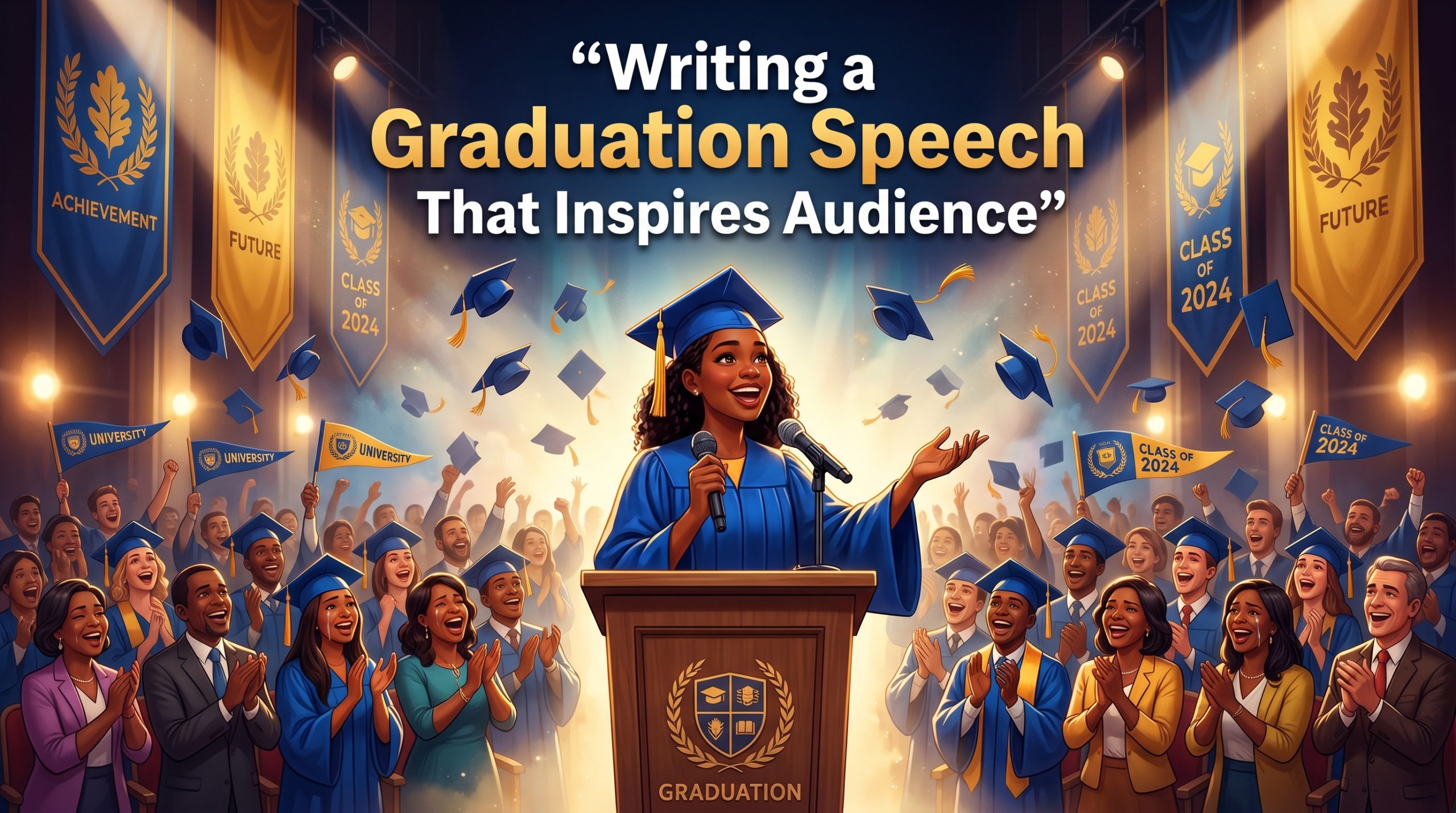
A graduation speech is not just a formal requirement; it is a psychological moment where memory, identity, and future direction intersect in real time. When students sit in their caps and gowns, they are not only listening for inspiration—they are unconsciously scanning for meaning that connects their years of effort to what comes next. That is why writing a graduation speech requires more than motivation lines or celebratory language. It demands precision in message design, emotional intelligence, and a strong understanding of how audiences process storytelling under emotional conditions.
Most effective graduation speeches rely on structured clarity rather than decorative language. The goal is not to sound poetic for the sake of performance but to create resonance through carefully chosen words, relatable experiences, and controlled emotional pacing. This is where speech writing intersects with narrative craft: every sentence must serve direction, tone, or emotional escalation.
A strong graduation speech writer thinks in terms of transitions—how to move from shared past experiences into individual reflection, and then into forward-looking aspiration. The speech becomes a bridge rather than a statement. It connects achievement with uncertainty and confidence with humility, without losing coherence.
The Audience Psychology in Graduation Speech Writing
A graduation audience is emotionally layered. You are speaking to students, parents, teachers, and administrators simultaneously, each group processing the same message through different emotional filters. Effective speech writing begins by mapping these layers instead of treating the audience as a single entity.
Students are typically focused on identity transition—they want reassurance that uncertainty is normal. Parents are processing pride mixed with release. Educators are evaluating long-term impact. A strong speech writer aligns language to these overlapping emotional states without explicitly addressing each one.
Tone calibration is critical. Overly formal language creates distance, while overly casual phrasing reduces authority. The best graduation speeches use conversational precision—structured but natural, reflective but not abstract.
- Identify emotional expectations of each audience segment before drafting
- Balance authority with relatability using controlled conversational tone
- Avoid universal clichés that flatten emotional diversity
Understanding audience psychology is not about pleasing everyone but about ensuring no segment feels ignored. That balance defines credibility in graduation speech writing.
Defining a Clear Core Theme for the Speech
Every impactful graduation speech revolves around a single controlling idea. Without a core theme, even well-written sections begin to feel disconnected. The theme acts as a structural anchor that ensures coherence across emotional shifts, anecdotes, and reflections. Strong themes are not generic concepts like “hard work pays off.” Instead, they are interpretive lenses such as “growth through uncertainty,” “failure as a shaping force,” or “becoming comfortable with unfinished identity.” These allow the speech to move beyond motivational language into meaningful reflection.
A well-defined theme also influences word choice and narrative selection. Every story included in the speech must reinforce the central idea rather than exist independently.
- Choose a theme that reflects transformation, not just achievement
- Ensure every story or example reinforces the central message
- Avoid broad motivational statements that lack narrative grounding
| Weak Theme | Strong Theme |
| Success is important | Identity is built through repeated uncertainty |
| Work hard and succeed | Discipline shapes clarity in ambiguous moments |
| Follow your dreams | Direction matters more than certainty |
A theme is not decoration; it is the architecture of the entire speech.
Structuring the Speech Like a Narrative Arc
A graduation speech works best when structured like a narrative journey rather than a list of ideas. The human brain retains stories more effectively than isolated statements, especially in emotionally heightened environments like ceremonies.
The structure typically follows three stages: grounding in shared experience, exploration of struggle or transition, and forward projection. This arc mirrors the psychological reality of graduation itself.
Transitions between sections matter as much as the content. Abrupt shifts break emotional continuity, while smooth progression builds engagement and trust.
- Begin with shared experience to establish connection
- Transition into reflective tension or challenge
- End with forward-looking perspective that avoids over-prediction
The narrative arc ensures that the audience does not just hear ideas but experiences progression. This is a core principle of effective speech writing techniques and public speaking structure design.
Using Rhetorical Devices for Impactful Graduation Speech Writing
Rhetorical devices are not ornamental language choices; they function as cognitive reinforcement structures that shape how memory, emotion, and meaning are processed in real time. In both graduation speech writing and Writing a Eulogy for a Friend: What to Include, the goal is not linguistic elegance for its own sake but emotional clarity under pressure. When an audience is emotionally saturated—whether in celebration or grief—structure becomes the primary carrier of meaning.
Repetition, when used deliberately, strengthens emotional anchoring by returning the audience to a central idea without forcing recall. In a graduation speech, this might be a core theme about growth or identity; in a eulogy, it might be a defining truth about the person being remembered. Metaphors translate abstract emotional experiences into familiar mental images, allowing audiences to process complex transitions—such as leaving school or losing a friend—through relatable frameworks. Parallelism, meanwhile, creates rhythm that stabilizes attention, especially when listing qualities, shared moments, or reflections.
The key principle across both contexts is restraint. Rhetorical devices lose effectiveness when they shift from structural support into verbal decoration. Precision ensures that each device carries functional weight rather than aesthetic excess.
- Use repetition only to reinforce a single central emotional or thematic idea
- Employ metaphors grounded in lived experience, not abstract sentiment or clichés
- Maintain parallel sentence structures to create rhythm and cognitive stability
Rhetorical effectiveness is not about sounding polished or persuasive in a performative sense. It is about reducing cognitive friction so that emotional meaning can be processed with clarity. Whether in a graduation hall or a memorial setting, the strongest writing is the kind that allows people to feel, remember, and understand without struggling against the language itself.
Crafting a Strong Opening Hook That Sets Direction
The opening of a graduation speech determines whether the audience mentally engages or passively listens. A strong hook does not rely on humor or dramatic statements alone; it introduces relevance.
Effective openings often use shared memory, unexpected observation, or reflective questioning that connects immediately to the audience’s experience.
| Opening Style | Purpose | Example Use |
| Shared memory | Immediate connection | “We all remember the first day we walked in here…” |
| Reflective question | Cognitive engagement | “What does it really mean to graduate?” |
| Unexpected truth | Attention disruption | “We are not the same people who started this journey.” |
The opening should never attempt to summarize the entire speech. Its role is to establish emotional direction and intellectual curiosity.
Building Emotional Resonance Without Overstatement
Emotional resonance in speech writing is achieved through specificity, not exaggeration. Instead of broad emotional claims, grounded experiences create authenticity.
Graduation speeches often fail when they rely on inflated emotional language without narrative support. Real resonance comes from small, relatable details that reflect shared experience.
- Use specific moments instead of abstract emotional claims
- Balance emotional intensity with reflective pauses
- Avoid overdramatizing achievements or struggles
Emotional control is what separates memorable speeches from forgettable ones. The goal is not to overwhelm but to align emotional tone with audience experience.
Delivery Strategy and Rehearsal in Speech Writing
Even the strongest written graduation speech can fail in delivery if pacing, tone, and pauses are not considered during writing. Speech writing must anticipate spoken performance.
Rehearsal is not repetition alone—it is calibration. Writers must adjust sentence length, rhythm, and emphasis based on how the speech sounds aloud.
A well-delivered speech uses controlled pacing to allow emotional processing. Strategic pauses are as important as spoken words.
- Test speech aloud to refine rhythm and clarity
- Insert intentional pauses for emotional absorption
- Adjust sentence complexity for spoken delivery flow
Delivery planning is not separate from writing; it is part of the writing process itself.
Table: Essential Elements of Graduation Speech Writing
| Element | Function | Writing Focus |
| Theme | Structural anchor | Consistency across speech |
| Audience mapping | Emotional alignment | Tone calibration |
| Narrative arc | Engagement flow | Progression design |
| Rhetorical devices | Memorability | Controlled emphasis |
| Opening hook | Attention capture | Immediate relevance |
| Emotional tone | Authenticity | Balanced expression |
| Delivery planning | Performance success | Spoken rhythm |
FAQ: Writing a Graduation Speech
1. How long should a graduation speech be?
A strong graduation speech typically balances depth with attention span, focusing on clarity and pacing rather than strict length. The content should feel complete without exhausting the audience.
2. What makes a graduation speech memorable?
Memorability comes from a clear central theme, relatable storytelling, and controlled emotional pacing. The speech should feel personal yet widely applicable.
3. How do I avoid sounding generic in my speech?
Avoid overused motivational phrases and instead rely on specific experiences, grounded observations, and original reflections tied to real academic or life moments.
4. Can humor be used in a graduation speech?
Yes, but it should be context-based and subtle. Humor works best when it emerges naturally from shared experiences rather than forced jokes.
5. What is the most important part of speech writing?
The central theme is the most important component, as it ensures consistency, coherence, and emotional direction throughout the entire speech.