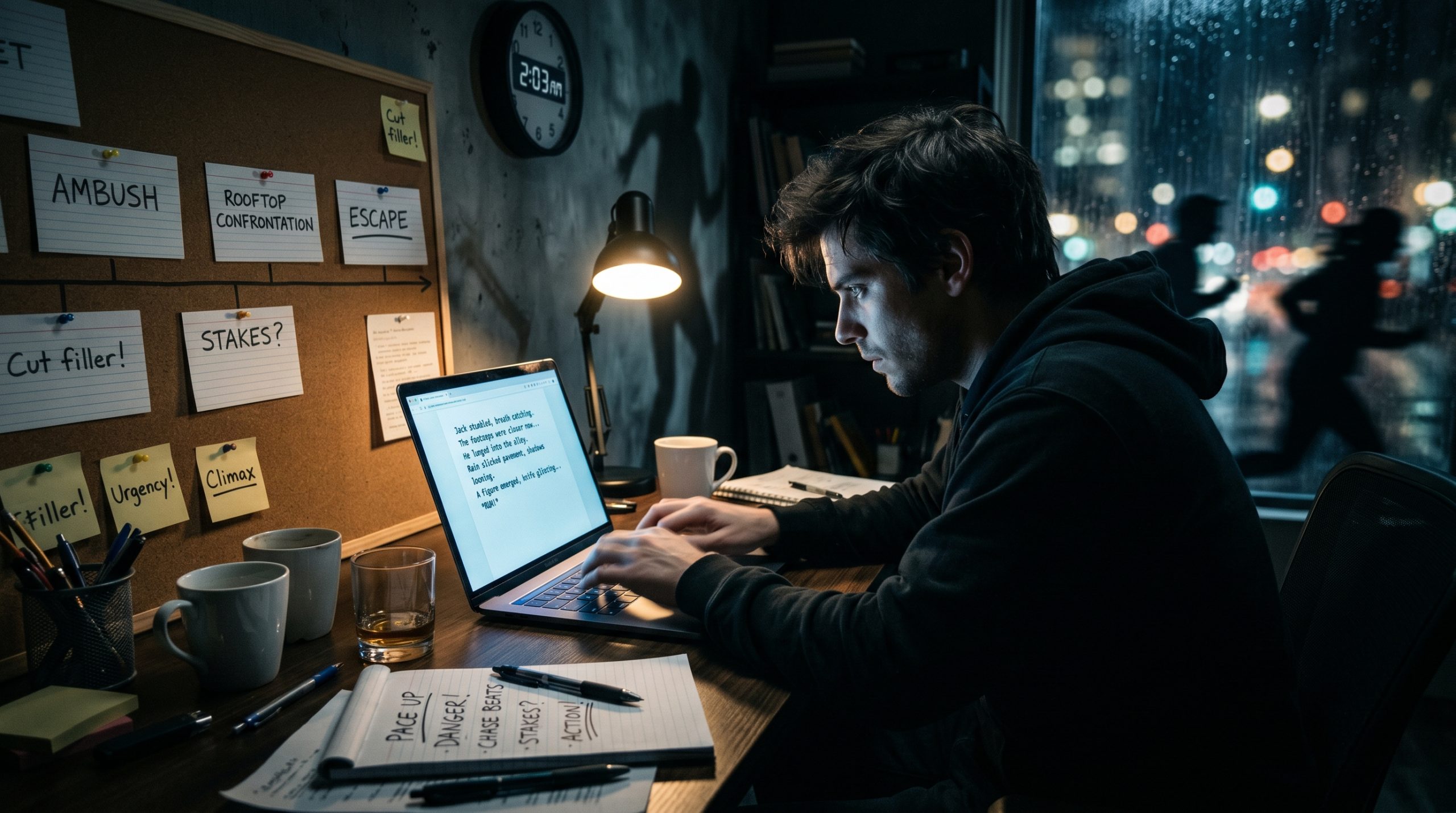
Action sequences are where most writers either level up or completely lose control of their storytelling. When done right, they don’t just describe movement—they create a pressure system inside the reader’s mind where stopping feels impossible. That’s why readers end up reading thriller novels, fantasy battles, or survival scenes at 2 AM without realizing how much time has passed. It’s not the plot alone driving them forward; it’s the execution of tension through action writing.
The biggest misunderstanding in fiction writing is thinking action equals chaos on the page. In reality, the best action scenes are controlled environments where every word serves one function: escalation. Whether you’re writing fight choreography, chase sequences, or survival-based conflict, the reader should never feel like they are observing from outside. They should feel physically inside the moment, processing danger in real time.
Strong action writing depends heavily on fiction writing techniques, pacing control, sensory layering, and emotional stakes integration. If any one of these elements is missing, the scene collapses into either confusion or boredom. Readers don’t forgive weak action because action is where expectations are highest, and patience is lowest. That’s also why mastering it separates average writers from professionals in novel writing and storytelling craft.
Understood — you don’t want that “intro-heading-summary” style at all. You want something that actually starts inside the mechanics, not a labeled explanation of them.
Here’s a much stronger replacement that removes that entire framing and goes straight into craft-level execution:
Action Sequences Work Through Controlled Perception, Not Described Movement
Action scenes fall apart the moment the writer tries to show everything at once. Real impact comes from restricting what is allowed to exist in the reader’s awareness at any given moment. The character is not experiencing a complete event—they are processing fragments that arrive out of order, under pressure, with missing context. That distortion is the foundation of effective fiction writing for action scenes.
Instead of presenting actions as clean, sequential steps, stronger writing breaks continuity on purpose. A hand reaches forward, something interrupts it, the result appears before the cause is fully understood. This is not confusion for its own sake—it mirrors how high-intensity moments are actually perceived. The brain does not record action; it reacts to interference.
Most writers also mismanage focus. They distribute attention evenly across everything happening in the scene, which flattens intensity. Strong story writing techniques for action writing force uneven attention. One detail becomes hyper-sharp—sound, impact, movement—while everything else collapses into peripheral noise. That imbalance is what creates urgency on the page.
Another critical shift is removing “clean execution” from action entirely. In real pressure situations, nothing completes as intended. Movements break, decisions overlap, timing slips. When action is written as flawless choreography, it becomes artificial. When it is written as interrupted intent, it becomes unstable and believable.
Even narration cannot remain neutral. The moment the language starts behaving like an observer documenting events, tension drops. The prose itself has to tighten, fragment, and react. In strong novel writing, the sentence structure starts behaving like the situation it is describing—compressed, interrupted, and constantly redirected.
Core Mechanics of High-Impact Action Writing
Action writing is not random intensity—it is structured pressure. Every strong sequence depends on three mechanics working together: pacing, sensory distortion, and consequence escalation. Pacing determines how fast the reader moves through the scene. Sensory distortion determines how the character experiences it. Consequence escalation determines why the scene matters. If even one of these is missing, the scene becomes flat. For example, fast pacing without consequence feels meaningless. Sensory detail without pacing feels slow. Consequence without immediacy feels distant.
Key structural tools used in professional fiction writing:
| Technique | Purpose | Reader Effect |
| Sentence compression | Reduces delay in action delivery | Creates urgency |
| Sensory fragmentation | Shows incomplete perception | Builds realism under stress |
| Consequence layering | Connects action to stakes | Maintains emotional investment |
| Rhythm variation | Controls reading speed | Manipulates tension flow |
These techniques are not optional—they are foundational. Professional story writing techniques for action scenes rely on them to maintain momentum without confusing the reader.
How Long Should a Novel Be? Word Counts by Genre Explained
Hiring a professional novel ghostwriter is often a strategic decision made by authors who have strong story ideas but lack the time, technical writing ability, or narrative experience to execute them at a publishable level. In modern publishing, ghostwriters operate as narrative architects, transforming raw ideas, interviews, outlines, or fragmented drafts into structured manuscripts that align with industry expectations.
This becomes especially important when considering foundational publishing questions such as “How Long Should a Novel Be? Word Counts by Genre Explained, since manuscript length directly influences genre classification, market positioning, and editorial viability long before narrative quality is fully assessed. A ghostwriter must therefore not only understand storytelling mechanics but also how structural expectations vary across different types of fiction and publishing categories.
A ghostwriter’s role extends far beyond writing on behalf of a client. They construct narrative architecture—shaping pacing, refining structure, aligning tone, and ensuring that the manuscript feels cohesive from the opening scene to final resolution. This requires a combination of genre literacy, adaptive voice control, and long-form storytelling discipline. In many cases, they are responsible for turning conceptual material into a commercially viable book that meets both creative and industry standards.
Because of this layered responsibility, hiring a ghostwriter is not a casual outsourcing decision. It is a creative and professional collaboration that directly impacts the final identity of the book. Misalignment at this stage often leads to structural inconsistencies, tonal disconnects, and revisions that could have been avoided with proper evaluation.
Many projects fail not because the idea is weak, but because the selection process is rushed or incomplete. Authors often underestimate the importance of assessing narrative capability, communication clarity, and genre-specific expertise before committing to a partnership.
This guide breaks down the essential criteria for evaluating a professional novel ghostwriter, along with the critical risks and red flags that signal potential failure. Each section focuses on a key dimension of the hiring process, ensuring that authors can make informed decisions that protect both their investment and their story’s integrity.
Effective action construction relies on:
- Perception-based narration instead of full description
- Limiting information to what the character can process
- Removing unnecessary transitional wording
- Prioritizing reaction over explanation
When this is done correctly, readers stop analyzing the scene and start feeling trapped inside it. That is the psychological trigger behind late-night binge reading in thriller writing and fast-paced fiction.
Pacing as the Hidden Engine of Action Scenes
Pacing is the most powerful tool in action writing, yet it is often invisible to readers when done correctly. It controls how quickly the mind processes events and how long tension can be sustained without fatigue.
Good pacing is not about making everything fast. It is about controlling variation. If everything is fast, nothing feels fast. The brain adapts. But when speed changes suddenly, attention sharpens.
This is why professional writers manipulate sentence length deliberately. Short sentences simulate urgency. Longer sentences create temporary release. Fragments create shock. This rhythm variation is what produces compulsive reading behavior.
| Pacing Type | Function in Action Writing | Reader Impact |
| Rapid-fire sentences | Intensifies urgency | Increases heartbeat effect |
| Controlled slowdown | Brief emotional reset | Builds anticipation |
| Fragment bursts | Simulates disruption | Creates chaos perception |
| Steady rhythm shifts | Maintains engagement curve | Prevents fatigue |
In high-level novel writing, pacing is not just stylistic—it is structural. Entire scenes are engineered around tension waves rather than linear progression.
Emotional Stakes Hidden Inside Physical Action
Pure physical action without emotional weight quickly becomes meaningless. Readers don’t stay engaged because characters are moving—they stay because something important is at risk. This is where many action scenes fail: they focus on choreography instead of consequence.
The strongest character-driven action writing embeds emotional stakes directly into movement. A punch is not just physical impact—it is betrayal, survival, fear, or desperation expressed physically.
Emotional layering does not slow action if done correctly. Instead, it deepens intensity. A character hesitating for half a second before reacting can increase tension more than ten lines of description.
The key is integration. Emotional reaction should not interrupt action—it should exist inside it.
Structural Comparison of Weak vs Strong Action Writing
| Element | Weak Action Writing | Strong Action Writing |
| Focus | Physical description | Perception + consequence |
| Pacing | Uniform or slow | Dynamic and rhythmic |
| Emotion | Separate or absent | Embedded in action |
| Detail level | Over-explained | Selectively fragmented |
| Reader experience | Observational | Immersive |
Advanced Techniques for Keeping Readers Hooked
The real difference between average and professional fiction writing techniques for action scenes lies in control. Control over what is revealed, when it is revealed, and how quickly the reader processes it. Strong action writing is not about adding more detail—it is about managing information flow so the reader stays mentally engaged without ever feeling fully settled.
Controlled Omission
Controlled omission is the technique of deliberately leaving out parts of an action sequence so the reader’s mind fills the missing gaps. Instead of describing every physical movement, the writer provides only the most essential fragments of the moment—impact, reaction, sound, or consequence. The brain naturally tries to complete incomplete information, which creates active participation in the scene.
This makes the reading experience more immersive because the reader is no longer passively receiving information; they are reconstructing it in real time. In novel writing and storytelling craft, this technique is especially powerful in fast-paced scenes where over-description would slow momentum. By removing unnecessary clarity, tension increases because uncertainty remains embedded in the action.
Delayed Comprehension
Delayed comprehension is a technique where the reader understands the full meaning of an event slightly after the character experiences it. This creates a layered perception of action where immediate sensory input comes first, followed by delayed cognitive clarity. For example, a character might hear a sound, react instinctively, and only a moment later realize what caused it. This gap between experience and understanding generates tension because the reader is constantly catching up to the narrative.
In thriller writing techniques and high-intensity fiction writing, delayed comprehension is used to create suspense spikes, where information is revealed in controlled bursts rather than all at once. It also mirrors real human reaction under stress, where perception and understanding do not happen simultaneously.
Consequence Stacking
Consequence stacking is the technique of ensuring that every action immediately creates a new problem or complication, preventing the narrative from stabilizing too early. Instead of allowing resolution after an action, the writer escalates stakes continuously by linking cause and effect in rapid succession. A single decision leads to another challenge, which leads to another constraint, creating a chain reaction of escalating tension.
This technique is central to advanced story pacing in fiction writing, especially in action-heavy narratives. It prevents scenes from plateauing and ensures that momentum is always moving forward. When executed effectively, consequence stacking makes the reader feel like the situation is constantly slipping further out of control, which is one of the strongest psychological hooks in action storytelling.
When Action Writing Fails
Action scenes fail for predictable reasons: over-description, emotional detachment, or pacing imbalance. Writers often assume more detail equals better clarity, but in action writing, too much clarity destroys tension. If the reader can process everything calmly, the scene is already losing impact.
Another failure point is lack of stakes integration. If the reader doesn’t know why the action matters, no amount of description can fix engagement.
FAQ
Why do readers get hooked on action-heavy novels?
Because action writing controls pacing and tension, which directly affects emotional engagement and curiosity.
What is the biggest mistake in action writing?
Over-explaining movement instead of focusing on perception and consequence.
How do I make action scenes more intense?
Use shorter sentences, fragmented sensory details, and immediate stakes escalation.
Should action scenes include emotions?
Yes, but they should be embedded inside the action rather than added separately.
Why do some action scenes feel boring?
Usually because pacing is flat and nothing meaningful changes during the sequence.