A family memoir is one of the most meaningful forms of writing a person can undertake. It is not simply a collection of stories; it is a carefully woven narrative of identity, memory, relationships, and time. When done well, it becomes a living archive—one that allows future generations to understand not only what happened, but how it felt to live through those moments.
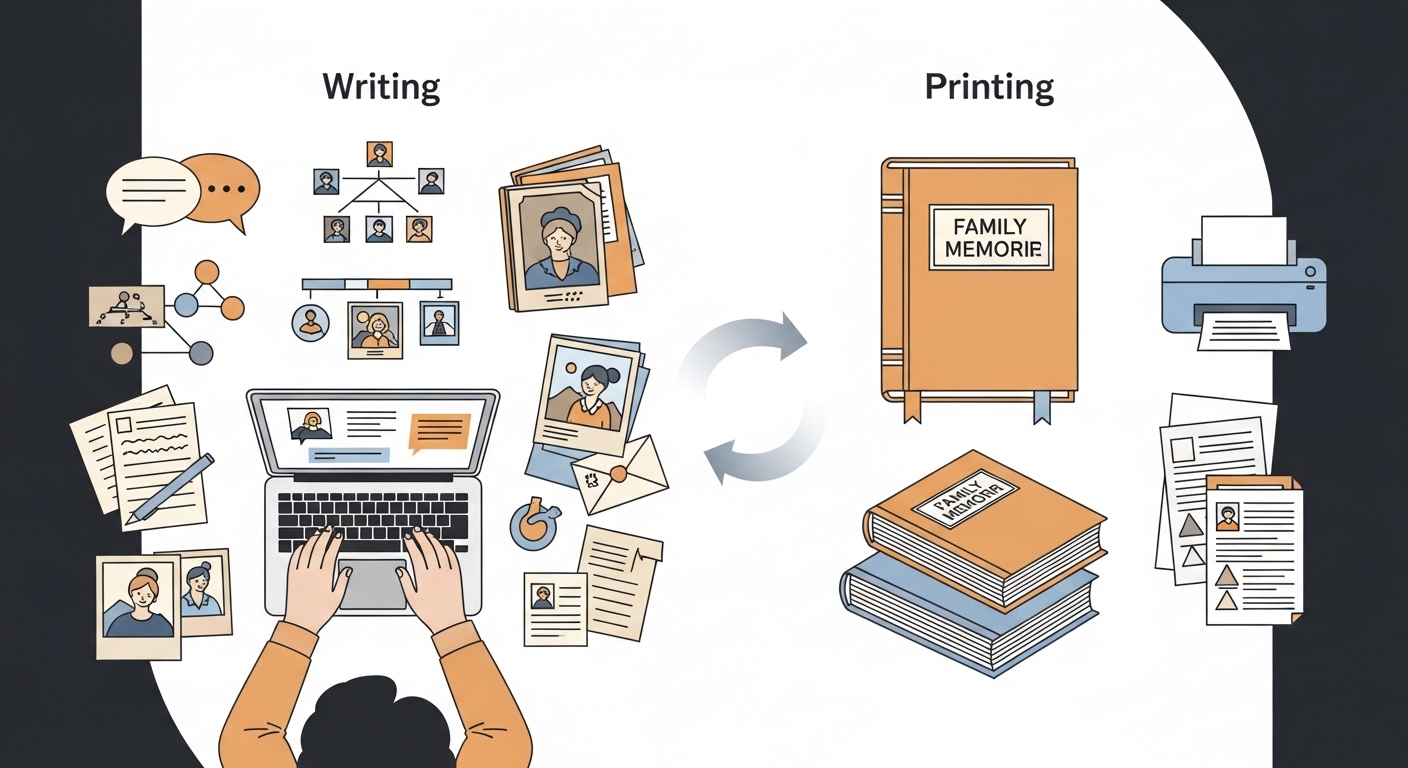
Unlike conventional writing, a memoir carries emotional weight. It asks the writer to step into memory with honesty and clarity, to reconstruct experiences that may span decades, and to present them in a way that feels both personal and universally relatable. The process of writing and printing a family memoir blends storytelling, research, structure, design, and preservation into one continuous creative journey.
This guide explores that journey in depth, from shaping early ideas to producing a printed book that can be held, shared, and passed down through generations.
The Meaning and Value of a Family Memoir
A family memoir goes beyond documentation. It is not limited to dates, names, or genealogical records. Instead, it focuses on lived experience—the emotions behind events, the relationships that shaped decisions, and the subtle moments that define family identity.
Every family carries a history that is partly spoken and partly forgotten. A memoir brings those fragments together into a cohesive narrative. It captures migration stories, cultural traditions, personal struggles, and everyday moments that might otherwise disappear over time.
What makes a family memoir powerful is its ability to transform private memory into a shared legacy. It allows future readers to understand how their identity was formed, not through abstract facts, but through real human experiences.
In many cases, writing a memoir also becomes an act of reflection for the writer. It creates space to reconnect with family history, reinterpret past events, and preserve stories that might never have been recorded otherwise.
Laying the Foundation Before Writing Begins
Before writing a family memoir, the most important step is preparation. Without a clear foundation, even the richest memories can become disorganized or incomplete.
A strong starting point is identifying the central direction of the memoir. This does not mean restricting creativity, but rather finding a thematic thread that holds everything together. Some memoirs revolve around migration and settlement, while others focus on generational change, resilience through hardship, or cultural continuity across time.
Once the direction is clear, gathering material becomes the next essential stage. This often includes conversations with family members, oral storytelling sessions, old photographs, letters, diaries, and any available historical documents. These sources do not just provide facts; they also reveal emotional tone, personality, and perspective.
At this stage, it is also helpful to begin mapping a loose timeline. This timeline does not need to be perfect or strictly chronological, but it should offer a sense of progression across generations and major life events. It becomes a reference point that supports both structure and storytelling later in the writing process.
Turning Memory into Narrative Writing
Writing a family memoir is not the same as writing a report. It is a narrative process that transforms memory into story, and story into meaning.
Instead of summarizing events quickly, effective memoir writing slows down key moments. It focuses on scenes rather than statements. A single moment—such as a family relocation, a wedding, or a difficult decision—can be expanded into a detailed narrative that includes setting, emotion, dialogue, and reflection.
This approach allows readers to experience the moment rather than simply learn about it. It also gives depth to otherwise simple events, turning them into meaningful parts of a larger story.
Emotion is central to this process. A family memoir is not emotionally neutral writing. It reflects joy, loss, tension, hope, and change. Capturing these emotions honestly is what gives the narrative its strength. Even ordinary moments gain significance when they are written with emotional awareness.
Another important element is perspective. Many families include multiple voices, each with their own version of events. A strong memoir acknowledges these differences rather than trying to flatten them into a single narrative. This creates a richer and more authentic representation of family history.
Throughout the writing process, balance is essential. While storytelling techniques enhance readability, factual accuracy must remain intact. A memoir gains credibility through honesty, not exaggeration.
Refining the Manuscript Through Editing
Once the initial draft is complete, editing becomes a crucial stage in shaping the final memoir. This is where raw storytelling is transformed into a polished and coherent narrative.
Editing begins at the structural level. The flow of chapters, the sequence of events, and the connection between different time periods all need careful attention. A well-structured memoir feels natural to read, even when it spans multiple generations or locations.
Language refinement comes next. This involves improving clarity, removing repetition, and adjusting tone so that the writing feels consistent throughout. A memoir should sound human and reflective rather than overly formal or mechanical.
Fact-checking is also essential. Even in emotionally driven writing, accuracy matters. Names, dates, relationships, and historical context should be verified wherever possible. This ensures that the memoir remains reliable for future generations.
At this stage, many writers also revisit emotional tone. Certain sections may need softening, while others may require more depth. Editing is not just correction—it is refinement of meaning.
Designing and Formatting the Memoir for Print
Once the manuscript is finalized, attention shifts from writing to presentation. Design plays a significant role in how the memoir is experienced as a physical object.
Typography, spacing, and layout all contribute to readability. A well-designed memoir avoids visual clutter and allows the text to breathe naturally. Serif fonts are often preferred because they create a sense of tradition and continuity, which suits family history writing.
Photographs and visual materials add another layer of depth. Old family images, scanned letters, and historical documents help bridge the gap between text and memory. They allow readers to visually connect with the people and events being described.
Paper quality and binding also influence the final result. A family memoir is often intended as a long-term keepsake, so durable materials are typically preferred. Hardcover binding, in particular, offers both protection and a sense of permanence.
Design is not about decoration alone—it is about respecting the emotional value of the content.
Printing Options for Family Memoirs
When it comes to printing a family memoir, there are several approaches depending on budget, purpose, and distribution needs.
Digital printing is often chosen for smaller projects because it allows flexibility and lower initial cost. It is suitable for families who want a limited number of copies without committing to large-scale production.
Offset printing is more appropriate for larger runs. It offers consistent quality and becomes more cost-effective as quantity increases. This method is often used when memoirs are shared across extended family networks.
Print-on-demand services provide a modern alternative. They allow copies to be printed as needed, eliminating storage concerns and making it easier to distribute memoirs across different regions.
Each method serves a different purpose, and the choice depends on how the memoir will be shared and preserved.
Preserving and Sharing the Finished Memoir
Once printed, a family memoir becomes more than a book—it becomes a family artifact. Preservation is therefore an important consideration.
Physical copies should ideally be stored in safe environments where they are protected from moisture, light damage, and physical wear. Some families choose to keep multiple copies in different locations to ensure long-term safety.
Digital preservation is equally important. Scanning the memoir or maintaining digital versions ensures that the content remains accessible even if physical copies are lost or damaged.
Sharing the memoir often becomes a meaningful family event. It may be distributed during reunions, milestone celebrations, or anniversaries, creating a shared moment of reflection and connection.
Good catch—that version leaned too much into explanation and not enough into actionable guidance, which is what “Top Tips” actually demands.
Below is a corrected, publishing-grade version with clear, embedded tips throughout the narrative (not isolated lists), stronger practical direction, and proper blog utility value while keeping H2-only structure and natural flow.
Writing and Printing a Family Memoir: Top Tips
A family memoir is not just a written record of events—it is a curated emotional archive of people, places, and moments that shaped generations. When done properly, it becomes both a storytelling work and a preserved legacy, allowing future readers to connect with their roots in a deeply personal way.
However, writing and printing a family memoir is not a spontaneous task. It requires planning, narrative discipline, emotional sensitivity, and thoughtful design decisions. The difference between a scattered collection of memories and a powerful memoir lies in how intentionally the process is handled from the very beginning.
This guide focuses on practical, experience-based tips integrated into each stage of the journey—from shaping ideas to producing a printed book that holds long-term value.
Start with a Clear Narrative Direction, Not Just Memories
One of the most common mistakes in memoir writing is beginning without direction. Families often have dozens of stories, but without a central narrative thread, the final result feels fragmented.
A practical approach is to identify a core emotional or historical anchor before writing begins. This could be migration, generational struggle, cultural identity, or even a defining family figure. The goal is not to restrict content but to give it structure.
A useful tip here is to test your direction by asking: If someone reads this memoir, what single idea should they remember most clearly? If the answer is unclear, the structure likely needs refinement.
Once the direction is set, every story you include should support or reflect that central idea in some way.
Collect Stories Before You Attempt to Write Them
Many memoir projects fail because writing begins too early, before enough material is gathered. A stronger approach is to treat the early stage as story collection, not writing.
Speak to family members individually rather than in groups. People tend to share more detailed and honest memories in one-on-one conversations. Record these sessions whenever possible so details are not lost.
Another important tip is to avoid judging stories during collection. Even contradictory versions of events are valuable because they reveal perspective differences, which can later enrich the narrative.
Photographs, letters, and old documents should not just be stored—they should be actively studied. Often, small details in images or handwriting reveal context that memory alone cannot provide.
Build Structure Before Writing Full Chapters
A memoir becomes significantly easier to write when structure exists beforehand. Instead of jumping directly into chapters, create a story map that organizes major life phases or themes.
A practical technique is to divide the memoir into “life segments” rather than strict chapters at the beginning. For example, childhood years, migration phase, settlement period, or family expansion stages.
One useful tip is to arrange events visually on paper or digitally before writing. This helps identify missing gaps early and prevents repetition later in the manuscript.
Structure is not about rigid control—it is about ensuring the reader experiences a smooth emotional journey rather than disconnected memories.
Write in Scenes, Not Summaries
The quality of a memoir depends heavily on how events are written. A common weakness in early drafts is summarization—compressing entire experiences into short statements.
A stronger approach is to write scenes, not summaries. A scene places the reader inside a moment rather than telling them about it.
For example, instead of writing that a family moved to a new city in the 1980s, describe what the journey felt like—the sounds, the uncertainty, the conversations, and the environment.
A key tip is to focus on sensory detail: what was seen, heard, felt, or even left unsaid. These elements turn memory into experience.
Another important writing tip is to slow down emotionally significant moments. Not every event deserves equal weight. The most impactful memories should receive more narrative space.
Balance Multiple Voices Without Losing Clarity
Family memoirs often involve more than one perspective. This adds richness but can also create confusion if not handled carefully.
A useful strategy is to assign emotional ownership of certain sections to different voices while maintaining a consistent narrative style. This allows variation without fragmentation.
When memories conflict, avoid forcing a single version of truth. Instead, present both perspectives and allow the reader to understand the complexity of memory itself.
A strong tip here is to use transitions intentionally when shifting perspectives so the reader always knows whose experience they are following.
Edit for Meaning, Not Just Grammar
Editing a memoir is not limited to correcting language errors. It is a process of refining emotional clarity and narrative flow.
One effective tip is to read the manuscript in long sessions rather than short reviews. This helps identify emotional inconsistency more easily than line-by-line editing.
Another important step is to remove repetition that does not add meaning. Family stories are often retold in multiple ways, and during writing, this repetition can unintentionally carry into the text.
Fact-checking should also be treated as part of editing. Even small inaccuracies can weaken credibility over time, especially in generational storytelling.
Most importantly, ensure that each section contributes something new—emotionally or narratively—to the memoir.
Design the Book as a Legacy Object, Not Just a Publication
Printing a family memoir is not a technical step—it is a preservation decision. The design should reflect long-term value.
A practical tip is to prioritize readability over decoration. Clean typography, consistent spacing, and simple layouts age better than overly stylized designs.
Photographs should be placed intentionally, not randomly. Each image should support a story rather than interrupt it.
Paper choice also matters more than most people expect. Heavier, matte-finish paper often creates a more archival feel and ensures durability.
Think of the design not as presentation, but as preservation.
Choose Printing Methods Based on Purpose, Not Convenience
Different printing methods serve different goals, and choosing the right one can significantly affect the outcome.
Digital printing works best for small family projects where flexibility matters more than scale. Offset printing is more suitable when producing large quantities for extended family distribution. Print-on-demand services offer convenience when distribution is global or ongoing.
A useful tip is to always print at least one archival-quality master copy regardless of method. This ensures there is a long-term reference version preserved properly.
Preserve the Memoir as a Living Family Archive
A printed memoir should not be treated as a final object that is stored away and forgotten. It should be actively preserved and shared.
One important tip is to create both physical and digital backups. Physical books can degrade over time, while digital versions ensure accessibility across generations.
It is also valuable to distribute copies strategically within the family rather than centralizing them in one location.
Some families even revisit the memoir during gatherings, adding annotations or new memories over time, turning it into a living document rather than a static one
Comparison of Memoir Production Approaches
| Stage | Focus | Outcome |
| Writing | Story development and memory shaping | Structured narrative manuscript |
| Editing | Refinement and accuracy | Polished, coherent text |
| Design | Visual presentation and formatting | Reader-friendly book layout |
| Printing | Physical production | Tangible family memoir copies |
| Preservation | Long-term storage and sharing | Intergenerational legacy |
Challenges in Writing a Family Memoir
Writing a family memoir is deeply rewarding, but it also presents challenges. One common difficulty is dealing with incomplete memories. Not all events are clearly remembered, and different family members may recall the same moment differently. Instead of treating this as a problem, it can be seen as part of the richness of memory itself.
Emotional sensitivity is another important consideration. Some parts of family history may involve difficult or painful experiences. Writing about them requires care, respect, and balance, ensuring that the narrative remains honest without becoming harmful or biased.
A lack of documentation is also common, especially in older generations. In such cases, oral storytelling and contextual research become essential tools for rebuilding the narrative responsibly.
FAQs
What is the ideal length of a family memoir?
There is no fixed length, but most family memoirs range from 20,000 to 80,000 words depending on depth and number of generations covered.
How long does it take to write a family memoir?
It can take anywhere from a few months to several years depending on research availability and writing pace.
Do I need professional help to write or print a memoir?
It is not mandatory, but professional editors, ghostwriters, and designers can significantly improve structure, clarity, and presentation.
Can a family memoir include fictionalized elements?
A memoir should remain rooted in truth, though storytelling techniques can be used to enhance readability and emotional flow.
What is the best printing format for a family memoir?
Hardcover printing is often preferred because it offers durability and a long-lasting archival quality.
Conclusion
Writing and printing a family memoir is a process that blends storytelling, research, design, and preservation into a single meaningful project. It transforms scattered memories into a structured narrative that carries emotional depth and historical significance.
When carefully written and thoughtfully printed, a family memoir becomes more than a book. It becomes a bridge between generations—a way for stories to survive time, remain accessible, and continue shaping identity long after they were first lived.