Choosing a fantasy sub-genre is not just a stylistic preference—it is a foundational creative decision that determines how your entire story world will function, feel, and be interpreted by readers. The sub-genre you select shapes everything from narrative tone and character behavior to the structure of your world itself. It defines whether your story leans toward external systems of conflict or internal layers of emotional meaning, and it ultimately influences how believable and immersive your universe becomes.
This decision becomes especially important in the context of World-Building 101: How to Create Believable Fantasy Universes, where the goal is not only to imagine a fictional setting but to construct a world that feels consistent, intentional, and emotionally grounded. Within this framework, dystopian fiction and magical realism represent two very different approaches to bending reality—each with its own logic, storytelling style, and impact on reader experience.
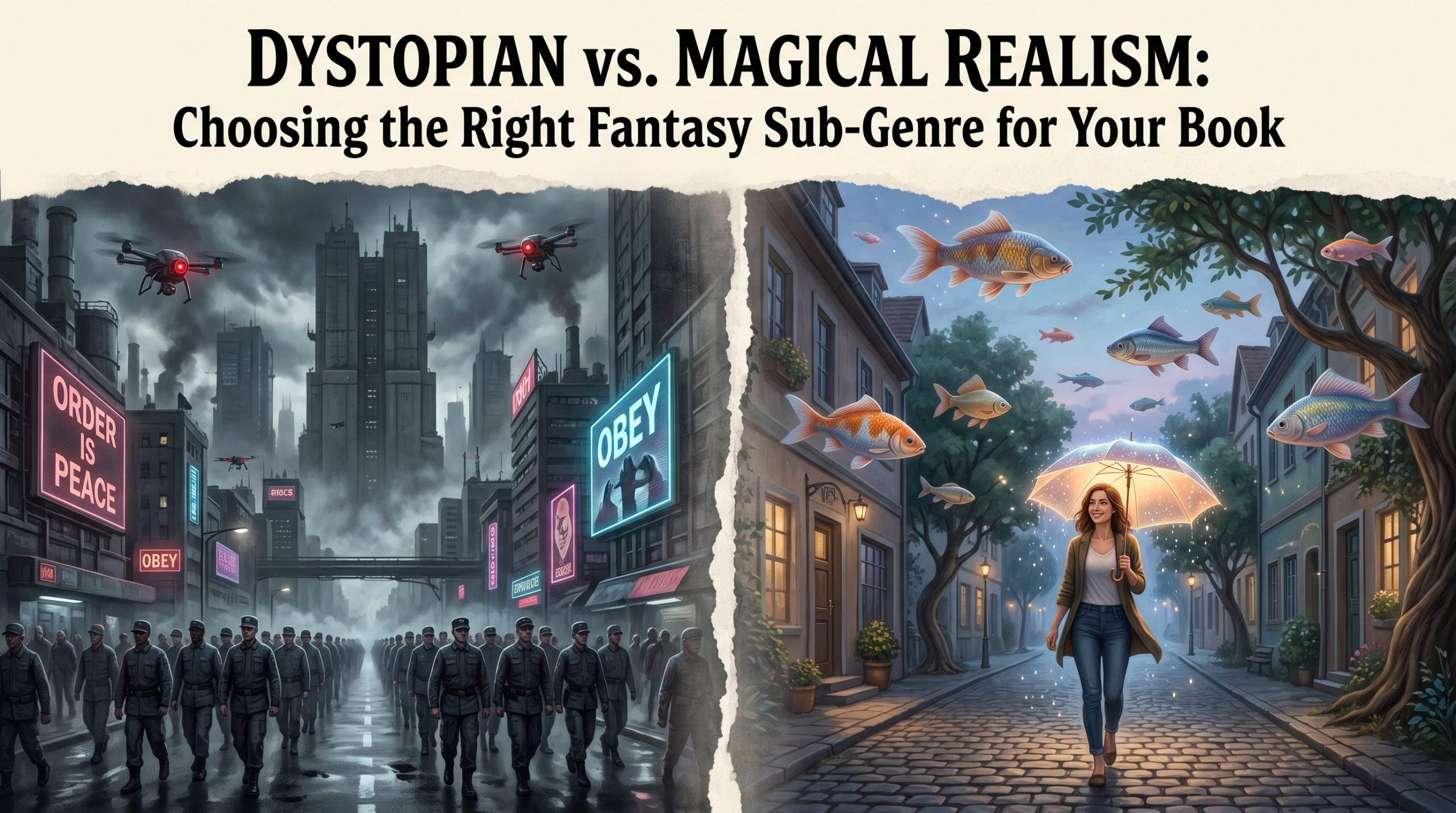
Dystopian fiction builds its worlds through structure, control, and systemic tension, often focusing on societies shaped by oppression, collapse, or rigid governance. Magical realism, in contrast, blends subtle, unexplained elements of the extraordinary into otherwise realistic environments, emphasizing emotional truth and perception over strict system-building.
Understanding the distinction between these two approaches is essential for any writer aiming to create a believable fantasy universe because it ensures that the world you design is not only imaginative, but also coherent in its rules, tone, and emotional depth.
Understanding Dystopian Fiction
Dystopian fiction presents a world that has deviated from an ideal or natural state, usually due to political, technological, or societal collapse. It is grounded in control, restriction, and systemic imbalance.
Core characteristics of dystopian storytelling
Dystopian worlds are defined by oppressive systems. These may include authoritarian governments, surveillance states, environmental collapse, or rigid social hierarchies. The focus is often on how individuals navigate or resist these systems.
The tone is typically tense, critical, and reflective. Even when fictional, dystopian settings often feel uncomfortably close to reality, which enhances their emotional impact.
Themes commonly explored in dystopian fiction
Dystopian stories often examine power, freedom, identity, and resistance. They question what happens when systems designed to protect society instead begin to restrict it.
Unlike pure escapism, dystopian fiction often carries a cautionary message, encouraging readers to reflect on real-world parallels.
World-building in dystopian settings
World-building in dystopian fiction is tightly controlled. Every aspect of the world—laws, technology, social structure—is shaped by the central system of control or failure.
The environment often reinforces the theme. Urban decay, surveillance infrastructure, and restricted spaces are commonly used to visually express oppression.
Understanding Magical Realism
Magical realism blends realistic environments with subtle, often unexplained magical elements that are accepted as part of everyday life. Unlike traditional fantasy, it does not create a separate “fantasy world”—it embeds magic within the ordinary.
Core characteristics of magical realism
Magical realism is defined by its quiet integration of the extraordinary into the mundane. Magic is not presented as shocking or disruptive; it is simply part of existence.
The tone is often reflective, poetic, and emotionally grounded rather than action-driven or plot-heavy.
Themes commonly explored in magical realism
This sub-genre often explores memory, identity, time, grief, love, and cultural history. The magical elements are typically symbolic rather than system-based.
Instead of focusing on external conflict, magical realism often emphasizes internal emotional experience and perception of reality.
World-building in magical realism
World-building in magical realism is subtle. The setting closely resembles the real world, but with small distortions or impossible elements that are accepted without explanation.
Rather than building complex systems, the focus is on atmosphere, emotional truth, and symbolic meaning.
Key Differences Between Dystopian Fiction and Magical Realism
| Aspect | Dystopian Fiction | Magical Realism |
| Core focus | Oppressive systems and societal control | Emotional reality blended with subtle magic |
| Tone | Dark, tense, critical | Reflective, poetic, grounded |
| Role of magic | Often absent or technological | Subtle and unexplained |
| World structure | Highly system-driven | Fluid and symbolic |
| Conflict type | External (society vs individual) | Internal and emotional |
| Reader experience | Suspense and urgency | Reflection and interpretation |
How to Choose the Right Sub-Genre for Your Story
Selecting between dystopian fiction and magical realism depends on what kind of story you want to tell and how you want readers to emotionally engage with it.
Choose dystopian fiction if your focus is conflict and systems
If your story revolves around power structures, resistance, survival, or societal critique, dystopian fiction provides the right framework. It allows you to build tension through external pressure and systemic control.
This sub-genre works best when your narrative depends on high stakes, clear opposition, and structured world rules.
Choose magical realism if your focus is emotion and perception
If your story is more introspective, symbolic, or emotionally driven, magical realism may be more suitable. It allows subtle magical elements to enhance themes rather than dominate them.
This style works well when you want readers to interpret meaning rather than follow strict plot mechanics.
Consider hybrid approaches carefully
Some stories blend both elements, but this requires control. A dystopian world with magical realism elements must balance system-driven logic with symbolic ambiguity.
Without clarity, blending can weaken both styles instead of strengthening them.
Which One Is Better for Your Story?
There is no universal “better” option between dystopian fiction and magical realism. The right choice depends entirely on the purpose of your narrative.
Dystopian fiction is more effective when your story relies on external conflict, structured world systems, and high-stakes tension. It works best when you want to explore societal breakdown, power structures, or survival under pressure.
Magical realism is more effective when your story is driven by emotion, symbolism, and introspection. It works best when you want to explore human experience, perception, and subtle shifts in reality that reflect deeper meaning.
Ultimately, the stronger genre is the one that aligns with your story’s core intention. When the genre and message are in harmony, both world-building and reader engagement become significantly more powerful.
Frequently Asked Questions (FAQs)
What is the main difference between dystopian fiction and magical realism?
Dystopian fiction builds worlds centered on oppressive systems, control, and societal breakdown, where external conflict drives the story. Magical realism blends realistic settings with subtle, unexplained magical elements that are accepted as part of everyday life, focusing more on emotional and symbolic meaning than external systems.
Is magical realism considered fantasy?
Yes, but only partially. Magical realism is often placed under the broader umbrella of speculative fiction. However, unlike traditional fantasy, it does not create separate magical worlds or detailed magic systems. Instead, it integrates magical elements into realistic environments without explanation or disruption.
Why do readers enjoy dystopian fiction so much?
Readers are drawn to dystopian fiction because it creates tension, urgency, and high stakes. These stories often reflect real-world concerns such as political control, surveillance, or inequality, making them both entertaining and thought-provoking.
What makes magical realism unique compared to other genres?
Magical realism stands out because it treats magical events as normal rather than extraordinary. The focus is not on explaining the magic but on how it affects perception, emotion, and human experience within a realistic world.
Can a story include both dystopian elements and magical realism?
Yes, but it requires careful balance. A story can feature a dystopian system while using subtle magical realism to reflect emotional or symbolic layers. However, if not handled carefully, combining both styles can create tonal confusion.
Which genre is easier to write for beginners?
Dystopian fiction is often easier for beginners because it relies on clear systems, rules, and structured conflict. Magical realism can be more challenging because it depends heavily on subtlety, tone, and emotional depth rather than explicit explanations.
Final Insight
Both dystopian fiction and magical realism offer powerful but very different ways of shaping a fantasy narrative. One builds tension through structure and control, while the other creates depth through subtlety and emotion.
The most effective choice is not the most popular one, but the one that best supports your story’s core intent. When the sub-genre aligns with your thematic direction, both world-building and storytelling naturally become stronger and more cohesive.