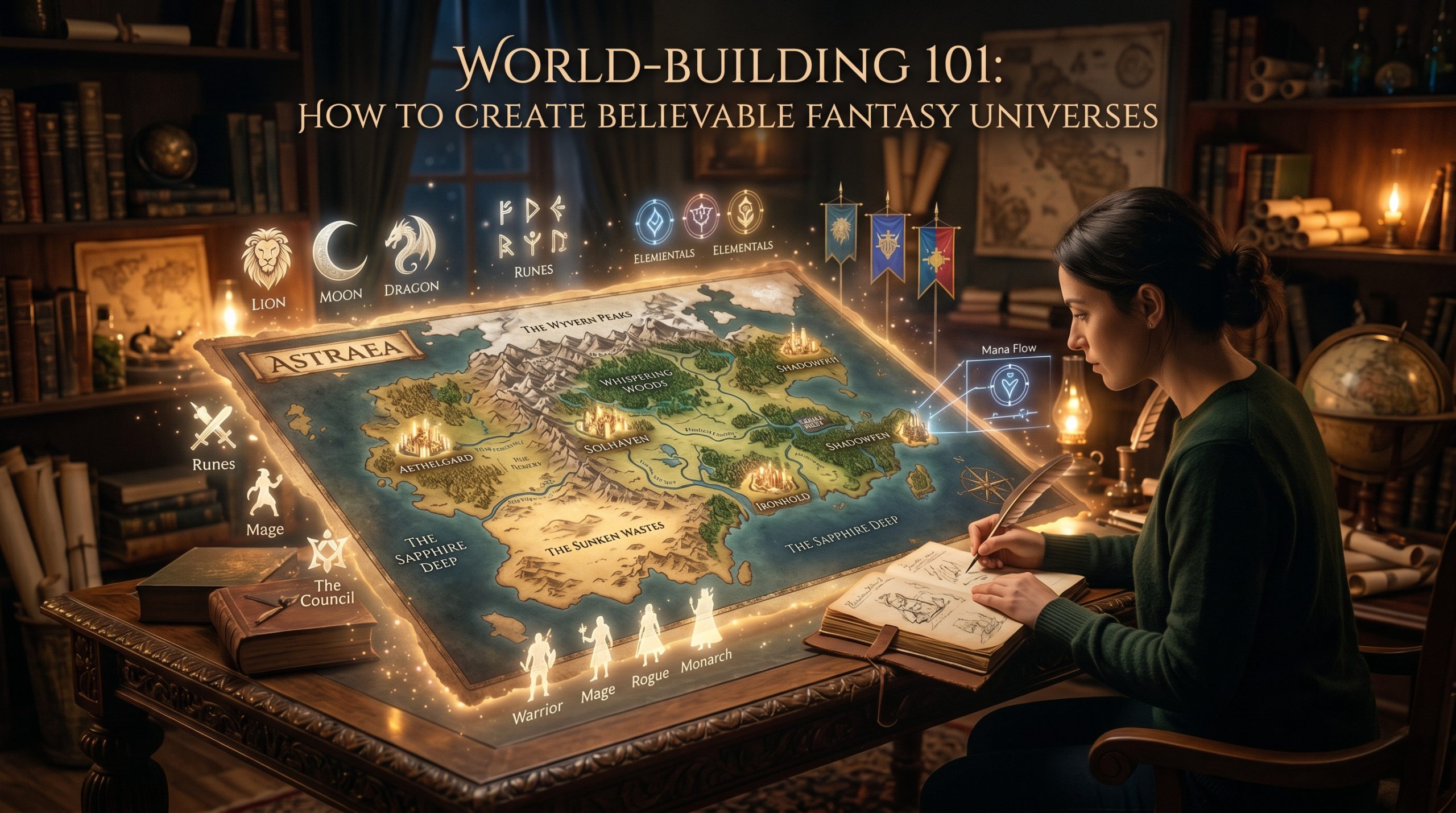
World-building is the structural backbone of any fantasy story. It determines whether a reader feels like they are observing a constructed idea or stepping into a living universe that continues beyond the page. Strong world-building does not just support the story—it actively shapes how the story is experienced, influencing tone, pacing, character behavior, and emotional depth.
What often separates forgettable fantasy from immersive storytelling is not originality alone, but believability. A world does not need to resemble reality, but it must behave as though it has its own internal logic. Readers are willing to accept dragons, magic systems, or impossible geography if the world feels consistent and grounded in cause-and-effect relationships. This same principle also connects to broader storytelling choices, including Fiction vs. Non-Fiction: Which Style Fits Your Story?, since the way a narrative is framed directly influences how its world is constructed and perceived.
The challenge lies in balance. Overloading a story with lore, maps, and explanations early on creates distance. Underdeveloped worlds feel empty and unconvincing. The goal is to build a setting that feels deep without overwhelming the reader—revealing complexity gradually through story rather than dumping it upfront.
The Foundation of Any Fantasy World
Every strong fantasy universe begins with a foundation that defines its identity. Without this, world-building becomes a collection of disconnected ideas rather than a unified system.
Core Concept of the World
The core concept is the central idea that gives the world purpose and direction. It might be a world governed by collapsing magic, a fractured empire recovering from divine war, or a society built around forbidden knowledge.
This concept should influence everything else in the world. Geography, politics, culture, and conflict should feel like natural extensions of it. When the core idea is strong, it prevents the world from becoming scattered or inconsistent.
A useful approach is to ask: What is the one defining tension of this world? That tension becomes the anchor that everything else connects to.
Tone and Genre Identity
Tone defines how the world feels emotionally to the reader. A dark fantasy world emphasizes moral ambiguity, survival, and consequence. A heroic fantasy world leans into hope, destiny, and larger-than-life figures. Urban fantasy blends magical systems into modern environments, creating contrast between the ordinary and the extraordinary.
Tone affects everything—from how characters speak to how magic is perceived. A consistent tone ensures that readers remain emotionally oriented within the world. Sudden tonal shifts without intention can break immersion and weaken credibility.
Tone also determines expectations. Readers approach a grim, political fantasy very differently than a whimsical magical adventure, even if both contain similar elements.
Internal Logic and Rules
Internal logic is what keeps a fantasy world believable. Even when physics or reality is altered, the world must still follow its own consistent rules.
If magic requires energy, that cost must remain stable. If a political system is corrupt, that corruption should influence events consistently. When rules shift unpredictably without explanation, readers lose trust in the world.
Consistency does not mean rigidity—it means predictability within the system. Readers should feel that if they understand the rules, they can anticipate outcomes.
A strong world is not one without surprises, but one where surprises still feel justified.
Geography and Physical Design of the World
Geography is more than visual setting—it is a silent force shaping culture, conflict, and survival. Physical space influences everything from trade routes to belief systems.
Mapping the World
A map does more than show locations; it defines relationships between places. Distance affects politics, isolation shapes culture, and borders create tension.
Even when not shown visually, writers benefit from having a mental map. Knowing where kingdoms sit, how far cities are apart, and what natural barriers exist helps maintain consistency.
A well-designed world map also supports narrative pacing. Travel becomes meaningful when distance has consequence rather than being instant or irrelevant.
Climate and Environment
Climate shapes civilization in subtle but powerful ways. A desert kingdom develops different survival strategies, architectural styles, and social systems than a forest-based society.
Environment also influences conflict. Scarce water resources, harsh winters, or dangerous terrain naturally generate tension between groups. These environmental pressures make the world feel organic rather than artificially constructed.
A believable world treats environment as an active force, not just scenery.
Natural Resources and Boundaries
Resources define power. What a world has—and what it lacks—creates natural imbalance.
A kingdom rich in magical minerals may dominate trade but become a target for invasion. A land with fertile soil but no defense system may rely on alliances. Scarcity creates story movement.
Boundaries, whether natural or political, shape how cultures interact. Mountains, oceans, and deserts are not just obstacles—they are separators of identity.
Magic Systems and Rules of Power
Magic is one of the most defining features of fantasy worlds, but also one of the easiest to misuse if not carefully structured.
Defining the Source of Magic
Magic must originate from something identifiable, even if mysterious. It could stem from elemental forces, divine beings, cosmic energy, or internal human potential.
The source determines everything else: who can use magic, how it is learned, and how it affects society. A well-defined origin prevents magic from feeling arbitrary.
Costs and Limitations
Without limits, magic removes tension. If anything can be solved instantly, conflict disappears.
Costs can take many forms: physical exhaustion, emotional consequences, limited resources, or irreversible side effects. These restrictions create meaningful decisions.
The most compelling magic systems are not defined by what they can do, but by what they cannot do without consequence.
Structure vs Mystery in Magic Systems
Structured magic systems follow clear rules, making them predictable and strategic. Readers understand how abilities work and what their limits are.
Mystery-based systems keep rules hidden or partially undefined, creating awe and unpredictability.
Both approaches are valid, but mixing them without control can weaken consistency. The key is intentional design—knowing what the reader is meant to understand and what is meant to remain unknown.
Cultures, Societies, and Civilizations
A fantasy world feels real when its people feel distinct and internally consistent.
Building Distinct Cultures
Culture is not just aesthetics—it is behavior shaped by history and environment. Language patterns, rituals, architecture, clothing, and social norms all contribute to identity.
Each culture should feel like it developed independently based on its circumstances. When cultures feel interchangeable, the world loses depth.
Social Hierarchies and Class Systems
Power structures define how societies function. Whether based on wealth, lineage, magic ability, or political influence, hierarchy creates natural tension.
Class systems also shape character motivation. A character’s position in society influences their worldview, opportunities, and limitations.
Religion and Belief Systems
Religion in fantasy is not just spiritual—it is structural. It influences law, politics, education, and identity.
Even the presence or absence of religion shapes culture. Belief systems explain how societies interpret existence, power, and morality.
Politics, History, and Power Structures
No world exists in the present alone. History gives weight to current events.
Historical Backstory of the World
Past wars, alliances, betrayals, and collapses shape current instability or peace. History explains why borders exist, why tensions remain unresolved, and why certain groups distrust others.
Well-developed history creates depth without needing constant exposition.
Governments and Leadership Systems
Governance determines how power is controlled and maintained. Monarchies, councils, republics, and authoritarian regimes all create different narrative dynamics.
Leadership systems also influence conflict. Power struggles within governments can be as important as external wars.
Power Struggles and Political Tension
Politics provides long-term narrative fuel. Unlike isolated battles, political tension affects entire societies.
Competing factions, ideological divides, and resource disputes create ongoing instability that drives plot development.
Characters as a Reflection of the World
Characters and world-building are deeply interconnected. A character is never separate from the environment that shaped them.
Their beliefs, fears, and motivations should feel like natural consequences of the world they inhabit. A war survivor will perceive safety differently than someone raised in peace. A magically gifted individual will have different social experiences than someone without power.
When characters feel rooted in their world, the setting becomes more believable through them.
Techniques for Making Fantasy Worlds Feel Real
Believability in fantasy does not come from how complex a world is, but from how naturally it is experienced. Readers accept impossible things when the world feels consistent, emotionally grounded, and revealed in a way that feels organic rather than explained. The following techniques help achieve that effect.
Gradual Revelation (Layered World-Building)
Gradual revelation is the technique of introducing world details slowly through story progression instead of explaining everything upfront.
Rather than pausing the narrative to explain rules, history, or systems, information is embedded into scenes as it becomes relevant. A character might casually mention an old war in dialogue, or a magical limitation might only become clear when it affects an action in real time.
This approach works because it mirrors how people actually learn about the world—through exposure, not instruction. The reader is not “taught” the world; they discover it piece by piece.
The result is stronger engagement, because curiosity stays active. The world feels larger than what is immediately visible, which creates a sense of depth and continuity.
Sensory Grounding (Physical Immersion)
Sensory grounding is the technique of making the fantasy world feel physically real by engaging the reader’s senses.
Instead of describing a place in abstract terms, the writing focuses on how it is experienced. The texture of stone, the smell of burning herbs, the pressure of wind through narrow streets, or the hum of distant magic all contribute to immersion.
This technique is powerful because it bypasses intellectual interpretation and creates direct sensory imagination. Even unfamiliar or impossible environments become believable when they are physically felt.
Without sensory grounding, fantasy risks feeling like a conceptual map rather than a lived environment.
Emotional Anchoring (Human Experience First)
Emotional anchoring ensures that every element of the fantasy world connects back to human feeling.
No matter how unusual the setting is, readers relate through emotion. Fear, curiosity, grief, ambition, and wonder are what make the world meaningful.
A floating city or magical curse only becomes impactful when the reader understands how it affects people emotionally. Without that human layer, even the most creative ideas feel distant.
This technique ensures that fantasy remains grounded in emotional reality, even when physical reality is entirely fictional.
Rule Consistency (Internal Logic Stability)
Rule consistency is the foundation of believable fantasy. It means that the world operates according to stable, understandable principles.
If magic has limits, those limits must remain consistent. If political systems function in a certain way, they must follow that structure throughout the story.
Consistency does not limit creativity—it strengthens it. When readers understand how a world behaves, they can engage with it more deeply because outcomes feel earned rather than random.
Breaking rules without explanation weakens trust and reduces immersion.
Show-Don’t-Explain Integration
This technique focuses on revealing world-building through action instead of direct explanation.
Instead of telling the reader how something works, the writer demonstrates it in motion. A law is seen being enforced, a cultural belief is shown through behavior, and a magical rule is revealed through consequence.
This keeps the narrative active and prevents the story from becoming overloaded with exposition.
It also increases immersion because the reader participates in discovering meaning rather than passively receiving it.
Environmental Storytelling (World as Evidence)
Environmental storytelling uses physical surroundings to communicate history and meaning without direct explanation.
A ruined monument suggests a fallen regime. Burned villages hint at past conflict. Abandoned structures imply migration, disaster, or collapse.
These details allow the world itself to tell parts of its story.
This technique adds depth without slowing pacing, and it rewards readers who pay attention to detail. The environment becomes an active narrator rather than passive background.
Emotional Contrast in World Design
Emotional contrast involves placing opposing emotional tones within the same world to create depth and realism.
A joyful festival might occur in a city recovering from war. A beautiful palace might sit above poverty or unrest. Peaceful landscapes might hide historical trauma.
This contrast prevents the world from feeling emotionally flat or uniform. It reflects the complexity of real societies, where beauty and suffering often coexist.
It also strengthens narrative tension by highlighting contradictions within the world.
Character-Led World Exposure
Character-led world exposure means the reader experiences the world through the perspective of characters rather than direct explanation.
Different characters interpret the same world differently based on their background, role, and beliefs. A soldier, a scholar, and a merchant will all notice different aspects of the same environment.
This technique allows world-building to unfold naturally through perspective. It also prevents information overload by distributing details across multiple viewpoints.
The result is a more layered and realistic world structure.
Controlled Mystery (Intentional Unknowns)
Controlled mystery is the technique of deliberately leaving parts of the world unexplained while maintaining internal logic.
Not everything needs to be revealed immediately—or ever. Ancient ruins with unknown origins, forgotten magical systems, or incomplete histories create a sense of depth beyond the page.
However, mystery must feel intentional. The reader should sense that answers exist, even if they are not revealed yet.
This technique expands the perceived size of the world and keeps curiosity alive throughout the narrative.
Summary Insight
Fantasy worlds feel real when they are experienced rather than explained. Techniques like gradual revelation, sensory grounding, emotional anchoring, and environmental storytelling work together to create immersion.
A believable world is not one that is fully described—it is one that feels like it continues beyond what the reader can immediately see.
Below is a refined, expanded, and more in-depth version of your section with stronger explanations, richer craft insight, and clearer writing mechanics—while keeping your structure intact.
Techniques for Making Fantasy Worlds Feel Real
Believability in fantasy does not come from how complex or expansive a world appears on paper, but from how naturally it is experienced by the reader. A world becomes convincing when impossible elements are treated with internal consistency, emotional truth, and gradual discovery rather than direct explanation.
Readers do not reject fantasy because it is unrealistic—they reject it when it feels constructed. The techniques below focus on removing that artificial feeling and replacing it with immersion, flow, and lived-in authenticity.
Gradual Revelation (Layered World-Building)
Gradual revelation is the technique of introducing world details in controlled layers instead of presenting them all at once through exposition.
Rather than pausing the narrative to explain political systems, magical rules, or historical events, the world is revealed through action and implication. A passing comment in dialogue, a ritual performed without explanation, or a consequence unfolding mid-scene becomes the mechanism for discovery.
This works because it mirrors real human cognition. People do not learn their environment through structured lectures—they infer meaning through experience, repetition, and context. Fantasy becomes more believable when it follows the same principle.
The key advantage of this method is narrative momentum. The reader is never “paused” for explanation. Instead, they are continuously interpreting, which creates engagement and curiosity.
Well-executed gradual revelation also creates depth by implication. The world feels larger than what is shown because not everything is immediately visible or explained.
Sensory Grounding (Physical Immersion)
Sensory grounding is the practice of anchoring fantasy environments in physical experience rather than abstract description.
Instead of stating what a place is, the writing communicates what it feels like to exist inside it. Texture, temperature, sound, smell, and spatial awareness become the tools of immersion.
A stone corridor is not just old—it is damp, cold, and echoing with distant movement. A magical field is not just powerful—it hums under the skin, distorts breath, or bends light unnaturally.
This technique works because the human brain processes sensory input more intuitively than conceptual explanation. Even the most alien environments become believable when they are rendered through physical sensation.
Without sensory grounding, fantasy settings risk becoming diagrammatic—understood intellectually but not emotionally experienced.
Emotional Anchoring (Human Experience First)
Emotional anchoring ensures that every element of a fantasy world remains connected to recognizable human emotion.
No matter how extraordinary the setting becomes, readers remain emotionally oriented through fear, curiosity, grief, desire, and hope. These emotional signals are what make unfamiliar worlds accessible.
A floating kingdom, a cursed forest, or a sentient artifact becomes meaningful not through its mechanics, but through how it affects people emotionally. The impact of magic or politics is always secondary to the emotional consequences it creates.
This technique ensures that fantasy does not drift into abstraction. It keeps the narrative grounded in psychological reality, even when physical reality is entirely imaginary.
In practice, emotional anchoring turns “world events” into “human experiences.”
Rule Consistency (Internal Logic Stability)
Rule consistency is the structural backbone of believable fantasy. It refers to the requirement that all systems within the world—magical, political, physical, or social—follow stable and predictable internal logic.
If a magical ability has limits, those limits must remain intact unless intentionally changed within the story. If a political system is corrupt or hierarchical, that structure must influence outcomes consistently across different scenarios.
Readers are highly sensitive to inconsistency. Even small contradictions can break immersion because they signal that the world is not operating under real rules, but under author convenience.
However, consistency does not restrict creativity—it enables it. Once readers understand how a system works, writers can build tension through manipulation of that system rather than arbitrary change.
A consistent world feels stable, and stability is what allows suspension of disbelief.
Show-Don’t-Explain Integration
This technique replaces direct explanation with demonstrated function inside the narrative.
Instead of telling the reader how something works, the writer allows it to be observed through action and consequence. A legal system is understood through courtroom behavior. A cultural belief is understood through ritual. A magical rule is understood when a character fails because of it.
This method keeps the story active rather than instructional. The reader is not being informed—they are interpreting what they see.
The result is higher engagement, because meaning is constructed through participation rather than delivery.
It also prevents exposition overload, which often slows pacing and reduces emotional impact.
Environmental Storytelling (World as Evidence)
Environmental storytelling uses physical space as a narrative device to communicate history, conflict, and cultural memory.
Instead of explaining past events, the world itself carries their traces. A collapsed bridge suggests a forgotten trade route or wartime destruction. Overgrown ruins indicate abandonment or catastrophe. Modified architecture reveals cultural adaptation over time.
This technique transforms the environment into a form of silent narration.
Its strength lies in efficiency: it delivers narrative depth without interrupting pacing. It also rewards attention, allowing readers to reconstruct history from clues rather than receiving it directly.
In well-built fantasy worlds, environments do not simply exist—they remember.
Emotional Contrast in World Design
Emotional contrast involves deliberately placing opposing emotional states within the same world to create complexity and realism.
A celebratory festival may occur in a city still recovering from war. A peaceful landscape may conceal historical trauma. A majestic palace may exist alongside widespread poverty.
This contrast reflects real-world complexity, where beauty and suffering often coexist rather than exist separately.
It prevents the world from feeling emotionally uniform, which is a common weakness in fantasy writing.
More importantly, contrast creates narrative tension at a structural level. The reader is constantly aware that surface appearance and underlying reality are not always aligned.
Character-Led World Exposure
Character-led world exposure means that all world-building is filtered through the perception of characters rather than presented objectively.
Different characters interpret the same environment differently depending on their background, status, beliefs, and personal history. A soldier, a merchant, and a noble will each notice entirely different aspects of the same city.
This technique adds natural diversity to world-building without requiring separate explanatory sections.
It also prevents information overload by distributing details across multiple subjective perspectives rather than centralizing them in exposition.
As a result, the world feels more dynamic, layered, and psychologically realistic.
Controlled Mystery (Intentional Unknowns)
Controlled mystery is the deliberate preservation of unanswered questions within the world while maintaining internal coherence.
Not every aspect of a fantasy universe needs explanation. Ancient ruins with unknown origins, forgotten magical disciplines, or incomplete historical records create a sense of depth beyond what is shown.
However, mystery must feel intentional rather than accidental. The reader should sense that answers exist within the world, even if they are not revealed.
This creates cognitive expansion—the feeling that the world is larger than the narrative scope.
Controlled mystery also sustains long-term engagement by maintaining curiosity across chapters or entire series.
Fantasy worlds feel real not because they are fully explained, but because they are consistently experienced. Techniques like gradual revelation, sensory grounding, emotional anchoring, and environmental storytelling transform abstract construction into lived perception. A successful fantasy world is one that behaves like it exists independently of the story being told—structured, emotional, and continuous even beyond the page.
Conclusion: The Balance Between Imagination and Believability
A powerful fantasy world is not defined by complexity alone, but by coherence. It should feel like a place that exists independently of the reader, with its own logic, history, and emotional truth.
When world-building is done effectively, the reader stops noticing the structure and begins experiencing the world itself. That is the point where imagination becomes believable reality.