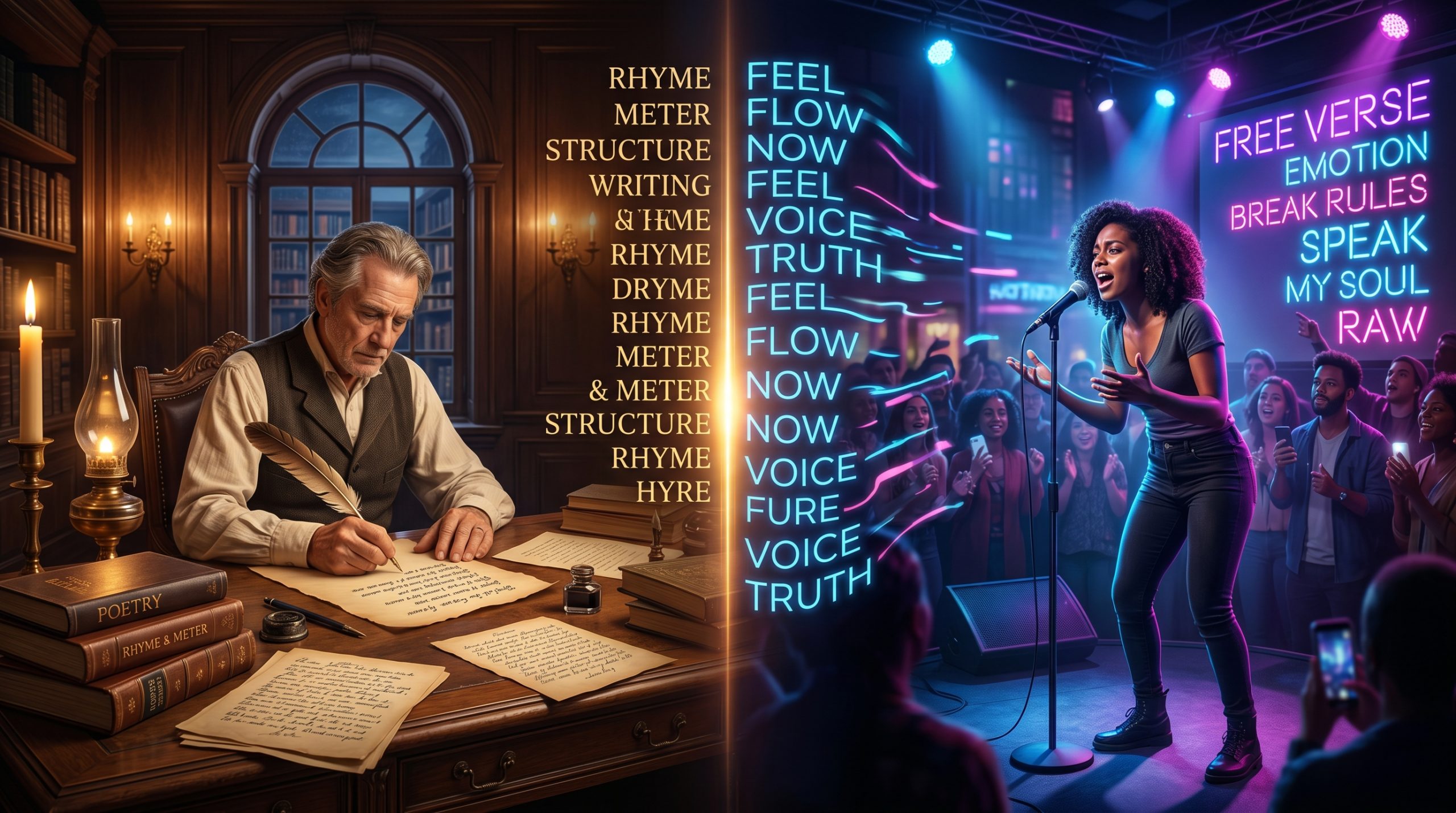
There’s a quiet shift happening in the way people read, write, and emotionally respond to poetry. Scroll through social media for a few minutes, attend a spoken word event, or open a contemporary poetry collection, and one thing becomes immediately clear: the dominance of rhyme is no longer guaranteed. What once felt like the defining feature of poetry now exists alongside a much wider range of expressive possibilities.
For centuries, rhyme was almost synonymous with poetry itself. It shaped how poems were memorized, performed, and taught, giving structure and musicality to verse across cultures and literary traditions. Yet in modern literary culture, free verse has risen to prominence, often outpacing traditional rhymed forms in both popularity and emotional reach. This shift is closely tied to broader cultural conversations about expression, authenticity, and accessibility—questions that also sit at the center of debates like Is Poetry Dead? Why Poetry Is More in Demand Than Ever.
This raises a compelling question that sits at the heart of contemporary poetry culture: Rhyme vs. Free Verse—what type of poetry actually resonates with modern readers?
The answer is not as simple as choosing one over the other. Instead, it reveals something deeper about how people experience language, emotion, and meaning in a fast-changing digital world, where poetry is not disappearing but actively reshaping itself to fit new modes of attention and emotional engagement.
The Changing Identity of Poetry in Modern Culture
Poetry today no longer belongs exclusively to printed anthologies or classroom analysis. It exists across platforms, voices, and formats—ranging from Instagram captions and spoken word performances to literary journals and experimental digital storytelling. This expansion has blurred the boundaries of what counts as poetry, allowing it to circulate more freely across both formal and informal spaces of expression.
This shift has also transformed how readers engage with poetic language. Instead of approaching poetry as a rigid literary structure defined by rules, meter, or form, modern audiences often experience it as an emotional encounter. The focus has moved from technical composition to emotional resonance, where meaning is felt as much as it is interpreted. This change has had a direct impact on the ongoing discussion between rhyme and free verse, as readers increasingly prioritize immediacy and emotional clarity over structural convention.
In earlier literary traditions, rhyme functioned as more than aesthetic decoration—it was a structural necessity. It helped organize memory, reinforce rhythm, and signal poetic form within oral and written traditions. However, contemporary readers tend to place less emphasis on structure as an end in itself. Instead, there is a stronger preference for emotional authenticity, immediacy, and relatability, especially in digital and performance-based environments.
The Changing Identity of Poetry in Modern Culture
Poetry today no longer belongs exclusively to printed anthologies or classroom analysis. It exists across platforms, voices, and formats—ranging from Instagram captions and spoken word performances to literary journals and experimental digital storytelling. This expansion has blurred the boundaries of what counts as poetry, allowing it to circulate more freely across both formal and informal spaces of expression.
This shift has also transformed how readers engage with poetic language. Instead of approaching poetry as a rigid literary structure defined by rules, meter, or form, modern audiences often experience it as an emotional encounter. The focus has moved from technical composition to emotional resonance, where meaning is felt as much as it is interpreted. This change has had a direct impact on the ongoing discussion between rhyme and free verse, as readers increasingly prioritize immediacy and emotional clarity over structural convention.
In earlier literary traditions, rhyme functioned as more than aesthetic decoration—it was a structural necessity. It helped organize memory, reinforce rhythm, and signal poetic form within oral and written traditions. However, contemporary readers tend to place less emphasis on structure as an end in itself. Instead, there is a stronger preference for emotional authenticity, immediacy, and relatability, especially in digital and performance-based environments.
This cultural transition also connects to how modern writing is refined and evaluated through processes such as proofreading—a stage that ensures clarity and coherence while preserving emotional intent. As poetry becomes more fluid and widely produced, attention to refinement remains important, even as formal constraints loosen. Together, these shifts set the stage for a broader re-evaluation of poetic forms in contemporary culture.
Understanding Rhymed Poetry in Contemporary Context
Rhymed poetry writing refers to verse that follows predictable sound patterns, often using end rhymes, internal rhymes, and structured meter. Historically, it has been associated with classical poetry traditions, from Shakespearean sonnets to structured lyrical forms found in romantic and Victorian literature.
In modern contexts, rhyme is still widely used, but its role has evolved. Instead of being a default expectation, it is now a stylistic choice.
The Emotional Effect of Rhyme
Rhyme creates musicality. It gives poetry rhythm, structure, and memorability. This is why it has historically been used in songs, nursery rhymes, and oral storytelling traditions. The human brain naturally responds to repetition and pattern, which makes rhymed poetry feel satisfying and complete.
In contemporary usage, rhyme often appears in:
- Song lyrics and music-driven poetry
- Children’s literature and educational poetry
- Performance poetry with rhythmic emphasis
- Traditional or formal poetic collections
However, modern readers sometimes associate heavy or forced rhyme with artificiality if it feels more decorative than meaningful. This perception has influenced its reduced dominance in contemporary literary spaces.
The Rise and Expansion of Free Verse Poetry
Free verse has emerged as one of the most defining forms of modern poetic expression, shaping how poetry is written, shared, and emotionally received today. Unlike traditional rhymed structures that rely on predictable patterns of sound and meter, free verse removes formal constraints in favor of rhythm that feels organic and responsive to thought itself. This shift has fundamentally changed the way poetry operates, moving it away from rigid composition rules and toward a more fluid relationship between language and emotion.
What makes free verse particularly significant is not simply its lack of structure, but the creative space that absence provides. Poets are no longer bound to predetermined patterns; instead, they can construct meaning through pacing, line breaks, imagery, and tone. Language becomes shaped by perception rather than convention, allowing poetry to feel more immediate and closely tied to lived experience.
Why Free Verse Feels More Natural in Contemporary Communication
One of the primary reasons free verse resonates so strongly with modern readers is that it reflects the way people actually think and communicate today. Contemporary communication rarely follows linear or highly structured patterns. Instead, it is often fragmented, spontaneous, and emotionally layered—especially in digital environments where conversations unfold quickly and across multiple contexts.
Free verse mirrors this internal rhythm. It often resembles the flow of thought rather than the structure of formal writing. Sentences break in unexpected places, ideas overlap, and emotional shifts occur without transition. This creates a reading experience that feels closer to internal dialogue than traditional literary construction.
In many ways, free verse captures the texture of modern consciousness itself. It reflects how people process emotions in real time—through partial thoughts, interruptions, and sudden shifts in perspective. This makes it especially effective in expressing complex emotional states that do not follow neat narrative arcs.
Free Verse as Emotional Language Rather Than Structural Form
Unlike traditional poetic forms that emphasize rhyme and meter as defining features, free verse places emotional authenticity at the center of expression. Its structure is shaped by feeling rather than formula. This allows poets to prioritize what is being said over how it is formally arranged.
In practice, this means free verse often carries a conversational tone, even when addressing deeply personal or philosophical themes. It can move fluidly between reflection, observation, and emotional intensity without needing to maintain consistent structural patterns. This flexibility gives it a distinctive ability to capture nuance—especially emotions that are contradictory, evolving, or difficult to define.
Because of this, free verse is frequently associated with introspective and confessional writing styles. It becomes a medium through which personal experience can be expressed without the constraints of traditional poetic architecture.
Where Free Verse Dominates Modern Literary Expression
The influence of free verse extends across nearly every major contemporary poetic space, particularly those shaped by accessibility and digital culture. In modern poetry collections, it is often the dominant form because it aligns with current expectations of readability and emotional immediacy. Readers are more drawn to language that feels direct and unforced, rather than formally constructed.
In spoken word performance, free verse plays an even more central role. The fluidity of the form allows performers to adjust rhythm dynamically, using pauses, emphasis, and vocal variation to shape meaning in real time. This makes the poem less about fixed structure and more about lived expression in the moment of delivery.
Digital poetry has also amplified the presence of free verse. On social platforms, where brevity and emotional impact are essential, free verse adapts easily. Its lack of structural dependency allows it to be broken into short segments, visually arranged, or paired with imagery without losing coherence.
Across personal writing practices as well, free verse has become a preferred mode of expression. Many people use it in journaling, reflective writing, or emotional articulation because it does not require formal training or adherence to literary rules. It functions more like a natural extension of thought than a constructed literary form.
Emotional Honesty as the Core Strength of Free Verse
At the heart of free verse lies a commitment to emotional honesty. Because it is not restricted by formal patterns, it allows emotion to dictate structure rather than the other way around. This often results in writing that feels raw, immediate, and deeply personal.
This emotional transparency is one of the main reasons free verse resonates so strongly with modern readers. It does not attempt to refine or stylize emotion into fixed patterns; instead, it allows emotional complexity to remain visible. Contradictions, interruptions, and shifts in tone are not flaws within this form—they are essential features.
In a cultural environment where authenticity is highly valued, this quality gives free verse a strong sense of relevance. It aligns with how people increasingly prefer to engage with language: not as polished performance, but as genuine emotional expression.
Free verse has become central to modern poetry not simply because it rejects structure, but because it redefines what poetic structure can be. By aligning itself with natural thought patterns, emotional complexity, and contemporary communication styles, it has positioned itself as one of the most adaptable and expressive forms of poetry today.
Its strength lies not in formal precision but in emotional flexibility. It captures the fragmented, layered, and often nonlinear nature of modern experience in a way that feels immediate and authentic. Whether in books, spoken word performances, or digital platforms, free verse continues to shape how poetry is written and understood in the present moment.
Rather than replacing traditional forms entirely, it expands the possibilities of poetic expression, offering a space where language can move freely between thought and feeling without constraint.
Emotional Authenticity vs. Structural Beauty
At the core of the rhyme vs. free verse debate is a deeper distinction: structural beauty versus emotional authenticity.
Rhymed poetry often emphasizes craft, symmetry, and musicality. It rewards technical precision and formal control. Free verse, on the other hand, prioritizes emotional immediacy, allowing language to feel raw, fragmented, or conversational.
Modern readers tend to gravitate toward emotional authenticity because it reflects lived experience more closely. In a world saturated with information and rapid communication, readers often seek writing that feels unfiltered and genuine.
However, this does not mean structured poetry has lost its value. Instead, its role has become more specialized and stylistic.
Rhyme vs. Free Verse in Digital Reading Culture
Digital platforms have significantly influenced how poetry is consumed. Attention spans are shorter, reading habits are fragmented, and emotional engagement happens quickly.
In this environment, free verse often has an advantage because it adapts easily to short-form reading. A few lines of free verse can convey an emotional moment without requiring sustained attention or formal interpretation.
Rhyme, while still effective, often requires more time to process due to its structured nature. However, when used effectively, it can make poetry more memorable, especially in performance or audio formats.
This dynamic has reshaped how poets choose their forms depending on platform and audience.
The Role of Spoken Word in Shaping Preferences
Spoken word poetry has played a major role in shifting preference toward free verse. Since spoken word relies heavily on performance, tone, and pacing rather than strict structure, free verse naturally fits its format.
In spoken word settings, poets often prioritize:
- Emotional rhythm over metrical structure
- Vocal intensity over rhyme schemes
- Personal storytelling over formal composition
This has reinforced the idea that poetry is more about emotional transmission than structural discipline.
However, rhyme still appears frequently in spoken word, especially for emphasis, memorability, or dramatic effect. The two forms are not opposites but tools that can coexist within performance.
Comparative Overview: Rhyme vs. Free Verse
To understand their differences more clearly, it helps to view them side by side in terms of function and reader experience.
| Feature | Rhymed Poetry | Free Verse Poetry |
|---|---|---|
| Structure | Fixed rhyme and meter | No fixed structure |
| Emotional Tone | Controlled, musical | Raw, conversational |
| Reader Experience | Predictable rhythm, memorability | Natural flow, emotional immediacy |
| Modern Usage | Music, traditional forms, performance | Digital poetry, spoken word, contemporary writing |
| Strength | Aesthetic pattern and rhythm | Emotional authenticity and flexibility |
This comparison shows that neither form is superior; rather, each serves different expressive purposes.
Why Modern Readers Still Value Rhyme
Despite the rise of free verse, rhyme has not disappeared. In fact, it remains deeply embedded in cultural expression, particularly in music, advertising, and oral storytelling.
Rhyme continues to resonate because it activates memory and creates satisfaction through pattern recognition. In performance settings, it also enhances audience engagement by creating anticipation and resolution within language.
For many readers, rhymed poetry still represents tradition, craft, and lyrical beauty.
Why Free Verse Dominates Contemporary Poetry Spaces
Free verse dominates modern poetry spaces primarily because it aligns with contemporary communication habits. It reflects how people think, speak, and process emotions in real time.
Its flexibility allows poets to experiment with:
- Fragmented thought structures
- Emotional pacing
- Visual line breaks
- Hybrid storytelling techniques
This adaptability makes free verse especially effective in digital environments where content must feel immediate and relatable.
The Psychological Dimension of Poetic Preference
Reader preference between rhyme and free verse is often influenced by psychological and emotional factors.
Rhyme tends to appeal to readers who enjoy structure, predictability, and musicality. It creates a sense of order and closure, which can be emotionally satisfying.
Free verse appeals to readers who value emotional exploration, ambiguity, and realism. It allows space for interpretation and personal connection.
This means poetic preference is less about literary quality and more about emotional resonance.
The Future of Poetry: Hybrid Forms and Blended Styles
The future of poetry is not a competition between rhyme and free verse but a convergence of both. Many contemporary poets already blend structured rhyme with free verse elements, creating hybrid forms that combine rhythm with emotional fluidity.
These hybrid approaches reflect the complexity of modern communication itself—structured yet fragmented, expressive yet minimal.
As poetry continues to evolve, rigid categories are becoming less important than expressive effectiveness.
Conclusion
The debate between rhyme and free verse is less about which form is better and more about how poetry adapts to cultural and emotional change. Rhyme offers structure, rhythm, and tradition. Free verse offers flexibility, emotional depth, and modern relevance.
In today’s literary landscape, free verse has become more dominant due to its alignment with digital communication and emotional authenticity. However, rhyme continues to hold value in performance, music, and formal expression.
Ultimately, modern readers do not choose between rhyme and free verse in isolation. They respond to emotional truth. And whether that truth is delivered through structured rhythm or fluid language, poetry remains effective when it captures something real.
FAQ: Rhyme vs. Free Verse in Modern Poetry
Is rhyme still important in modern poetry?
Yes. Rhyme is still widely used in music, performance poetry, and traditional poetic forms where rhythm and memorability matter.
Why is free verse more popular today?
Free verse aligns more closely with modern communication styles, emphasizing emotional authenticity and conversational flow.
Does free verse mean there are no rules?
Not exactly. Free verse does not follow strict rhyme or meter, but it still relies on rhythm, imagery, and intentional structure.
Which is better for beginners—rhyme or free verse?
Free verse is often easier for beginners because it allows more flexibility and reduces pressure around structure.
Can a poem use both rhyme and free verse?
Yes. Many modern poems blend both styles to create rhythm while maintaining emotional freedom.
What type of poetry resonates most with modern readers?
Free verse tends to dominate digital and contemporary spaces, but emotional impact—not form—is what ultimately determines resonance.